Find Shopify Stores With Klaviyo Installed
A Klaviyo install is one of the most useful single data points you can know about a Shopify store.

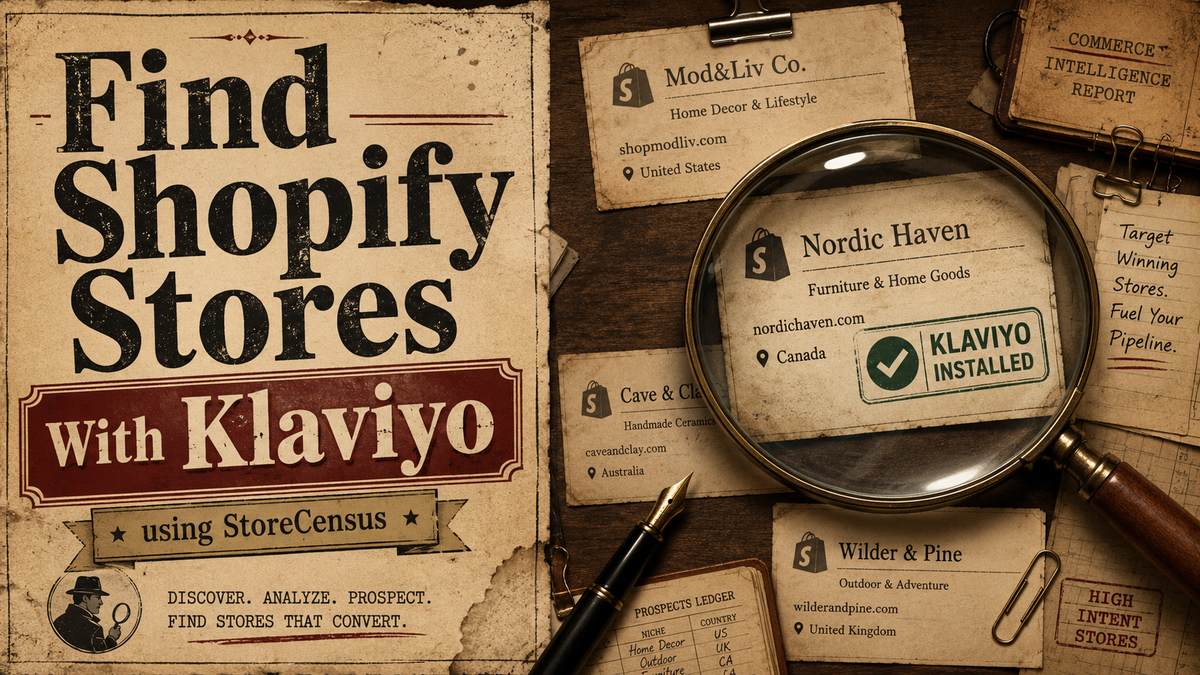
A Klaviyo install is one of the most useful single data points you can know about a Shopify store. It tells you the store invests in retention, pays real money for software, and has someone on the team who thinks about email revenue. If you sell services or software to ecommerce brands, a list of Shopify stores running Klaviyo isn't trivia. It's a pre-qualified market.
Key takeaways:
- A Klaviyo install signals budget and intent. Klaviyo pricing scales with list size, so established stores routinely pay hundreds to thousands per month for it.
- The list works in both directions. Stores with Klaviyo buy optimization services and complementary apps. Stores without it are migration and setup prospects.
- The real leverage comes from combining the Klaviyo filter with other signals: platform tier, traffic, vertical, and what else is (or isn't) in the stack.
What a Klaviyo Install Actually Tells You
Klaviyo is the dominant email and SMS platform in the Shopify ecosystem, and it isn't a set-and-forget tool. Its pricing grows with the subscriber list, which means a store still running it at scale has decided, month after month, that retention marketing is worth paying for.
That single fact carries a lot of information:
- Budget. The store already spends on growth software. You're not their first vendor.
- Sophistication. Someone set up flows, segments, and integrations. There's a person or team behind the tool.
- Priorities. They care about repeat revenue, not just acquisition. That mindset shapes what else they'll buy.
- Room to grow. Most Klaviyo accounts run a fraction of what the platform can do. Underused Klaviyo is one of the most common gaps in ecommerce, and gaps are pitches.
Who This List Is For
Email and retention agencies. The obvious fit. Stores already on Klaviyo don't need convincing that email matters. They need better flows, better segmentation, and better numbers than whoever set it up first. Your pitch starts from shared ground: same tool, better results.
Klaviyo partner agencies specifically. Your entire addressable market is, by definition, stores on Klaviyo plus stores that should be. A filterable list of both is your territory map.
App developers. If your app integrates with Klaviyo, every store on this list is a warm prospect: reviews apps, loyalty programs, SMS add-ons, quiz builders, CDPs. "Works with your existing Klaviyo setup" is a much easier install than "adopt a new workflow."
Competing platforms and their partners. Omnisend, Sendlane, and Attentive partners prospect this same list from the other side. Every Klaviyo store hitting a pricing tier jump is a switching conversation waiting to happen.
CRO and paid media agencies. A Klaviyo install tells you the store measures marketing revenue. Those are the clients who understand attribution and renew retainers.
Building the List in StoreCensus
StoreCensus tracks app and tech installs across 6M+ Shopify and WooCommerce stores, so finding Klaviyo stores is a filter, not a project:
- Filter by Klaviyo to pull every store in the index running it.
- Stack your fit criteria. Vertical, country, traffic tier, and platform. Klaviyo plus Shopify Plus is a shortlist of retention-serious brands with verified budgets.
- Look for the gap that matches your offer. Klaviyo without a reviews app. Klaviyo without SMS. Klaviyo on a store with high traffic but a thin app stack. The combination is the pitch.
- Flip the filter when it suits you. High-traffic stores without Klaviyo are the setup and migration market.
- Export with contacts to CSV, your CRM, or directly into your outreach tool.
Outreach Angles That Come Free With the Data
The point of a filtered list is that your first line can be specific instead of generic:
- To a Klaviyo store with no SMS: "You're clearly invested in retention, but you're leaving the SMS channel on the table."
- To a Klaviyo store with huge traffic: "At your traffic level, a 1% improvement in flow revenue is a real number. Here's where stores like yours usually find it."
- To a growing store without Klaviyo: "You've outgrown what you're doing for email. Here's what the migration actually looks like."
None of those emails could be written from a generic lead list. All of them can be written from a tech-filtered one.
FAQs
How current is install data?
Stores add and remove apps constantly, so freshness matters. StoreCensus re-scans stores on a rolling basis, which also means you can spot recent installs and removals, and both are buying moments.
Can I combine Klaviyo with other app filters?
Yes, and you should. Single-filter lists are big and unfocused. Klaviyo plus your complementary (or competing) tools is where the list turns into a pipeline.
Does this work for WooCommerce too?
Yes. StoreCensus covers WooCommerce stores as well, where Klaviyo also has a significant footprint.