CLV Benchmarks for Shopify Plus Stores
Shopify Plus stores usually beat standard Shopify on CLV with higher AOV, more repeat orders, longer lifespan, and stronger profit-based LTV:CAC.

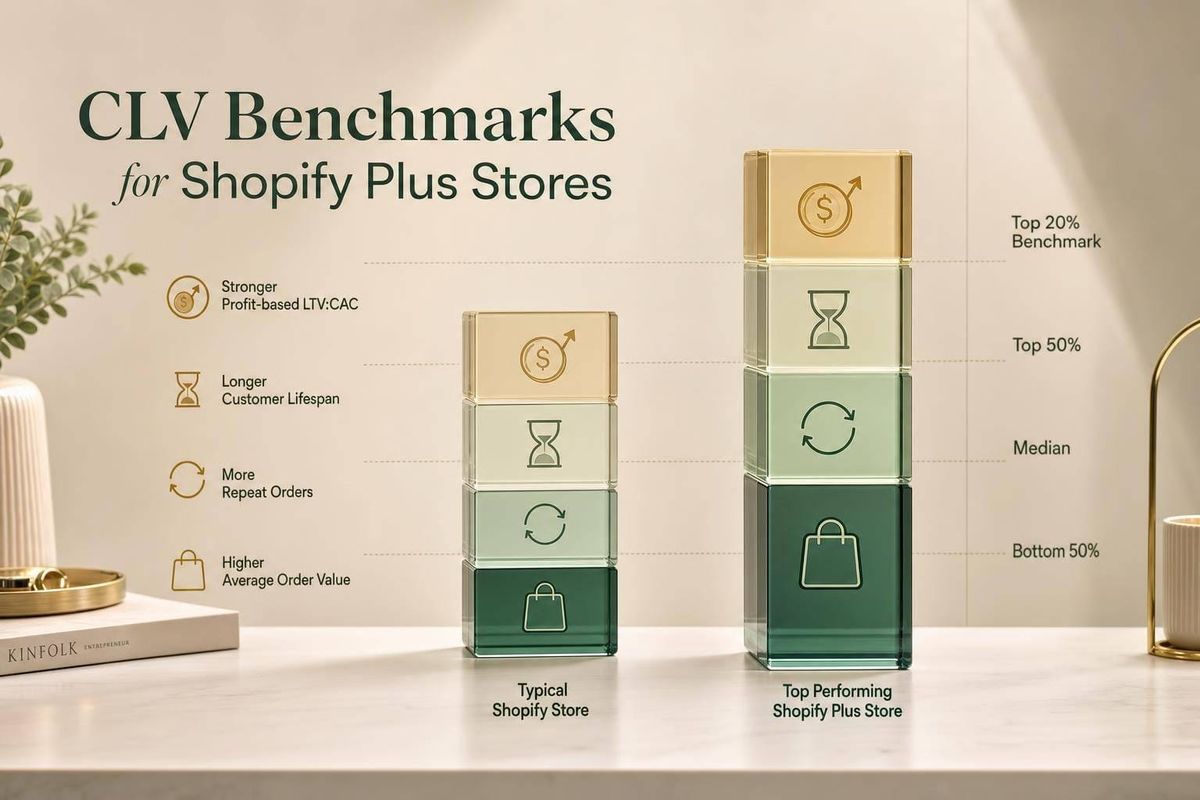
If you want a fast answer: Shopify Plus stores usually beat standard Shopify stores on CLV because they tend to have higher AOV, more repeat orders, longer customer lifespan, and stronger LTV:CAC.
Here’s the short version:
- Average 3-year CLV across Shopify is about $168
- Many Shopify Plus brands land around $250 to $450
- Subscription brands can hit $350 to $800+
- A healthy LTV:CAC ratio is usually 3:1
- Stronger stores often aim for 4:1 to 5:1
- Standard Shopify stores often sit near $60 AOV, 1.8 orders per year, and 1.5 years of lifespan
- Plus stores often reach $80 to $150+ AOV, 2.5 to 3.5+ orders per year, and 2 to 4+ years of lifespan
If I were checking a store fast, I’d look at four things first:
- AOV
- Purchase frequency
- Customer lifespan
- Profit-based LTV:CAC
That matters because a store can look fine on revenue and still have weak unit economics. Revenue-based LTV can overstate customer value by 40%+. So the safer formula is:
AOV × gross margin × purchase frequency × customer lifespan
How to Calculate Customer Lifetime Value (Shopify)
sbb-itb-61169e3
Quick Comparison
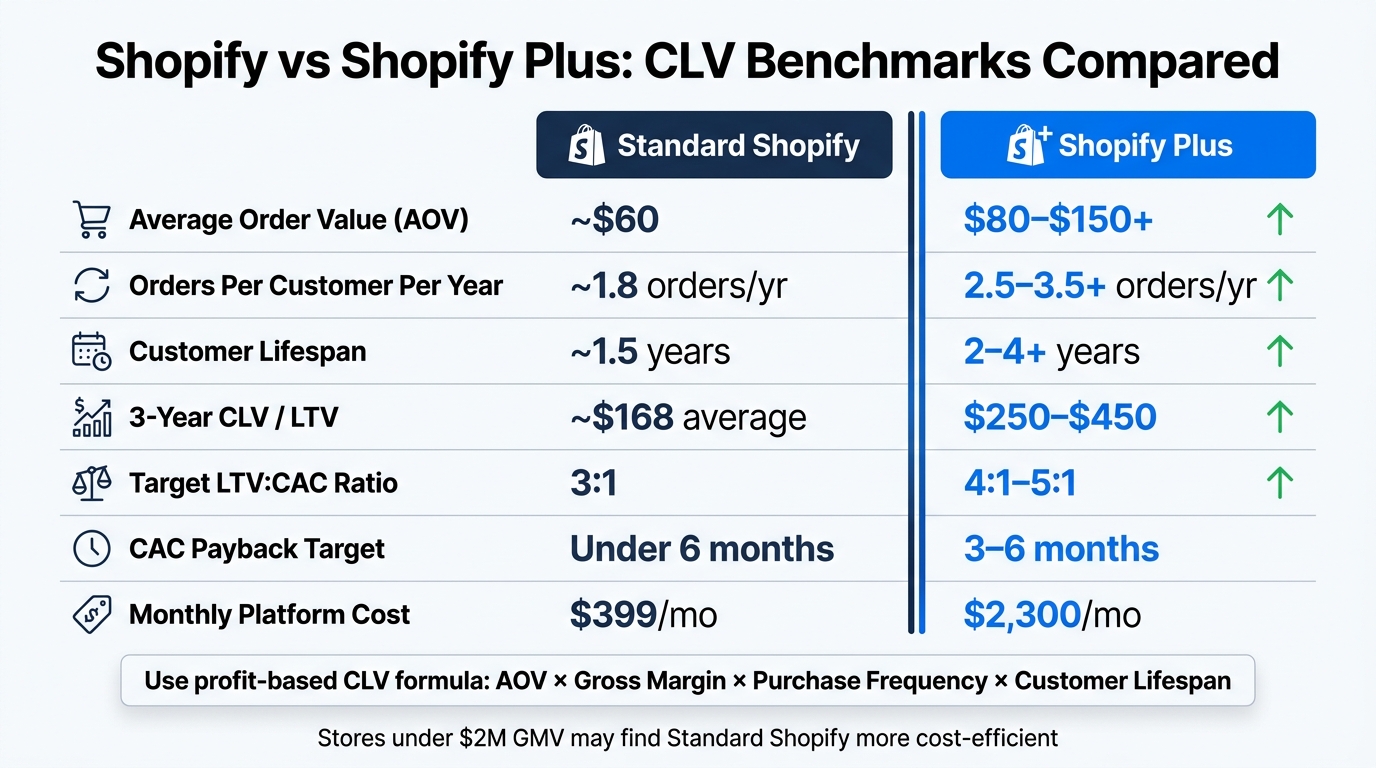
Shopify vs Shopify Plus: CLV Benchmarks Compared
| Metric | Standard Shopify | Shopify Plus |
|---|---|---|
| AOV | About $60 | About $80 to $150+ |
| Orders per customer per year | About 1.8 | About 2.5 to 3.5+ |
| Customer lifespan | About 1.5 years | About 2 to 4+ years |
| 3-year CLV / LTV | About $168 average | Often $250 to $450 |
| Target LTV:CAC | 3:1 | 4:1 to 5:1 |
| Payback target | Under 6 months | Often under 3 to 6 months |
| Monthly platform cost | $399 | $2,300 |
There’s also a tradeoff. Plus can support more retention and checkout control, but it also comes with more monthly cost, more apps, and more moving parts. For stores under about $2 million in annual GMV, standard Shopify can still make more sense on efficiency.
So if I had to sum up the article in one line, it would be this: don’t judge CLV by one Shopify average - judge it by store tier, margin, and how well retention supports acquisition spend.
1. Shopify Plus stores
Shopify Plus stores tend to score higher on the four CLV inputs that matter most: AOV, purchase frequency, customer lifespan, and CLV:CAC.
AOV
Plus merchants often land in the $80 to $150+ AOV range, compared with about $60 for standard Shopify stores.
A big part of that comes from simple levers that work well in ecommerce. Think free-shipping thresholds set 20% to 30% above AOV and post-purchase upsells that catch buyers right after checkout.
Purchase frequency
High-growth Plus stores often reach 2.5 to 3.5+ orders per customer per year.
That lift usually comes from automation doing the heavy lifting in the background:
- replenishment reminders
- post-purchase cross-sells
- win-back flows launched within the first 90 days after a first purchase
That 90-day window matters a lot. Return rates are highest during that stretch, so win-back flows have the most impact there. If a customer doesn’t come back within 90 days, the chance of a return drops to 12%.
Customer lifespan
Plus stores often keep customers active for 2 to 4+ years.
Tiered loyalty programs help stretch that window by rewarding more than just purchases. Reviews and social shares can play a part too. Even a small move here can change the math in a big way. Extending lifespan from 2.5 to 3 years can materially lift CLV.
CLV:CAC ratio
Shopify Plus merchants usually aim for a 4:1 to 5:1 CLV:CAC ratio.
One key point: use profit-based CLV, not raw revenue. The formula is:
AOV × gross margin × frequency × lifespan
That gives you a more grounded view of customer value. Revenue-based LTV can overstate value by 40%+, which can push brands to spend too much on acquisition.
These benchmarks set the bar for the Plus tier. The next section looks at how standard Shopify stores usually fall below them.
2. Standard Shopify stores
Standard Shopify stores usually bring in less than about $1M to $2M in yearly revenue and lag behind Plus stores across every CLV input.
AOV
The average AOV for standard Shopify stores is about $60. A simple move here is to set free shipping thresholds 20%–30% above that number and use upsells and cross-sells to push basket size higher.
That matters because when AOV is lower, you can't lean on a big first order to make the math work. Repeat purchases and retention do more of the heavy lifting.
Purchase frequency
Standard stores average about 1.8 orders per customer per year. The repeat purchase rate sits at 28.2%, while annual churn lands between 70% and 75%.
Where a customer comes from also changes the picture. Customers acquired through TikTok average $95 in LTV, while email-acquired customers average $285. That's a big gap. It also helps explain why more advanced email programs can lift repeat purchases in a meaningful way.
Customer lifespan
The average customer lifespan for a standard Shopify store is around 1.5 years. Looking at 3-year CLV, the average comes in at $168, and the median is $125.
CLV:CAC ratio
A 3:1 CLV:CAC ratio is the baseline for healthy profitability at this tier. If that number drops below 1:1, the store is losing money on each customer it acquires.
Payback period matters too. Healthy payback is under 6 months, and under 3 months is the target. These are the baselines to use in the next section when judging whether a store's CLV is healthy.
How to Tell If a Store's CLV Is Healthy
Use the benchmarks below to size up a store based on its tier. Averages are just a starting point. What matters is how the store stacks up against others at the same level. This table turns that into a simple health check.
| Metric | Watchlist | Healthy | High-Performing |
|---|---|---|---|
| AOV (Standard / Plus) | <$50 / <$100 | ~$85 / ~$150 | >$120 / >$300 |
| Purchase Frequency | <1.5 orders/yr | 1.8–2.5 orders/yr | >3.5 orders/yr |
| Customer Lifespan | <12 months | 2–3 years | 3+ years |
| CLV:CAC Ratio | <2:1 | 3:1 | 5:1+ |
| CAC Payback Period | >6 months | ~6 months | <3 months |
Use profit-based CLV, not revenue-only CLV. Revenue can make a store look stronger than it is and cover up margin issues.
AOV thresholds by store tier
For standard Shopify stores, an AOV under $50 leaves almost no room to cover CAC. Healthy standard stores tend to land around $85. One simple way to push that number up is with bundles, cross-sells, and free-shipping thresholds set 15%–20% above the current AOV.
For Plus stores, the bar is higher. Below-benchmark means under $100, healthy stores sit around $150, and high-performing stores often clear $300+ per order.
Purchase frequency benchmarks
Low purchase frequency is not always bad news. It depends on what the store sells. A snack brand and a TV store don't play by the same rules.
For consumables like food and beverage, a healthy repeat rate is 35%–52%. Apparel usually falls around 20%–30%, while electronics can be closer to 15%. Once frequency drops below the norm for that category, CLV can weaken in a hurry.
Customer lifespan ranges
A customer lifespan under 12 months is a warning sign for any store tier. Stores that use replenishment reminders, subscriptions, or loyalty programs often stretch lifespan into the 2–3 year range.
Subscriptions matter a lot here. Subscription adoption alone can lift CLV by 54%. That helps explain why high-performing stores treat subscriptions as a core retention tool, not a nice extra.
CLV:CAC ratio targets
A 3:1 CLV:CAC ratio is the minimum for a healthy store, whether it's Standard or Plus. Drop below 2:1, and there's usually a problem with retention, acquisition spend, or both.
High-performing stores, especially those with strong subscription and loyalty setups, often reach 5:1 or better.
Why stores land in each tier
When a store falls short of these marks, it's usually not bad luck. It's usually tied to how the business runs day to day.
Watchlist stores often have no automated post-purchase flows and lean too hard on paid social, even when repeat intent is low. Healthy stores usually have the basics in place, like email flows, basic segmentation, and some AOV work. What sets high-performing stores apart is a deeper retention system: advanced email flows, RFM segmentation, subscriptions, and loyalty programs.
Pros and Cons
The benchmarks above show where CLV tends to land. This section gets into why Plus stores often hit those numbers with less friction. The short version: Plus gives merchants more room to grow CLV, but it also brings more cost and more moving parts.
Shopify Plus: advantages and drawbacks
Plus stores often have more CLV upside because they can shape checkout more deeply and stack stronger retention tools on top. Checkout Extensibility helps merchants cut friction in the buying process, which can support higher AOV and conversion. Plus stores also use retention tools at much higher rates. Loyalty programs appear on 15.9% of Plus stores versus 6.6% of standard stores, and review apps show up on 51.9% versus 27.8%. That matters because these tools can help drive more repeat orders and a longer customer lifespan, which is a big part of why Plus CLV tends to beat standard benchmarks.
The downside is cost. And not just the sticker price. Once you add apps and services, Plus-level operations usually run $5,000–$15,000 per month, not only the $2,300 platform fee. In 2026, higher COGS and CPMs squeezed margins by 180–220 basis points, which made that overhead harder to carry. That's the tradeoff: Plus can open more upside, but at lower scale, Standard can still win on efficiency.
Standard Shopify: advantages and drawbacks
Standard stores tend to run leaner. Overhead is lower, and lifecycle management is simpler. For merchants under $2 million in annual GMV that don't need Plus-only features, Advanced is usually the lower-cost option.
The catch is that Standard gives merchants fewer retention levers to work with. There's less room for deeper personalization and less automation around retention, which can put a ceiling on CLV compared with Plus.
| Factor | Standard Shopify | Shopify Plus |
|---|---|---|
| Monthly Platform Cost | $399 | $2,300 |
| Transaction Fee | ~2.0% | ~0.15% |
| Avg. App Count | 1.8 | 6.5 |
| Retention Headroom | Lower | Higher |
| Operational Overhead | Low | High |
| Ideal Annual GMV | Under $2 million | Over $3 million |
Conclusion
These benchmarks only mean anything when you compare similar stores by tier and category. One CLV average can point you in the wrong direction. The spread between a standard Shopify store at $168 in 3-year LTV and a top store at $250–$450 is simply too large to treat as one neat benchmark. Tier-based benchmarks beat a single industry average.
Use a 3:1 profit-based LTV:CAC ratio as the baseline health check. If that number isn’t there, fix retention and margin before you put more money into acquisition.
A store can have plenty of traffic and still be in bad shape. If there’s no loyalty program, no subscription model, and no retention automation, that store is an audit candidate, not one that’s ready for more ad spend. Category also changes the picture. Consumables can support higher CLV, while electronics usually can’t. Use the wrong benchmark for the wrong vertical, and the advice falls apart.
These benchmarks are a filter, not a finish line. The key questions are pretty simple: Is the store’s AOV and repeat purchase rate in line with its tier? Is the LTV:CAC ratio sustainable on a profit basis? Is the retention system strong enough to support the level of acquisition spend in play? For agencies, the main check is whether retention, margin, and acquisition are working together.
FAQs
How do I calculate profit-based CLV?
Calculate profit-based CLV by using profit instead of revenue:
Average Order Value × Purchase Frequency × Customer Lifespan × Gross Margin
If you want a tighter estimate, subtract average return costs and discount rates from your per-order margin first. That gives you a more realistic ceiling for Customer Acquisition Cost (CAC) based on how your store actually makes money.
When does Shopify Plus make financial sense?
Shopify Plus makes financial sense when it fixes clear operating limits, not just because you crossed some revenue line.
In most cases, the choice comes down to three things:
- You need Plus features in the next 90 days
- Transaction fee savings line up with your sales volume
- Your current plan is starting to slow growth
The pricing crossover often shows up at around $800,000 to $1,000,000 in monthly GMV. But that doesn’t mean Plus pays off right away.
For many merchants, Shopify Plus doesn’t start to make sense until they reach about $2 million to $3 million in annual GMV. Below that range, you’re often paying extra for features more than direct financial return.
Which retention levers improve CLV fastest?
Prioritize purchase frequency first. After that, focus on average order value (AOV) and customer lifespan. For most stores, the biggest win usually comes from getting more people to make a second purchase.
A few tactics can help:
- Subscriptions
- Automated post-purchase email flows
- Personalized experiences
- Loyalty or referral programs
- Bundling
- Free-shipping thresholds
- Post-purchase upsells
If you can get that second order to happen, a lot of the rest gets easier.