
How Seasonal Trends Impact Shopify Merchant Budgets
Explains when Shopify merchants open budgets, common seasonal budget mistakes, and agency strategies to time outreach and retainers.


If I want to sell agency services to Shopify merchants, I need to know when they can spend - not just what they sell.
For many high-ticket Shopify stores, Q4 can drive 35%–45% of yearly revenue. That usually means one thing: budgets don’t move in a flat line. Money often goes out before peak season for inventory, ads, email, and site work. Agencies can identify these needs by analyzing a store's tech stack to see which apps they rely on for peak season. Then after the rush, many brands pull spending back hard in Q1 to protect cash.
Here’s the short version:
- Budget timing follows revenue timing
- Q3 is often when holiday budgets start getting locked in
- Q1 is often a slower spend period
- Flat monthly budgets can cause stockouts, weak ad pacing, or cash gaps
- Agencies that time outreach to budget windows can get better close rates and larger deals
- Seasonal retainers often fit merchants better than one flat monthly fee
A few numbers stand out:
- $500–$5,000+ products often have a 3–6 week buying cycle
- Overseas inventory can require 14–18 weeks of lead time
- 34% of holiday purchases happened before December 1
- A $200,000 Q4 ad budget may need $20,000–$30,000 held in reserve for early-season shifts
What I take from this is simple: if a merchant earns most of their money in short windows, their budget will also open and close in short windows. So I’d look at past revenue by month, watch for buying signals in Q3, and shape outreach using prospect lists, pricing, and scope around the merchant’s season - not my sales calendar.
That’s the core idea behind the article.
How to identify seasonal budget patterns in Shopify stores

Niche alone won’t tell you much about when a merchant is ready to spend. If you want a clean read, look at the store’s own numbers. That’s what helps agencies tell the difference between a merchant moving into a spend-up period and one heading into a pullback.
Use 24–36 months of revenue data to find peak months and slow quarters
Start with at least two years of monthly revenue. Three years is even better. With 24–36 months of data, you can separate repeat seasonal patterns from one-off spikes and longer-term growth shifts.
A simple way to read the data is to track:
- each month’s share of annual revenue
- year-over-year growth by quarter
That gives you a clearer picture of peak months, slower quarters, and how those patterns hold up over time.
Q1 can also create a second planning window for refund-driven categories. If you only focus on Q4, you’ll miss that second stretch when spending can open up.
Break down seasonality by product line, channel, and customer type
Store-wide revenue averages can blur the real story. What looks like one broad seasonal pattern may actually be driven by a single product line or channel.
Take a merchant selling outdoor furniture. Their sales curve may peak around Memorial Day, with Labor Day clearance creating a second lift. That’s a very different budget calendar from a year-round category.
Channel mix matters too. Merchants using Amazon FBA often need to front-load inventory spend by August or September to avoid Q4 bottlenecks. So their budget window tends to open earlier than it does for a pure DTC store.
Customer behavior can also hint at demand before revenue peaks. Rising add-to-cart rates, wishlist activity, and repeat visits can show which customer segments are moving into the season early.
Use StoreCensus to find merchants with visible seasonal signals
If you don’t have a merchant’s revenue history, use StoreCensus to filter Shopify and WooCommerce stores by revenue tier, tech stack, country, and growth signals, then surface decision-maker contacts.
Watch for signals like these:
- merchants adding Klaviyo, Recharge, or BNPL tools like Affirm or Klarna in Q3
- stores building holiday landing pages by mid-September
Those signs can show when budgets start to open up - and when they begin to tighten. Once you can spot that timing, the next move is to avoid the budgeting mistakes that usually follow.
sbb-itb-61169e3
The most common seasonal budgeting mistakes Shopify merchants make
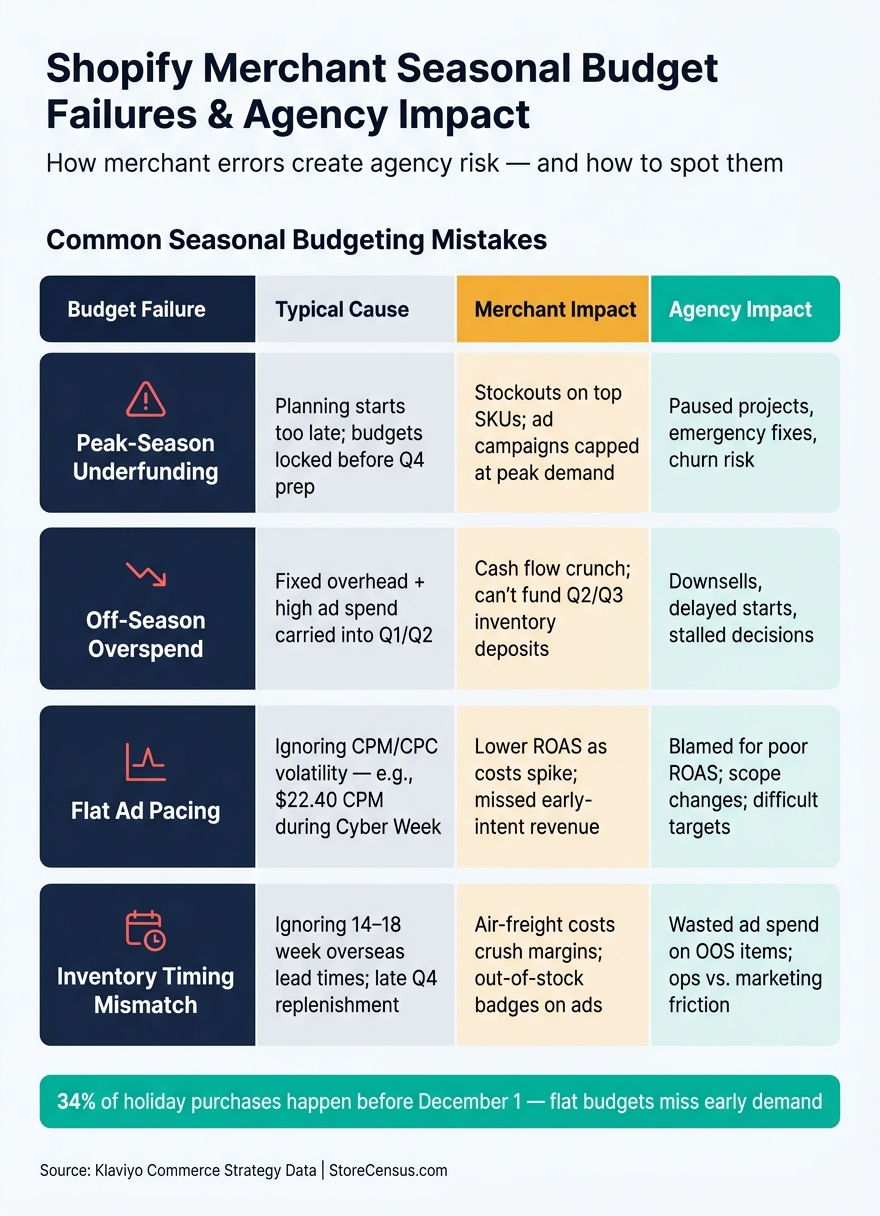
Shopify Merchant Seasonal Budget Failures vs. Agency Impact
Once merchants can see their seasonal patterns, the next issue is how they mishandle them. A lot of them do. And those mistakes can hurt closes, retainers, and account performance.
Underfunding peak season and overspending in the off-season
The most common mistake is simple: bad budget timing. Merchants keep too much fixed spend running through slow quarters, then hit Q4 without enough cash left to compete. For high-ticket stores, that kind of timing mistake can wreck the whole year's cash plan.
Ad campaigns get capped right when demand is at its highest. Top SKUs sell out. Then the merchant is left scrambling to patch performance without any money left to put to work. At the same time, Q1 and Q2 may have been draining cash on overhead and ad spend that never produced matching returns.
For agencies, this usually shows up fast. You see retainer pressure, paused projects, or a client who goes quiet after three months because they used up their budget before peak season even began.
Using flat monthly budgets for uneven costs and inventory timing
A fixed monthly ad budget assumes each month costs the same and converts the same. That's just not how it works.
Meta Advantage+ campaigns averaged $22.40 CPM during Cyber Week 2025 [5]. When CPMs jump like that, a flat weekly pacing setup stops being a safe plan and starts becoming a problem.
The same issue applies to inventory. Merchants sourcing overseas need to plan around 14–18 week lead times [4]. If they miss that window, they often end up air-freighting products late in the season, and that can crush margins. There's another timing issue too: 34% of holiday purchases happened before December 1 in recent years [4]. So if budgets stay flat all season, merchants can miss a big chunk of early demand.
"The mistake I see constantly is merchants taking the NRF number and applying it directly to their category. A 4% top-line growth forecast could mean 12% growth in your segment and negative growth in a neighboring one." - Katie Hotze, Head of Commerce Strategy, Klaviyo [4]
Flat budgets also skip over one more cost: rebuilding awareness after the off-season.
Comparison table: seasonal budget failures and their agency impact
These problems usually show up first in pacing, inventory, and retainer pressure.
| Seasonal Budget Failure | Typical Cause | Impact on Merchant | Agency Impact |
|---|---|---|---|
| Peak-season underfunding | Starting planning too late | Stockouts on top SKUs; capped ad campaigns during peak demand days | Paused projects, emergency fixes, churn risk |
| Off-season overspend | Carrying fixed overhead and high ad spend into slow quarters (e.g., Q1/Q2) | Cash flow crunch; inability to fund Q2/Q3 inventory deposits | Downsells, delayed starts, stalled decisions |
| Flat pacing | Ignoring CPM/CPC volatility and seasonal intent shifts | Lower ROAS as costs spike; missed revenue during early-intent windows | Blame for poor performance metrics; scope changes; difficulty hitting ROAS targets |
| Inventory timing mismatch | Ignoring 14–18 week lead times; late Q4 replenishment | High air-freight costs; margin destruction; out-of-stock badges on landing pages | Wasted ad spend on out-of-stock items; friction between marketing and ops teams |
The next step is turning that seasonal pressure into a budget plan agencies can help build.
Budget planning fixes agencies can help merchants put in place
Build rolling forecasts with best-case, base-case, and worst-case scenarios
Once seasonality is clear, the next step is simple: turn that pattern into a spending plan. Agencies can help merchants build three-scenario models - worst-case, base-case, and best-case - so budget decisions are planned instead of improvised [4][8].
Start scenario modeling in July so October is for execution, not planning.
Each scenario should have a clear job. Worst-case covers fixed costs. Base-case covers planned spend. Best-case covers growth inventory and ad spend. A useful setup combines a 13-week cash flow forecast with a 6–12 month seasonal budget so merchants can plan for COGS, staffing, and inventory lead times [4]. That gives them enough runway to avoid pulling back growth spend the second performance dips, only to run short when demand comes back.
It also helps to split revenue into two buckets: predictable revenue from repeat purchases and variable revenue from new customer acquisition driven by marketing [8]. That line makes forecasts tighter and shows which part of the budget is most exposed during a slow quarter.
Shift spend across the year
A forecast only matters if spend moves with demand. Match spend to revenue, and keep agency scope in line with the months merchants can actually afford to fund it [3].
For Q4-heavy stores, that often means moving some budget earlier. In 2025, 34% of holiday purchases happened before December 1 [4]. Pushing 15–20% of the holiday budget into October helps merchants show up during that early-intent window [4].
Q1 and Q2 are a better fit for retention, email automation, CRO, and SEO. That shift helps protect retainers because slow-season months can be used for backlog work instead of peak-season acquisition.
There’s also the reserve piece. Agencies should suggest holding back 10–15% of total seasonal spend until early performance signals come into view [4]. For a merchant with a $200,000 Q4 ad budget, that means keeping $20,000–$30,000 unallocated until early sales show whether results are ahead of or behind the base-case projection.
Comparison table: from seasonal budget problem to budget action
These fixes turn seasonal pressure into direct budget moves.
| Budget Problem | Data Needed | Forecasting Approach | Recommended Budget Change |
|---|---|---|---|
| Q4-heavy revenue swings | Trailing 3-year revenue by month | 3-scenario model (worst-case, base-case, best-case) | Mirror spend to revenue distribution; shift part of the holiday budget into October [3][4] |
| Inventory stockouts | Lead time history by supplier | SKU-level replenishment modeling | Commit to base-case inventory early and reserve budget for upside demand [4] |
| High peak-season CAC | Early purchase-intent data | Budget timing based on seasonal demand | Move budget earlier to capture pre-holiday demand [4] |
| Post-holiday cash crunch | Return rate history; 13-week cash flow projections | Rolling cash flow forecast | Shift slow-month spend to retention and SEO [3] |
How agencies should adjust outreach, pricing, and retainers around seasonality
Once you've mapped seasonal budgets, the next move is simple: line up outreach and pricing with the months when merchants can actually spend.
Match your offer to the merchant's budget window
A lot of agencies pitch too late. When a Shopify merchant is already deep in Q4, the budget is often spoken for, and the team is buried in shipping, fulfillment, and conversion work. That means the best time to reach out is before budgets get locked and inventory calls are set.
For merchants that rely on overseas manufacturing, 14–18 week lead times can push inventory decisions into midsummer [4]. So if an agency shows up with a clear offer - scenario modeling, campaign briefs, landing pages, and email sequences - it lines up with the merchant's actual buying window.
The offer should also change by quarter. In Q3, merchants are more likely to buy planning and prep work like BFCM offers, landing pages, and email sequences [3]. In Q1, the better fit is often retention programs, loyalty setup, and system fixes, especially for merchants coming off a heavy holiday run [6][7].
"The brands that get inventory right every holiday season aren't smarter - they start the scenario modeling in July, not September." - Marc Gorlin, Founder, Roadie [4]
One simple rule helps here: the first week of any new quarter is a prime outreach window [9]. Budgets refresh. Delayed projects come back into play. Decision-makers are often more open to spending. And when a lead says "not right now", don't leave it fuzzy. Set a follow-up for 30 days before their next peak season, not some loose "check back in a few months" [9].
That timing shouldn't stop at outreach. It should shape the deal itself.
Structure retainers around peak workload and off-season maintenance
Flat retainers often create tension because a merchant's peak-season cash flow looks nothing like their off-season cash flow. Charge the same rate all year, and one of two things usually happens: the agency becomes too expensive in slow months, or it underprices the months with the heaviest workload.
Seasonal retainers fix that. If a business is heavily weighted toward Q4, the retainer should move with that demand. The setup is pretty simple:
- Higher fees and a heavier scope in the two to three months before and during peak
- Lighter maintenance work in slower months
- Rate changes agreed on upfront [6]
This cuts down on surprise churn because the merchant isn't hit with a bill in January they can't comfortably cover. It also helps the agency plan better. Slow months can be used for backlog work, loyalty programs, and systems updates instead of scrambling to defend a flat monthly fee [6].
Pricing should also match merchant size. A common range looks like this [1][2]:
| Merchant size | Monthly retainer range |
|---|---|
| $500K–$2M stores | $2,000–$5,000 |
| $2M–$10M stores | $5,000–$15,000 |
| $10M+ brands | $15,000+ |
There's also a small contract tweak that can matter a lot: offering Net-30 or Net-45 payment terms during the merchant's pre-peak spending period [6]. That gives them room to commit before the revenue lands, instead of asking them to pull from cash reserves they're trying to protect.
When pricing follows the season, retention gets easier and churn tends to drop.
Conclusion: reading seasonal budgets leads to better agency sales decisions
Shopify merchant budgets tend to follow revenue. Agencies that read that pattern well can qualify leads faster, pitch at the right time, and build retainers that don't fall apart in a slow quarter.
The bigger shift is this: treat seasonality as a sales input, not just an execution issue. If you know when a merchant's revenue peaks, you also know when the budget opens, when the decision window starts to close, and what kind of offer is more likely to land. That can change close rates more than polishing a pitch deck ever will.
StoreCensus gives agencies a direct way to act on that insight. You can use StoreCensus to filter 6M+ Shopify and WooCommerce stores by revenue tier, tech stack, country, and growth signals, then find decision-maker contacts and track store changes that point to buying intent.
FAQs
How can I tell if a Shopify store is truly seasonal?
Review its historical revenue and traffic patterns next to category trends. A seasonal store will often show the same pattern year after year, with clear peaks. For example, Q4 holiday sales may climb far above the rest of the year.
You can also track live store changes, revenue bands, and traffic spikes with StoreCensus. Checking activity about 30 days before an expected peak can help you see if the store is getting ready for another busy season.
When should agencies pitch seasonal budget planning?
Agencies should pitch seasonal budget planning at least 30 days before a merchant’s peak season. For big moments like Black Friday and holiday campaigns, the best time to reach out is July through August.
That lead time gives agencies room to match budget pacing to periods when shoppers are most ready to buy, instead of sticking to a flat weekly spend pattern. StoreCensus can also help spot real-time growth signals that show when a merchant is ready to invest.
What retainer model works best for seasonal merchants?
For seasonal merchants, the best retainer setup often follows the 1% Rule: a monthly fee that lands between 0.5% and 1% of annual revenue.
That works well because seasonal revenue can swing hard during busy periods. A store might look quiet for months, then surge fast when peak season hits. If pricing is based on fixed projections, things can get out of sync pretty quickly.
With StoreCensus, agencies can check revenue tiers and growth signals, then set pricing that stays sustainable and tied to actual performance, not guesswork.