Payment MFA Trends Across 6M Stores
Payment MFA across 6M stores: adoption clusters by platform, region, and revenue—Shopify Plus, mid-market WooCommerce, and EU/UK lead.


Here’s the short version: payment MFA clusters by platform, region, and store size. In this data set of about 6 million Shopify, Shopify Plus, and WooCommerce stores, I’d focus first on Shopify Plus stores with thin fraud layers, WooCommerce stores in the $100,000–$1 million range, and EU/UK stores where SCA signals should be easier to spot.
If I had to boil the study down, it says 3 things:
- Shopify Plus stores tend to show more layered payment stacks than standard Shopify stores.
- EU and UK stores show more visible 3DS2/SCA signals than U.S. stores because of PSD2 rules.
- Higher-revenue stores are more likely to use multiple gateways, fraud apps, and added verification tools.
This isn’t a security audit. It’s a storefront-level read of public signals like gateway choice, fraud apps, wallet use, and checkout-related verification tools. So I’d treat the results as a way to rank stores by visible payment-security depth, not as proof of what happens in every checkout flow.
A simple way to read the findings:
- Baseline: one gateway, little else visible
- Intermediate: added fraud app, maybe more than one gateway
- Advanced: layered stack with tools like Signifyd or Riskified and clearer 3DS2/SCA signals
- Edge case: extra ID checks, OTP flows, or dense verification layers
If you sell payment work, fraud tools, or checkout services, the main takeaway is simple: look for stores where revenue, risk, and stack depth no longer match. That gap is where outreach is most likely to land.
Study Design: Definitions, Segments, and Observable MFA Signals
What Counts as Payment MFA in This Study
In this study, payment MFA means any extra verification step that shows up at checkout or when a payment is being confirmed. That includes 3D Secure 2 (3DS2) flows, SCA-related prompts, bank-app approvals, and SMS one-time passwords (OTPs) used during payment verification.
It does not include general admin-login MFA. The point here is payment security maturity, not back-office security. Fraud tools matter, but they are supporting signals rather than direct proof that payment MFA is in place.
With that scope in place, the study compares stores by platform, size, country, and category.
How Stores Are Segmented for Analysis
The study looks at stores across four dimensions:
- Platform: Shopify, Shopify Plus, and WooCommerce
- Revenue tier: from small stores through $100 million+
- Country: separating the United States from SCA markets like the UK and EU
- Category: industry verticals where fraud risk tends to be higher
Which Stack Signals Indicate Stronger Payment Security
Those segments only help if the signals are measured the same way across stores. So the study relies on a fixed set of public storefront proxies, which means every result should be read as directional, not absolute.
The clearest observable signs of stronger payment security maturity are:
- Gateways with 3DS2 or SCA support: Shopify Payments [8] and WooPayments [4] are the strongest proxies for likely MFA support.
- Fraud-management apps: Tools like Signifyd, ClearSale, SEON, and Blockify Fraud Filter suggest that a merchant is actively managing payment risk. These count as supporting signals.
- Multiple gateways: Stores routing payments through more than one provider point to a more developed payment setup.
- Account security add-ons: Apps like KwikPass [3] or Token of Trust suggest layered verification beyond a basic checkout flow.
These signals help rank prospects by payment security maturity. If a signal is missing, that only means it is not visible in public data.
sbb-itb-61169e3
Findings: Where Payment MFA Adoption Clusters
Using those proxies, adoption clusters most clearly by platform, geography, and revenue.
Platform Differences: Shopify, Shopify Plus, and WooCommerce
Platform is the clearest driver of payment-security visibility.
Shopify is usually more standardized because many merchants run on Shopify Payments, which sets much of the baseline. That leads to a tighter pattern: standard Shopify stores often show fewer visible payment-security signals than bigger merchants, and the setup is usually centered on Shopify Payments.
Shopify Plus merchants look quite different. Since they’re paying $2,300+/month and get access to checkout extensibility, they’re more likely to go beyond platform defaults. In practice, that often means layering in gateways like Stripe, Adyen, or Authorize.Net, along with fraud systems like Signifyd (2,924 active installs), Riskified, or Kount. In some cases, they also use apps or integrations that directly mention 3D Secure or SCA [2][1].
WooCommerce is the most fragmented of the three. There’s no platform-level default, so visible payment MFA depends on the gateway plugin and whether it supports 3DS/SCA. Gateways like Stripe for WooCommerce with 3DS2 support, Eway, and Sola - which advertises SCA-ready 3D Secure - stand out as the clearest public signs of a stronger security setup [12][13]. If a merchant isn’t using one of these gateways, there may be no visible MFA signal at all, even when authentication is still happening behind the scenes through the bank or issuer.
| Signal | Shopify | Shopify Plus | WooCommerce |
|---|---|---|---|
| Default payment behavior | Shopify Payments standardizes much of the stack | Same default layer, with more room to extend | Gateway/plugin dependent |
| Third-party fraud tools | Present, but usually lighter | Common in advanced stacks | Varies widely by merchant and region |
| Visible 3DS/SCA signals | Often implicit in the gateway layer | More visible through gateway and app mix | Most visible when a gateway/plugin explicitly supports 3DS2 or SCA |
| Multiple gateways | Less common | More common | Common among larger or higher-risk stores |
| Stack consistency | Higher | Moderate | Lower |
Geography sharpens the pattern even more.
Country Patterns: United States vs. SCA Markets
In the U.S., merchants aren’t operating under PSD2, so payment-security choices are usually driven by fraud exposure and the math around chargebacks. That’s why U.S. stores - especially on Shopify - over-index on fraud tools like Blockify (25,466 installs) and Signifyd (2,924 installs) instead of explicit SCA plugins [1].
In EU and UK markets, the pattern flips. PSD2 requires strong customer authentication for most card-not-present transactions, so 3DS2- and SCA-ready gateways and plugins are much more visible in the stack [6][7]. WooCommerce stores in these markets are especially likely to list SCA-specific gateway plugins, because self-hosted merchants had to pick compliant solutions on purpose [12][13].
There’s also a tradeoff here. Early SCA rollouts in Europe reduced conversion by 1–8 percentage points, which helps explain why merchants paid such close attention to exemptions and frictionless flows [5][9][10][11].
| Pattern | United States | EU / UK (SCA Markets) |
|---|---|---|
| Primary adoption driver | Fraud reduction and chargeback ROI | Regulatory compliance (PSD2/SCA) |
| Explicit 3DS2/SCA signals | Less common | More common, especially on WooCommerce |
| Fraud tool prevalence | Higher | Moderate |
| Multiple gateways | Less common | More common |
Revenue Tiers: How Adoption Changes From Small Stores to Large Merchants
Revenue also tracks closely with payment MFA maturity.
Stores under $100K usually rely on a single default gateway and show few, if any, extra fraud tools. In the $100K–$1M range, basic fraud apps and secondary gateways like PayPal or BNPL providers start to appear. By $1M+, merchants are much more likely to layer multiple gateways, dedicated fraud systems, and explicit 3DS2 support in SCA markets.
At $10M+, the stack tends to look much more mature. Signals like Token of Trust (33 installs) and Real ID verification (153 installs) show up much more often in this group [1].
| Revenue Band | Typical Stack | Payment MFA Maturity |
|---|---|---|
| Under $100K | Single default gateway, minimal or no fraud tooling | Baseline |
| $100K–$1M | Basic fraud app, occasional secondary gateway | Emerging |
| $1M–$10M | Multiple gateways, dedicated fraud system, some 3DS signals | Advanced |
| $10M+ | Multi-gateway, risk engine, more visible 3DS/SCA usage | Complex |
One important caveat: these results are directional, not exhaustive. Some 3DS2 setups and custom WooCommerce flows don’t show up in public data, so the picture isn’t complete. Still, the patterns are clear enough to show where outbound attention should go.
These clusters map directly to the maturity levels that follow.
Security Maturity Model: Baseline, Intermediate, Advanced, and Edge Cases
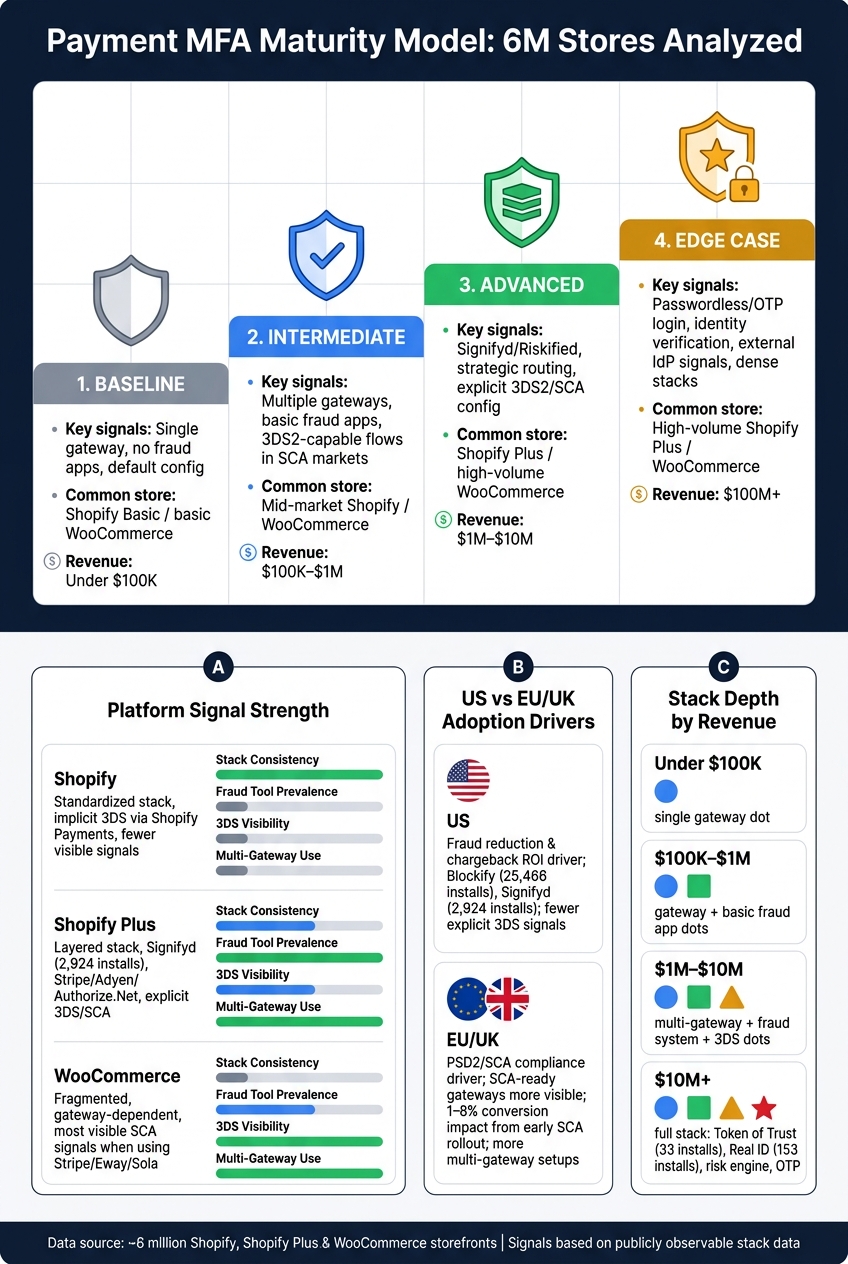
Payment MFA Maturity by Platform, Region & Revenue: 6M Store Study
The platform, geography, and revenue patterns above boil down to four clear tiers: Baseline, Intermediate, Advanced, and Edge Case. These levels come from what you can observe in a store’s stack, not from internal rules, audits, or certifications.
A Four-Level Model Based on Observable Stack Signals
Baseline stores usually depend on one gateway with default settings and no dedicated fraud tools. There’s no fraud app, no visible 3DS2 behavior, and no clear sign that the merchant has put money or effort into security.
Intermediate stores have started adding layers of protection. In many cases, they use at least one fraud or risk app, work with multiple gateways, and, in SCA markets, run a 3DS2-capable payment flow. Beyond that, checkout verification is still pretty light.
Advanced stores show clear intent. Their security stack is layered and planned. Common signals include enterprise fraud platforms like Signifyd or Riskified, planned gateway routing, and direct 3DS2 or SCA setup. These merchants are often Shopify Plus stores or higher-volume WooCommerce stores. They also tend to use risk-based authentication instead of putting friction in front of every order.
Edge cases sit at the far end of the spectrum. You may see passwordless or OTP-based login flows, identity verification tools, unusually dense security stacks, and sometimes external identity providers for staff and B2B access. Those signals point to payment security that has gone past standard ecommerce tooling.
| Level | Key Stack Signals | Common Store Type |
|---|---|---|
| Baseline | Single gateway, no fraud apps, default configuration | Shopify Basic / basic WooCommerce |
| Intermediate | Multiple gateways, basic fraud/risk apps, 3DS2-capable flows in SCA markets | Mid-market Shopify / WooCommerce |
| Advanced | Signifyd, Riskified, strategic routing, explicit 3DS2/SCA configuration | Shopify Plus / high-volume WooCommerce |
| Edge Case | Passwordless or OTP login, identity verification, external IdP signals, dense security stacks | High-volume Shopify Plus / WooCommerce |
These tiers don’t show up evenly. Region, product category, and store type all shift where a business tends to land.
Which Countries, Categories, and Store Types Cluster at Each Level
You can use these tiers to rank prospects by region, vertical, and business model. EU and UK stores often start one tier above U.S. stores because 3DS2 is already part of the normal checkout baseline in those markets.
High-AOV and high-fraud categories also tend to cluster higher. That includes:
- Jewelry
- Electronics
- Luxury goods
- Subscriptions
- B2B
- Gift cards
Stores making under $50,000 a year represent most of the market, and they usually follow the same pattern: one gateway, no fraud app, default setup. For agencies, the strongest prospects are often fast-growing stores where the current payment stack no longer fits the level of risk. That’s where StoreCensus growth and revenue filters become especially useful for targeting.
What Agencies Should Do With These Signals
High-Value Prospect Patterns to Target in StoreCensus
Using the four maturity levels above, agencies can build prospect lists from platform, country, revenue, growth, and visible payment-security signals using Shopify store guides. A solid starting point is U.S.-based Shopify Plus stores with no visible dedicated fraud or authentication layer. Shopify Plus can signal budget, but that only means so much if the payment stack doesn't line up with that spend.
Another useful segment is WooCommerce merchants at $100,000–$1,000,000 in revenue with recent growth and thin security stacks. These stores often scale faster than their setup. They start getting more orders, more payment risk, and more edge cases, but they still haven't added stronger checkout controls. In StoreCensus, you can combine platform, revenue, growth, and payment-stack filters to spot that pattern.
Pain Signals That Make Outreach Timely
Timing matters more than list size. If a store recently changed its payment stack, added payment methods like Klarna or Afterpay, or moved into a revenue tier where fraud exposure tends to climb, that store is already in motion. Those are the moments to reach out. Use the signals to time outreach, not just to build a list.
| Pain Signal | Likely Business Problem | Best-Fit Service Angle |
|---|---|---|
| High revenue and no fraud app | Higher chargeback risk and more manual review | Fraud prevention and automated risk scoring |
| High-AOV category and no OTP or MFA app | Higher account-takeover risk on high-value orders | Secure login and MFA implementation |
| Revenue increase in the last 30 days and basic plan | Outgrowing current security controls | Fraud-stack audit and checkout optimization |
| Shopify Plus plan and low app spend | Enterprise platform without enterprise-grade authentication or fraud tooling | Checkout and risk-control review |
| Regulated or cross-border market with thin authentication signals | Processor requirements, trust, or acceptance problems | MFA audit and payment-stack hardening assessment |
Lead with the visible gap and the business cost tied to it. For example, outreach can point out that a store is scaling fast but still appears light on fraud and verification controls. As order volume grows, that can drive up dispute costs. That angle connects an observable signal to a business problem people care about, instead of falling back on a generic security warning.
At the same time, treat these signals as proxies. Hidden controls may already be in place. In some cases, stronger security work may be less about fixing a broken setup and more about tuning, review, or monitoring.
Conclusion: What the 6M-Store Dataset Says About Payment MFA Maturity
Across this dataset, payment MFA maturity tends to cluster around revenue, regulation, and category. Merchants in SCA-sensitive or cross-border markets usually show stronger authentication signals. Fast-growing merchants in the middle revenue bands often show more visible gaps in the stack.
That uneven pattern creates the opening. The clearest targets are merchants where business scale and payment security maturity have drifted apart: fast-growing stores, high-AOV verticals, and Shopify Plus brands that have not matched platform investment with a stronger payment-security layer. In StoreCensus, turn those patterns into one targeted list and one test sequence.
FAQs
How reliable are storefront MFA signals?
Storefront MFA signals are not something you can reliably detect from the outside through storefront scans or signature checks.
Here’s why: MFA is an internal admin setting in platforms like Shopify and WooCommerce. It doesn’t add public JavaScript, HTML, or API markers that a crawler can pick up and index.
StoreCensus can reliably detect things like tech stacks, app installs, and platform activity by observing the storefront. But MFA settings stay private.
That means these signals can’t be used for direct outbound targeting or automated storefront audits.
Why do EU and UK stores show more 3DS2 signals?
EU and UK stores tend to show more 3DS2 signals for a simple reason: payment rules are stricter there. Requirements like Strong Customer Authentication under PSD2 make multi-factor authentication necessary for most electronic payments.
That pushes merchants in these markets to lean on 3DS2 so they can stay compliant while also cutting down on checkout friction. StoreCensus data helps spot these regional patterns in payment security across Shopify and WooCommerce stores.
Which stores should agencies target first?
Start with mid-market stores that are scaling fast. Focus on the ones that show clear payment-security gaps and clear intent to buy. Put Shopify Plus merchants first, along with WooCommerce brands that run more complex plugin stacks, not just out-of-the-box setups.
From there, narrow the list to stores with 50,000 to 200,000 monthly visitors. Then rank those leads by gap clusters with StoreCensus tech-stack data and growth-signal filters.