2026 Study: IoT Use in Circular Ecommerce
Circular ecommerce loses revenue when item identity and status aren't tracked — IoT (QR, RFID, BLE, sensors) fixes returns, rental, and repair workflows.

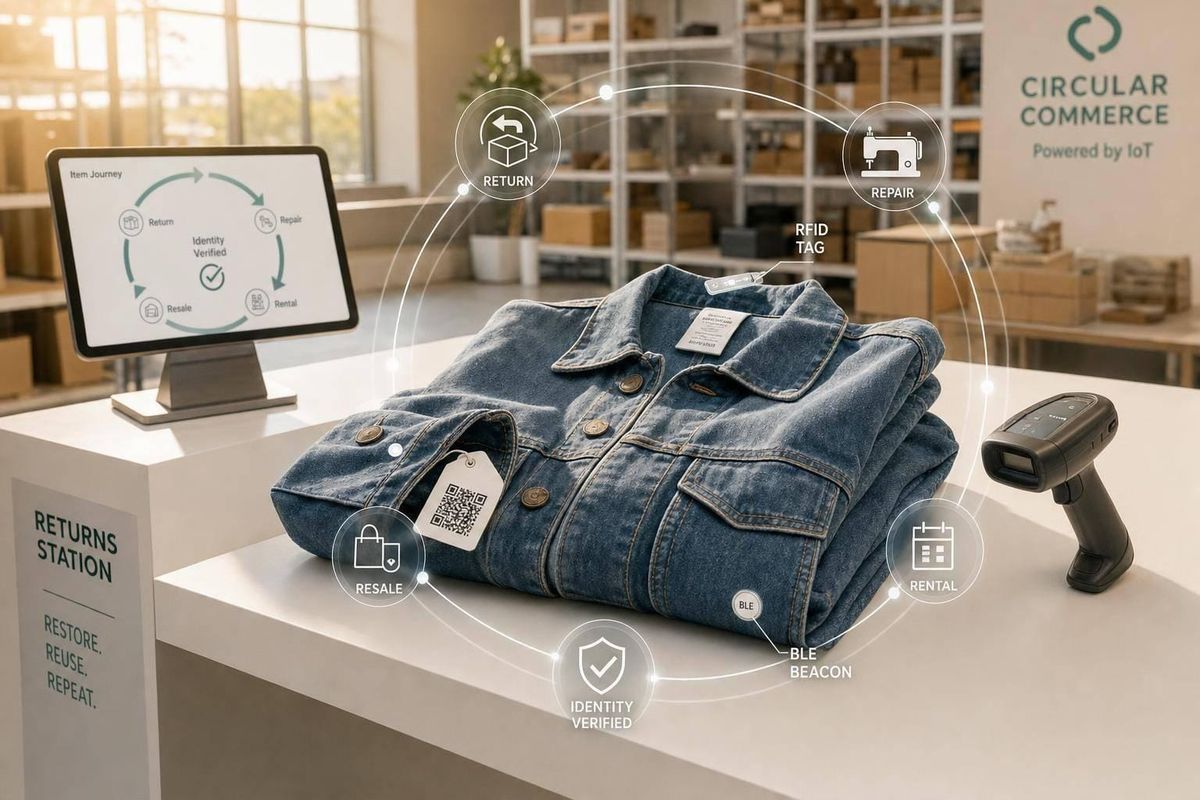
If you run resale, rental, or repair, SKU counts are not enough. I’d sum up this 2026 study like this: merchants need to track each item, not just total stock, and IoT tools help them do that with IDs, location data, condition data, and system sync.
Here’s the short version:
- Circular ecommerce depends on item-level tracking
- Returns are high-volume, but post-return status is still a gap
- Most merchants start with QR codes or barcodes
- RFID helps when item volume gets high
- BLE, GPS, and sensors help with location and wear
- Shopify and WooCommerce merchants tend to buy for different workflow pain
- Agencies should sell the workflow, not the hardware
A few numbers stand out right away:
- The reverse logistics market was put at $841 billion in 2024
- It is growing at 7.2% CAGR
- Shopify’s Recommerce app reached 288 active installs as of August 27, 2026
- That app grew 152.6% year over year
- Shopify’s top return and exchange apps total 57,294 installs
What does that mean for you?
It means merchants already care about getting items back. But many still struggle with what happens after the return: grading, repair holds, cleaning, routing, and relisting. That is where IoT fits. It helps answer four plain questions: Which unit is this? Where is it? What shape is it in? What should happen next?
I’d boil the article down into three takeaways:
- Resale needs item history and condition grades
- Rental needs per-unit availability and return timing
- Repair needs intake control and status updates across systems
Retail IoT Explained: Smart Stores, RFID, Beacons & Sensors for Inventory Management
sbb-itb-61169e3
Quick Comparison
| Area | Main need | Common tools | Main issue solved |
|---|---|---|---|
| Resale | Condition and lifecycle status | QR codes, barcodes, RFID | Misgraded items and lost margin |
| Rental | Per-unit availability and location | RFID, BLE, GPS | Double-booking and return delays |
| Repair | Intake, work status, release control | Serial tracking, sensors, middleware | Items listed before they are ready |
So if I had to state the article’s main point in one line, it would be this: in circular ecommerce, money is lost when merchants cannot see item identity and item status at the unit level.
That’s the core idea the rest of the article builds on.
Why Circular Ecommerce Requires Item-Level Visibility
Standard inventory systems count units. Circular ecommerce has to track the actual item.
That means answering a different set of questions: Which unit is it? Where is it right now? What shape is it in? What should happen next? A standard SKU count can't tell you any of that. It tells you how many units exist on paper, not what's happening to each one in the real world.
That's why IoT has to follow items, not just SKUs.
How Resale, Rental, and Repair Break Standard Inventory Logic
Once a merchant adds resale, rental, or repair, standard inventory logic starts to crack.
Each item builds its own history. Two units of the same product may share a SKU, but they are not the same in practice. One might be graded "Excellent." Another might be stuck in a repair hold. On paper, they look identical. In operations, they're miles apart.
Rental makes the problem even sharper. An item returned this morning may show up as available in the system, while it's still sitting in a cleaning queue. That opens the door to double-booking the same unit and creates avoidable cost. It's the kind of issue that looks small until it hits fulfillment.
When these status changes aren't tracked at the item level, merchants lose sellable inventory and run into fulfillment mistakes. That's why circular inventory needs serialized IDs and live condition data.
The Most Consistent Findings Across the Research
The research keeps pointing to the same operational gap: circular flows need item-level status control.
One signal is hard to miss. On Shopify, the "Returns and exchanges" category - the starting point for most circular recovery flows - has 57,294 installs across the top 25 apps [2]. That's nearly 7.5x the install volume of dedicated inventory sync tools [3].
That pattern says a lot. Merchants are putting serious effort into the moment an item comes back. But there is far less support for what comes after: checking condition, assigning the right status, and routing the item to the next step. That's the hole IoT tools are built to fill.
IoT Technologies Used for Circular Inventory Tracking
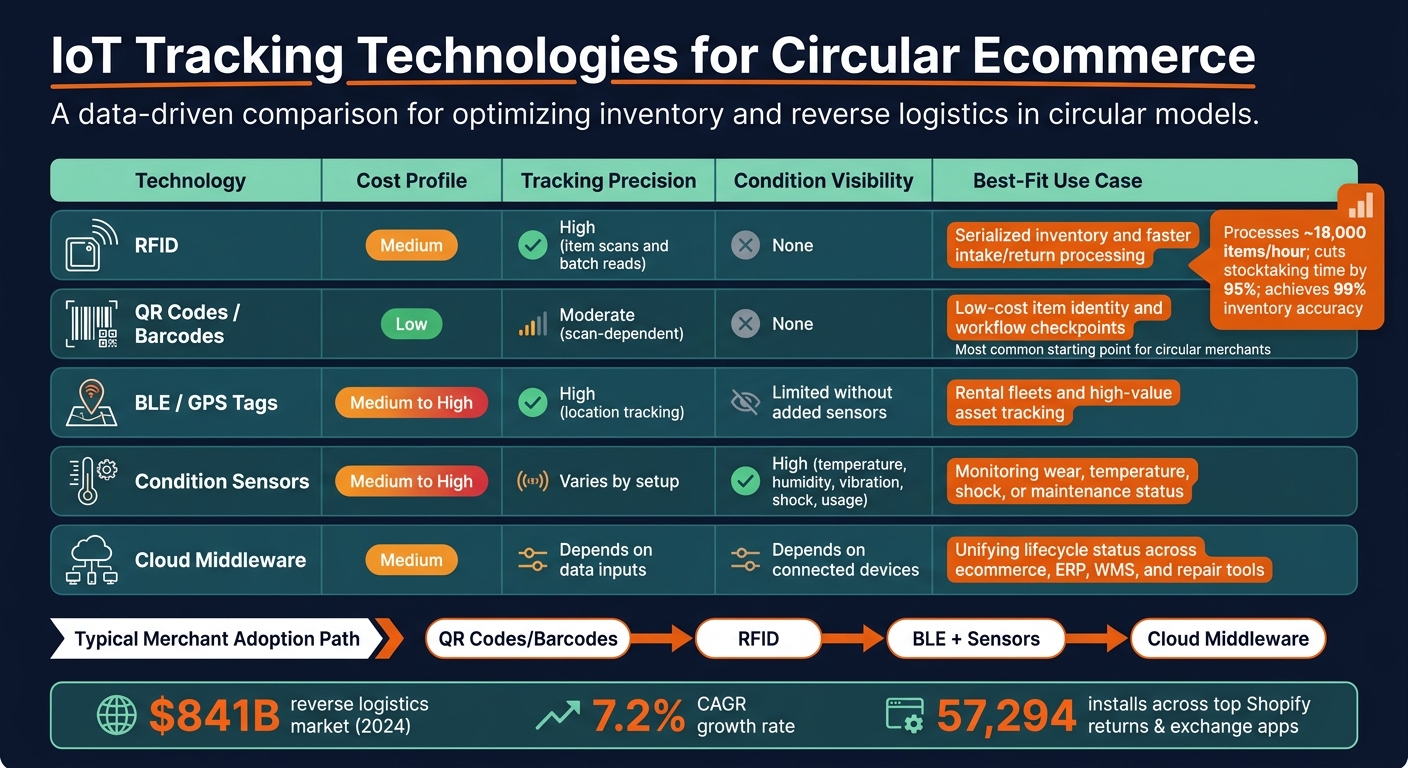
IoT Tracking Tools for Circular Ecommerce: Technology Comparison 2026
Circular tracking works in layers: identity, location, condition, then system sync.
RFID, QR Codes, and Barcodes for Item Identity
Start with item identity: which unit is this? QR codes and barcodes handle that at the lowest cost. A label can store a serial number, condition grade, or ownership type - owned, consigned, rented - and almost any smartphone or warehouse scanner can read it. That’s why these tools are often the first move.
The catch is simple: updates only happen when someone scans the item at intake, inspection, packing, or return. For merchants just launching a resale or rental program, that’s often enough. The setup cost is low, and it pushes teams to clean up and standardize their data before they add more advanced tracking.
RFID adds another layer. Tags don’t need line of sight, and RFID-based stocktaking can process about 18,000 items per hour, cutting stocktaking time by 95% compared with manual methods. Inventory accuracy can reach 99%, which is a big deal for rental and resale operations [15]. Rentex and similar rental operators have moved past barcodes to RAIN RFID to handle more complex inventory with less friction [16][17][14].
Identity is the base layer. Next comes knowing where the item is.
BLE, GPS, Sensors, and Cloud Dashboards for Status Tracking
Once identity is set, the next gap is location and condition. That’s where BLE tags, GPS trackers, and condition sensors come in. It’s also where costs start to climb.
Rental fleets often combine BLE tags on units with GPS gateways on service vehicles, so position gets logged automatically as trucks pass tagged assets [6][7][9][11]. That setup makes sense for equipment rental fleets, shared mobility devices, or offsite consignment stock spread across many places.
Condition sensors track temperature, humidity, vibration, shock, and usage, which helps teams see wear, not just location [5][8][4][12][13]. For safety-critical or high-value goods, that data can guide repair scheduling, grading decisions, and end-of-life calls.
Cloud middleware ties it all together. It pulls in RFID scans, BLE pings, GPS coordinates, and sensor readings, then syncs that data to Shopify tech stacks, WooCommerce, ERP, WMS, and repair tools [5][8][4][10]. So one lifecycle event - a return scan, a temperature alert, or a usage threshold - can update stock availability, open a repair ticket, or shift an item from a rental queue to a resale listing.
The table below sums up the tradeoffs [4][10][13]:
| Technology | Cost Profile | Tracking Precision | Condition Visibility | Best-Fit Use Case |
|---|---|---|---|---|
| RFID | Medium | High for item scans and batch reads | None | Serialized inventory and faster intake/return processing |
| QR codes / barcodes | Low | Moderate, scan-dependent | None | Low-cost item identity and workflow checkpoints |
| BLE / GPS tags | Medium to high | High for location tracking | Limited without added sensors | Rental fleets and high-value asset tracking |
| Condition sensors | Medium to high | Varies by setup | High | Monitoring wear, temperature, shock, or maintenance status |
| Cloud middleware | Medium | Depends on data inputs | Depends on connected devices | Unifying lifecycle status across ecommerce, ERP, WMS, and repair tools |
Most merchants start with labels, then add RFID as volume grows. After that, they layer in BLE, sensors, and middleware as tracking gets more complex. That stack can look very different for Shopify and WooCommerce merchants, which the next section breaks down.
Vendor and Merchant Adoption Patterns on Shopify and WooCommerce
2026 adoption data points to a pretty clear split.
Circular vendors sell serialized, item-level workflows built for condition, lifecycle, and return status. Merchants tend to buy when money is slipping away because of misgraded items, double-bookings, or repair holds. That gap shows up fast in how tools are packaged for Shopify and WooCommerce.
| Workflow | Primary Operational Focus | Return Handling | Repair Support |
|---|---|---|---|
| Resale | Condition grading and lifecycle state | Moderate to high | Often adjacent |
| Rental | Availability windows and turnaround timing | Core workflow | Sometimes built in |
| Repair | Intake control and status sync | Intake and release focused | Core workflow |
How Vendor Positioning Differs by Resale, Rental, and Repair
Resale tools center on condition grading and lifecycle state. Platforms like Supercycle swap Shopify’s basic SKU counts for serialized, item-level tracking. [18] That matters because grading affects pricing, and pricing affects margin. If the grade is off, revenue usually is too.
Rental tools put the spotlight on availability windows and turnaround timing. Their pitch is simple: cut down double-booking risk. They do that with real-time availability calendars, check-out and check-in flows, and per-unit rental history that can flag items with repeat damage or late returns.
Repair tools are sold around intake control and status sync. Shopify repair apps turn jobs into tracked work orders with intake photos, serial numbers, custom status flows, and parts inventory sync. The goal is plain enough: don’t let anything get listed before it’s ready.
Platform-Level Adoption Patterns on Shopify and WooCommerce
Shopify merchants usually adopt serialized inventory and lifecycle tracking first. That’s common among brands running resale, in-house repair, or rental next to a main product catalog.
The Recommerce app shows that trend well. As of August 27, 2026, it had 288 active Shopify installations and had grown 152.6% year-over-year. Its adoption is grouped under Returns and Exchanges instead of being treated as a separate inventory silo. [1] That says a lot. Resale is being framed as an extension of the return lifecycle, not as a side operation living on its own.
WooCommerce merchants often start from the other end. They begin with booking logic, then layer in per-unit tracking as asset complexity increases. In practice, WooCommerce leans more toward equipment rental and booking-heavy use cases, while Shopify leans more toward brands that need one shared item record across resale, repair, and rental.
For service providers, that split matters because it shapes where outreach is most likely to land.
Using StoreCensus to Find Merchants with Circular Program Signals
These same adoption signals also work well for outbound targeting.
Use StoreCensus to find Shopify brand prospect lists that already show signs of rental, returns, repair, multi-location, or asset-management activity. Then line up outreach with new installs or store changes.
What the Data Means for Ecommerce Service Providers
Where IoT Delivers Measurable Gains in Daily Operations
This gap hits hardest for merchants and agencies already dealing with returns, repairs, and rental volume. For service providers, the payoff is simple: faster check-in, fewer grading mistakes, and less inventory sitting around doing nothing.
RFID improves inventory accuracy, cuts labor hours, and sharply reduces cycle-count time [19][20][21]. That matters for a basic reason: it gets items back on the sales floor faster instead of leaving them stuck in the back room.
For circular merchants, the biggest wins show up in the workflows where mistakes happen most often:
- check-in
- return-to-stock decisions
- repair intake
- final disposition
Every hour between a return and a relisting slows down revenue. IoT helps close that gap by updating item status automatically.
What Agencies Should Sell Into This Market
For agencies, the play is not the hardware. It's the workflow wrapped around it.
The service opportunity falls into three offers: sell serialization for resale, availability control for rental, and intake/status sync for repair.
The best prospects already show signs of returns, repair, or inventory-optimization activity. In plain English, these merchants already feel the pain of returns friction, stock gaps, and repair backlogs. Agencies that frame IoT around revenue protection - fewer stock-outs, faster recovery, and less shrinkage - will usually do better than agencies that lead with specs and device talk.
Conclusion: The 2026 Signal in One View
Put together, the adoption data points to one buying pattern. The 2026 signal is clear: merchants need identity plus status tracking, and providers should sell against the revenue losses that tracking helps prevent.
FAQs
When should a merchant move from barcodes to RFID?
Merchants should look at moving from barcodes to RFID when day-to-day work starts to break down in ways that hurt speed and accuracy.
That usually shows up as inventory bottlenecks, repeated manual entry mistakes, or weak visibility across the supply chain. If staff keeps chasing missing stock, rechecking counts, or fixing input errors by hand, barcodes may be doing less than the business now needs.
The switch tends to make sense when a few things are true at the same time:
- Manual processes no longer keep up with the size of the business
- RFID can plug into current systems without creating data silos
- Teams are ready to use the digital tools that come with the setup
In plain terms, RFID fits when the old way still works on paper, but not at the pace the business now has to run.
Which circular ecommerce model benefits most from IoT first?
IoT-first tracking works best for electronics and fashion brands that need tight control over reverse logistics, repair workflows, and product-level traceability.
It can automate end-of-life routing and verification across complex supply chains, which helps replace slow, manual work. But there’s a catch: adoption takes serious operational investment. That makes it a better fit for enterprise retailers that already pay for take-back or resale programs.
How can agencies pitch IoT without leading with hardware?
Focus on the outcomes the hardware makes possible, not the gadgets themselves. Talk about IoT in terms of fixing clear problems in resale, repair, or take-back programs.
For example, if a seller is dealing with slow item intake, weak tracking, or too many manual checks, lead with that. The point isn't the device. The point is a smoother workflow, fewer missed steps, and a better setup for circular commerce.
Use StoreCensus to spot merchants that are already putting money into these workflows. Look for stores with:
- returns portals
- warranty tools
- resale widgets
That gives you a much warmer starting point. You're not pitching a hard new hardware rollout from scratch. You're showing how your service fits into a system they already have and makes it work better.