Why Niche Stores Choose Headless Frameworks
For niche stores, headless delivers faster performance, full customization, and multi-channel support — but costs more and requires engineering.

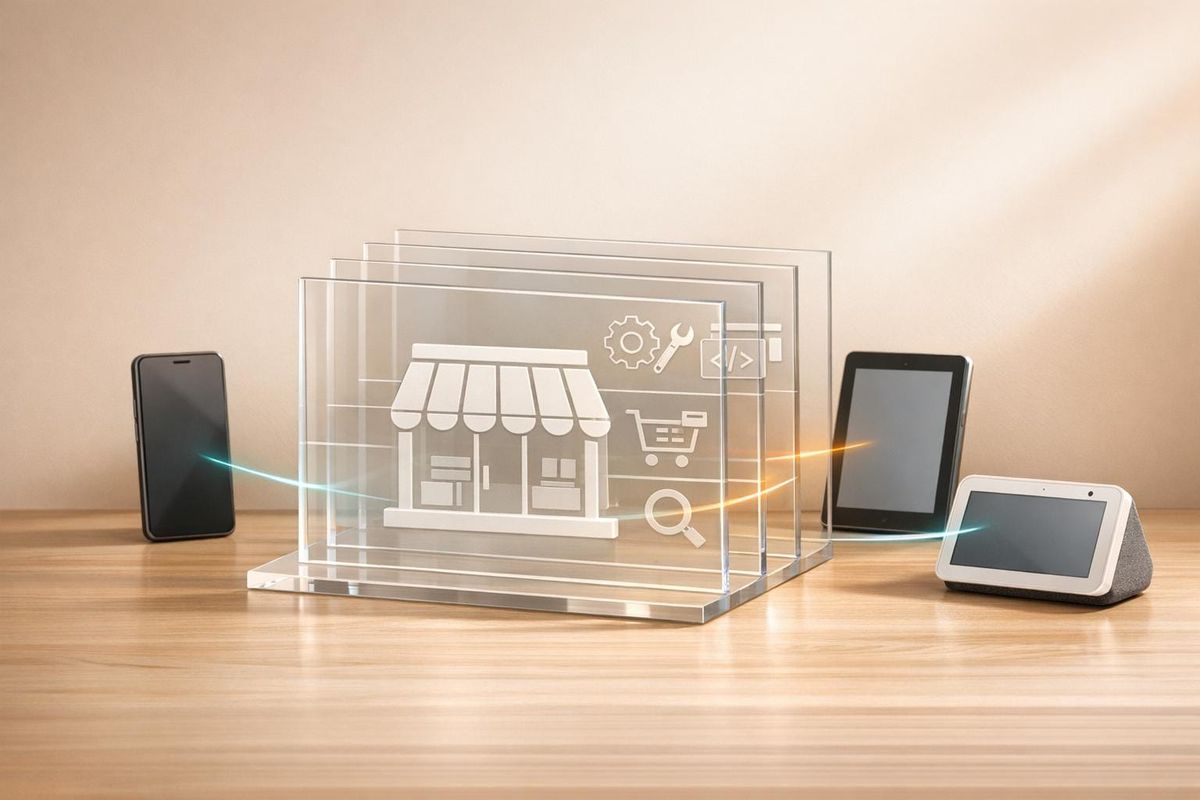
Headless commerce separates the frontend (storefront) from the backend (inventory, payments, etc.) to provide more flexibility for niche ecommerce stores. Unlike theme-based setups, headless frameworks like Next.js or React allow custom features, faster performance, and multi-channel integration. However, this approach requires higher upfront costs and ongoing developer resources, making it ideal for businesses with specific needs and larger budgets.
Key Takeaways:
- Performance: Headless systems deliver faster load times (LCP under 1.5 seconds) compared to theme-based platforms like Shopify Liquid (LCP 2.5–4.0 seconds).
- Customization: Full control over design and advanced features like product configurators or editorial-driven content.
- Cost: Initial builds range from $75,000–$150,000, with monthly maintenance at $4,000–$15,000. Monolithic setups cost significantly less.
- Challenges: Higher complexity, SEO risks during migration, and ongoing engineering needs.
- Best Fit: Stores generating $5M+ annually or facing specific platform limitations (e.g., performance issues, multi-channel needs).
Quick Comparison:
| Factor | Theme-Based (Monolithic) | Headless Framework |
|---|---|---|
| Cost | $5,000–$40,000 upfront | $80,000–$300,000 upfront |
| Monthly Maintenance | $0–$2,000 | $4,000–$15,000 |
| Performance (LCP) | 2.5–4.0 seconds | 0.8–2.0 seconds |
| Customization | Limited by templates | Full design freedom |
| SEO Risk | Low | Moderate |
| Engineering Needs | Minimal | High |
Headless is a business decision, not just a technical upgrade. Consider it if your store faces measurable challenges that theme-based solutions can't solve.
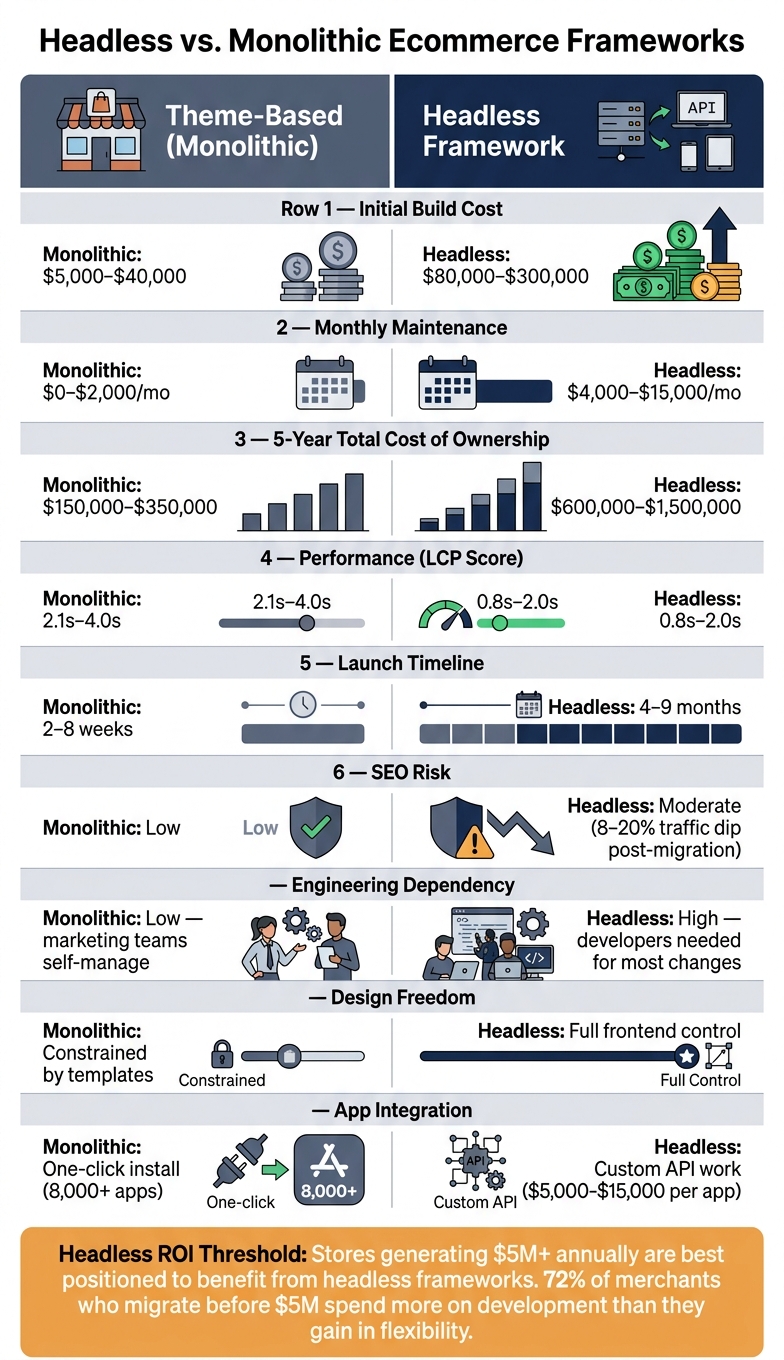
Headless vs. Monolithic Ecommerce: Cost, Performance & Complexity Compared
1. Headless Frameworks
Performance and Scalability
Headless frameworks are known for their ability to deliver faster performance and handle growth effectively. By separating the frontend from the backend, content can be delivered through CDN edge networks, significantly reducing latency compared to traditional server-rendered themes. For example, modern frameworks like Hydrogen 3.0, hosted on Shopify's Oxygen, have achieved impressive median LCP (Largest Contentful Paint) scores of under 800ms.
Real-world examples back up these claims. Carve Supply Co., an outdoor apparel brand generating $12M annually, switched to Shopify Hydrogen and saw mobile LCP drop from 3.8 seconds to 1.4 seconds. This improvement boosted their mobile conversion rate by 17%. Similarly, Allbirds experienced a significant transformation after migrating in late 2025, with page load times decreasing from 3.2 seconds to 1.1 seconds, leading to a 23% increase in mobile conversions.
"If you're spending more than $15,000 monthly on apps and customizations to work around platform limitations, headless probably makes financial sense." - Marcus Chen, VP of Engineering, Allbirds
Headless frameworks also shine for niche stores with extensive catalogs or intricate variant logic. For example, jewelry stores that filter products by metal, stone, and occasion simultaneously can bypass the rendering limitations found in Liquid and PHP themes.
Customization and Content Flexibility
Speed isn't the only advantage. Headless frameworks provide unmatched customization possibilities. Brands gain full control over the user experience, enabling marketing teams to manage editorial content, localization efforts, and seasonal campaigns without relying on developers. A decoupled CMS allows for quick updates - like swapping out banners - without disrupting the overall commerce release cycle.
Take ILIA, for instance. In 2025, the brand implemented custom tools like "find my shade" and "compare shades" on Shopify Plus. These features led to an 18% reduction in exit rates and a 10% drop in bounce rates.
"It's that next 20% where headless comes in and where we really spend our time. What we're trying to do is let Shopify handle the stuff they do so well, and we can focus on what makes us unique." - Benjamin Sehl, Cofounder, Kotn
Another strength of headless frameworks is their ability to power multiple channels simultaneously. The same backend can support a web storefront, mobile app, B2B portal, and even retail kiosks, all drawing from a single source of product data. That said, these benefits come with challenges.
Operational Complexity and Cost
Unlike managed platforms, headless frameworks place greater responsibility on merchants. Tasks like handling security patches, upgrading frameworks, and maintaining infrastructure fall directly on their shoulders. Initial build costs for smaller brands (with $1M–$5M in annual revenue) typically range between $75,000 and $150,000. Additionally, ongoing monthly expenses for developer retainers can run from $4,000 to $15,000. For those adopting a full MACH stack, annual SaaS fees alone can range from $80,000 to $300,000, even before factoring in development work.
Revenue plays a critical role in determining whether headless is a wise investment. Research shows that 72% of merchants transitioning to headless before reaching $5M in annual revenue end up spending more on development than they gain in flexibility. The risks extend beyond costs. Glow Recipe, for example, suffered a 40% drop in organic traffic for six months after a late 2025 migration due to poorly executed SEO.
"The merchants who are getting real ROI from headless in 2026 are the ones who had a specific, measurable problem - usually site speed or content complexity - that their existing platform couldn't solve." - Jamie Crestwood, VP of Commerce Technology, Diff Agency
2. Monolithic/Theme-Based Frontends
Performance and Scalability
Monolithic frontends, such as Shopify Liquid or WooCommerce, bundle the catalog, cart, checkout, and storefront into one tightly integrated system. This setup allows merchants to launch their storefronts quickly with minimal coding. However, as businesses expand, some trade-offs become more noticeable. For instance, a typical Shopify theme delivers a Largest Contentful Paint (LCP) score of 2.5–4.0 seconds, whereas headless builds often achieve LCP scores under 1.5 seconds. A major factor here is app bloat - adding 10–15 third-party apps can introduce 800KB to 2MB of JavaScript, which slows down load times and reduces conversions. Research suggests that every additional second of load time can lead to a 7% drop in conversions.
That said, around 60% of Liquid-based sites manage to pass all Core Web Vitals, which provides a solid performance foundation for many smaller or niche ecommerce stores.
Customization and Content Flexibility
Customization is another area where monolithic platforms face scrutiny. While they now offer some visual customization options, they still fall short compared to the advanced capabilities of headless setups. Shopify's Horizon framework, introduced in 2026, improved flexibility by enabling sections on every page and allowing custom CSS edits. This gave merchants greater control over their storefront's appearance.
However, challenges persist when it comes to implementing advanced features. Monolithic platforms often struggle with building complex product configurators, integrating real-time ERP systems, or creating dynamic, video-heavy editorial pages. Additionally, their fixed URL structure (e.g., "/products/", "/collections/", "/pages/") can limit advanced SEO strategies. For stores requiring interactivity, many merchants opt to embed "React islands" within Liquid themes rather than fully transitioning to headless setups.
"A good Shopify 2.0 theme with sections gets you 80% of the visual freedom for 5% of the cost." - Arbaz Khan, Blog Author, Datasoft Technologies
Operational Complexity and Cost
When it comes to cost, monolithic setups are significantly more affordable than headless builds. While headless systems can cost between $8,000 and $20,000 per month, monolithic platforms typically require $3,000–$15,000 upfront and less than $500 in monthly expenses. This makes them a practical choice for smaller stores or businesses with limited budgets.
However, this affordability often comes at the expense of flexibility and advanced functionality, which leads many niche brands to eventually transition to headless systems. App subscriptions are another expense to consider, ranging from $800 to $2,500 per month for mid-sized stores. In some cases, investing in a custom-built Liquid theme that replaces third-party app functionality can save costs over time - often paying for itself within 18 to 24 months and eliminating the need for a full headless migration.
As StoreCensus highlights, optimized traditional themes strike a balance between performance, scalability, and cost efficiency for many niche ecommerce brands. While monolithic themes are cost-effective and easy to deploy, their limitations in advanced features often push growing businesses toward headless solutions.
"A well-built traditional Shopify theme outperforms a poorly maintained headless build - and costs a fraction to run." - Jamie Buchanan, Founder & CTO, Rogue Digital
Choosing the Right Commerce Architecture: Monolith vs. Headless | Steve Netzlaw | @Acro_Commerce
sbb-itb-61169e3
Pros and Cons
Both models come with their own advantages and challenges. The right choice depends on your store's size, budget, and specific needs.
| Factor | Monolithic (Theme-Based) | Headless Framework |
|---|---|---|
| Launch Speed | 2–8 weeks | 4–9 months |
| Initial Build Cost | $5,000–$40,000 | $80,000–$300,000 |
| Monthly Maintenance | $0–$2,000 | $4,000–$15,000 |
| 5-Year TCO | $150,000–$350,000 | $600,000–$1,500,000 |
| LCP Performance | 2.1s–4.0s | 0.8s–2.0s |
| App Integration | One-click install | Custom API work ($5,000–$15,000 per app) |
| Design Freedom | Constrained by templates | Full frontend control |
| Engineering Dependency | Low (marketing teams self-manage) | High (developers needed for most changes) |
| SEO Risk | Low | Moderate (8–20% traffic dip post-migration) |
| Maintenance Ownership | Platform vendor | In-house or agency team |
This comparison sheds light on the trade-offs between the two approaches, particularly regarding performance, costs, and flexibility. While headless frameworks offer more customization and control, they demand higher upfront investment and ongoing maintenance.
For smaller stores, the performance difference is often less impactful, and the costs associated with going headless can outweigh the benefits. Early migrations to headless setups can lead to hefty development expenses, which may not make sense for businesses with limited budgets.
App integration is another major consideration. Shopify's App Store has over 8,000 apps that integrate seamlessly with Liquid themes. However, in a headless environment, these apps require custom API development, costing $5,000–$15,000 per app. Stores relying on multiple apps for features like reviews, loyalty programs, or upselling could face additional costs exceeding $50,000 before even launching their site.
"The build is the down payment. The operations are the mortgage." - Liberty Design Studio
That said, for niche businesses with advanced needs, the benefits of a headless setup can justify the investment. For example, luxury fashion retailer Nour Hammour transitioned to a headless Shopify store integrated with Sanity CMS. This move led to a 63% increase in year-over-year conversion rates and a 128% rise in sales. These results, however, come with the caveat of requiring ongoing engineering resources beyond the initial build.
Conclusion
Headless frameworks aren't a one-size-fits-all solution for niche stores. The decision to go headless should stem from your platform's limitations, not just the allure of the concept.
The strongest reason to consider headless is when your current theme-based store faces a specific, measurable challenge. For example, an LCP (Largest Contentful Paint) stuck above 3 seconds, a product configurator that Liquid can't handle, or a content-commerce setup requiring editorial capabilities that templates can't support. In these cases, headless can offer a return on investment by addressing performance or complexity issues that traditional setups can't fix.
Financially, the numbers often don’t work out for smaller stores. Stores generating less than $5M–$10M in annual revenue rarely see a benefit from going headless. In fact, 72% of merchants who migrate before hitting $5M end up spending more on development than they gain in flexibility. This highlights why optimizing your existing theme is usually a smarter move for smaller businesses.
For those ready to take the leap, hybrid solutions like Shopify Hydrogen offer a balanced approach. These frameworks allow you to build a custom React-based frontend while keeping the backend and checkout managed by the platform. This option provides many of the benefits of headless without the overwhelming infrastructure demands of a fully headless setup.
Ultimately, headless is a business decision - not just a technical trend. It requires a clear problem to solve, a realistic budget for ongoing maintenance, and a team with at least two senior frontend engineers. Without these pieces in place, the transition to headless can quickly turn into a costly and complex commitment.
FAQs
What should I optimize on my theme-based store before going headless?
Before considering a switch to headless, make sure your theme-based store is running as efficiently as possible. If your Largest Contentful Paint (LCP) exceeds 3 seconds, start with basic optimizations like:
- Compressing and optimizing images
- Removing unnecessary apps
- Upgrading to a faster CDN
- Enhancing caching mechanisms
For many stores, adopting a modern Online Store 2.0 theme can lead to significant performance gains. Headless architecture should only be pursued if these steps don't resolve key issues with design, content, or performance.
How do I estimate headless ROI for my store?
To figure out the ROI of going headless, weigh the higher upfront and ongoing costs against the potential boost in revenue from better site performance and increased flexibility. Generally, headless setups are a better fit for stores generating $3 million or more in annual revenue.
Take a close look at your store’s speed, structural requirements (like handling complex pricing models or managing a large number of SKUs), and the overall costs involved. If these factors make the investment worthwhile, headless could offer stronger returns. If not, focusing on optimizing your current platform might be the smarter move.
How can I avoid an SEO traffic drop during a headless migration?
When transitioning to a headless setup, maintaining SEO traffic requires strategic planning and a focus on continuity. Expect an organic traffic decline of about 8–20% for 2–3 months as Google adjusts to your new frontend. To keep this period from dragging out, avoid altering your URL structures.
You can soften the blow by temporarily boosting your paid search budget during this time. Additionally, ensure the migration is executed with care - problems like inefficient API calls or over-hydration can negatively affect your site's performance and user experience. Attention to detail here can make all the difference.