
UGC Trends in Social Commerce 2026
UGC, short-form video, and live shopping now drive conversions and cut acquisition costs for Shopify merchants in 2026.


Here’s why it matters in 2026:
- $100 billion in U.S. social commerce sales is projected this year.
- TikTok Shop alone hit $30 billion in GMV, while Instagram processes 40M+ monthly transactions.
- UGC drives 102% higher conversions and costs far less to produce than studio content.
For Shopify merchants, UGC is a game-changer. It boosts conversions by 144%, reduces acquisition costs, and fills the gap for online shoppers who can’t physically interact with products. Short-form videos and live shopping are now responsible for 70% of social commerce revenue, making them the most effective formats.
Agencies and vendors have a huge opportunity to help merchants optimize UGC strategies. From tools like Judge.me and Loox to TikTok Spark Ads, the focus is on scaling content production, testing, and integrating native checkout for smoother customer journeys.
The bottom line: UGC is no longer optional. It’s the engine driving trust and sales in social commerce today.
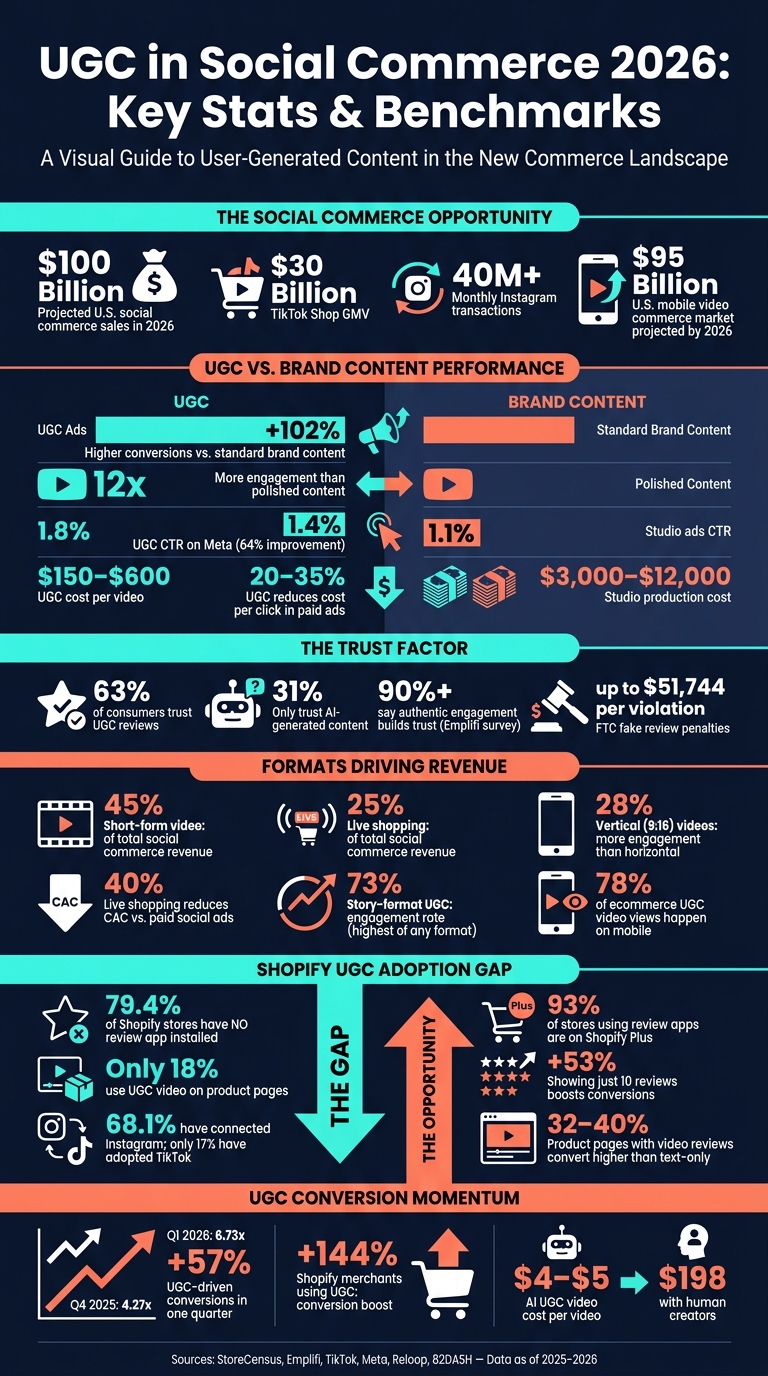
UGC in Social Commerce 2026: Key Stats & Benchmarks
Data Sources and Methodology
How StoreCensus Data Was Used
StoreCensus collects its data by using a headless browser to scan over 626,941 live Shopify stores (representing 11.4% of the total base as of May 2026). This process involves analyzing the stores' DOM, scripts, meta tags, and network requests. Through this scanning, StoreCensus identifies more than 400 Shopify apps and 50 tracking pixels, allowing for segmentation based on revenue, tech stack, and social commerce adoption.
This segmentation adds depth to the analysis by breaking down Shopify merchants into specific groups. Instead of treating all stores as one entity, the data categorizes them by the UGC tools they've implemented, the social platforms they've integrated, and traffic signals that hint at their scale. For instance, StoreCensus data reveals that 68.1% of Shopify stores have connected Instagram, but only 17% have adopted TikTok as of May 2026. This disparity plays a key role in shaping the report's findings.
However, it’s worth noting that this scanning method may miss server-side or private API-loaded apps. While the tech stack coverage is extensive, it isn’t fully comprehensive.
External Data Sources
StoreCensus data focuses on what merchants have installed. To understand how much these tools impact performance, external data sources were used. These sources were chosen based on three main factors: their recency (2025–2026), relevance to Shopify merchants, and their ability to offer detailed metrics on specific content formats.
Studies from vendors like Reloop, 82DASH, and Emplifi provided insights that connect merchant adoption rates to actual conversion outcomes. Additionally, platform-level data from TikTok and Instagram offered benchmarks for GMV and transaction volumes. Academic insights were drawn from a systematic review of 60 peer-reviewed studies (published between 2014 and 2024), following PRISMA 2020 guidelines. Emplifi’s aggregated benchmarks ensured accuracy by normalizing data and applying statistical thresholds across thousands of brand accounts, avoiding distortions from outliers.
"Authentic content is the fastest way to move the needle on your most pressing ecommerce goals. More than 90% of the people we surveyed said that authentic engagement builds trust." - Susan Ganeshan, CMO, Emplifi
These external sources enhance the analysis by adding valuable context to the performance metrics.
Analytic Methods and Limitations
The performance of UGC was primarily assessed using A/B testing frameworks. These tests tracked two key indicators: Hook Rate (3-second view-through) and Hold Rate (average watch time). These metrics serve as early predictors before full conversion data becomes available. This is particularly important given the challenges of attribution in social commerce - for example, purchases made within TikTok Shop might not always show up clearly in a Shopify dashboard.
It’s important to note some limitations in the methodology. Traffic tiers were estimated using SimilarWeb proxies and CDN patterns, providing directional insights rather than exact figures. Data from the Meta Ad Library excluded dark posts and custom audience campaigns, and public social data likely underrepresents customer-generated content, as 79% of customers share privately.
Key UGC Trends in Social Commerce for 2026
UGC Outperforming Brand-Created Content
User-generated content (UGC) is proving to be a game-changer, outperforming traditional studio-produced content in both engagement and conversions. UGC ads can drive up to 102% higher conversions compared to standard brand content, while UGC videos generate 12 times more engagement than their polished counterparts. On Meta platforms, UGC-style videos boast a 1.8% click-through rate (CTR) compared to 1.1% for studio ads - a 64% improvement.
This success stems from what researchers call the "ad recognition reflex." Polished ads are identified as advertisements in under a second, prompting users to scroll away almost immediately. In contrast, UGC, often shot on phone cameras, takes 2–3 seconds to be recognized as an ad, giving it a better chance to capture attention. UGC is also far more cost-effective: while a studio-produced video can cost $3,000 to $12,000, a single UGC clip costs just $150 to $600. This allows brands to test 5–10 times more creative ideas within the same budget.
Real-world examples highlight the power of UGC. In a 2024 TikTok Conversion Lift study, eyewear brand Quay saw creator-led clips boost add-to-cart actions by 70%, purchases by 54%, and branded search by an incredible 417% compared to a control group. Similarly, skincare brand Peter Thomas Roth sold six months’ worth of inventory in just one week after a single UGC TikTok video went viral.
This performance advantage has solidified UGC’s role in emphasizing authenticity, with verified reviews becoming increasingly important.
Why Verified Reviews and Authenticity Are Gaining Ground
Trust in content is shifting rapidly. 63% of consumers trust user-generated reviews, a stark contrast to the 31% who trust AI-generated content. As AI-generated visuals flood social media, everyday customer content - like a product shown in a real kitchen, wardrobe, or unboxing moment - stands out as more believable and relatable.
"A photo of your product on someone's kitchen counter, in their wardrobe, in their child's hands, carries a weight of proof that no generated image can replicate." - Isabelle Simon, Communications Lead, 82DASH
Regulations are also steering brands toward authenticity. The FTC’s 2024 rule on fake reviews and undisclosed incentivized content imposes civil penalties of up to $51,744 per violation. This has pushed businesses to rely on verified, rights-cleared content rather than scraped or inauthentic posts, making genuine customer reviews not just a trust signal but a key driver of revenue.
Short-Form Video and Live Shopping Are Driving Sales
Dynamic video formats are taking authenticity to the next level, with short-form videos and shoppable content now generating 45% of total social commerce revenue in 2026. Live shopping adds another 25% and is expected to account for 10–20% of all ecommerce by the end of 2026. The focus is on 15–60 second vertical videos, which are currently the most effective UGC format for Shopify sellers. Vertical (9:16) videos also see 28% more engagement than horizontal ones.
Live shopping events are reshaping customer acquisition strategies by significantly reducing costs. Brands using live shopping report 40% lower customer acquisition costs (CAC) compared to paid social ads. Platforms like TikTok Shop, with native checkout features, eliminate the need for redirects, reducing drop-off rates that previously impacted 60–70% of potential buyers.
Take PawSnack Pet Treats as an example: in 2026, the brand used AI tools to produce 200 TikTok UGC assets in just three days. Two of these videos surpassed 1 million views each, contributing to $112,000 in gross merchandise value (GMV) during their launch month.
"The brands winning with AI UGC in 2026 aren't the ones using the most sophisticated tools - they're the ones with the clearest understanding of what their audience responds to, and the production velocity to test it at scale." - Daniel Carter, Designkit
How Shopify Merchants Use UGC in Social Commerce

UGC Tools and Apps in the Shopify Ecosystem
A surprising number of Shopify merchants are missing out on the benefits of capturing social proof. StoreCensus data shows that 79.4% of Shopify stores don’t use a review app at all. This means most stores aren’t systematically collecting customer reviews, which could be a game-changer for their social commerce strategies. For those that do use review tools, the choice of app often depends on the store’s size and goals.
For smaller or newer brands, Judge.me is a popular choice, with 9.8% adoption. Its "Forever Free" plan allows unlimited review requests, making it budget-friendly for stores with tight margins. On the other hand, Loox (used by 3.9% of stores) focuses on visual reviews - photo and video galleries that resonate with industries like fashion and home goods. Starting at $9.99/month, it’s tailored for brands that rely on aesthetics. At the higher end of the spectrum, Yotpo (3.8% adoption) bundles reviews with loyalty programs and SMS marketing, making it ideal for enterprise-level stores with over a million monthly visitors. Notably, 93% of stores using review apps are on Shopify Plus, compared to just 61% of stores without review tools. This shows that investment in UGC tools often grows alongside a store’s sophistication.
Beyond reviews, apps like Foursixty and EmbedSocial enable merchants to create shoppable galleries from tagged social posts. Customers can click on a photo and immediately add the featured product to their cart. For brands that need more control over content rights, platforms like 82DASH offer direct submission forms for what they call Customer-Generated Content (CGC). This ensures brands own the content from the moment it’s uploaded, eliminating the hassle of chasing permissions later. These tools help merchants turn organic content into powerful marketing assets.
Turning Organic UGC into Paid Social Ads
Collecting UGC is just the first step. The real magic happens when merchants repurpose that content into paid campaigns. Data shows that UGC-driven conversions jumped from 4.27x in Q4 2025 to 6.73x in Q1 2026 - a massive 57% increase in a single quarter. Plus, replacing polished studio content with UGC in ads can reduce cost per click by 20%–35%.
Execution is key to making these campaigns work. On TikTok, merchants often use Spark Ads, which allow them to promote creator-made content while keeping its authentic, organic feel. A proven framework for these ads includes three elements: a strong hook in the first three seconds, a demonstration phase up to the 20-second mark, and a clear call to action. This structure can account for up to 80% of performance differences. Testing different hooks with the same ad body is a standard practice to find what resonates best.
One important thing to note: just because a post is tagged or hashtagged doesn’t mean you have the legal right to use it in a paid campaign. Many merchants now rely on direct submission tools that secure usage rights upfront, avoiding legal complications after a campaign goes live. This seamless integration of organic and paid strategies highlights how essential UGC has become in social commerce.
How Merchants Get More UGC from Customers
To maximize UGC, merchants don’t just wait for customers to share - they actively encourage it. A common approach is sending automated post-purchase emails or SMS messages 7–14 days after delivery. Interestingly, SMS requests outperform email, converting 66% higher.
For merchants looking to boost the quality of submissions, tiered incentives can be effective. For example, offering 50 loyalty points for a text review but 300 points for a video review nudges customers to create more valuable content. Some brands go a step further by using Apple and Google Wallet passes that instantly deliver discount codes upon submission, giving customers an immediate reason to shop again. Another strategy is product seeding through platforms like JoinBrands, which starts at $99/month and gives access to over 250,000 vetted creators. This approach can generate a library of content for less than $200 per video.
"The brands that win today are the ones that turn a one-time buyer into a lifetime advocate." - Amit Bachbut, Director of Growth Marketing, Yotpo
Where UGC is displayed is just as important as how it’s collected. Placing UGC directly below the main product image on a product detail page can address customer concerns about fit and quality, which often delay purchases. Even a small collection can make a big impact - showing just 10 reviews on a product page can boost conversions by 53%. This underscores how systematic UGC collection and strategic placement can significantly enhance performance across Shopify’s social commerce ecosystem.
What This Means for Agencies and Vendors
Finding Shopify Merchants Already Investing in UGC
There's a clear gap between Shopify merchants who have fully embraced user-generated content (UGC) and those who haven’t yet taken the plunge. For agencies and SaaS vendors, this gap represents a massive opportunity. The key is to focus on merchants who are already spending on UGC tools and refining their strategies.
Platforms like StoreCensus make this process easier. By filtering Shopify merchants based on their installed apps, you can quickly identify stores using tools like Yotpo, Loox, Foursixty, or Cevoid. Adding filters for revenue tiers, location, and growth signals helps zero in on merchants actively investing in UGC rather than just dabbling. For agencies offering UGC ad services, filtering for merchants with active TikTok Shop storefronts or Spark Ads integrations can help you find brands already playing in this space. Meanwhile, SaaS vendors can target merchants with static, non-shoppable UGC galleries, offering solutions to streamline and enhance their UGC efforts. This approach allows you to tailor your pitch based on each merchant's current UGC maturity.
A UGC Maturity Framework for Shopify Merchants
Once you’ve identified merchants investing in UGC, segmenting them by their level of maturity helps refine your strategy:
| Tier | What They Have | What They Need |
|---|---|---|
| Tier 1 – Beginner | Basic text reviews, 1–2 static customer photos on product pages | Tools for collecting reviews and launching initial UGC ad campaigns |
| Tier 2 – Intermediate | Shoppable Instagram galleries, incentivized photo/video reviews, basic Meta/TikTok UGC ads | Rights management systems and creative testing frameworks |
| Tier 3 – Advanced | AI-driven creative testing (15+ weekly), TikTok Shop integration, live shopping, cross-channel review syndication | Scaling infrastructure, AI-powered UGC production, and LLM optimization |
The biggest opportunities lie within Tier 1 and Tier 2. Only 18% of Shopify stores currently use UGC video on their product pages, leaving a lot of untapped potential. For agencies, this is a strong selling point: product pages with video reviews convert 32–40% higher than those relying solely on text reviews.
At the advanced level, the challenge shifts from collecting content to producing it at scale. To sustain ad performance with $50,000+ in monthly ad spend, brands need to test 15–25 new creatives per week to prevent ad fatigue. AI tools like Reloop can help here, cutting the cost of video production from an average of $198 per video (using human creators) to just $4–$5.
"The ecommerce brands winning with UGC ads in 2026 aren't the ones with the best single video. They're the ones with a system for producing, testing, and iterating." - Clément Janssens, Founder, Reloop
Where UGC in Social Commerce Is Headed
Looking ahead, UGC is set to reshape content ownership by 2026. While 87% of brands already use some form of UGC, only 16% have a dedicated strategy. This creates an opening for agencies to move beyond one-off campaigns and offer ongoing, retainer-based services that handle UGC collection, moderation, and distribution.
Two trends will dominate in the coming year:
- AI-driven search: Brands with structured UGC will surface more often in AI-generated answers from tools like ChatGPT and Google's AI Overviews.
- Mobile-first "story" formats: With 78% of ecommerce UGC video views happening on mobile, story-format content is now achieving a 73% engagement rate, the highest of any format this year.
These trends emphasize the growing importance of UGC in social commerce. Vendors who help merchants optimize their reviews and video content for AI discovery will gain an edge. Meanwhile, agencies without mobile-first UGC workflows risk falling behind.
The U.S. mobile video commerce market alone is projected to hit $95 billion by 2026. For agencies and vendors focused on UGC, the opportunity isn’t in question - the real challenge lies in sharpening your strategy to seize it.
sbb-itb-61169e3
Conclusion
The data from 2026 paints a clear picture: user-generated content (UGC) has transitioned from being a "nice-to-have" to becoming the backbone of how social commerce drives conversions. Quarter-over-quarter, UGC-driven conversions have surged, signaling a fundamental change in how online trust is built.
Today’s shoppers are faster and more skeptical than ever. A staggering 61% abandon product pages if they don’t find enough trustworthy details to justify a purchase. And mobile users? They make trust decisions in less than eight seconds. Authentic, phone-shot videos and peer reviews strike a chord with consumers in ways that polished, professional content just can’t replicate. As outlined earlier, a well-planned UGC strategy has become a critical tool for merchants and agencies alike.
Despite this shift, many merchants have yet to fully embrace UGC's potential. For agencies and vendors, this presents a huge opportunity. Those who prioritize systematic strategies - building processes for collecting, testing, and distributing UGC rather than relying on sporadic campaigns - stand to gain the most. AI tools are accelerating this transformation, slashing video production costs from around $200 per video to as little as $4–$5. This makes high-volume creative testing accessible to merchants across all revenue levels. These advancements highlight UGC's pivotal role in redefining social commerce.
The takeaway is undeniable: UGC is no longer optional for social commerce success. Merchants and agencies that integrate UGC deeply into their strategies will set the pace in 2026.
FAQs
How can I tell if my UGC is boosting conversions?
To gauge success, monitor key performance metrics on platforms like Meta and TikTok. Pay close attention to click-through rates (CTR) and cost per acquisition (CPA) - well-crafted UGC often results in better engagement and reduced ad costs.
On your website, analyze conversion rates by comparing visitors who engage with UGC (like customer photos or video reviews) to those who don’t. The data is clear: users interacting with UGC tend to convert at much higher rates.
What’s the safest way to get UGC rights for ads and product pages?
When collecting content from customers, the best option is to use a branded submission form. This allows customers to upload their content directly to your library while agreeing to clear usage terms. Why is this important? Because it gives you explicit legal permission to use their content across various platforms - whether it's for ads, emails, product pages, or even packaging.
Avoid depending on social media tags, hashtags, or direct messages. These methods don't provide the legal consent you need, which could lead to complications later. A submission form streamlines the process and ensures everything is above board.
What should I launch first: reviews, short-form UGC videos, or live shopping?
Short-form user-generated content (UGC) videos are a powerhouse for Shopify merchants. They’re not just great for driving sales but also for getting your products discovered on platforms like TikTok and Instagram Reels. Formats like unboxing videos or day-in-the-life clips feel natural and relatable, making them perfect for capturing authentic engagement.
Boost Conversions with Embedded Reviews
Take it a step further by embedding video and photo reviews directly on your product pages. Seeing real customers share their experiences can build trust and significantly increase conversion rates.
Try Live Shopping for Scaling
If you're ready to scale, live shopping is worth exploring. It creates a dynamic, interactive experience for shoppers. However, success here depends on having a reliable host and sticking to a consistent schedule.