Store Leads vs StoreCensus: Full Comparison
Compare broad multi-platform store coverage with focused Shopify/WooCommerce depth—filters, contact quality, and outreach readiness.

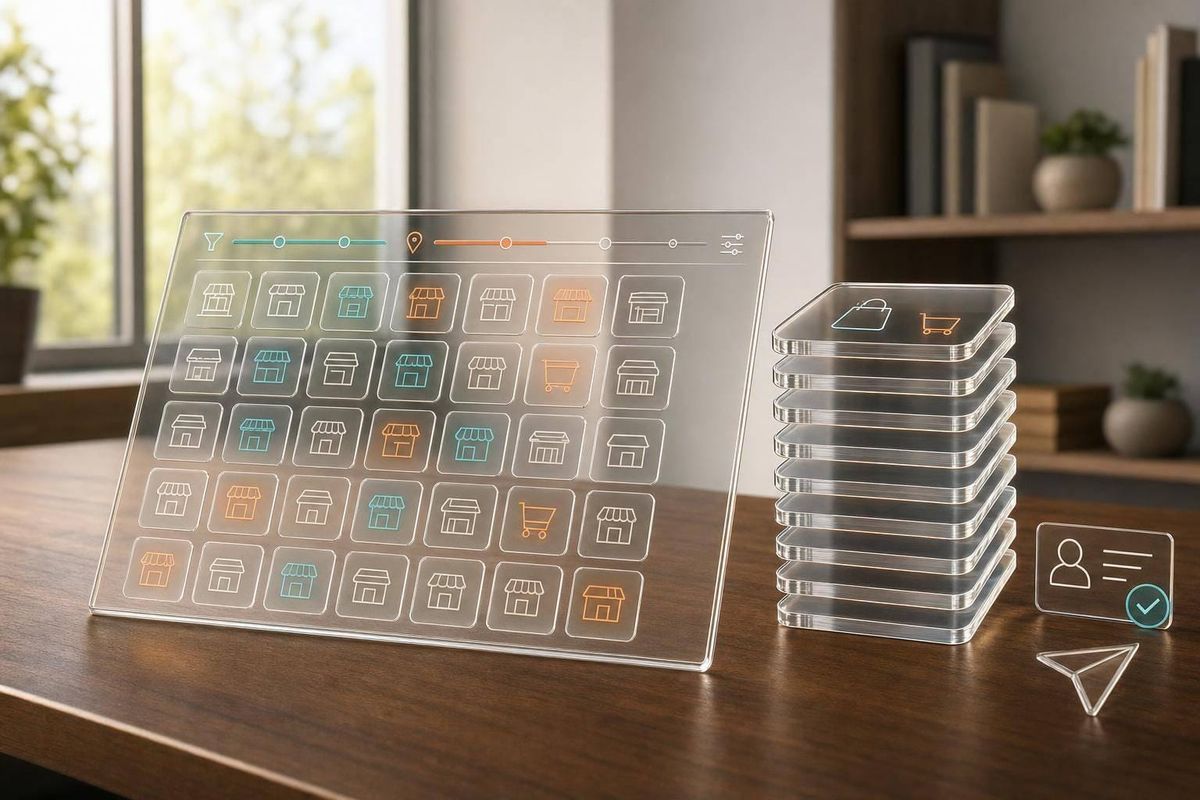
If I had to boil it down to one line: Store Leads is better for cross-platform research, while StoreCensus is better for Shopify and WooCommerce outbound.
If you sell into Shopify or WooCommerce stores, I’d focus on four things right away:
- Database fit: Store Leads lists 13.7 million+ stores across 400+ platforms, while StoreCensus tracks 5.4 million+ stores across Shopify and WooCommerce
- Filtering: StoreCensus gives me more control with a $0 to $100M+ revenue slider and 100+ attributes
- Contacts: Store Leads leans on generic inboxes like info@ and support@; StoreCensus includes decision-maker contacts on higher plans
- Workflow: Store Leads is more suited to research and market scans; StoreCensus is built more for list building, trigger-based outreach, and send-ready handoff
So if I need to study many ecommerce platforms, Store Leads has more reach. But if I need cleaner lists, better contact data, and faster outreach for Shopify or WooCommerce, StoreCensus is the stronger fit.
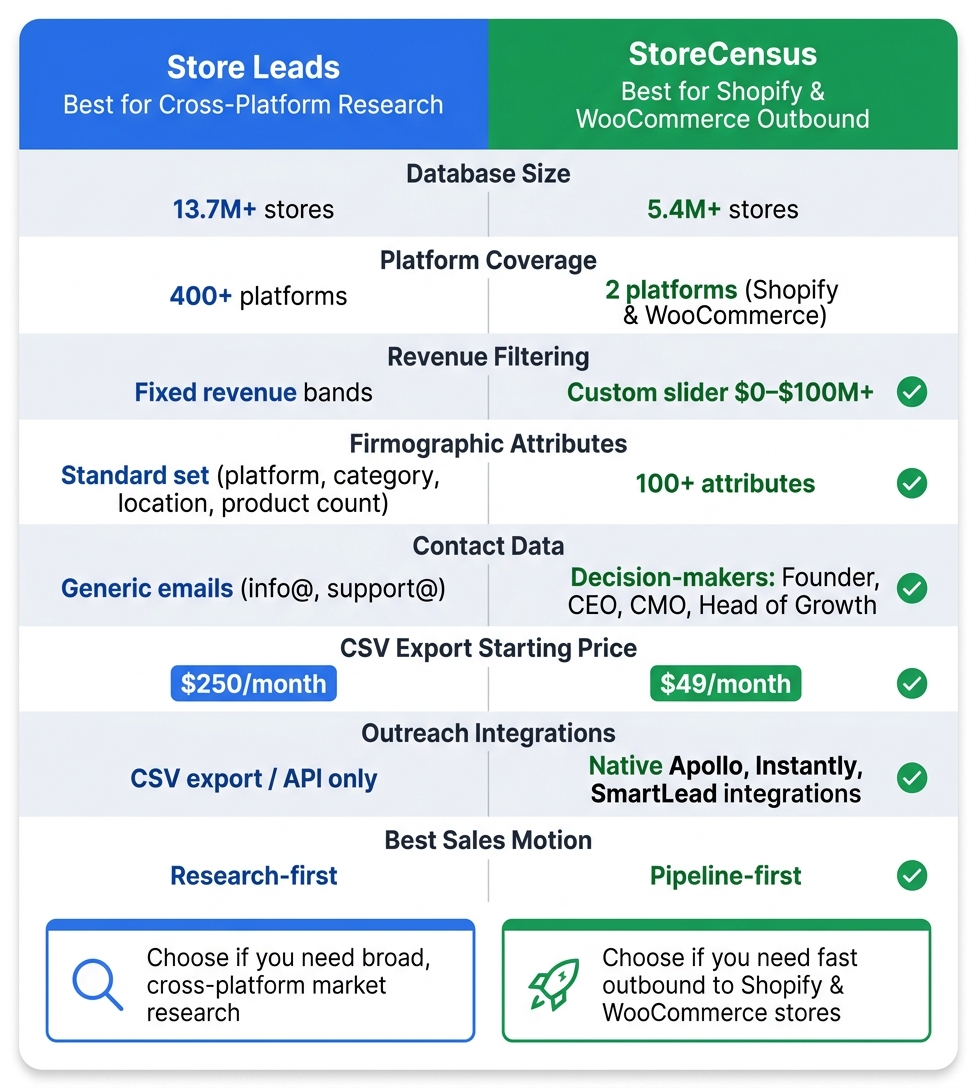
Store Leads vs StoreCensus: Side-by-Side Comparison
How to Find Shopify Store Leads With Contact Information Fast | StoreCensus Shopify Tool
sbb-itb-61169e3
Quick Comparison
| Criteria | Store Leads | StoreCensus |
|---|---|---|
| Best for | Cross-platform ecommerce research | Shopify and WooCommerce prospecting |
| Store count | 13.7M+ | 5.4M+ |
| Platform coverage | 400+ | 2 |
| Shopify/Woo depth | Good, but spread across many platforms | Deep focus on both |
| Revenue filtering | Fixed bands | Custom slider: $0 to $100M+ |
| Contact data | Generic store emails | Decision-maker contacts on higher tiers |
| Change tracking | App install/uninstall history | App, theme, and catalog change signals |
| Export starting price | $250/month | $49/month |
| Best sales motion | Research-first | Pipeline-first |
My take: if your team cares most about breadth, Store Leads makes more sense. If your team cares most about depth, contact quality, and outreach speed, StoreCensus is likely the better pick.
Below, I break down where each tool fits, what each one does well, and where the tradeoffs show up in day-to-day use.
Database coverage and platform depth
These tools take different paths. Store Leads casts a much wider net across ecommerce, while StoreCensus goes deeper where a lot of teams spend their time: Shopify and WooCommerce.
Store Leads: broad ecommerce database across many platforms
Store Leads tracks 13.7 million active stores across more than 400 ecommerce platforms [3]. That kind of scale is useful for market research, platform-adoption analysis, and prospecting across many store types.
If your ICP covers a lot of platforms, that reach can help. If your ICP is tight, though, all that range can add noise and slow you down.
That broad platform coverage matters most when your target market is spread across multiple ecommerce systems.
StoreCensus: focused depth for Shopify and WooCommerce prospecting
When your list is narrower, platform depth starts to matter more than raw coverage.
StoreCensus tracks 5.4 million+ stores across Shopify and WooCommerce [2]. It’s built for prospecting in those two ecosystems, with data on 8,500+ Shopify apps and 1,200+ technologies [7][4]. Both tools update weekly [2][3].
| Feature | Store Leads | StoreCensus |
|---|---|---|
| Estimated Store Count | 13.7M+ [3] | 5.4M+ [2] |
| Platforms Covered | 400+ [3] | 2 (Shopify & WooCommerce) [2] |
| Shopify Depth | High [3] | High (8,500+ apps) [2][7] |
| WooCommerce Depth | Moderate (one of many platforms) [3] | High (1M+ stores, plugin detection) [2] |
| Update Cadence | Weekly [3] | Weekly [2] |
This becomes more important once you start filtering by revenue, tech stack, and growth signals.
Filters, technographics, and contact data
Once you get past platform coverage, this is where the choice usually gets made: how tightly can each tool narrow a prospect list?
Revenue filters and firmographic targeting
Store Leads uses revenue bands. StoreCensus uses a range slider that goes from $0 to $100M+ [7].
That sounds like a small detail, but it changes how you build lists. If you're trying to sort stores by size, a slider gives you more control than fixed bands. StoreCensus also adds 100+ attributes, while Store Leads sticks to a smaller set built around platform, category, location, and product count [3][7].
In practice, those filters matter most when you're segmenting accounts and lining up outreach timing.
App stack, theme data, and decision-maker emails and names
Store Leads tracks install and uninstall history over time. That's useful if you're looking for competitor displacement or trying to target stores based on stack changes [3]. StoreCensus tracks 8,500+ apps and 1,200+ technologies with weekly updates, and it adds a Technology Spend filter that estimates monthly app spend [4][7]. Both platforms include theme detection.
The bigger split shows up in contact data.
Store Leads gives you generic store emails like info@ or support@, which means many teams still need a separate enrichment step before they can reach an actual decision-maker [3]. StoreCensus includes native decision-maker contact discovery on Professional. Store Leads, by contrast, needs a higher-cost export tier before outreach data becomes practical to use. CSV exports start at $49/month on StoreCensus Starter and $250/month on Store Leads Pro [1][2][3].
For agencies, that's the difference between a list that's ready to prospect and a list that still needs cleanup and enrichment.
| Feature | Store Leads | StoreCensus |
|---|---|---|
| Revenue Filters | Revenue bands [3] | Range slider ($0–$100M+) [7] |
| Firmographic Fields | Platform, category, location, product count [3] | 100+ attributes [7] |
| App Tracking | Install/uninstall history [3] | 8,500+ apps, Technology Spend filter [4][7] |
| Theme Detection | Vendor, style, and version [3] | Theme name and version [7] |
| Contact Types | Generic store emails (info@, support@) [3] | Decision-makers: Founder, CEO, CMO, Head of Growth [1][2] |
| Min. Price for CSV Export | $250/month [3] | $49/month [1] |
| Outreach Integrations | CSV export/API [3] | Native Apollo, Instantly, SmartLead integrations [2] |
Change tracking and day-to-day agency workflows
Store changes, growth signals, and outreach timing
Once your filters and contacts are set, timing becomes the last edge. Cold outreach tends to work better when it follows a clear trigger: a theme change, a new app install, or a jump in revenue.
Store Leads tracks app install and uninstall history, with historical depth locked behind its Enterprise plan at $950/month [3][6]. That makes it useful for spotting movement across the market. But if you want to act on that movement, you still have to do more of the legwork yourself.
StoreCensus takes a different path. It uses Activity Signals to alert you when a store changes theme, installs an app, or grows its catalog [5][7]. So the split is pretty clear: Store Leads leans toward market analysis, while StoreCensus is geared toward fast, store-level outreach. For most agencies, the main issue isn’t just seeing the signal. It’s how fast you can turn that signal into an email, sequence, or lead handoff.
Which tool fits which team and workflow
This is where workflow fit starts to matter more than raw data. Both tools surface useful information. The bigger difference is how much time sits between finding a lead and reaching out.
Store Leads fits enterprise sales teams and market researchers that need cross-platform coverage and historical data [8]. But outreach still needs another step because contact enrichment happens outside the platform [3].
StoreCensus is built more for agencies that want to move from search to send without patching together extra tools. Activity Signals show the right moment. Built-in contacts show the right person. And direct integrations with Instantly.ai, SmartLead, and Apollo push leads straight into your sending stack [4][7].
It also supports automation flows - up to 25 on the Growth plan at $149/month - that can fire when a store upgrades to Shopify Plus or uninstalls a competitor’s app [4][7]. That kind of setup is handy when speed matters and your team doesn’t want to babysit every trigger by hand.
| Feature | Store Leads | StoreCensus |
|---|---|---|
| Change Alerts | Available on Elite ($450+) and Enterprise plans [6] | Activity Signals with email alerts and automated triggers on Growth ($149+) [5][7] |
| Historical Tracking | Deep historical data, including app install history, locked to Enterprise ($950) [3][6] | Historical and timing filters from Starter ($49) [2] |
| Growth Signals | Revenue estimates, platform shifts, and app install history [3] | Theme changes, app installs/uninstalls, and product catalog growth [5] |
| Campaign Readiness | Requires external enrichment for contacts [3] | Built-in decision-maker contacts and direct outreach integrations [4][7] |
| Best-fit Workflow | Cross-platform market research [6] | Agency outbound and automated routing [7] |
Conclusion: Which tool fits your sales motion
After looking at coverage, filters, contacts, and change signals, the right pick mostly depends on how your team sells.
Store Leads gives you broader coverage. If your team needs to research stores across more ecommerce platforms, it works well as a research source for enterprise sales teams and market researchers that already rely on separate enrichment tools.
StoreCensus is a better fit for teams selling to Shopify and WooCommerce merchants that want built-in decision-maker contacts and direct outreach integrations.
Put simply: if your main goal is research, Store Leads gives you more platforms and deeper historical data. If your main goal is pipeline generation, StoreCensus gives you stronger filters, built-in contacts, real-time signals, and direct integrations without needing separate tools.
The best choice comes down to your target platforms, the kind of list quality you need, and how your outreach workflow runs day to day.
FAQs
Which tool is better for agencies doing outbound?
For agencies running outbound prospecting, StoreCensus is the better pick. It brings store data, decision-maker contact details, and outreach workflow tools into one place.
That matters because speed and timing can make or break a campaign. StoreCensus also supports intent-based outreach with activity signals and native integrations with Apollo, Instantly.ai, and Zapier. So instead of jumping between tools, teams can move from research to outreach with less friction.
With plans starting at $49/month, it’s a cost-effective option for Shopify and WooCommerce campaigns.
Do I need another tool for contact enrichment?
No. StoreCensus lets you find decision-maker contact information right in the platform, including founders, CEOs, and CMOs.
The built-in Apollo integration is optional and meant for outreach. You don’t need it to view contact data. That means less cost and less hassle than using a separate enrichment tool.
What should I choose if I only target Shopify and WooCommerce?
If you only target Shopify and WooCommerce merchants, StoreCensus is the better fit. It gives you focused coverage across both platforms, with filters for platform, revenue, category, and app stack.
You can build Shopify-only, WooCommerce-only, or mixed lists. On top of that, you get decision-maker contact discovery, outreach integrations, and alerts for buying signals like new apps or theme changes.