How Social Commerce Drives Cross-Border Sales
Launch cross-border sales via social platforms: pick demand-ready markets, localize pricing and content, and fix checkout and shipping.

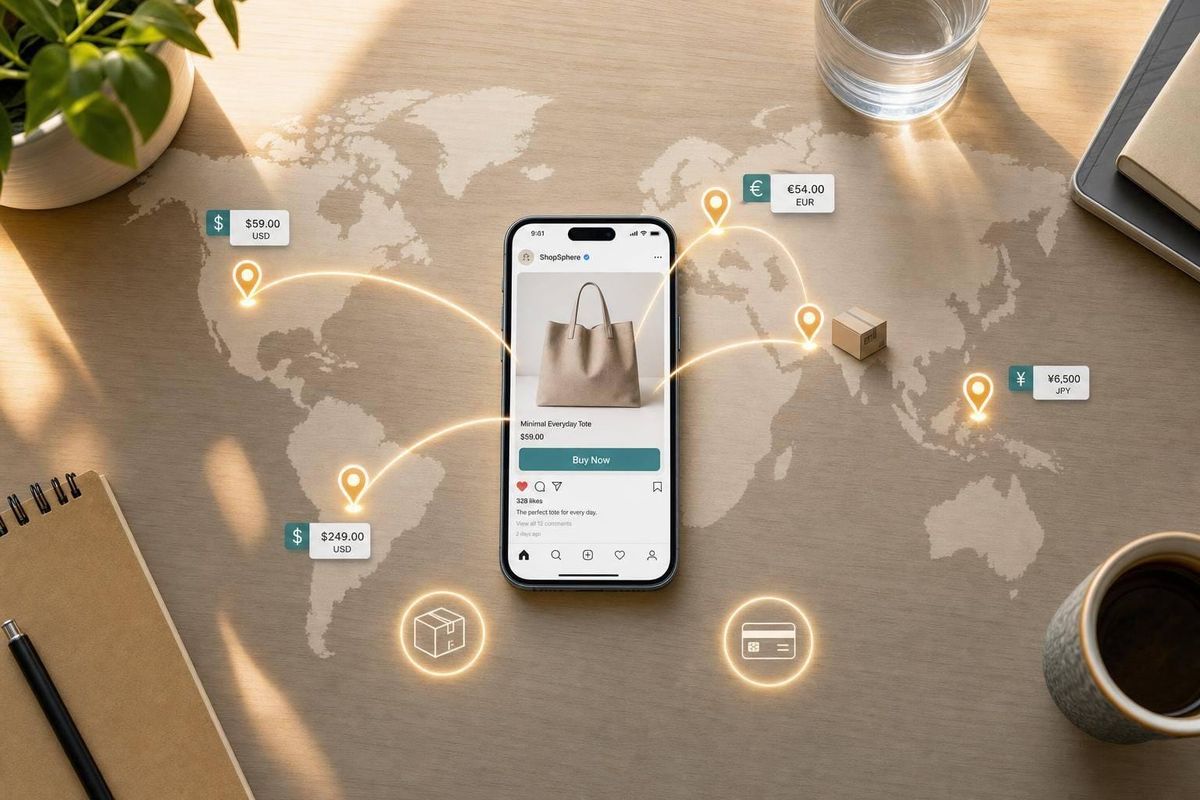
Social commerce is now one of the shortest paths to cross-border revenue. A shopper can see a product on TikTok or Instagram, tap, and buy in one flow. And with cross-border ecommerce GMV projected to hit $2.1 trillion by the end of 2026, the upside is hard to ignore.
If I were setting this up, I’d focus on four things first:
- Pick markets with proof of demand from your own store data
- Use the right platform by region, not the same playbook everywhere
- Set up checkout, duties, shipping, and returns before scaling ads
- Localize pricing, content, and delivery expectations so buyers don’t feel friction
A few numbers stand out:
- Top TikTok Shop sellers get 60%–70% of GMV from creators and affiliates
- A clear 3–5 day delivery promise can lift checkout completion by 12%–18%
- Showing full landed cost up front can cut delivery refusals by 22%
- Social commerce return rates can reach 18%–22%
Here’s the short version: if you want cross-border social commerce to work, I’d start with countries already sending social traffic, match each market to TikTok or Instagram based on buyer behavior, keep prices and content local, and make sure duties, payments, and returns are set before spend ramps up.
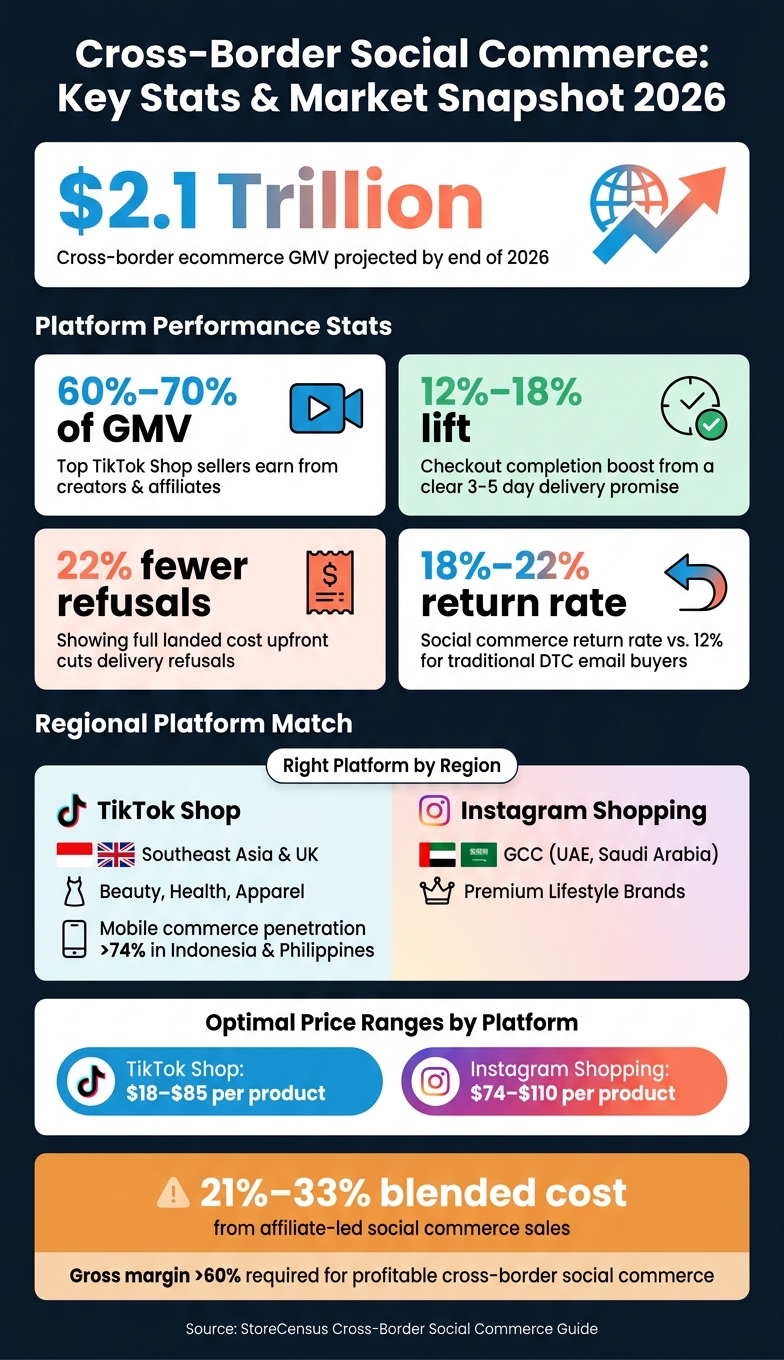
Cross-Border Social Commerce: Key Stats & Market Snapshot 2026
Quick Comparison
| Focus area | What I’d look at first | Why it matters |
|---|---|---|
| Market choice | Social referral sessions, conversion rate, shipping fit | Bad country choice kills launch odds early |
| Platform fit | TikTok Shop vs. Instagram Shopping by region | Channel fit changes conversion and CAC |
| Store setup | Catalog sync, pixel, taxes, duties, payments | Setup gaps break tracking and checkout |
| Localization | Local prices, language, delivery promise, creator-led content | Buyers drop off when the offer feels foreign |
| Post-purchase | Returns, dispatch speed, local carriers | Trust can fall apart after checkout too |
If you’re an agency or Shopify Partner, that’s the core job: choose the right market, set the store up right, and remove buyer friction before traffic scales.
sbb-itb-61169e3
Choose the right countries before you launch
Most failed launches begin in the wrong country. Before you put money into international social ads, check that platform reach, payment options, and shipping speed can support profitable sales in that market. One simple way to avoid a bad bet is to score each country on reach, checkout fit, and delivery speed.
Score markets by platform reach, buying behavior, and delivery speed and reliability
Start with data you already have inside your store. Pull Shopify Analytics and look for countries with 500+ social referral sessions and a conversion rate above 0.8%. That gives you a strong first filter for organic demand.
Next, compare that list with TikTok Shop availability. TikTok Shop operates in the US, UK, Indonesia, Malaysia, Thailand, Vietnam, the Philippines, Singapore, and Saudi Arabia. If a country appears in your analytics but TikTok Shop isn't live there, plan for a heavier off-platform push from day one.
Shipping expectations can change a lot from one market to another, and missing them can hurt trust fast. In the UK, buyers expect 3–5 business days. In the UAE, the window is tighter at 2–4 days, and DHL Express is the main reliable carrier. Mexico can work well for urban addresses through Estafeta or Mercado Libre's logistics network, but rural delivery is less steady.
Match TikTok and Instagram audiences by region
After a market passes the first check, line up the platform with the region. TikTok Shop performs especially well for beauty, health, and apparel in Southeast Asia and the UK, where mobile commerce penetration is above 74% in markets like Indonesia and the Philippines.
Instagram Shopping tends to work better for premium lifestyle brands in the GCC, especially the UAE and Saudi Arabia. Same product, different channel fit. That's where many brands get tripped up.
Build a country-priority matrix
This matrix turns platform fit and logistics into a simple launch order. Use it to rank countries before you spend on paid social.
| Market | Social Commerce Features | Preferred Payments | Delivery Tolerance | Key Regulatory Note |
|---|---|---|---|---|
| United States | TikTok Shop (Full), Instagram Checkout | Credit cards, Shop Pay, Apple Pay | 2–3 business days | US entity & EIN required for TikTok Shop |
| United Kingdom | TikTok Shop (Full), Meta Advantage+ | Debit/credit, PayPal, Klarna | 3–5 business days | IOSS registration for shipments under £135 |
| Germany | Instagram Shopping, TikTok (Ads only) | SEPA, PayPal, Giropay | 3–5 business days | GPSR compliance + VAT OSS required; EU Responsible Person needed for non-EU sellers |
| Mexico | Instagram Shopping, WhatsApp | Local cards, OXXO cash, installments | 3–7 business days | Strong urban 3PL networks; rural delivery inconsistent |
The UK is often a practical place to start because TikTok Shop is live, delivery expectations are within reach, and IOSS registration makes VAT handling simpler for shipments under £135. Germany takes more off-platform work and a bigger compliance lift before launch.
Set up Instagram and TikTok storefronts for international sales
Once you've picked your target markets, the next step is to turn those countries into live storefronts. This is where many merchants get stuck. The tools themselves aren't the problem. The problem is that the handoffs, approvals, and setup steps often aren't planned in advance.
Instagram Shopping setup for Shopify and WooCommerce
For Shopify merchants, Shopify Markets Pro is the main cross-border localization layer for Shopify merchants. It uses Global-e to localize currency, duties, and tax at checkout in 40+ countries.
A smart way to start is with your top 20 SKUs, then add more once demand is clear. For U.S.-facing product listings, use inches and ounces. For Europe and Latin America, switch to metric units.
For WooCommerce stores, the recommended stack includes the Mollie plugin for European payment methods, WPML for translation, and Aelia Currency Switcher for market-specific fixed pricing. Don't rely on straight FX conversion. Price at €49.99, not €47.83, to keep price psychology intact.
Currency, language, and payment methods aren't just setup details. They're conversion levers.
That same localization logic should carry over to TikTok. The big difference is the format: instead of static product pages, you're selling through creator-led video.
TikTok Shop and shoppable video setup
TikTok Shop's Cross-Border Trade (CBT) program lets U.S.-based sellers ship from domestic warehouses while TikTok handles Spanish-language listings for Mexico, customer service routing, and customs clearance. To apply, go to the "International Programs" tab inside TikTok Shop Seller Center. Approval for accounts in good standing typically takes 5–7 business days.
Before you publish even one shoppable video, sync your pixel and catalog. If pixel tracking is off, attribution falls apart fast, especially when you're testing more than one market at the same time. For SKU selection, keep products under 5 lbs and price them below local de minimis thresholds where possible ($50 USD for Mexico) to reduce customs friction.
In Mexico, Spanish-language creator content usually performs better than translated English creative.
Assign setup tasks across agency and merchant teams
Cross-border setup usually breaks down when no one owns the dependencies. The table below shows who should handle each task, what needs to happen first, and how long setup usually takes.
| Task | Owner | Dependency | Est. Setup Time |
|---|---|---|---|
| Market audit | Strategy Lead | Analytics Access | 3–5 days |
| Markets Pro setup | Ops/Dev Team | Tax/VAT IDs | 7–10 days |
| TikTok CBT application | Channel Manager | Account Health Review | 5–7 days |
| Catalog translation | Content/AI | Final SKU Selection | 2–4 days |
| Payment activation | Finance/Ops | Payment Gateway | 1–2 days |
| Duty calculator setup | Dev Team | Zonos/Avalara API | 3–5 days |
| Pixel setup | Agency | Storefront Access | 1 day |
| Creator outreach | Influencer Lead | Product Samples | 14–21 days |
| Creative testing | Paid Media | Localized Assets | 14 days |
Adding a landed cost calculator like Zonos or Avalara is worth the 3–5 days of dev time. Showing full landed costs upfront reduces customs-related delivery refusals by an average of 22%.
Start creator outreach at the same time as technical setup. It has the longest lead time, so waiting until everything else is done can slow the whole launch.
Localize the offer and operations for each market
After you pick the market and get the storefront live, localization is the part that makes the offer feel like it belongs there. That's what moves conversion. A market can show strong demand and still underperform if the price looks odd, delivery feels unclear, or fees show up too late.
Localize content, pricing, and trust signals inside social channels
Don't just convert prices at spot rates. Round them to local price points that feel normal instead of translating directly from USD. That small detail matters more than most teams think.
Delivery messaging matters too. Show accurate delivery windows. A realistic 3–5 day window in your international storefront can lift checkout completion by 12–18%.
On the content side, lifestyle images beat studio product shots by 40% on social commerce platforms. That's a big gap. People want to see the product in real life, not floating in a blank studio setup.
Local micro-creators also help a lot here. Creators with 10K–100K followers can produce market-specific assets for about $150–$400 per video. Send product samples and a cultural brief, not just a script. The goal is simple: make the content feel local, not translated.
Put those pieces together:
- Rounded local pricing
- Realistic delivery windows
- Market-specific creator content
That mix helps the buyer feel like the product didn't cross a border to get to them.
Set up payments, shipping, duties, and returns before scaling spend
Trust has to carry from the ad all the way through checkout and delivery. Before you scale paid spend, publish landed costs. Let buyers see the full amount upfront. No one likes a surprise at the last step.
Enable local payment methods in each market, prioritize BNPL in the GCC, and process returns locally to protect margin. If service-level pressure is high, keep fast-moving inventory in-market.
Returns need special attention. Social commerce buyers return products at a rate of 18–22%, versus 12% for old-school DTC email buyers. That's not a rounding error. It's a different operating model.
Tools like Loop or Happy Returns can manage TikTok Shop return labels natively and help you stay in line with the 30-day return window buyers expect. Dispatch speed matters too. TikTok Shop suppresses discovery if you don't maintain a dispatch rate above 95% within 2 business days.
Dedicated country account vs. single global account
Once the market feels local, your account setup should match the level of volume and complexity. Start with a single global account for testing. Move to dedicated country accounts when monthly volume is high enough to justify the extra work.
| Factor | Dedicated Country Account | Single Global Account |
|---|---|---|
| Speed to launch | Slower (more setup) | Faster |
| Content relevance | High (market-specific) | Lower (one-size-fits-all) |
| Operational complexity | Higher | Lower |
| Cost | Higher (separate creators, assets) | Lower |
| Compliance control | Easier to manage per market | Harder to segment |
| Best for | High-volume, committed markets | Testing or early-stage expansion |
Below 200 units per month in a given market, cross-border fulfillment is usually more economical. Once you move above that point, regional inventory positioning starts paying off.
Before spend starts climbing, assign one compliance owner for each priority market. The EU DSA, UK Online Safety Act, and Saudi ZATCA VAT rules create direct exposure.
Use StoreCensus to find merchants ready for cross-border social commerce
Define an ICP for cross-border social commerce services
Once you’ve picked your launch markets, the next move is simple: find merchants that already have cross-border demand. Don’t go after every Shopify or WooCommerce store. Go after the ones that are already getting signals from buyers abroad.
A strong ICP usually looks like a Shopify or WooCommerce merchant in beauty, apparel, or home goods. For TikTok Shop, the sweet spot is products priced between $18 and $85. For Instagram Shopping, it’s $74 to $110. You’ll also want gross margins above 60%, because affiliate-led social commerce sales can eat up a 21%–33% blended cost.
The clearest sign? International orders coming in even though the store still has no localized checkout, payments, or shipping. That gap matters. About 34% of Shopify stores are already getting those orders before turning on a single cross-border tool.
Use StoreCensus to filter stores by:
- revenue tier, country, platform, app stack, and theme
- growth signals, plus missing localization, payment, and fulfillment tools
That gives you a sharper prospect list. More importantly, it gives you a clear story for outreach: here’s the gap, and here’s the revenue slipping through it.
Time outreach using store-change and readiness signals
Timing often beats copy. A decent message sent at the right moment can do more than a polished pitch sent too early.
Reach out when merchants install tax, returns, or catalog-sync tools. Those changes usually mean they’re getting ready for the next stage.
Watch for installs of apps like TikTok for Business or Meta for Shopify (v4.2+). That usually means catalog syncing is already in motion. A new returns-app install can point to scale-readiness. Merchants getting close to TikTok Shop’s top domestic seller tiers are also strong candidates for cross-border expansion.
This shifts outreach from a cold pitch to a qualification process.
StoreCensus tracks store changes across 6M+ Shopify and WooCommerce stores, which makes it easier to reach merchants when the timing lines up.
Conclusion: When market choice, localization, operations, and merchant intelligence align
Social commerce is now the discovery layer for cross-border shoppers, especially in Southeast Asia and the Middle East. The agencies that build a repeatable practice around it use StoreCensus to turn merchant intelligence into a prospecting system - one that finds the right clients at the right moment.
FAQs
How do I know which country to launch in first?
Start with the Shopify data you already have. Pull international social referral traffic from the last 90 days, then mark any market that has at least 500 sessions and a conversion rate above 0.8%.
From there, compare that short list against the countries where TikTok Shop is currently available. Put the top weight on markets where your AOV makes sense for local buying habits. After that, sort them based on:
- Platform access
- Competitive density
- Fit with your product category
This gives you a cleaner way to spot markets that don’t just show interest, but also have a path to sales inside TikTok Shop.
Should I use TikTok Shop or Instagram for cross-border sales?
It comes down to who you're selling to, what you're selling, and who your buyers are.
TikTok Shop tends to work best for discovery-led sales. It shines with Gen Z and does well in markets like Southeast Asia, the UK, and Saudi Arabia.
Instagram is often the better fit for premium and lifestyle brands. It's especially strong in North America, Australia, and the GCC, and it tends to connect better with audiences 35 and older.
What must be localized before scaling social ads?
Before you scale social ads, go beyond translation. Update product listings for the local language, currency, and sizing or measurement standards. Set pricing that reflects regional duties, taxes, and shipping costs.
You also need to tailor the creative for each market’s local context, humor, and trust signals. At the same time, make sure fulfillment and logistics match what shoppers in that market expect. If those pieces are off, cart abandonment can creep up fast.