
Shopify GDPR Compliance Trends: What Agencies Need to Know
What agencies must know to keep Shopify stores GDPR-compliant: consent blocking, DSARs, vendor DPAs, and repeat audits.

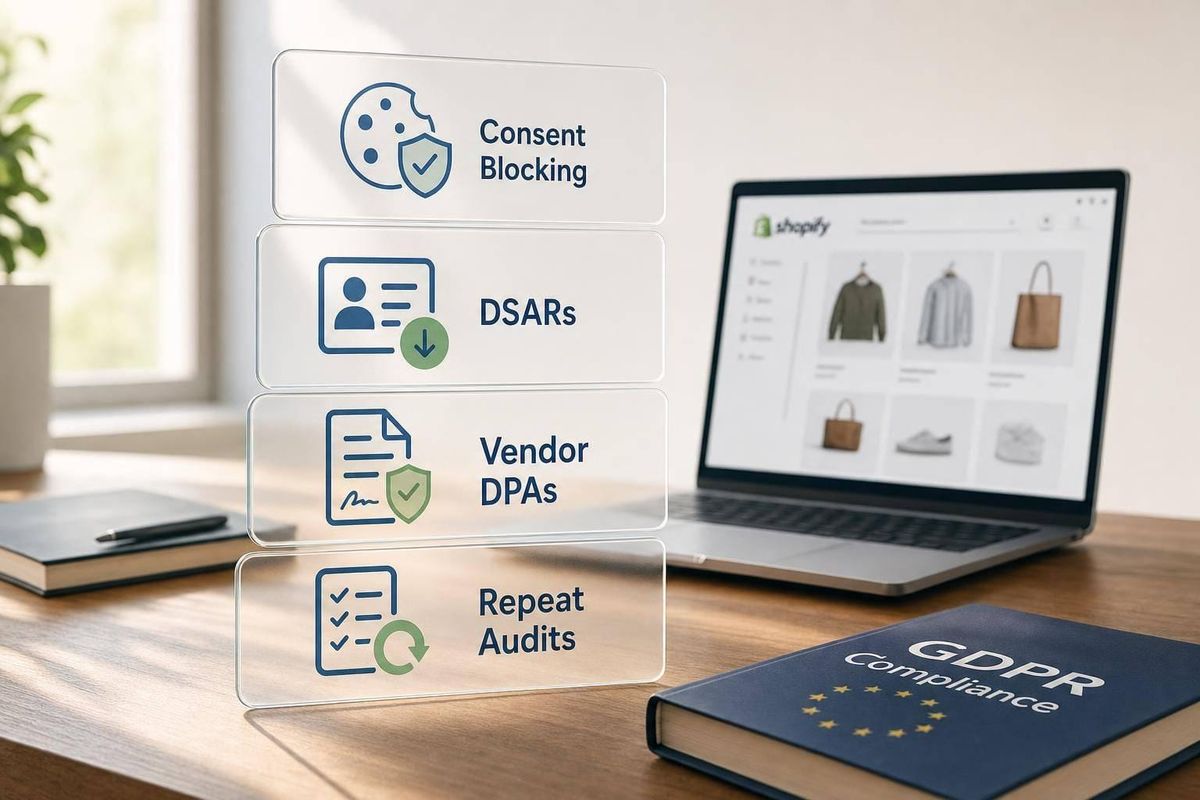
GDPR setup on Shopify is no longer just a banner job. If I run or support Shopify stores, I now need to prove that tracking stays off before consent, that requests are handled within 30 days, and that each app or vendor is documented.
Here’s the short version:
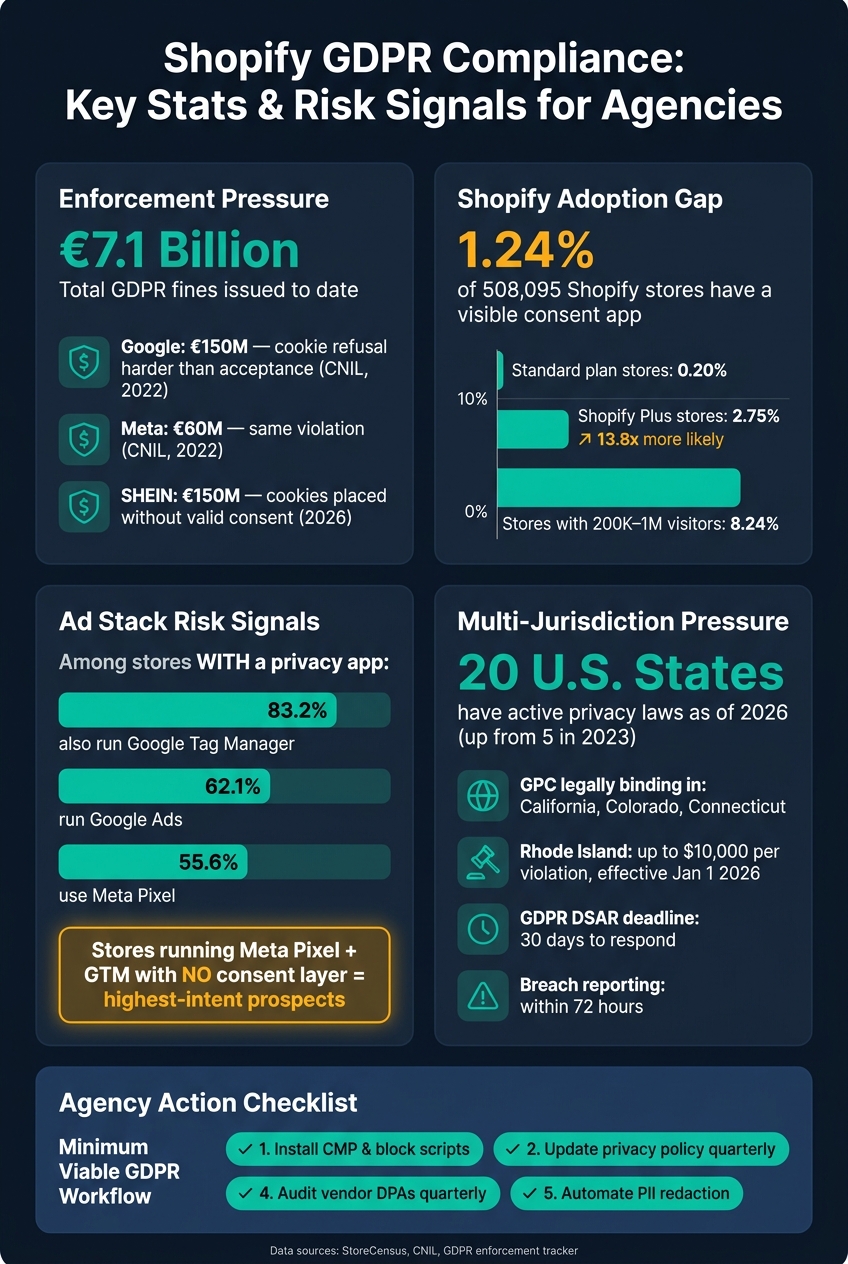
- Fines are growing: GDPR penalties have passed €7.1 billion.
- Shopify’s native privacy tools have limits: they don’t fully block many third-party scripts added outside Shopify-managed pixels.
- Risk often starts with the stack: tools like Meta Pixel, Google Analytics, GTM, and Klaviyo can load too early.
- Proof matters now: regulators want consent logs, vendor records, and working controls.
- U.S. privacy rules add more work: 20 states now have privacy laws in force, and some rules, like GPC, can’t be ignored.
- Agencies have a clear service angle: audits, CMP setup, DSAR process design, and app/vendor reviews.
What I take from this article is simple: privacy work on Shopify has moved from one-time setup to repeat account work. The stores most likely to need help are usually easy to spot too: they ship to the EU or UK, run ad trackers, and still don’t have a visible consent layer.
Shopify GDPR Compliance: Key Stats & Risk Signals for Agencies
How to prepare your Shopify store for a GDPR compliance Audit

sbb-itb-61169e3
Quick comparison
| Area | What agencies should watch | Main risk |
|---|---|---|
| Consent | Scripts firing before opt-in | Fines, weak audit trail |
| DSARs | No clear intake and tracking process | Missed 30-day deadline |
| Vendor records | Missing DPAs, old app lists | Poor audit readiness |
| U.S. state laws | No GPC handling, weak disclosures | State penalties |
| Shopify native tools | Limited blocking for third-party scripts | Gaps in compliance proof |
If I were turning this into action, I’d focus on three things first: install a CMP that blocks scripts, document every vendor and transfer, and set a repeat review process each quarter.
Core GDPR Requirements Shopify Merchants Must Meet
Shopify merchants need to get three connected areas under control: consent, request handling, and vendor governance. On a day-to-day level, that boils down to three jobs inside a Shopify setup: getting consent the right way, handling customer requests on time, and keeping tight control over apps and data partners.
Consent, Privacy Notices, and Lawful Basis
Every use of customer data in Shopify needs a lawful basis. The ones that show up most often are Contract for order fulfillment, Legitimate Interest for fraud screening, and Consent for marketing emails, behavioral retargeting, and non-essential cookies.
| Activity | Lawful Basis |
|---|---|
| Processing/fulfilling an order | Contract (Art. 6(b)) |
| Fraud screening | Legitimate Interest (Art. 6(f)) |
| Marketing emails | Consent (Art. 6(a)) |
| Behavioral retargeting | Consent |
| Tax/accounting records | Legal Obligation (Art. 6(c)) |
Your privacy notice can't stay vague. It should list the actual apps and vendors in your stack, including analytics, ads, email, and fulfillment tools. That matters because people have a right to know who touches their data.
Consent also needs to be clear and freely given. Pre-ticked checkboxes don't count. And cookie banners can't play games. "Reject All" needs to be just as visible as "Accept All." In January 2022, France's CNIL fined Google €150 million and Meta €60 million for making cookie refusal harder than acceptance.
Data Subject Requests, Retention, and Deletion Workflows
Once consent is handled, the next weak spot is usually request handling. People covered by GDPR can ask to access their data, correct it, erase it, transfer it, or object to some types of processing. Merchants have 30 days to respond.
That deadline comes up fast. If there's no written intake process, requests can sit in an inbox until it's too late. Agencies should spell out who receives requests, who checks identity, and who closes the ticket.
Retention is another area where stores get sloppy. Keeping data forever is not allowed, and regulators have fined platforms for holding data for more than five years after a customer's last activity. A store needs fixed retention rules for order data, cart data, and consent records. Think of it like cleaning out a stockroom: if you never throw anything away, the mess becomes the risk.
Security and Cross-Border Data Transfer Controls
The last big trouble spot is vendor access and cross-border transfers. Under Article 28, merchants need a signed DPA with every vendor that processes customer data. That includes Shopify, payment processors, email tools, ad platforms, and apps. In this setup, Shopify merchants are the controllers, and vendors are the processors.
It helps to keep all of this in one place. A simple spreadsheet or Notion doc can track each app, processor, and transfer path, along with the DPA link and the date it was accepted. For U.S. vendors that handle EU data, merchants should check whether the vendor relies on the EU-U.S. Data Privacy Framework or SCCs. If a breach happens, it must be reported to regulators within 72 hours.
What the Research Shows About GDPR Pressure on Ecommerce
Enforcement Has Shifted from Cookie Banners to Proof of Compliance
Regulators aren't stopping at "Does the site have a banner?" anymore. They want proof. That means showing that consent was collected, recorded, and applied before any tracking started. Data Protection Authorities now use automated website crawlers and standard questionnaires to check whether privacy notices are in place, up to date, and easy to find. For ecommerce stores that depend on ad tags and analytics scripts, that shift changes the game.
You can see that pattern in major cases. In January 2022, the CNIL fined Google €150 million and Meta €60 million because their banners made it harder to reject cookies than to accept them. In early 2026, SHEIN was hit with a €150 million penalty for placing cookies on visitors' devices without valid consent. These cases weren't about missing paperwork. They came down to how the systems and page design worked in practice. Regulators are now checking whether consent tools do what they claim to do.
For Shopify merchants using Meta Pixel, Google Analytics, or Klaviyo, the issue is simple: can the store show that those scripts stayed off until the visitor said yes? Many native setups still don't provide a downloadable consent log or a clear audit trail.
Why Ecommerce Stores Face Recurring Compliance Risk
Ecommerce stores face repeat risk because each app, pixel, and vendor can open the door to a new failure. A normal Shopify setup might include tools for marketing, loyalty, shipping, and support. If just one script fires on the first pageview before the visitor interacts with the banner, the merchant is exposed. That's one of the most common technical problems regulators are now finding.
The proof issue gets worse as more apps are added. Without an intake process or a consent log, data access requests slow down and audits fall apart. For SMEs, penalties often land between €50,000 and €200,000.
Multi-Jurisdiction Privacy Is Now the Default Operating Model
This proof burden no longer stops with GDPR. As of 2026, 20 U.S. states have active privacy laws, up from just five in 2023. For agencies, that changes day-to-day operations. One store may now need to meet overlapping rules across the EU and the U.S. That means agencies need one clear inventory of apps, vendors, and regional signals if they want to stay ahead.
One key part of that setup is Global Privacy Control (GPC), a browser-level signal that tells a site to opt the visitor out of data sale and sharing automatically. GPC is now legally binding in California, Colorado, and Connecticut. Shopify's native tools do not reliably detect it, so a store can slip out of CCPA/CPRA compliance for GPC-enabled visitors without knowing it.
Rhode Island's privacy law adds even more pressure. It takes effect on January 1, 2026, removes the cure period, allows penalties of up to $10,000 per violation, and requires businesses to disclose every third-party recipient of personal data. In plain English, if your app list is outdated, you're asking for trouble.
Agencies are starting to line up around one base approach:
- Default to GDPR-style opt-in
- Use geo-IP only where needed
- Keep one compliance framework across regions
It's more work at the start. But compared with juggling separate regional setups, it's a lot easier to run.
Shopify Privacy Tooling and App Ecosystem Trends Agencies Should Track
What Shopify Provides Out of the Box and Where It Falls Short
Merchants are under more pressure to prove consent in the stack, not just show a banner on the page. Shopify gives them a starting point: privacy pages, customer-privacy hooks, and request webhooks. But it stops short of full consent control.
The biggest gap is simple: blocking third-party scripts before consent. Shopify's native banner only controls Shopify-managed pixels. Scripts added straight into theme.liquid - like Klaviyo, Meta Pixel, Hotjar, and TikTok - can still fire on the first pageview before the visitor clicks anything. That's where the compliance problem starts.
There are other weak spots too. Shopify's native setup doesn't provide downloadable consent logs, doesn't detect GPC opt-out signals, and doesn't support TCF v2.3. That last point matters for programmatic ads in the EU as of February 28, 2026.
That gap is exactly why CMP features have shifted from a nice add-on to a buying standard.
Common GDPR and CCPA App Features Merchants Now Expect
The privacy app market has moved fast. At this point, agencies should expect any solid CMP to include:
- Region-aware banners for EU/UK opt-in and California opt-out
- Automated cookie scanning
- Per-category consent controls
- A clear "Reject All" option
The stronger apps in this space also offer downloadable audit logs, GPC detection, and TCF v2.3 support on higher-tier plans.
One problem still shows up all the time, even after an app is installed: weak audit trails. Privacy policies often fail to list the actual cookies dropped by the 8–15 apps commonly running on a store. So the merchant may have a banner, but the record behind it can still be messy.
How to Use App Install Data as a Buying Signal
Only 1.24% of 508,095 analyzed Shopify stores have a visible consent app. That's a big compliance gap, and for agencies, it's a clear prospect pool.
The trend gets stronger when you look at traffic and plan data. Shopify Plus stores are 13.8x more likely to run a visible privacy app than standard-plan stores, at 2.75% vs. 0.20%. Adoption also climbs with traffic, from 0.28% for stores under 50,000 visitors to 8.24% for stores with 200,000 to 1,000,000 visitors.
That tells you something useful: stores with more traffic are usually the ones starting to feel legal and ad-platform pressure. And once that pressure hits, they start buying.
The clearest signal comes from ad-stack density. Among stores that already have a privacy app:
- 83.2% also run Google Tag Manager
- 62.1% run Google Ads
- 55.6% use Meta Pixel
If a store is running Meta Pixel and GTM but has no visible consent layer, that's not a random setup. It usually means the store has the stack, the risk, and an unsolved problem. That's your highest-intent prospect group.
StoreCensus can help agencies filter Shopify stores by installed apps, revenue, country, and live changes. It can also surface stores running Meta Pixel or Google Tag Manager without a visible CMP. That makes it useful for building audit lists and outreach targets.
Agency Workflows and Prospecting Takeaways
A Minimum Viable GDPR Workflow for Shopify Client Accounts
Once you spot the gaps, the next step is simple: build a workflow your team can run the same way every time. Shopify’s built-in tools help with the basics, but they don’t cover full GDPR compliance on their own.
A practical workflow should cover five areas:
- Consent Management: Install a CMP and block third-party scripts until consent is given. Check in DevTools that no script fires before consent.
- Transparency: Update the privacy policy to list third-party apps and international data transfers. Review it every quarter.
- DSAR Handling: Set up a dedicated intake form and track requests in one place across Shopify and connected apps.
- Vendor Review: Keep DPAs on file for every app. Run a quarterly app audit.
- Data Minimization: Use automated redaction for inactive accounts to cut down retained PII volume.
Two parts of this usually fall through the cracks.
First, DSAR handling. Agencies need a written process that makes it possible to respond within 30 days. If requests are scattered across inboxes, spreadsheets, and app dashboards, things get messy fast.
Second, vendor review. DPAs should be audited every quarter, and the app index should be updated each time a new app goes live. That sounds simple, but it’s one of those jobs that often gets pushed aside until there’s a problem.
Which Merchants Are Most Likely to Buy GDPR Help
The same signals that point to risk also point to buying intent. And the strongest signals usually come from the store’s setup, not from what the merchant says.
Merchants with dense app stacks and EU traffic are usually the best prospects. Mid-market D2C brands in the $2 million to $50 million revenue range deal with the same legal exposure as enterprise brands, but they often don’t have in-house legal or compliance staff. That gap is where agencies step in.
App count matters too. A typical Shopify store with 8 to 15 apps can set 30 to 80 cookies. Stores running 15 to 20 apps are often sharing PII with a dozen third parties without fully listing that in the privacy policy.
Add a few more signs, and the buying intent gets even stronger:
- EU or UK shipping destinations
- A Meta Pixel and GTM setup with no visible consent layer
- A banner without a clear "Reject All" button
That kind of stack is a red flag. It also tends to mean the merchant knows something feels off, even if they haven’t mapped out the problem yet.
StoreCensus can help filter Shopify stores by revenue, tech stack, and country when building CMP prospect lists.
Conclusion: What Agencies Should Do Next
Regulators now expect timestamped consent logs, proof that scripts are blocked until consent, and documented vendor agreements. Shopify’s native tools don’t provide those on their own.
That creates a clear opening for agencies: package this into a quarterly audit offer and use stack data to find stores that don’t have a CMP in place. Done right, compliance becomes a recurring service line.
FAQs
Do Shopify's native privacy tools fully block third-party tracking?
No. Shopify's native privacy tools can signal consent, but they don't automatically block all third-party tracking.
Third-party pixels, hard-coded tags, and embedded widgets can still fire or set cookies before consent. So if you rely only on Shopify's built-in tools, tracking may still run on the first pageview. Under strict GDPR rules, that can be a problem.
What should agencies include in a Shopify GDPR audit?
Focus on three areas:
- A complete data map of every app and third-party tool that can access customer data, where that data lives, and whether each one has a signed DPA
- A privacy policy that clearly explains data categories, purposes, legal bases, sub-processors, and safeguards for international data transfers
- A consent platform that blocks tracking until consent is given and offers granular choices with equally prominent Accept and Reject buttons
How can agencies spot Shopify stores that likely need compliance help?
Agencies can find Shopify stores that may need compliance help by looking at the last 12 months of order data. The goal is simple: see whether the store shipped to places with active privacy laws, such as the EU, UK, and U.S. states like California, Virginia, and Texas.
They should also review the store’s setup for two common trouble spots:
- Third-party apps that don’t have Data Processing Agreements
- Tracking scripts, like pixels or analytics, that fire before the user gives consent
StoreCensus can help surface these prospects by looking at revenue, tech stack, and growth signals.