We Studied 500 Shopify Outreach Emails
Short, signal-led Shopify cold emails beat generic pitches: use store signals, specific subjects, 50–100 words, and a 4-touch follow-up.

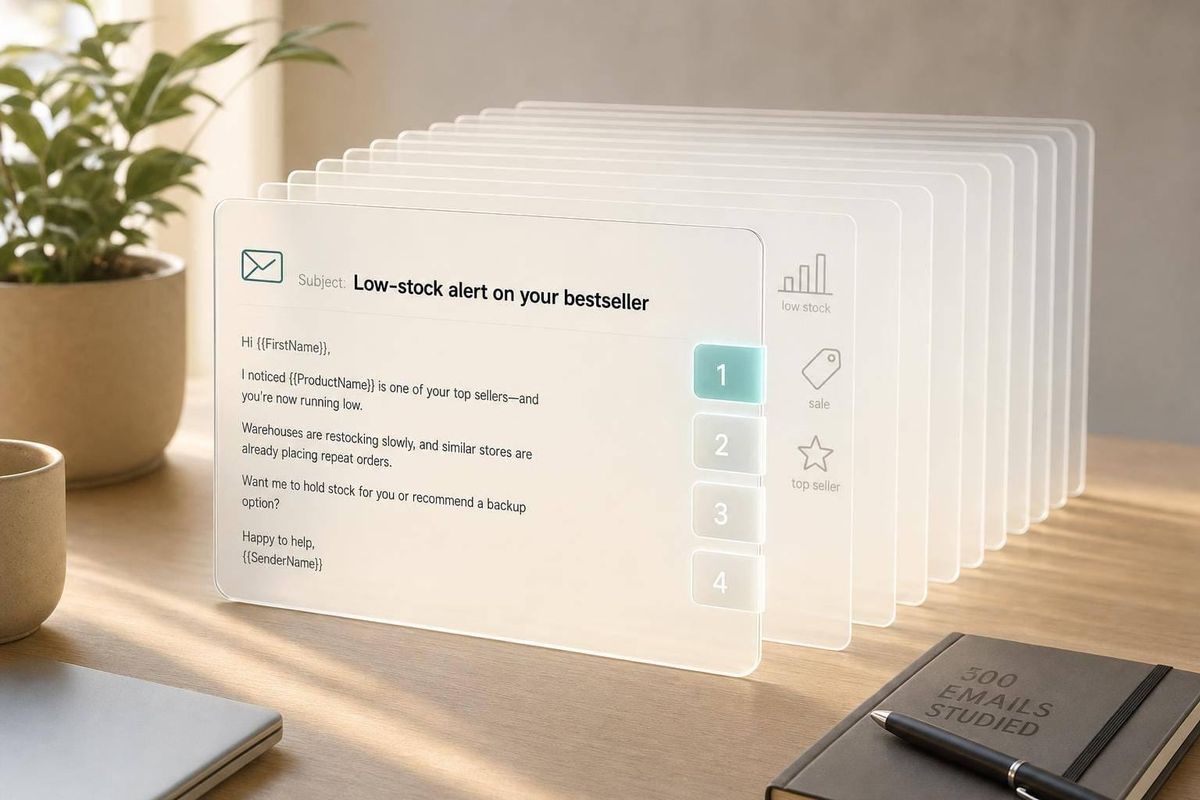
Most Shopify cold emails fail for one simple reason: they sound generic. From this 500-email review, I’d boil the whole article down to this: the emails that got replies were short, specific, and tied one visible store signal to one clear business problem.
If you want the fast version, here it is:
- Specific subject lines beat generic agency lines
- 50–100 words worked best for first-touch emails
- Observed, signal-led personalization beat praise like “love your brand”
- Trigger-based offers outperformed broad service pitches
- Most positive replies came from follow-ups 2 to 4
- Reply quality mattered more than raw reply count
A few numbers stood out:
- Generic service pitches got only 0.3%–0.5% reply rates
- Generic agency outreach sat around 1%–3% replies
- Better subject lines reached up to 22% reply rates
- In stronger campaigns, 40%–60% of replies were positive
- A 4-email sequence over 14 days produced most of the results
What I took from it is pretty simple: don’t lead with what your agency does. Lead with something you can see on the store, tie it to a problem, and ask one direct question. Then follow up with a new angle instead of repeating yourself.
If I were rebuilding a Shopify outbound system from this article, I’d focus on four things: store signals, subject lines, offer framing, and follow-up quality. You can also use our guide to finding and targeting Shopify stores to refine your prospecting strategy.
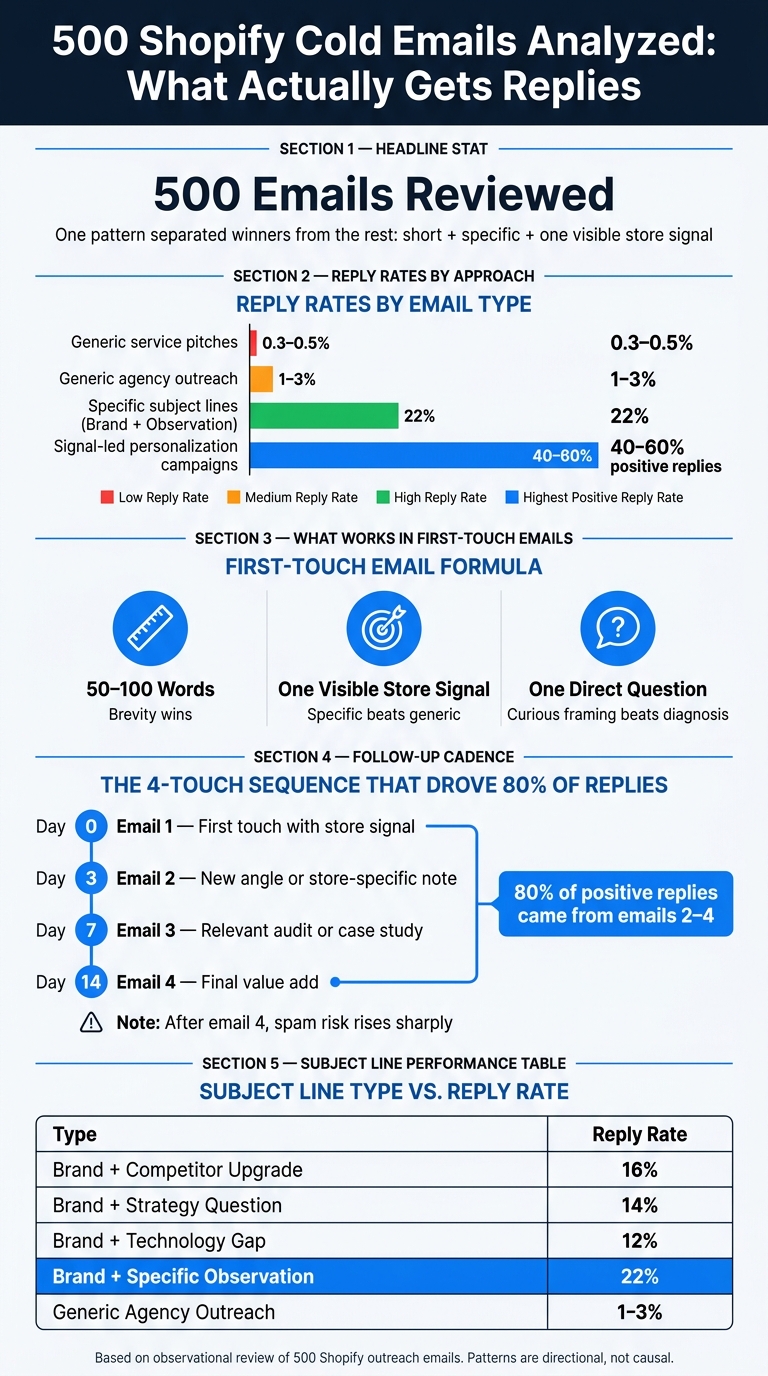
500 Shopify Cold Emails Analyzed: What Actually Gets Replies
The Cold Email Formula That Made Premium Shopify Stores Respond
sbb-itb-61169e3
Methodology and Coding Framework
Definitions had to be set before reviewing the emails. That way, the coding stayed consistent across senders and could be used again in agency reporting.
The main idea was simple: test whether emails built around visible store signals did better than generic agency language. The next section looks at how these coded variables shaped first-touch replies.
Variables Tracked Across the 500 Emails
Each email was coded across six variables. The table below shows what each variable covered and the outcome tied to it.
| Variable | Definition | Outcome Measured |
|---|---|---|
| Subject line specificity | Generic agency language vs. specific store observation | Open rate and initial engagement |
| Email word count | Total words in the message body | Correlation between brevity and reply likelihood |
| Personalization depth | Scale from no personalization to signal-led | Positive reply rate per level |
| Offer type | One of five categories (audit, recommendation, case study, pitch, call) | Reply intent and meeting conversion |
| Follow-up cadence | Total touches sent and days elapsed between them | Cumulative reply volume and re-engagement windows |
| Reply pattern | Coded as positive, neutral, or negative/unsubscribe | Message quality and merchant fit |
Personalization Scale and Offer Categories
Personalization depth was scored on four levels, from the weakest signal of relevance to the strongest. The scale was built to test a practical idea: does one visible store signal plus one clear problem beat broad positioning?
- No personalization - Generic templates with no store-specific data.
- Basic personalization - Mail merge with the store name, category, or founder name.
- Observed personalization - References a visible storefront signal, such as Klaviyo or product count.
- Signal-led personalization - Links a visible gap to a specific business problem, such as paid ads without visible email capture [3].
Offer type was grouped into five buckets: a free audit or teardown of a specific store function, a specific recommendation with one immediate insight, a case study or benchmark showing how similar brands fixed a gap, a direct service pitch for retainer or project work, and a short diagnostic call framed around a specific pain point.
Limits of the Dataset
This is an observational review, which means it shows patterns, not causation. List quality, deliverability, sender reputation, service category, and merchant fit all changed across senders, and those factors are hard to isolate.
There’s another constraint here too. Storefront scans only catch client-side signals; server-side tracking and internal analytics may not show up [3].
With the coding framework in place, the results section can compare subject lines, personalization depth, offers, and follow-up cadence. These patterns should be read as directional, not causal.
What Worked Best in First-Touch Emails
Short, Specific Subject Lines vs. Generic Agency Language
Specific subject lines beat generic ones. In this set of 500 emails, the lines that did best named the store, pointed to a visible signal, or called out a clear opening. Vague agency-style subject lines didn't keep up.
Out of all the things tracked, subject line specificity separated the winners the fastest.
| Subject Line Category | Median Word Count | Open Rate | Reply Rate |
|---|---|---|---|
| Brand + Strategy Question | 7 words | 32% [5] | 14% [5] |
| Brand + Competitor Upgrade | 7 words | 29% [5] | 16% [5] |
| Brand + Technology Gap | 5 words | 27% [5] | 12% [5] |
| Brand + Specific Observation | 5 words | - | 22% [7] |
| Generic Agency Outreach | Varies | - | 1–3% [7] |
A subject line like "[Store Name] missing [specific technology]?" drove a 27% open rate and a 12% reply rate [5]. Generic lines that led with agency credentials or fuzzy value props landed at 1–3% reply rates, with under 1% positive replies [7].
The subject line opened the door. But signal-led personalization decided whether the reply had any value.
Email Length and Message Clarity
Short emails worked best when they were clear. The top templates came in at 50–100 words, usually 2–3 sentences. Each sentence had a job: show research, point to the gap, and ask one direct question [5].
Short for the sake of short didn't work. If the email had no concrete reason for reaching out, it still felt like generic outreach. A tight message only works when it's tied to something the sender can actually see.
Why Deeper Personalization Beat Generic Compliments
Generic praise didn't move merchants. Lines like "I love what you've built" or "Your brand really stands out" sounded like copy-and-paste filler, not research. What did work was something the merchant could check for themselves: a specific app in the tech stack, a paid-media signal, or a missing tool.
The best first-touch emails tied one visible signal to one business problem. That gave merchants a plain reason to reply instead of one more compliment to scroll past.
The framing mattered too. Curious framing beat blunt diagnosis. For example:
"I noticed Meta tracking but didn't see a public attribution layer - curious how you handle that?"
That kind of line performed better because it opened a conversation instead of sounding like a verdict.
With 99.6% of Shopify stores showing visible app or pixel signals [3], there's usually something real to work from. Short emails did best when they made that store signal obvious fast.
That first-touch pattern leads straight into the next issue: which offers and follow-ups turned replies into meetings?
Offers, Follow-Ups, and Reply Patterns
Which Offer Types Got the Most Positive Replies
Offer framing mattered more than a broad “we offer X service” pitch. In this 500-email sample, offers tied to a visible store signal did better again and again.
The top-performing emails were trigger-based offers. They called out one clear gap and asked an easy, low-pressure question about it. That worked better than trying to sell a full service in the first touch.
| Offer Type | Signal Used | Reply Rate |
|---|---|---|
| Revenue Opportunity | High traffic + no email app | 14% [5] |
| Competitor Upgrade | Competitor app installed | 16% [5] |
| Generic Service Pitch | None | 0.3–0.5% [1] |
The takeaway is pretty plain: broad service pitches underperformed every trigger-based offer in this sample. When the trigger was easy to see, the reply tended to be more useful too.
That matters most at the start of the sequence. If the first email opens with a visible trigger, the message feels more relevant. If it opens with a broad pitch, it usually lands flat.
How Many Follow-Ups Produced Most Replies
The first email almost never finished the job. Roughly 80% of positive replies came from emails 2 through 4, and each follow-up added something new: a store-specific note, a relevant audit, a case study, or a result tied to that niche. This happened across a four-message cadence sent on Day 0, Day 3, Day 7, and Day 14 [1] [2].
That “something new” part is the key. Sequences that just repeated the first message did worse [1] [2]. People notice when a follow-up is just the same email wearing a different hat.
After the fourth email, returns fell off fast, while the chance of spam reports goes up [5] [2].
Once that cadence is in place, the next thing to watch is the kind of reply you get. That tells you if the offer matched the merchant or missed the mark.
What Reply Intent Tells You About Message Quality
Raw reply rate can fool you. A generic blast can rack up replies, but if most of them are unsubscribes or “not interested,” the campaign isn’t helping pipeline. The better metrics are cumulative positive replies and meetings booked [1].
Reply intent gives you a read on message quality. A high unsubscribe rate usually points to weak qualification or framing that feels too aggressive. A high “not now” rate isn’t always bad news. In fact, 60% of the best prospects are not ready to buy for 3–12 months [7], so those people should go into a nurture sequence. Referral replies often mean the account is a fit, but you reached the wrong person.
| Reply Type | What It Signals | What to Do |
|---|---|---|
| Positive | Strong offer-fit match | Book the call immediately |
| Not Now | Qualified, wrong timing | Set a 90-day follow-up reminder [7] |
| Referral | Right account, wrong contact | Ask for a direct intro |
| Unsubscribe | Poor list or risky framing | Audit ICP filters; soften framing [3] |
| No Response | Follow-up gap or deliverability issue | Confirm the sequence has at least 4 touches [1] |
Those reply patterns show where the system needs work next. Sometimes the issue is the list. Sometimes it’s the framing. And sometimes the offer is fine, but the timing or contact is off.
What Agencies Should Change in Their Outbound System
Build Outreach Around Store Signals, Not Broad ICP Claims
Start with a visible store trigger, not a broad ICP label. In plain English: don't target a store just because it "fits ecommerce." Target it because you can point to something concrete on the site.
For example, reach out to stores that are running paid ads but don't have a visible email capture. Or stores using a reviews app without any upsell tool in place. Those are real gaps you can verify. And they give you a legit reason to send the email in the first place.
Traffic tier should shape the offer. Stores in the 50,000–200,000 monthly visits range often have budget, but they don't always have an in-house team to fix more complex growth problems. That's why this group tends to be the main market for paid agency services. [2][4] Stores under 50,000 are usually a better fit for low-ticket audits or free tools. Stores above 200,000 often need account-level research before outreach makes sense. [6]
Use StoreCensus to filter by revenue tier, tech stack, country, and growth signals, then find the right contact. For stores under $5 million in revenue, that usually means the founder or CEO. Above $5 million, you're often aiming for the Head of Marketing or VP of Ecommerce. [2]
That step matters more than most agencies think. If the contact is wrong, even solid copy falls flat. If the trigger is vague, the email sounds like a template. But when the signal is clear, you can verify it and build the first line around that exact detail.
Say your trigger is paid ads. Don't assume. Check the Meta Ad Library and confirm the store is actively running ads. [3] That small step changes the tone of the email right away. The first sentence feels researched instead of mass-sent.
With the list narrowed down, the next thing that matters is how you test.
Test One Variable at a Time and Track the Right Metrics
Test one variable per batch across similar groups. That's the cleanest way to learn what's doing the work.
A simple flow looks like this:
- Test subject lines first
- Then test the opening observation
- Next, test offer framing
- After that, test word count or follow-up timing
Once you have a clear winner, move on to the next variable. Don't change five things at once and then guess what worked.
And don't judge the batch by opens. Opens mostly tell you about deliverability. What matters is positive replies and booked meetings.
A good benchmark for a personalized, signal-based campaign is a 5%–8% reply rate, with 40%–60% of those replies being positive. [1][5] If you hit that range with 200 emails, you're looking at about 3–5 meetings. That's in the same ballpark as what a generic blast of 1,000 emails might get you, but with far less waste. [1]
The pattern in the data is useful:
- If reply rate is high but meetings aren't getting booked, the problem is often the offer framing or the contact target, not the copy.
- If open rate looks good but replies stay flat, the subject line did its job, but the body didn't move the reader.
You can only spot that difference if you're tracking reply sentiment, not just total reply volume.
Conclusion: The Pattern Behind the Best Shopify Outreach
The 500 emails in this study didn't miss the mark because the writing was bad. Most missed because they went to the wrong stores, with no real signal behind them, and no follow-up plan that added anything new.
The emails that worked followed a clear pattern: short, specific subject lines, a first sentence that showed the message wasn't generic, an offer tied to one visible store gap, and a four-touch sequence over 14 days where each follow-up added something new to the conversation.
Winning agencies send fewer emails, but they send them with more intent. The best Shopify outreach comes from better signals, sharper targeting, and a sequence that gives the prospect a reason to keep reading at every touch.
FAQs
What counts as a store signal?
A store signal is any public-facing data point that hints at a merchant’s needs, stage of growth, or intent to buy. It gives agencies a way to tailor outreach by connecting a specific store detail to a service they may need or a problem they may be dealing with.
That can include technographic, firmographic, and growth signals. Common examples are installed apps, theme updates, product launches, paid media activity, or missing tools that may point to a pain point or a revenue opening.
How do I personalize without sounding creepy?
Skip personal details like a merchant’s city, social feeds, or generic praise. Instead, lean on public business signals to show you did your homework.
The safest move is a curious question, not a critique: "I noticed [public signal], so I was curious how you handle [related problem]." It keeps your outreach relevant, respectful, and centered on business workflows.
What should I include in each follow-up?
Each follow-up should add USEFUL context, not just bump the thread.
Every message needs to bring something new to the table, like:
- a relevant case study
- a data-backed insight
- an extra buying signal from your research
You can also take a different angle on a gap you already spotted or share a second opinion on the merchant’s tech stack.
Keep the sequence to three or four follow-ups, and end with a low-pressure breakup message.