Product-as-a-Service Challenges and Solutions
PaaS requires aligning finance, operations, and customer experience to manage deferred revenue, asset risk, and reverse logistics.

Switching to Product-as-a-Service (PaaS) can transform your business, but it comes with hurdles. Here's what you need to know:
- What is PaaS? Customers pay to use products (e.g., subscriptions or rentals) instead of owning them. Providers retain ownership, handle maintenance, and design for longer lifespans.
- Key Challenges:
- Financial: Managing cash flow, deferred revenue, and asset risks.
- Operational: Reverse logistics, asset tracking, and billing complexities.
- Customer-facing: Educating users about renting vs. owning and ensuring service quality.
- Organizational: Aligning teams, incentives, and adopting new tech stack tools.
Solutions include: advanced asset tracking (RFID, IoT), deferred revenue models, predictive maintenance, and tailored subscription tools. Start small with pilots, refine processes, and scale strategically. PaaS is reshaping industries like electronics, furniture, and B2B services, offering steady revenue and reduced waste.
Product-as-a-Service (PaaS) Business Model Explained 🔄💰
sbb-itb-61169e3
Financial and Business Model Challenges
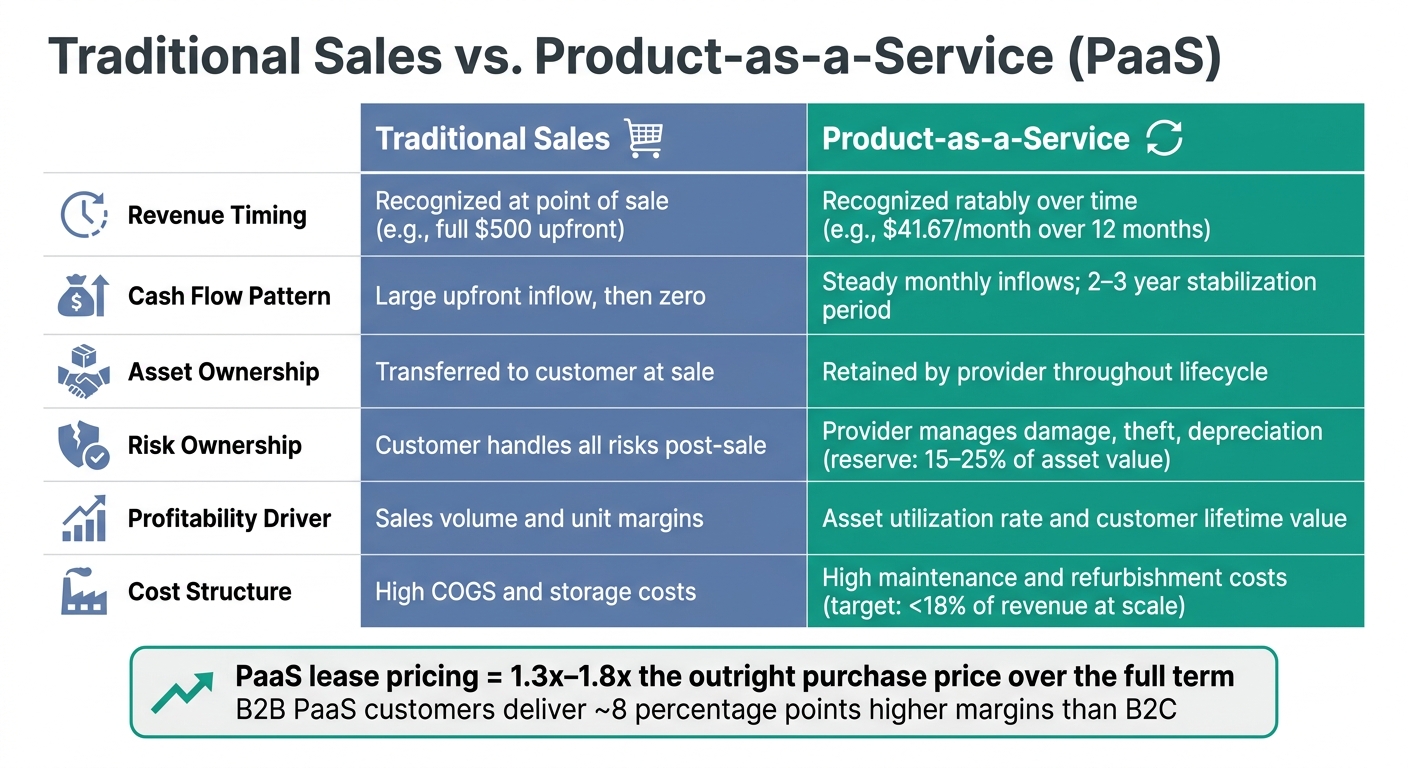
Traditional Sales vs. Product-as-a-Service: Key Financial & Operational Differences
Revenue Recognition and Cash Flow
Switching to a PaaS model changes how and when revenue shows up on your books. Instead of getting to record $500 immediately when a product is sold, you recognize that revenue in smaller chunks over the subscription period. Under ASC 606, revenue is only recognized as you fulfill your obligations. For example, a 12-month rental at $500 would show up as about $41.67 per month on your income statement, even if the customer paid the full amount upfront.
When customers prepay for the year, the payment is logged as deferred revenue. This doesn’t hit your income statement until the service is delivered. As a result, you might face a cash flow gap that can last 2 to 3 years before your recurring revenue base stabilizes. This can be a tricky pitfall for founders who mistakenly equate cash in the bank with financial health.
"The P&L was not going to show the demand problem until Q3 - by which point the company would have six months of weak pipeline already baked in. Recognised revenue would hold steady through Q2 regardless of new bookings." - Aleksandar Stojanovic, CEO & Founder, Fiscallion
The solution? A deferred revenue waterfall. This tool tracks your starting balance, new billings, revenue recognized each month, and your closing balance. Combine this with a three-statement financial model that links your ARR bridge, deferred revenue schedule, and cash flow. This way, you’ll always have a clear picture of how much future revenue is locked in. Being upfront about this gap from the beginning is absolutely critical.
While these revenue recognition hurdles affect cash flow, managing the risks tied to asset ownership presents the next big challenge.
Risk Management and Asset Ownership
In traditional sales, the customer takes on the risk as soon as the product leaves your warehouse. But with PaaS, you retain ownership of the asset - and all the risks that come with it. This includes dealing with damage, theft, non-payment, and the residual value of the product when it’s returned.
Take IKEA as an example. Their B2B leasing program successfully recovered 92% of assets at the end of the lease. However, their B2C pilot faced a 32% damage rate, with nearly a third of returned items needing repairs that cost over 25% of the original product value. To address this, IKEA introduced tiered deposits and optional damage insurance. This highlights the unique risks that come with PaaS, especially the differences between B2B and B2C customers. B2B clients generally take better care of assets and deliver about 8 percentage points higher margins compared to B2C customers.
"Your asset fleet dominates your balance sheet, and your ability to understand it is required for effective financial management." - Zack Wynegar, SVP of Product, Unagi Scooters
To manage these risks, categorize your asset fleet into three groups: Deployed (actively earning revenue), Float (idle but still on your books), and Decay (lost, stolen, or written off). It’s wise to maintain a financial reserve of 15% to 25% of total asset value to cover unexpected losses or depreciation. Pricing leases correctly is also key. Use a Total Cost of Ownership model that factors in acquisition, maintenance, transport, refurbishment, and residual value. Typically, lease pricing ends up being 1.3x to 1.8x the outright purchase price over the full term.
Traditional Sales vs. PaaS: Financial Comparison
Here’s a quick look at how the financial metrics differ between traditional sales and PaaS, which can help clarify things for finance teams or investors more familiar with retail-focused models:
| Financial Metric | Traditional Sales | Product-as-a-Service |
|---|---|---|
| Revenue Timing | Recognized at point of sale | Recognized ratably over time |
| Cash Flow Pattern | Large upfront inflow, then zero | Steady monthly inflows |
| Asset Ownership | Transferred to customer | Retained by provider |
| Risk Ownership | Customer handles risks | Provider manages risks |
| Profitability Driver | Sales volume and margins | Asset utilization and lifetime value |
| Cost Structure | High COGS and storage costs | High maintenance and refurbishment costs |
This isn’t just a shift in accounting - it’s a completely different way of running a business. Profitability now hinges on how well each asset generates income over its entire lifecycle, rather than how many units you sell. Up next, we’ll dig into the operational and technology challenges tied to this model.
Operational and Technology Challenges
Running a Product-as-a-Service (PaaS) model presents unique hurdles in managing assets, handling billing, and ensuring data security. These challenges demand a fresh perspective and tailored solutions.
Reverse Logistics and Asset Tracking
In a PaaS setup, you don't just ship a product and move on. You’re responsible for managing the entire lifecycle: returns, inspections, refurbishments, and redeployments. This is a heavy operational lift compared to traditional e-commerce.
The issue? Most ERP and e-commerce systems are designed for one-way transactions. As Rolf Smeding, Director of Business Development at Bugaboo, explained:
"We tried to incorporate the rental business into our existing process of sales, finance and logistic which was a huge mess and didn't work out."
The solution lies in integrating advanced tracking methods - like serial numbers, RFID, or GPS - into your reverse logistics. Purpose-built platforms such as Circuly or FlexPortal can handle returns and refurbishments seamlessly. The choice of tracking technology should match the value of your assets: QR codes are fine for lower-cost items, while RFID or GPS is better for high-value equipment. For instance, Hilti’s Fleet Management program tracks over 1.5 million tools using RFID and telemetry, processing 500,000 repair and replacement events annually with next-day turnaround.
Another way to cut costs? Leverage existing infrastructure for returns. IKEA UK reduced reverse logistics costs by 35% by routing furniture returns through its 38 stores. This approach is especially cost-effective in rural areas, where collection costs can be 80% to 120% higher than in urban centers.
These operational complexities naturally spill over into billing and subscription management.
Billing and Subscription Management
PaaS billing isn’t as straightforward as standard subscription models. You’re often dealing with usage-based charges, mid-cycle changes, proration, security deposits, and late fees - all tied to physical assets still in customer hands.
Involuntary churn is a major revenue drain. Payment failures - like expired cards or insufficient funds - account for 40% to 60% of churn in subscription businesses. However, a strong dunning process can recover 30%–70% of failed payments. A practical trick? Time payment retries for "insufficient funds" on dates like the 1st, 15th, or Fridays to align with payroll cycles. For a business with 4,000 subscribers, this could cut involuntary churn from 3.0% to 1.2% monthly.
While Shopify’s Subscriptions app covers basic needs, more complex billing scenarios require third-party tools like Recharge ($99/month) or Skio ($599/month). The choice depends on how intricate your billing requirements are, not just your budget.
Data Security and Compliance
PaaS generates a mountain of data - IoT sensor readings, usage patterns, location history, and recurring payment details - all of which increase your exposure to security risks.
On the payment front, PCI DSS compliance is non-negotiable. Tokenizing payment cards is the baseline, but for high-value assets, adding KYC verification and credit scoring during signup can help prevent fraud and asset loss. As Tuomo Laine, CEO of TWICE Commerce, pointed out:
"Some sellers must kind of figure out what if that person just pays for a month and never returns the device... There's a bunch of stuff that you can do with payment processing. It can be things like tokenizing cards, making sure that you have maybe an authorized deposit or you can do after charges."
For IoT and usage data, encryption is key - use SSL/TLS for data in transit and AES for data at rest. Role-based access controls limit exposure, and signing Data Processing Agreements with third-party vendors ensures compliance. If you’re operating across state lines or internationally, be aware of regulations like the CCPA, where penalties for intentional violations can reach up to $7,988. Automated consent management and clear data retention policies are essential to avoid costly mistakes.
Tackling these operational, billing, and security challenges head-on is critical to making a PaaS model efficient and sustainable.
Customer and Market Challenges
Overcoming Resistance to Access Over Ownership
One of the biggest hurdles for the PaaS model isn't just logistics - it's changing how customers think. Many people are deeply attached to the idea of ownership. Buying something feels permanent and gives a sense of control, while renting or subscribing can feel like an endless expense with nothing to show for it.
The key to overcoming this? Focus on outcomes, not just features or pricing. Customers need to see the value in what you're delivering. Take Signify's Lighting-as-a-Service partnership with Schiphol Airport as an example. Instead of selling light fixtures, they sold illumination. Schiphol paid for the amount of light delivered (measured in lux) across 3,700 fixtures. By 2025, this approach had expanded to over 1,500 commercial sites in Europe, with Schiphol alone cutting energy use by 50%. The product became secondary - the result took center stage.
Confusing checkout processes can also be a dealbreaker. Stores that fail to clearly differentiate between options like "One-time purchase" and "Subscribe & Save", or that don't prominently display savings, often lose over 50% of potential subscribers in the first month. A straightforward offer can make all the difference. As one expert put it:
"If your offer needs decoding, it's already dead. Spell it out: '$42 worth of product for $29/month. No risk. Cancel anytime.' Keep it stupidly simple." - Frontlevels
Another way to ease customer concerns is by giving them control. Self-service portals that let users pause, swap, or return items without needing to call support can significantly lower the perceived risk of committing to a subscription. That sense of autonomy often turns hesitation into action.
While reframing customer perceptions is critical, delivering consistent service quality is just as important to build and maintain trust.
Maintaining Service Quality and Support
In a PaaS model, customer experience doesn't end after the initial sign-up - it continues through every interaction, from maintenance to billing to support. This creates more touchpoints than a traditional one-time purchase, making quality a non-negotiable factor.
Predictive maintenance is a game-changer here. Michelin's tire-as-a-service program uses IoT sensors to monitor pressure and wear on over 300,000 commercial vehicles. By 2024, this approach extended tire lifespan by 37% and cut operator costs by 15% compared to traditional ownership. These sensors allow Michelin to address issues before they lead to failures, protecting both the product and the customer relationship.
Speed is equally important when it comes to returns. Grover, an electronics subscription service based in Berlin, has automated systems for grading and refurbishing returned devices. Their process takes just 48 hours, keeping inventory moving and ensuring customers aren't left waiting.
Finding the Right Customer Segments
Identifying the right audience is just as crucial as managing assets effectively. To succeed, PaaS providers need to analyze their data - especially metrics like repeat purchase rates and usage patterns - to pinpoint their best opportunities.
Three common subscription models can help guide your strategy:
- Replenishment: Designed for consumables like coffee or skincare, these models have low churn since they address recurring needs.
- Curation: Focused on discovery items like fashion boxes, these models often see higher churn (2–3 times more) as the novelty wears off.
- Access: Ideal for high-value items like electronics or furniture, where ownership isn't always practical.
B2B customers are often a safer starting point for PaaS. IKEA's furniture leasing program highlights this. By mid-2025, it had 180,000 active contracts across Europe. The B2B segment, which focused on office furniture like the BEKANT and TROTTEN ranges, saw a 92% return rate compared to 74% for B2C customers. Margins were also 8 percentage points higher. Businesses tend to maintain leased products better and appreciate the operational expense model over capital purchases. Starting with B2B clients allows companies to fine-tune their systems before tackling the more unpredictable consumer market.
Organizational and Change Management Challenges
Aligning Teams and Incentive Structures
Making the leap to PaaS isn’t just about operational tweaks - it’s about rethinking your organization’s entire approach. One of the biggest obstacles? Misaligned incentives. If your sales team is rewarded solely for quick deal closures, they’ll focus on volume rather than finding the right customers. That strategy might work for one-time purchases, but in a subscription model, poorly matched customers lead to high churn rates and lower retention.
To address this, align compensation with long-term customer success instead of short-term wins. HubSpot tackled this challenge in March 2020 under CEO Yamini Rangan by aligning Sales and Customer Success teams around shared goals like Customer Dollar Retention (C$R) and Revenue Retention (RR). This encouraged both teams to prioritize customers with strong long-term potential. They also reassigned ownership of Net Promoter Score (NPS) to the Product team, ensuring that customer satisfaction issues were addressed at the root, not just patched up by support teams.
"To change behavior, you must first change incentives." - Yamini Rangan, CEO, HubSpot
This kind of cross-departmental alignment isn’t just for Sales. Every team that interacts with customers - whether it’s Finance, Product, or Operations - should be evaluated based on shared retention goals, rather than isolated performance metrics.
Skills and Tools Needed for PaaS
Traditional ecommerce teams are usually geared toward transactional sales, but PaaS demands a whole new skill set. Teams need to understand metrics like Monthly Recurring Revenue (MRR), churn, and Lifetime Value (LTV). They also need expertise in managing assets through their entire lifecycle, as well as handling complex operations like returns and refurbishments.
On the technology front, a standard ecommerce setup won’t cut it. You’ll need advanced tools like:
- Asset tracking systems using RFID or IoT sensors to monitor inventory
- Subscription billing software with features like dunning to manage failed payments
- Seamless ERP-CRM integration to ensure smooth operations and customer communication
Take Rent the Runway as an example. To support its 170,000 active subscribers, the company invested $50 million in a fulfillment center in Arlington, Texas. They implemented RFID tags to track garments through cleaning and repair cycles, cutting turnaround time from 7 days to just 3 days. Achieving this level of operational efficiency requires both the right infrastructure and skilled personnel to manage it.
"PaaS requires fundamentally different capabilities than product sales: asset management, maintenance, logistics, and ongoing customer relationships." - Sustainable Atlas
Running a Pilot Before Scaling
Did you know that 60% of sharing economy pilots fail to scale? To avoid this pitfall, start with a focused 1–3 month pilot in a single product category. This approach provides critical data on unit economics and can significantly speed up the scaling process - from over 18 months to just 100 days.
Here’s a handy table outlining the key metrics to monitor during your pilot, along with targets and warning signs:
| KPI | Pilot Target | Scale Target | Warning Threshold |
|---|---|---|---|
| Asset Utilization Rate | >40% | >55% | <35% |
| Monthly Customer Churn | <8% | <5% | >10% |
| Reverse Logistics Cost (% Revenue) | <25% | <18% | >30% |
| Asset Loss Rate (Annual) | <5% | <3% | >8% |
| Net Promoter Score (NPS) | >50 | >45 | <30 |
| Refurbishment Turnaround | <7 days | <3 days | >10 days |
If your pilot metrics hit any warning thresholds, don’t panic. That’s the whole point of running a pilot - identifying and addressing issues before scaling up. As Sustainable Atlas explains:
"The gap between successful pilot and profitable scale-up has become the primary bottleneck for organizations pursuing circular business models."
Think of your pilot as a testing ground. It’s your chance to gather essential insights and refine your strategy before committing to a full rollout. These organizational adjustments are just as critical as the operational and financial strategies you’ve already explored. Together, they create the foundation for long-term PaaS success.
Conclusion and Key Takeaways
Shifting to a Product-as-a-Service (PaaS) model comes with its fair share of challenges, but it also opens the door to immense opportunities. Across the financial, operational, customer, and organizational aspects discussed, one thing is clear: success hinges on aligning strategies across every level. With PaaS programs expected to generate $80 billion in annual revenue by 2027, businesses that get it right can tap into customers who deliver 15–30% higher lifetime value compared to those making one-time purchases.
Winning companies take a strategic approach to this transformation. They carefully plan their finances, treating the shift from upfront sales to recurring revenue as a complete overhaul of their balance sheets. They invest in reverse logistics early, understanding that these costs could climb to 15–25% of total operating expenses if not properly managed. They focus on customers who genuinely benefit from access over ownership, offering flexible contracts and emphasizing a clear Total Cost of Ownership (TCO) advantage. Internally, they ensure their teams are aligned around long-term retention rather than short-term sales goals.
Here’s a quick recap of the key challenges and actionable solutions covered:
| Challenge | Practical Solution |
|---|---|
| Cash flow gaps from deferred revenue | Use a 7–10 year TCO model; pre-finance assets with predictable depreciation data |
| Expensive reverse logistics | Build a four-tier asset grading system; aim for reverse logistics costs under 18% of revenue at scale |
| Customer resistance to "access" models | Provide flexible contracts; highlight 20–40% lower TCO compared to traditional purchasing |
| Involuntary churn from failed payments | Automate dunning with pre-expiry alerts and payment retry systems |
| Misaligned sales incentives | Tie compensation to recurring revenue and retention metrics |
| Pilot failure before scaling | Monitor six key pilot KPIs; address red flags early |
This table underscores the importance of integrating financial, operational, customer, and organizational strategies into a cohesive plan.
Interestingly, 60% of sharing economy pilots fail before scaling, showing that operational and organizational readiness often outweighs the brilliance of the product idea. Companies like Grover and Michelin Fleet Solutions have demonstrated that early investments in infrastructure, data systems, and team alignment are critical to success.
"A recurring-revenue model breaks down the moment any one of these dimensions is out of sync with the others." - P2S Consulting
Achieving this level of synchronization is crucial as you transition from pilot programs to full-scale implementation. Start small, measure everything, and use the insights from your pilot to address weak spots before scaling up. This disciplined, methodical approach separates PaaS models that thrive from those that stall.
FAQs
How do I fund the cash-flow gap after switching to PaaS?
To handle cash-flow challenges during a shift to a Product-as-a-Service (PaaS) model, here are a few practical strategies:
- Self-financing: Tap into your cash reserves to get started and reinvest the income from subscription payments as they come in.
- External funding: Explore options like bank loans, asset-based financing, or leasing arrangements to secure the necessary capital.
- Financial reserves: Set aside 15-25% of the asset's value as a safety net to account for depreciation or unexpected risks.
By blending these methods, you can navigate the financial demands of the transition more smoothly.
What’s the best way to track and recover physical assets at scale?
To effectively manage and recover physical assets in a Product-as-a-Service (PaaS) model, a well-rounded asset management system is key. This system provides real-time insights into the location, condition, and usage of each asset, ensuring nothing slips through the cracks.
Using technologies like RFID, QR codes, or IoT devices can make tracking precise and efficient. These tools help monitor assets continuously, reducing the chances of loss or misuse.
On the recovery side, having a strong reverse logistics process is critical. This involves efficient methods for collection, inspection, and refurbishment of assets. Integrating these processes with an ERP system can further streamline operations, extending the life of assets and boosting their overall value.
Which customer segment should I launch PaaS with first?
Focus on customers who are drawn to products that are built to last and require little upkeep - think trailers, tools, or seasonal equipment. These types of items are a smart starting point for a Product-as-a-Service model because they streamline operations and fit seamlessly into established sales channels. It’s a practical way to get things rolling with minimal friction.