4 Growth Stages of Ecommerce Stores
Explore the four ecommerce growth stages, key metrics, tech gaps, and targeted outreach tactics to improve lead generation.

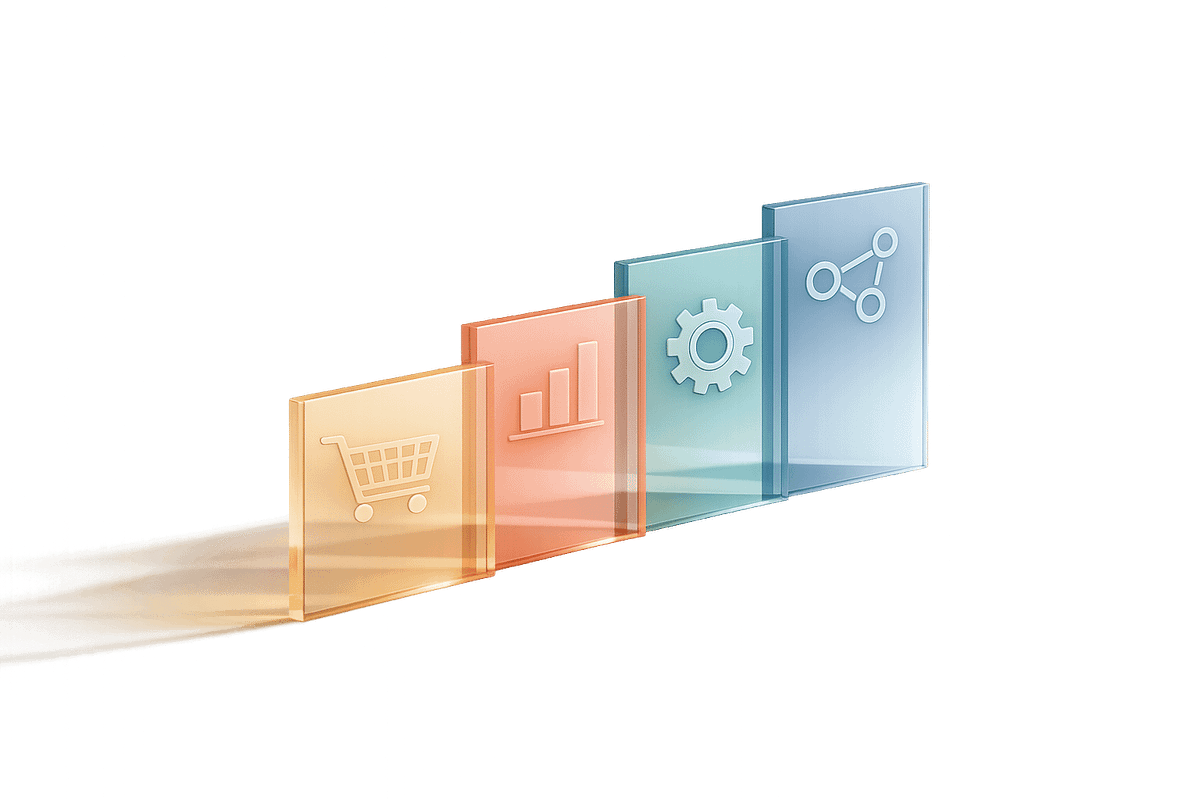
Ecommerce stores grow through four stages, each defined by revenue, traffic, and complexity. Most stores stay in the first three stages, rarely surpassing $25M in annual revenue. Recognizing these stages helps tailor solutions to meet their specific needs. Here’s a quick breakdown:
-
Stage 1: Launch Phase
Revenue under $1M/year, traffic below 50K/month. Focus: setting up basics like storefronts and finding initial customers. Common gaps: email marketing (69% lack it), reviews apps (83% missing).
Key Opportunity: Affordable tools for quick wins, like abandoned cart recovery. -
Stage 2: Growth Phase
Revenue between $1M–$5M/year, 50K–200K visitors/month. Focus: scaling marketing and upgrading tools. App usage increases 47%, but gaps remain (49% lack email marketing, 74% no reviews app).
Key Opportunity: Tools to optimize conversions and improve marketing. -
Stage 3: Scaling Phase
Revenue $5M–$25M/year, 1M–5M visitors/month. Focus: handling high traffic, advanced personalization, and efficiency. Custom themes rise (29.3%), but 43% still lack email marketing.
Key Opportunity: Advanced solutions like attribution models and support tools. -
Stage 4: Mature Brand Phase
Revenue over $25M/year, 5M+ visitors/month. Focus: streamlining tools and refining operations. Custom themes (35.9%) and personalization apps grow, but gaps like reviews apps (72%) remain.
Key Opportunity: High-impact tools for retention and differentiation.
Key Insight: Timing matters. Align your pitch with a store’s current stage for better results. Tools like StoreCensus help identify stores’ growth stages using data like app usage, traffic, and themes. This ensures your outreach addresses their specific challenges and priorities.
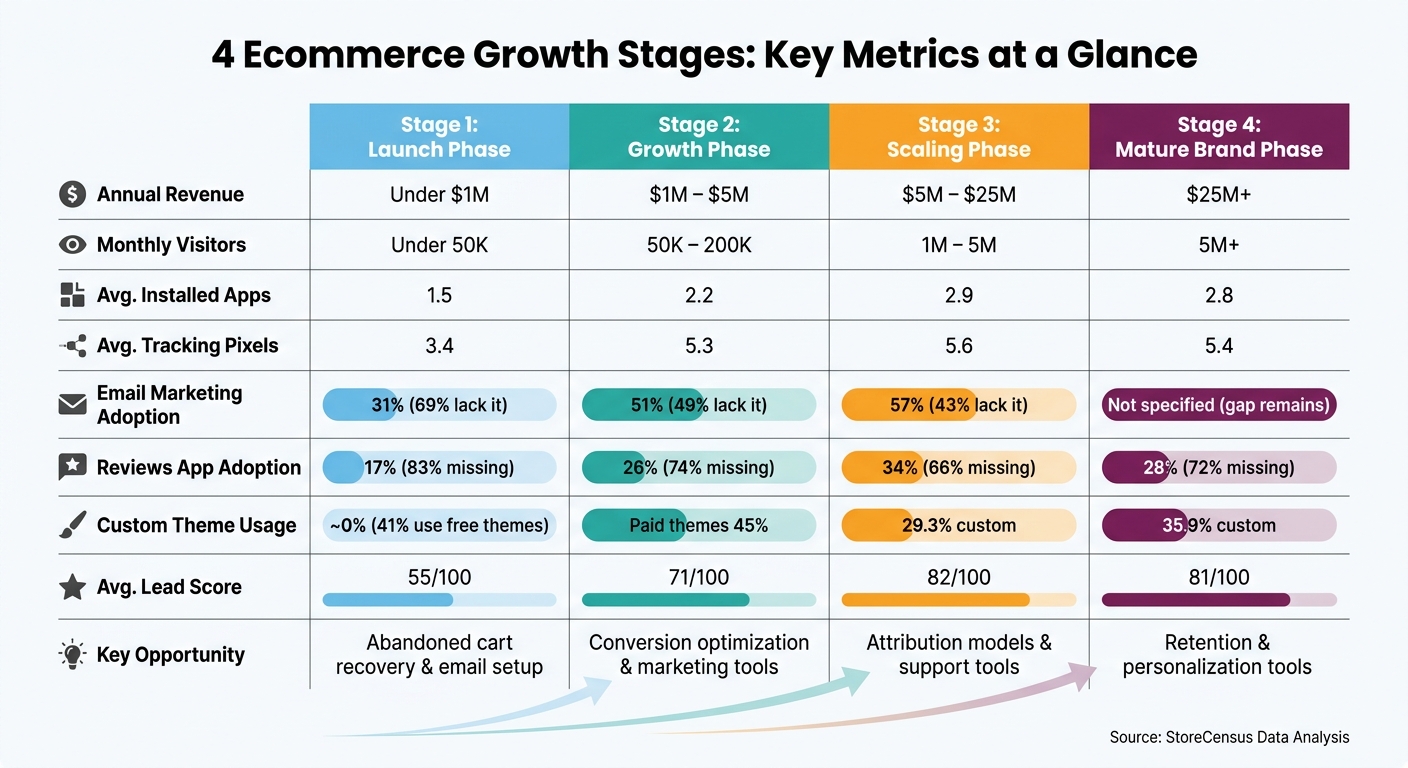
4 Ecommerce Growth Stages: Key Metrics at a Glance
Stage 1: Launch Phase
What Defines the Launch Phase
Stores in the launch phase are just getting started. They typically generate less than $1 million in annual revenue and attract fewer than 50,000 monthly visitors. At this stage, the main focus is on creating a functional storefront and finding those first customers.
The tech stack for these stores is often very basic. On average, they use just 1.5 installed apps and 3.4 tracking pixels, usually limited to essentials like Google Analytics 4 and the Meta Pixel. Additionally, about 41% of these stores rely on free themes like Shopify's Dawn or Debut. This highlights their focus on testing products rather than investing in custom design. As Faheem Siddiqi explains:
"The first stage ($0–1M) is the toughest. It's riddled with product challenges, inventory constraints, brand and creative playbook, tech stack selection."
The gaps in their tech stack are striking. For example, 69.1% of launch stores lack an email marketing app, 82.9% don’t use a reviews app, and 95.7% have no dedicated customer support tool. These gaps not only define the early stage but also highlight key opportunities for growth.
Lead Generation Opportunities for Launch Stores
These tech gaps reveal clear ways to help launch-phase stores grow. For instance, email marketing stands out as a major opportunity. While only 31% of these stores have email marketing set up, 77% of ecommerce businesses rank email as one of their top three ROI channels. Even a basic setup with platforms like Klaviyo or Mailchimp, especially for abandoned cart recovery, can deliver quick results.
Similarly, reviews apps are underutilized but can significantly boost conversions. Adding a simple customer support tool can also make a noticeable difference, addressing the lack of support infrastructure seen in most launch stores.
Using tools like StoreCensus, you can pinpoint stores that recently launched, use free themes like Dawn, and have fewer than two apps installed. This helps you identify businesses in this early stage and tailor solutions to their specific needs.
How to Target Launch Phase Stores
To connect with launch-phase stores, your approach needs to be practical and focused on delivering fast results. These owners are working with tight budgets and are more interested in quick wins than in-depth, enterprise-level solutions.
Your messaging should emphasize speed and measurable ROI. For example, instead of promoting a full-scale email marketing strategy, offer something simple like: "Set up abandoned cart recovery in one day to recover lost revenue." This kind of direct, results-driven pitch resonates with founders who are eager for immediate benefits.
On the other hand, avoid promoting higher-cost options like premium themes (which can cost $250–$400) or advanced tools like Elevar. These investments make more sense once the store has steady traffic and revenue.
The average lead score for a launch-phase store is 55 out of 100. While they might not be ready for expensive services yet, they represent a great opportunity for affordable, foundational solutions. These early partnerships can grow into long-term relationships as their businesses scale.
sbb-itb-61169e3
Stage 2: Growth Phase
What Defines the Growth Phase
During the growth phase, ecommerce stores typically generate between $1 million and $5 million annually and attract 50,000 to 200,000 monthly visitors. At this stage, the business has largely achieved product–market fit, so the focus shifts to scaling operations, improving marketing strategies, and upgrading the tech stack.
The data highlights this transition clearly. Stores in this phase see app usage increase from an average of 1.5 to 2.2 apps (a 47% jump), while tracking pixels rise from 3.4 to 5.3 (a 56% increase). Email marketing adoption grows from 31% to 51%, and the use of paid themes reaches 45% as stores move from free themes to premium ones like Prestige or Impulse. As Faheem Siddiqi notes:
"Creative, audience segmentation and messaging are starting to get dialed in as you approach $3–5M."
However, even with these advancements, there are still significant gaps. For instance, 49% of growth-phase stores don’t use an email marketing app, and 74% lack a reviews app. These gaps represent missed revenue opportunities, especially for stores with substantial traffic. Such metrics emphasize the operational improvements needed to fully capitalize on growth.
Key Growth Indicators for Ecommerce Stores
Revenue growth is just one sign of entering the growth phase - tech stack upgrades provide an even clearer signal. A sharp rise in tracking pixel usage, such as adding Google Ads (67% adoption) alongside the Meta Pixel (80%+ usage), points to increased investment in paid advertising. Similarly, the adoption of paid themes is a strong indicator of marketing sophistication. Stores using paid themes are 1.8x more likely to use email marketing and 1.9x more likely to have a reviews app, showing that theme choice often reflects broader marketing maturity.
Another notable trend is the rise in SMS marketing, with adoption jumping from just 1.05% to 6.7%, signaling that stores are branching out beyond basic channels. Additionally, the average lead score for growth-phase stores climbs to 71 out of 100, up from 55 in the launch phase, reflecting their increasing readiness for more advanced tools and strategies.
How to Target Growth Phase Stores
Despite their traffic and revenue, many growth-phase stores still lack critical tools for maximizing conversions. For example, stores with 50,000+ monthly visitors but no email marketing app are missing out on daily opportunities to recover abandoned carts. Similarly, stores with high traffic but no reviews app are leaving conversion gains - potentially up to 38% - on the table. These are clear, measurable losses.
Tools like StoreCensus make it easy to identify these gaps. You can filter for stores based on traffic levels, installed apps, theme types, and pixel counts to pinpoint businesses with specific needs. For instance, filtering for stores using a paid theme but missing Klaviyo can help you build a targeted list of businesses that are already investing in growth but are ready for the next step. This kind of precise targeting is far more effective than casting a wide net for any active store.
Stage 3: Scaling Phase
What Defines the Scaling Phase
Scaling stores stand out from growth-phase stores by excelling in both audience reach and operational complexity. These stores typically draw between 1 million and 5 million monthly visitors and manage intricate tech stacks, averaging about 2.9 installed apps - the most of any growth stage. Unlike growth-phase stores, which are still fine-tuning their strategies, scaling stores focus on optimizing for speed, efficiency, and large-scale performance.
The operational priorities at this stage shift dramatically. Scaling stores allocate larger ad budgets, handle omnichannel sales, and rely heavily on A/B testing and personalization to refine their strategies. One major change is in theme selection - while 45% of growth-phase stores use premium themes, scaling stores increasingly opt for custom-built themes (29.3%) to stand out and reinforce brand identity. Additionally, support tools see a significant increase in adoption, rising from 7% to nearly 19.8%, to handle the heavy demands of over 1 million visitors per month. These operational benchmarks make it easier to identify scaling stores through precise data signals.
How to Find Scaling Stores with StoreCensus
StoreCensus makes it simple to identify scaling stores by analyzing their unique data patterns. For instance, these stores average 5.6 tracking pixels, showcasing their advanced, multi-platform attribution strategies. Analytics tool usage jumps from under 2% to about 11%, and upsell app adoption peaks at 8.4%, the highest seen across all growth stages.
With StoreCensus, you can create highly targeted segments by filtering for factors like high pixel counts, custom themes, Shopify Plus status, and specific app combinations. Shopify Plus stores, in particular, are key players in the scaling phase - they use 2.75 times more apps and 3.5 times more tracking pixels compared to standard stores, making them excellent prospects for outreach. On average, scaling stores achieve a lead score of 82 out of 100, marking them as high-value opportunities.
How to Target Scaling Stores with High-Value Offers
Once scaling stores are identified, the focus shifts to closing their remaining tech gaps with impactful solutions. For example, 43% of these stores lack an email marketing app, and 66% don’t use a reviews app - both tools that can significantly boost conversions at their traffic levels. With over 1 million monthly visitors, even small improvements in conversion rates or average order value can translate into major revenue growth.
To effectively target these stores, an ROI-driven approach is critical. Basic analytics tools won’t cut it at this stage; scaling stores need advanced attribution tools to accurately measure returns on their substantial ad spend. Tailor your outreach to address the varied needs of stakeholders in marketing, operations, and technology. StoreCensus provides contact details for decision-makers, ensuring your message reaches the right people at the right time.
Stage 4: Mature Brand Phase
What Defines the Mature Brand Phase
Mature brands, often referred to as enterprise stores, are in a league of their own. These businesses attract 5 million or more visitors each month and generate $25 million or more in annual revenue. At this point, the focus shifts from aggressive growth to refining operations through innovation, consolidation, and differentiation.
A hallmark of this phase is what these brands stop doing. Instead of continuously adding apps, they consolidate their tools. On average, enterprise stores use 2.8 installed apps, fewer than scaling stores, as they replace fragmented solutions with more unified platforms. The StoreInspect Team explains this shift succinctly:
"Enterprise stores don't add more tools. They add different ones."
Custom themes also become more prominent, with 35.9% of enterprise stores adopting them compared to 29.3% at the scaling phase. These brands focus less on perfecting appearances and more on building competitive advantages. For example, enterprise-level stores are more likely to use personalization tools like Nosto and LimeSpot, with adoption rates reaching 5.3%, more than double the 2.2% adoption rate among scaling stores.
Data Signals That Identify Mature Brands
The strategies employed by mature brands create distinct data patterns that set them apart. The most telling indicator is Shopify Plus status: 70.8% of enterprise stores in the high-traffic category use Shopify Plus. These stores also demonstrate higher complexity, using 2.75 times more apps and 3.5 times more tracking pixels than standard stores.
Other markers include a higher prevalence of custom themes, increased pixel counts (enterprise stores average 5.4 tracking pixels), and a greater reliance on personalization apps. Interestingly, a slight decline in app count, paired with an increasing lead score (enterprise stores average 81 out of 100), signals a mature approach. This isn’t stagnation - it’s a reflection of consolidation and streamlined operations.
| Metric | Scaling (1M–5M visitors) | Enterprise (5M+ visitors) |
|---|---|---|
| Avg. Apps | 2.9 | 2.8 |
| Avg. Pixels | 5.6 | 5.4 |
| Custom Theme % | 29.3% | 35.9% |
| Personalization Adoption | 2.2% | 5.3% |
| Avg. Lead Score | 82 | 81 |
How to Target Mature Brands
Understanding these data signals can help tailor outreach strategies for mature brands. Despite their advanced operations, they still have areas for improvement. For instance, 72% of enterprise stores don’t use a reviews app, and 83% lack a dedicated customer support tool. For vendors, these gaps represent significant opportunities - especially given that even small improvements in conversion or retention can result in substantial revenue increases for high-traffic stores.
When pitching to mature brands, it’s critical to align with their decision-making style. These teams rely on data, involve multiple stakeholders, and take a methodical approach. As Rich Gardner, SVP of Strategic Partnerships at Klaviyo, puts it:
"The growth of your business parallels the complexity of both your business and your marketing operations."
This means crafting pitches that emphasize ROI, cost-benefit analyses, and optimization opportunities, rather than simply listing features. Using tools like StoreCensus, you can create account-based outreach lists filtered by Shopify Plus status, custom theme usage, and app gaps. From there, focus on reaching decision-makers - like Heads of Growth, VPs of Technology, or Marketing Directors - rather than sending generic cold emails that are likely to be ignored.
Using Data to Target Stores by Growth Stage
Building a Growth Stage Segmentation Framework
Defining clear growth stages allows you to create customized lead lists that align with each store's specific characteristics. By leveraging observable data signals - like traffic levels, app usage, theme choices, and platform status - you can segment stores and fine-tune your outreach efforts. For example, monthly visitor data serves as a key starting point for segmentation. Stores with fewer than 50,000 monthly visitors typically have an average of 1.5 installed apps and 3.4 tracking pixels. Meanwhile, Scaling stores (1M–5M visitors) average about 2.9 apps. Interestingly, many Scaling stores still lack essential tools such as email marketing or review apps.
Theme choice is another useful indicator for segmentation. As the StoreInspect Team explains:
"Theme choice is a proxy for marketing maturity."
Stores using paid themes like Prestige or Impulse are 1.8× more likely to have email marketing tools and 1.9× more likely to use review apps compared to those relying on free themes. Once you've established this framework, tools like StoreCensus can help you turn these insights into actionable lead lists.
How to Set Up Segmentation in StoreCensus
StoreCensus simplifies the process of transforming your segmentation framework into practical lead lists. Start by filtering the database by traffic tier to focus on your target growth stage. Then, refine your search with additional filters like app exclusions, theme type, Shopify Plus status, or pixel count to pinpoint your ideal customer profile.
For instance, if you're targeting Scaling stores (1M–5M visitors) that lack a dedicated support tool, StoreCensus can help. At this growth stage, only 20% of stores have adopted such tools, leaving 80% without a solution. Once you've created your segment, you can activate real-time alerts for updates, such as new stores entering the segment or changes in their tech stack. To streamline your outreach, integrate these segments with your outbound workflow using StoreCensus’s CRM integrations or API.
How Stage-Specific Targeting Improves Campaign Results
Precision in segmentation leads to better campaign outcomes by enabling tailored messaging. A generic, one-size-fits-all pitch risks alienating potential leads, as Starter stores (averaging 1.5 apps and a lead score of 55) have vastly different needs compared to Scaling stores (averaging 2.9 apps and a lead score of 82). Customizing your message to align with a store's actual growth stage ensures greater relevance.
For example, when reaching out to a Growing store (50K–200K visitors), you might highlight that 49% of stores at their level still lack an email marketing tool. This makes your offer immediately relatable and addresses a specific need. As Klaviyo’s research points out:
"A maturity model is a roadmap for progress."
The 5 Stages of E-Commerce Growth
Conclusion: Using Growth Stages to Improve Lead Generation
As we’ve explored, tailoring your outreach to match a store’s growth stage can make all the difference in lead generation. Each stage comes with its own set of challenges: launch stores need basic tools, growth stores are diving into their first tech investments, scaling stores grapple with heavy traffic and infrastructure gaps, and mature brands focus on consolidating systems for seamless email, SMS, and review management.
The key is timing. Aligning your pitch with a store’s current stage ensures your outreach is relevant and helpful, rather than just adding to the noise. For instance, a store hitting the 1M-visitor mark isn’t concerned with setting up a basic email system - they’re looking for helpdesk tools, attribution models, and loyalty program solutions. When your offer aligns with their immediate needs, it resonates.
On the flip side, mismatched offers don’t just fall flat - they can signal that you don’t understand the merchant’s priorities. As Rich Gardner, SVP of Strategic Partnerships at Klaviyo, puts it, business growth mirrors the increasing complexity of marketing operations. Your outreach must reflect this growing complexity to remain effective.
This is where StoreCensus steps in. By filtering leads based on traffic tiers, app stacks, theme types, Shopify Plus status, and pixel counts, you can create highly targeted lead lists. Plus, real-time alerts notify you when a store transitions to a new stage - right when they’re most open to exploring new solutions.
FAQs
How do I know my store’s growth stage?
Understanding where your store stands in its growth journey involves looking at several key factors: store size, technology usage, marketing efforts, and operational complexity.
For example, stores in the early stages typically stick to basic themes and rely on fewer apps to manage operations. On the other hand, more established stores often integrate advanced tools and focus on personalized marketing to engage their customers effectively.
If you're unsure about your store's growth phase, tools like StoreCensus can be a game-changer. It tracks real-time activity and monitors changes in the technologies you’re using, offering structured insights. This data can help you zero in on your current stage and fine-tune your strategies for better results.
What should I sell to stores at each stage?
When deciding which products to offer, consider where a store is in its growth journey:
- Early stages: Focus on basics that help them get started. Think essential apps, marketing tools, or infrastructure that lays the groundwork for their business.
- Scaling phase: Introduce more advanced options like email marketing apps or systems for collecting and showcasing reviews.
- Mature stores: Offer high-level solutions such as advanced analytics, custom themes, or integrations designed to support multi-channel expansion and fine-tuning.
Tailoring your offerings to match a store's development stage ensures you're meeting their needs effectively.
Which StoreCensus filters best identify high-intent leads?
StoreCensus pinpoints high-intent leads by applying filters like growth signals, technology stack details, installed apps, and store activity signals. It also keeps tabs on real-time updates, such as app installations or removals, to identify stores showing active business engagement and potential for growth.