Ultimate Guide to Ecommerce Referral Partnerships
Find, structure, and scale low-cost ecommerce referral partnerships: partner selection, reward design, tracking, and benchmarks.


Ecommerce referral partnerships are a cost-effective way to grow your business by collaborating with non-competing brands that share your target audience. With customer acquisition costs up by 60% in the last five years and 86% of consumers ignoring online ads, referral programs offer a trusted, high-conversion alternative to traditional marketing. Referred customers convert 3–5× more often and have a 16–25% higher lifetime value, making these partnerships a smart growth strategy.
Key Takeaways:
- What They Are: Referral partnerships involve businesses introducing each other to their customer bases, leveraging trust to drive sales.
- Why They Work: Trust-based referrals outperform paid ads in cost and effectiveness.
- How to Start: Identify partners with overlapping audiences, set clear terms, and choose rewards tailored to your business.
- Rewards: Options include discounts, store credit, cash commissions, or free products, with two-sided rewards often driving better results.
- Tracking Success: Use metrics like participation rate, conversion rate, and cost per acquisition to refine and scale your program.
Referral partnerships are built on trust, making them a powerful way to grow your brand while keeping marketing costs low.
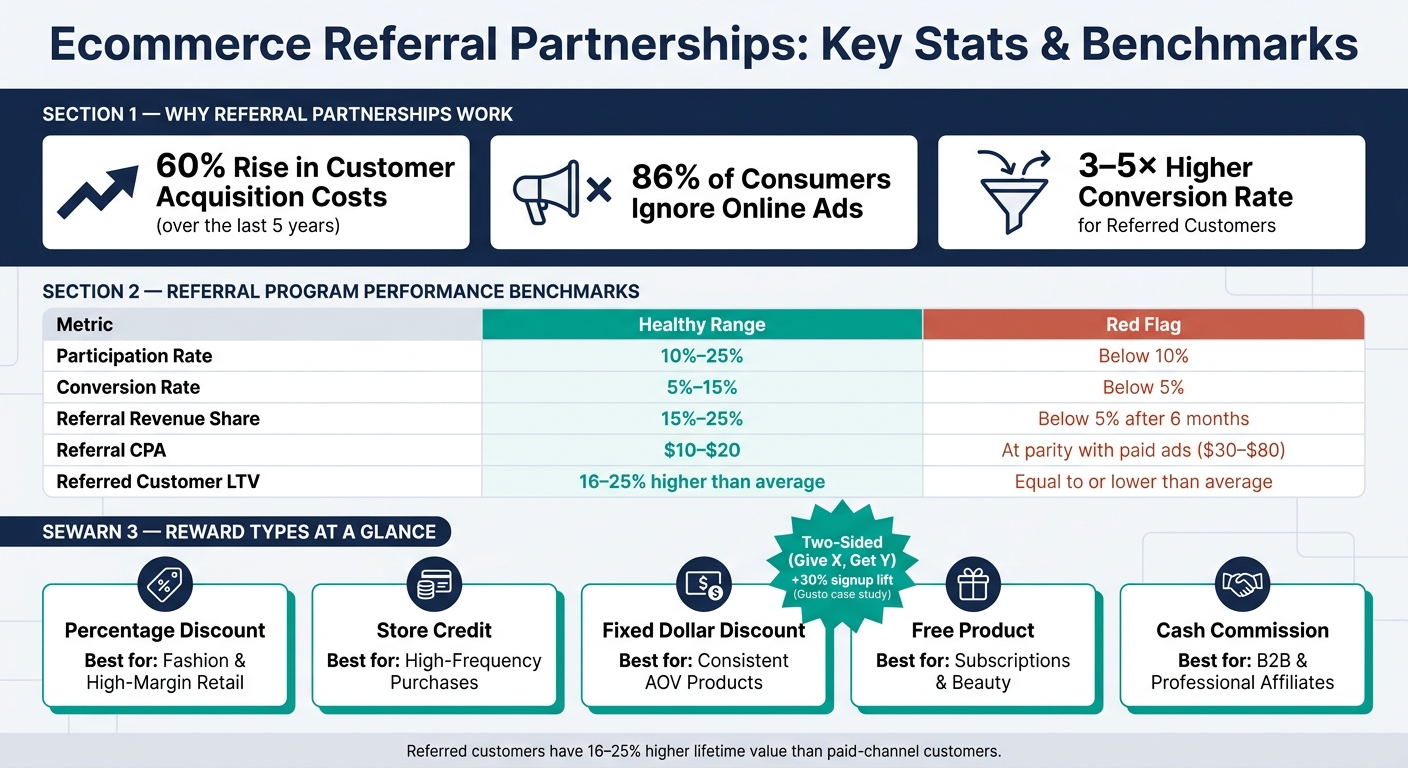
Ecommerce Referral Partnerships: Key Stats & Benchmarks
Launching an eCommerce Affiliate Program Made EASY
sbb-itb-61169e3
How to Find the Right Referral Partners
Finding the right referral partner isn't about casting a wide net; it's about being intentional. The focus should be on identifying businesses that cater to the same ideal customer but offer a different product. This shared audience forms the backbone of a successful referral partnership.
What Makes a Strong Referral Partner
The strongest referral partners meet a few key criteria. First, there must be audience overlap without competition. In other words, they should target the same type of customer, but their product shouldn't compete with yours. For example, a high-end luggage brand might pair well with a travel accessories company - they share the same customer base but don't compete directly.
Equally important is ensuring aligned brand values. If your business prioritizes sustainable practices and ethical sourcing, partnering with a brand that cuts corners on quality could confuse your audience and erode trust. A referral partnership thrives when both brands are seen as trustworthy by their shared customer base.
Two other factors to weigh are engagement quality and operational readiness. A partner with an engaged audience - think high email open rates or active social media followers - will likely deliver better results than one with a large but disengaged following. Additionally, make sure the potential partner has the resources and budget to execute the program. Even the best partnership ideas can falter if one party can't deliver on their responsibilities.
Here’s a quick guide to help evaluate potential partners:
| Criteria | What to Look For | Why It Matters |
|---|---|---|
| Audience | Similar demographics, different products | Reaches your ideal customers without competing |
| Values | Focus on quality, ethics, or sustainability | Keeps the partnership authentic and credible |
| Engagement | Active social followers or email subscribers | Demonstrates influence and ability to drive action |
| Tech Stack | Compatible tools for tracking and ecommerce | Simplifies attribution and reward management |
One practical way to find potential partners is to ask your current customers. A quick survey about other brands they follow or shop with can uncover partnership opportunities you might not have considered.
Beyond qualitative insights, using data can refine your search even further.
Using Data to Choose the Right Partners
Relying solely on gut instinct to pick a referral partner can be risky. Data-backed decisions provide a clearer picture of whether a business can support sustainable growth.
This is where ecommerce intelligence tools come in handy. Platforms like StoreCensus track over 2.5 million ecommerce stores and provide insights across 25+ data points, including technology stacks, installed apps, growth trends, and activity signals. If you're targeting complementary Shopify merchants, you can filter by category, revenue range, and growth indicators to create a tailored list of potential partners.
For instance, if you sell premium fitness equipment, you could use StoreCensus to identify growing Shopify stores in the nutrition category. Look for signals like recent tech upgrades or increased site traffic - these suggest the business is actively investing in growth and likely to be a motivated partner.
Once you've identified potential partners, tailor your outreach. Highlight specific aspects of their business and explain how a partnership could benefit both sides.
"Be transparent and when you're going to the negotiating table, be up front and say, 'This has to work within these parameters.'" - Uri Weinberger, Founder, Milky Mama
Before diving into a full-fledged partnership, start small. A short-term campaign or single giveaway can help test the waters. For example, Off Road Tents and Guana Equipment ran a 30-day rooftop tent giveaway that required email and phone submissions. The campaign generated over 7,000 high-quality leads, many of whom converted into paying customers through exclusive discounts. A pilot like this offers valuable insights before committing to a long-term collaboration.
How to Design Referral Reward Structures
Once you've chosen your partners, the next step is figuring out what rewards to offer and who should receive them. A well-thought-out reward structure can effectively drive leads while keeping your profit margins intact.
Types of Referral Rewards and Incentives
The type of reward you choose should align with your product type, pricing model, and profit margins. For instance, percentage discounts work great for industries like fashion or high-variety retail, where cart sizes can vary widely. On the other hand, free products might resonate more with subscription services or beauty brands. For professional or B2B partnerships, cash commissions can be a powerful motivator, though they may feel too transactional for consumer-focused programs.
| Reward Type | Best For | Pros | Cons |
|---|---|---|---|
| Percentage Discount | Fashion, high-margin retail | Scales with cart size; high perceived value | Less impactful on low-priced items |
| Store Credit | High-frequency purchases | Encourages repeat visits; keeps money in-house | Only appeals to existing customers |
| Fixed Dollar Discount | Consistent Average Order Value (AOV) | Easy to understand; tangible value | Less enticing for high-ticket products |
| Free Product | Subscriptions, beauty, accessories | High perceived value; introduces new SKUs | Higher fulfillment and shipping costs |
| Cash Commission | Professional or B2B affiliates | Universally appealing | Can feel overly transactional; fraud risk |
To safeguard your margins, consider adding a minimum spend requirement (e.g., "$15 off orders over $60"). Additionally, you can delay reward fulfillment until after the return window (typically 30 days) closes, ensuring you don’t pay for rewards tied to refunded purchases.
The next decision is whether to reward one party or both, as this can significantly impact the program's success.
One-Sided vs. Two-Sided Rewards
Choosing who receives the reward is just as important as selecting the type of reward. In a one-sided setup, only one party benefits - either the referring partner or the new customer. While this can work, it often fails to fully incentivize both sides.
Two-sided rewards - often called the "Give X, Get Y" model - tend to perform better. By providing rewards to both the referrer and the new customer, this approach encourages participation from both sides and reduces any awkwardness in asking for referrals.
"The 'Give X, Get Y' model is generally most effective as it incentivizes both parties and creates a strong value proposition." - E-comprofits
For example, Gusto used a two-sided program offering $200 Amazon gift cards to both the referrer and the new customer, which led to a 30% increase in new customer signups. Similarly, DigitalOcean structured its program so new customers received a $200 credit, while referrers earned $25 - but only after the referred customer spent their first $25. This ensured rewards were tied directly to actual revenue.
While one-sided programs can still be effective - especially if your main goal is to increase brand awareness and your margins are tight - they’re less likely to create the kind of self-sustaining referral program that drives long-term growth.
How to Run and Manage a Referral Program
Once you've nailed down a solid reward structure, the next step is managing your referral program effectively. Without proper management, the program can lose steam - partners may stop promoting, rewards might go untracked, and disagreements can arise over what counts as a qualified lead.
Tools for Tracking Referral Performance
Tracking referrals manually is a recipe for inefficiency, especially as your program grows. Once you have more than a handful of partners, referral program software becomes essential. Platforms like PartnerStack or Referral Factory take care of referral tracking, reward validation, and commission payouts. They also provide partners with a clear view of their performance, keeping everything transparent and organized.
For accurate referral attribution, layer tools like discount codes, cookie-based tracking (usually set for 30–90 days), and UTM codes. Use Google Analytics to monitor top-of-funnel traffic and ensure your data stays reliable.
"Shopify Flow... is what separates a professional referral program from a manual tracking nightmare." - JeriCommerce
If your target audience includes ecommerce businesses, it's just as important to identify and qualify the right partners before outreach using Shopify store guides. Tools like StoreCensus allow you to filter through over 2.5 million Shopify stores based on factors like installed apps, revenue tier, and growth signals. For example, if you're a Shopify app focused on email marketing, you can target stores actively scaling customer acquisition and approach them with a data-driven pitch instead of guessing.
Additionally, invest in software to prevent fraud. The best referral platforms automatically flag suspicious activity, such as self-referrals, shared IP addresses, or matching shipping addresses. This ensures your program stays fair and abuse-free.
Once tracking is in place, the next step is to clearly define the terms of your referral partnerships to avoid confusion and disputes.
Setting Clear Partnership Terms
Relying on verbal agreements is risky. Every referral partnership needs a written agreement that outlines the program details before either side commits to promoting it.
"A clear agreement helps build trust and prevents misunderstandings. It outlines exactly how the partnership works and what each side can expect." - Jessica Paluzzi, CMO, Referral Factory
Here’s a breakdown of the key terms every referral agreement should include:
| Term | What to Define |
|---|---|
| Commission Structure | Specify whether rewards are percentage-based, flat per deal, or tiered by milestone. |
| Payout Timeline | Clarify when payments are made - e.g., monthly or net-30 after the return window closes. |
| Lead Validation Rules | Define what qualifies as a legitimate referral to avoid disputes. |
| Brand Guidelines | Set rules for how partners can represent your brand in their promotions. |
| Termination Clause | Outline the conditions under which either party can end the agreement. |
Having these terms spelled out in writing helps prevent misunderstandings, misaligned expectations, and disputes over commissions. It also ensures both sides are aligned from the start, creating a smoother partnership experience.
How to Measure and Improve Referral Partnerships
Once your referral program is up and running with solid tracking and clear agreements, the next step is to evaluate its performance. Understanding what drives success will help you refine your approach and maximize results.
"A referral program without measurement is just a discount program with extra steps." - JeriCommerce
Key Metrics to Track for Referral Partnerships
To gauge the health of your referral program, focus on four main metrics: participation rate, conversion rate, cost per acquisition (CPA), and referral revenue share.
- Participation Rate: This measures the percentage of customers actively sharing referral links. A healthy range is between 10% and 25%. If this number drops below 10%, it signals a need for structural changes rather than minor tweaks to rewards.
- Conversion Rate: Referred friends typically convert at rates between 5% and 15%. Falling below 5% suggests deeper issues, not just a misaligned incentive.
- Customer Lifetime Value (LTV): Referred customers often have a 16–25% higher LTV compared to those acquired through paid channels. If their LTV is on par with or lower than your average, it might indicate you're attracting deal-seekers rather than loyal customers.
- Cost Per Acquisition (CPA): Referral programs generally acquire customers for $10–$20, significantly lower than the $30–$80 spent on Meta or Google ads. If referral CPA starts matching paid ad costs, it’s time to reassess your reward structure.
These metrics provide a clear snapshot of your program’s health. For example, if your referral revenue share remains below 5% after six months, it’s a sign to reevaluate the partnership.
| Metric | Healthy Benchmark | Red Flag |
|---|---|---|
| Participation Rate | 10%–25% | Below 10% |
| Conversion Rate | 5%–15% | Below 5% |
| Referral Revenue Share | 15%–25% | Below 5% after 6 months |
| Referral CPA | $10–$20 | At parity with paid ads |
| Referred Customer LTV | 16%–25% higher than avg. | Equal to or lower than avg. |
By keeping a close eye on these benchmarks, you’ll know where to focus your efforts to improve results.
How to Scale Referral Partnerships That Work
When your metrics confirm a partnership is thriving, it’s time to scale strategically. One effective approach is tiered rewards. Instead of offering a flat incentive, structure payouts to increase as advocates refer more people - for instance, $15 for the first three referrals and $20 for the next seven. This encourages repeat participation and rewards loyalty.
Another strategy is to collaborate on joint marketing campaigns. These can expand your reach without proportionally increasing costs. Take the example of Off Road Tents, which teamed up with Guana Equipment for a co-branded rooftop tent giveaway. By requiring participants to provide their email and phone number, the 30-day campaign generated over 7,000 high-quality leads. Many of these leads converted into customers for other products through targeted follow-up offers.
"We managed to collect 7,000+ emails and cellphone numbers in 30 days. The collaboration gave us lots of high-quality emails and SMS subscribers, which actually ended up buying other tents." - Gianluca Boncompagni, Founder, Off Road Tents
If a partnership underperforms - such as a referral revenue share below 5% after six months - don’t hesitate to cut ties. Instead, channel your energy into successful partnerships and explore ways to expand them into new customer segments or product categories. This often involves identifying new partners using Shopify brand prospect lists to find merchants with overlapping audiences. By focusing on what works, you’ll ensure your program continues to deliver strong results.
Conclusion
Creating a referral partnership program that thrives hinges on three key elements: choosing the right partners, offering motivating rewards, and maintaining consistent performance tracking. The numbers speak for themselves - referred customers convert 3–5× more often, boast about 16% higher lifetime value, and only cost $10–$20 to acquire.
Start with partner selection. Focus on businesses that cater to the same audience without competing directly. Partners with overlapping customer bases are ideal. Make sure to formalize agreements with clear commission structures, branding guidelines, and exit clauses to avoid misunderstandings.
Once the groundwork is laid, using data-driven tools can make all the difference in finding and managing the right partnerships. Platforms like StoreCensus simplify this process by offering advanced filters to identify complementary brands. With access to over 2.5 million stores, StoreCensus provides insights into technology stacks, installed apps, growth signals, and real-time activity, helping you zero in on brands that align with your ideal customer profile before outreach.
"Working with people or businesses that already speak to your ideal customers is one of the most efficient (and low-risk) ways to get in front of new audiences." - Syncio
FAQs
How do I approach a brand to propose a referral partnership?
To kick things off, look for partners that share common ground with your audience and objectives. These could be businesses that complement your offerings or influencers who resonate with your target market.
When reaching out, craft a personalized message that clearly explains the mutual benefits of collaborating. For instance, highlight how the partnership could help both parties expand their reach or boost sales. Make your offer clear and actionable - whether it’s a co-branded campaign, referral incentives, or something else.
Finally, suggest a meeting to brainstorm ideas and iron out the details. Be sure to discuss ways to measure the partnership’s success, like using unique promo codes or tracking links to monitor performance.
What reward amount is safe without killing margins?
A reward amount that's generally considered safe tends to fall between 5% and 10% of the sale value. The exact percentage often depends on your industry and profit margins. This range strikes a balance between encouraging referrals and maintaining healthy profits.
How can I prevent referral fraud and self-referrals?
To keep referral fraud and self-referrals in check, focus on setting clear and meaningful conversion goals - like requiring actual purchases or completed sign-ups before issuing rewards. Make sure rewards are only distributed after a designated return or reward period has passed to discourage abuse.
Leverage automated fraud protection tools to spot and block suspicious activity early. Additionally, consider offering lower-risk incentives such as discounts or gift cards instead of cash payouts, as these tend to be less tempting for fraudsters.
Finally, consistent monitoring and a well-thought-out program structure are essential to reducing the chances of fraud and ensuring your referral program remains effective.