How Agencies Use Data for Outreach Automation
Agencies use real-time ecommerce signals and app data to automate targeted outreach, qualify high-intent leads and boost response rates.


Agencies are transforming their outreach strategies by leveraging ecommerce data to target the right prospects at the right time. Instead of mass messaging, they focus on precision, using tools like StoreCensus to analyze platforms, tech stacks, and growth signals. This data-driven approach leads to better-qualified leads and higher response rates (18–25% compared to 2–3% for generic campaigns). Key methods include:
- Analyzing tech stacks: Identify app gaps or growth stages to craft relevant pitches.
- Tracking growth signals: Real-time updates like app installs or product launches highlight active buying cycles.
- Prioritizing decision-makers: Direct outreach to founders or CMOs boosts efficiency.
- Automated workflows: Triggers based on store changes ensure timely follow-ups.
How to automate ICP research and cold outreach with n8n
sbb-itb-61169e3
Key Data Sources for Outreach Automation
Agencies thrive when they focus on data that directly signals buying intent. The following data types provide clear insights into both fit and timing, forming the foundation for effective and targeted outreach.
Technology Stack and Installed Apps
A store's tech setup speaks volumes about its needs and growth stage. 99.6% of Shopify stores reveal app or pixel data, making this a goldmine for targeting opportunities. By analyzing what apps a store uses - or lacks - you can craft highly specific pitches.
Take the "missing app" approach: if a store uses ReCharge for subscriptions but hasn’t installed an email marketing platform, that's an opening for an email agency. This method works because it highlights a tangible gap in the store's setup, making your pitch feel relevant and tailored.
The complexity of a store's tech stack can also hint at its budget. Stores with premium apps like Gorgias or paid themes are more likely to invest in professional services. StoreCensus data shows that mature stores with 50,000–200,000 monthly visitors typically have 8.09 installed apps and 10.20 pixels. This rich data allows for more precise personalization.
Store Activity Signals and Growth Indicators
Timing is everything in outreach. Stores that recently installed a new analytics app, launched a product line, or started running paid ads are actively growing - and more likely to engage with your offer.
Real-time signals like app installs, theme updates, and product catalog expansions can reveal when a store is investing in growth. For example, stores rapidly adding products might benefit from services like search optimization, merchandising, or inventory management.
"When a store matches your trigger criteria, they're in an active buying cycle. Your message arrives exactly when they need it most." - StoreCensus
Other growth indicators, like active ad campaigns or hiring for marketing roles, further confirm a store’s scaling efforts. A brand running Facebook ads and hiring marketing professionals is likely ready to invest in external expertise.
Contact and Decision-Maker Data
Even the best outreach strategy falls flat if it doesn’t reach the right person. Directly connecting with decision-makers like founders, CMOs, or Heads of Growth can bypass gatekeepers and significantly boost response rates.
But here’s the challenge: while 74.8% of stores have at least one contact on record, only 1.1% have a verified outreach-role contact - such as a founder or marketing manager with a LinkedIn profile. This makes accurate decision-maker data one of the most valuable assets in outreach. Agencies that prioritize this data spend less time chasing unqualified leads and more time engaging with real buyers. Having the right contact information sets the stage for a smoother and more effective sales process.
Lead Qualification Workflows Using Data
Using detailed ecommerce data, agencies can build workflows to identify and qualify leads more effectively. By leveraging filtered, ranked, and cleaned data, they can focus on prospects that are ready to buy, leaving behind outdated methods based on guesswork or intuition.
Filtering and Segmenting by Intent Signals
The first step in streamlining lead qualification is narrowing down a broad pool of stores into a smaller, more relevant list. Agencies use a range of filters, including platform type, geographic location, revenue tiers, traffic levels, and, most importantly, technographic signals. For instance, identifying stores with specific app gaps can highlight opportunities for targeted outreach.
Timing signals add another layer of precision to this process. For example, a store that has recently updated its theme is likely in the middle of a redesign. That makes it a prime candidate for design or UX services. These real-time triggers don’t just tell agencies who to target - they reveal when to reach out for maximum impact.
Prioritizing High-Intent Leads
Once the list is refined, scoring leads helps prioritize outreach efforts. A common approach is the STAMP framework, which evaluates leads across five key areas: Size (traffic levels), Tech stack, Activity (marketing investments), Multiple contacts, and Pain points. Each area is assigned a weighted score to determine how much effort a lead deserves.
The numbers back this up. Stores with over 50,000 monthly visitors average a lead fit score of 96.9, compared to just 60.2 for stores with fewer visitors. Among the highest-scoring leads (95–100), 85.5% have contact coverage, and 40.8% include verified decision-maker contacts. This shows that high-scoring leads are not only a better match but are also easier to reach.
"The goal isn't more leads. It's better leads. 50 qualified stores will outperform 500 random ones every time." - StoreInspect Team
Removing Low-Quality or Inactive Prospects
Cutting out low-potential leads is just as important as finding the high-value ones. For example, stores earning less than $250,000 annually often lack the budget for professional agency retainers. A practical approach is to set a revenue threshold, ensuring your retainer represents about 0.5–1% of a store’s annual revenue. Pair this with a simple 1–5 star rating system: focus 60% of outreach on five-star leads and archive low-scoring ones immediately. This keeps your pipeline lean and focused on opportunities that are actually worth pursuing.
Personalization at Scale with Ecommerce Data
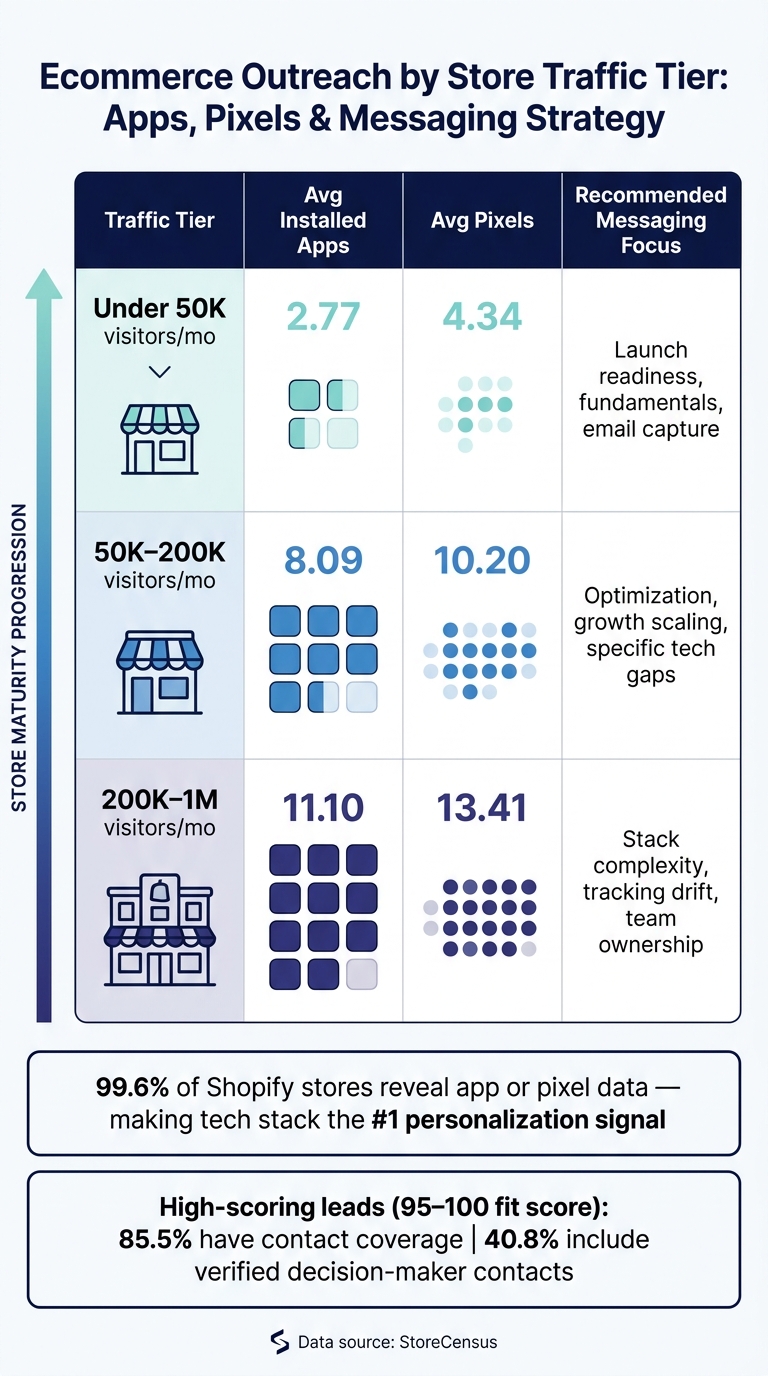
Ecommerce Outreach by Store Traffic Tier: Apps, Pixels & Messaging Strategy
Once you've filtered and prioritized leads, the real challenge begins: crafting outreach that grabs attention and drives responses. Generic emails simply won't cut it. To stand out, your messaging needs to be targeted and backed by research.
Referencing Store Technology and Recent Changes
The best personalization connects directly to something visible about the store. With 99.6% of Shopify stores revealing app or pixel data, there's almost always something specific you can reference. The trick lies in how you frame it.
"The safest personalization does not say 'you need X.' It says 'I noticed public signal Y, so I was curious how you handle Z.'" - StoreInspect Team
This method, often called "Safe First-Line Framing," uses a data point to spark curiosity rather than criticism. It encourages a conversation without putting the prospect on the defensive. Here's how this approach works in real-world scenarios:
| Public Signal | Effective Framing | Risky Framing |
|---|---|---|
| Meta Pixel, no analytics app | "I noticed Meta tracking, but didn't see a public attribution layer." | "Your attribution is broken." |
| Paid media, no email app | "It looks like you invest in acquisition, so I was curious how you capture traffic." | "You are wasting ad spend." |
| 100+ products, no search app | "With a larger catalog, I was curious how shoppers find the right products." | "Your search is bad." |
| Mailchimp, no Klaviyo | "I saw Mailchimp publicly, so I wondered whether lifecycle automation is still simple." | "You need to migrate to Klaviyo." |
Signals that seem mismatched can be especially useful. For example, a store using Klaviyo and Gorgias - both premium tools - on a free Shopify theme suggests they've invested in retention but not in design. This provides an easy opening for agencies offering development or UX services without needing to create a forced reason to reach out.
By tying your observations to these technology clues, and aligning your message with the store's scale and maturity, you can elevate your outreach efforts.
Tailoring Messaging to Store Size and Growth Stage
Personalization doesn’t stop at technology - it also depends on the store's size and stage of growth. A founder managing a $150,000/year store has vastly different priorities compared to a CMO leading a $5M brand. Treating them the same will hurt your chances of getting a reply.
Technology stack density offers a good indicator of a store's maturity. Smaller stores (under 50,000 monthly visitors) average just 2.77 apps and 4.34 pixels. These stores often lack essentials like social proof tools or basic email capture. On the other hand, mid-sized stores with 50,000–200,000 monthly visitors average 8.09 apps and 10.20 pixels. These businesses have likely tackled the basics and are now dealing with challenges like stack complexity or tracking issues.
| Traffic Tier | Avg Apps | Avg Pixels | Recommended Messaging Focus |
|---|---|---|---|
| Under 50K | 2.77 | 4.34 | Launch readiness, fundamentals, email capture |
| 50K–200K | 8.09 | 10.20 | Optimization, growth scaling, specific tech gaps |
| 200K–1M | 11.10 | 13.41 | Stack complexity, tracking drift, team ownership |
Pricing also plays a major role. If you pitch a $10K/month retainer to a store making $150K/year, your offer will likely be ignored. A more realistic approach is to align your pricing so it represents around 0.5–1% of the store's annual revenue.
For founder-led stores in the $500K–$2M range, focusing on tactical solutions and ROI tends to work best. For CMO-led businesses in the $2M–$10M range, a more strategic, peer-to-peer tone is often more effective. The data provides all the clues you need to tailor your message before you even start writing.
Automation Workflows for Scalable Outreach
Once your messaging is fine-tuned, the next hurdle is scaling your outreach efforts. Leveraging the ecommerce data we discussed earlier, you can set up automated workflows that ensure timely, scalable communication. Manually crafting emails for every lead isn’t practical, but workflows triggered by live ecommerce data make it possible to send outreach at just the right moment - without constant oversight.
Triggering Outreach Based on Store Changes
The best outreach happens when the timing is spot on. For example, when a store installs a new app, drops a competitor's tool, or updates its theme, automated triggers can take advantage of these high-intent moments. This eliminates the need for manual tracking and ensures your outreach is both timely and relevant.
| Trigger Scenario | Recommended Timeline | Outreach Approach |
|---|---|---|
| App Install Gap | Immediately upon detection | "Noticed you're using [App A] but not [App B]. Most brands see [X%] gain by connecting them." |
| Contract Lock-In | 2 weeks before end | "Your contract ends soon. Ready to explore alternatives?" |
| Budget Timing | 1st week of new quarter | "Budget should be refreshed now. Still interested?" |
| Product Launch | 2 weeks after launch | "Congrats on launch! Ready to tackle [specific problem]?" |
This approach, driven by real-time signals, consistently outperforms static outreach lists. Agencies using these triggers report response rates that are 3–5x higher than traditional cold outreach methods.
Once you’ve set up these triggers, the next step is to integrate them seamlessly into your existing sales tools for maximum efficiency.
Integrating Data with CRM and Outbound Tools
Having enriched store data is only half the battle - it needs to integrate smoothly with the tools your team already relies on. Instead of merely connecting platforms, the focus should be on optimizing workflows with tools like webhooks and event brokers. Many agencies push lead data into platforms like Apollo.io, Instantly.ai, or Smartlead, syncing it back to their CRM (e.g., HubSpot or Salesforce) via Zapier or direct API connections.
The goal is clear: when a sales rep opens a contact in the CRM, they should instantly see critical details such as the store’s apps, recent updates, and growth signals - not just a name and email.
"StoreCensus's installed-app filters let us zero in on high-potential prospects in a fraction of the time. It's become our go-to tool for precision targeting and has boosted our outreach efficiency across the board." - Noopur, Co-founder, Skailama
For teams managing high volumes, using an event broker like Amazon EventBridge can prevent bottlenecks during peak periods, ensuring data flows smoothly even when multiple triggers fire simultaneously.
To maintain momentum, it’s crucial to ensure that lead records stay current as store conditions evolve.
Keeping Lead Records Updated Automatically
Outdated data can derail your pipeline. In fact, 70% of qualified leads are lost by agencies because they fail to track and follow up effectively. The solution isn’t more manual work - it’s automation. Weekly automated crawls can track changes in a store’s tech stack, revenue, and traffic metrics, keeping your data accurate and actionable.
For example, if a store uninstalls a competitor’s tool, the lead record updates automatically and re-enters the outreach sequence. Even lead status tracking (e.g., Contacted → Replied → Negotiating → Closed) is updated in real-time, ensuring no prospect is forgotten in a spreadsheet.
Measuring Outreach Performance
Relying on automated workflows is just the start. To truly make an impact, you need to measure how well your outreach efforts are performing. Automation can make things easier, but without tracking the right metrics, you might confuse activity with success. Sending out countless emails or booking calls won't mean much if there's no revenue growth to show for it.
"Knowing you are doing outreach is not the same as knowing it is working. If you cannot measure it, you end up repeating the same messages, chasing the wrong leads, and calling it 'momentum' when it is actually noise." - Sagar Agrawal, Qubit Capital
Reply and Conversion Rates
Reply rate is one of the quickest indicators of how your outreach is landing. For instance, emails that address a specific tech gap can see response rates of 18–25%, while generic emails tend to perform far worse. Breaking down responses into categories like positive interest, objections, or unsubscribes can help you pinpoint issues. If you’re getting a lot of replies but most are objections, the problem likely lies in your targeting rather than your messaging.
Meetings Booked and Pipeline Contribution
While replies give you a sense of interest, the real measure of success is how many meetings you book. For example, Sarah's use of structured follow-ups turned 150 emails into 12 discovery calls, which ultimately led to 2 new clients. Tracking metrics like pipeline contribution rather than just focusing on monthly revenue can provide a clearer picture of outreach effectiveness. In fact, up to 39% of your pipeline can often be directly attributed to specific, data-driven outreach efforts when tracked properly. This level of insight can turn outreach from guesswork into a reliable system for growth.
How StoreCensus Powers Outreach Automation
StoreCensus takes data-driven personalization and workflow automation to the next level, giving agencies the tools they need to streamline outreach at every stage. By providing up-to-the-minute ecommerce insights, the platform empowers teams to run campaigns that are precise, timely, and scalable.
Real-Time Store Monitoring and Alerts
StoreCensus keeps tabs on over 2.5 million ecommerce stores, delivering instant updates on key activities like, “Installed Klaviyo 15 min ago” or “Changed theme to Dawn 2 min ago.” These aren’t just random updates - they’re actionable buying signals. For example, when a store installs a new app or switches themes, it’s often the perfect time to strike up a conversation about relevant services.
The platform lets you track individual stores or entire segments, sending automated email alerts whenever a meaningful change occurs. Want to take it further? The Automations tool can trigger workflows, like pushing a lead to Zapier, the moment a store meets specific criteria - whether that’s installing a particular app or reaching a new revenue milestone.
Advanced Filtering and Lead Enrichment
StoreCensus offers filtering across 25+ structured data points, including details like technology stack, installed apps, estimated revenue, traffic levels, store age, team size, and location. This means you can drill down into ultra-specific combinations, such as “Shopify stores using ReCharge but missing Klaviyo, with $1M–$5M in annual revenue.” This approach pinpoints stores with clear service gaps and the budget to address them.
The platform also enhances lead quality by providing direct access to decision-makers. With SMTP-verified emails and social profiles for roles like Founders, CMOs, and Heads of Growth, you can bypass generic company inboxes. Research shows decision-makers are 3x more likely to respond compared to general email addresses. Once enriched, these leads can flow seamlessly into automated outreach systems, saving time and boosting efficiency.
Automation and CRM Integrations
After enriching leads, StoreCensus simplifies execution with integrations to top sales tools. It connects directly to outbound platforms like Instantly.ai, Smartlead.ai, and Apollo.io, automatically routing qualified prospects into active campaigns - no manual CSV exports required. For teams using HubSpot, Salesforce, or other tools, the platform supports over 5,000 app integrations via Zapier.
StoreCensus also includes a built-in CRM to help agencies stay organized. You can track lead statuses (e.g., Contacted, Replied, Negotiating) and set reminders for timely follow-ups, such as two weeks before a contract renewal or at the start of a new quarter when budgets reset. Combined with automated triggers, this structured workflow can drive 3–5x higher response rates compared to static lead lists.
Conclusion: Using Data to Build Smarter Outreach Workflows
Top agencies focus on sending smarter emails, not just more of them. By leveraging data-driven outreach, they replace time-consuming manual prospecting with a pipeline that grows on its own - powered by real-time signals that highlight the perfect store to contact at the perfect moment. For instance, think of a Shopify brand that recently added ReCharge but hasn’t yet adopted an email platform, or a store that updated its theme last week. These actionable insights guide when and how to make your move.
The results speak for themselves. Take Sarah, who runs an email retention agency. By zeroing in on Shopify beauty brands earning $1M–$5M annually and using ReCharge but not Klaviyo, she achieved $84,000 in MRR with 14 clients in just 12 months. Similarly, Marcus, who operates a Meta Ads agency for DTC brands, refined his outreach to high-traffic stores with active Meta Pixels. With a well-managed pipeline and sales cycles spanning 2–4 months, he scaled to $95,000 MRR within a year.
As outlined earlier, syncing real-time store data directly into your CRM transforms your outreach workflow. It creates a dynamic system that ranks leads, tracks store updates, re-engages prospects at the ideal time, and removes the manual bottlenecks that often lead to missed opportunities. This approach ensures no qualified lead slips through the cracks.
FAQs
Which store signals best predict buying intent?
Store signals that hint at buying intent often involve changes in store activity. For example, a store might switch themes, install new apps, or expand its product catalog. These actions show the store is actively evolving and investing, which could indicate they're ready to make a purchase.
How do I score and prioritize leads with STAMP?
When using STAMP to score and prioritize leads, focus on identifying stores that align with your ideal customer profile and exhibit clear signs of readiness, like growth or recent technology changes.
Tools like StoreCensus can be incredibly helpful here. They allow you to monitor real-time activity, such as app installations or website redesigns. Plus, you can apply filters based on factors like revenue, location, or tech stack to refine your search.
Real-time alerts are another game-changer. They let you know exactly when to reach out, ensuring your outreach is well-timed and targeted at leads with the highest potential to convert.
How can I connect StoreCensus alerts to my CRM?
You can link StoreCensus alerts to your CRM through its built-in automation tools and API integrations. This allows you to create workflows that monitor store activity signals - such as app installations or revenue fluctuations - and automatically initiate CRM actions. Additionally, StoreCensus offers direct data exports and real-time updates, ensuring high-intent leads and store changes are synced with your CRM for prompt follow-ups.