Manual vs. Predictive Lead Identification
Compare manual vs predictive lead scoring for ecommerce, save research time, improve consistency, and raise close rates.

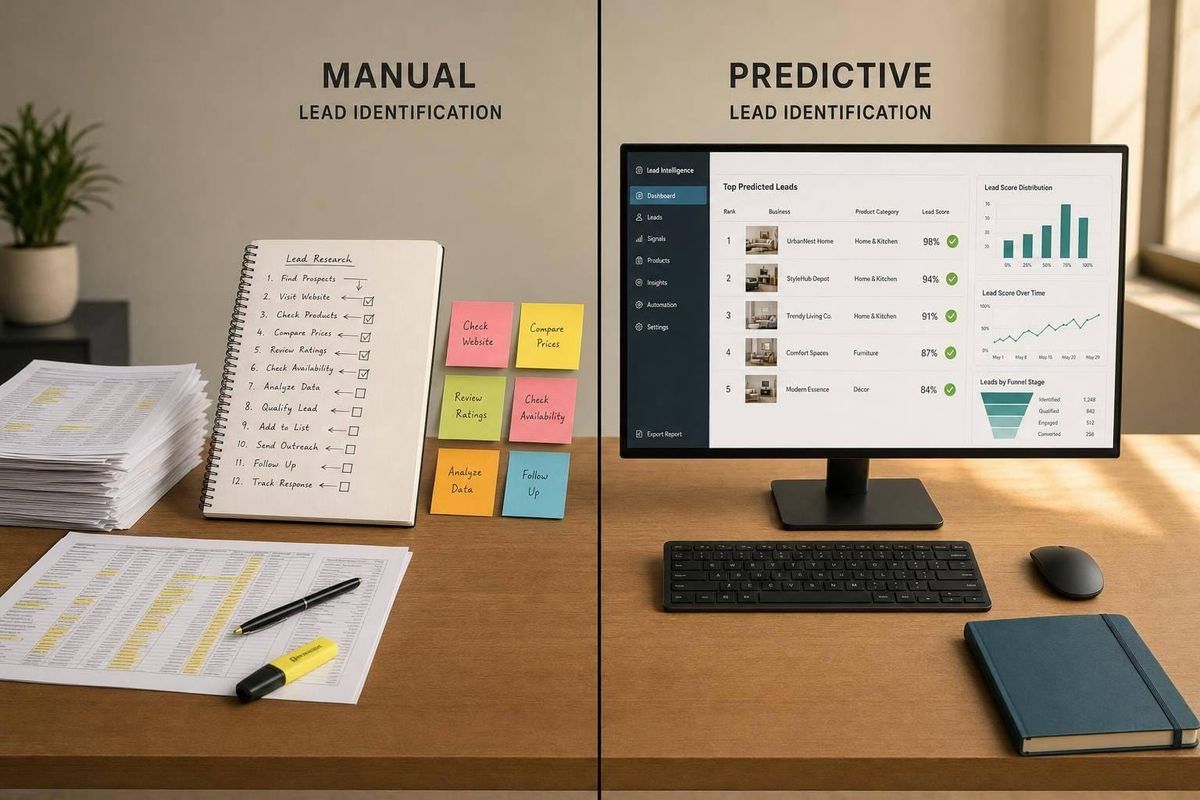
If your team is still scoring ecommerce leads by hand, you're likely spending too much time on research and not enough time on sales. For agencies that sell to Shopify and WooCommerce stores, manual lead review can take 50–100+ hours per 1,000 merchants, while predictive scoring can cut research time per qualified lead from about 5 minutes to 1 minute.
Here’s the short version:
- Manual lead identification works best for small, narrow account lists
- Predictive lead identification works best when you need scale, consistent scoring, and better list ranking
- The biggest difference is not just time - it’s who gets contacted first
- Unranked Shopify lists average a fit score of 72.8, but stores with 50,000+ monthly visitors average 96.9
- Manual lists often close around 5%, while filtered predictive lists can reach 8%–10%
In other words, I’d use manual review to define the ideal client profile, then move to predictive scoring once volume grows and rep-to-rep scoring starts to drift.
Quick Comparison
| Criteria | Manual | Predictive |
|---|---|---|
| Best for | 20–50 hand-picked accounts | Large lead lists |
| Time per store | 3–15 minutes | Filtered in minutes |
| Consistency | Varies by rep | Same rules every time |
| Main strength | Human judgment | Ranking by buying likelihood |
| Main weakness | Time, bias, weak tracking | Needs clean data and deal history |
| Close-rate range | ~5% | ~8%–10% |
If you need nuance, manual still has a place. If you need volume and better priority order, predictive is the better system.
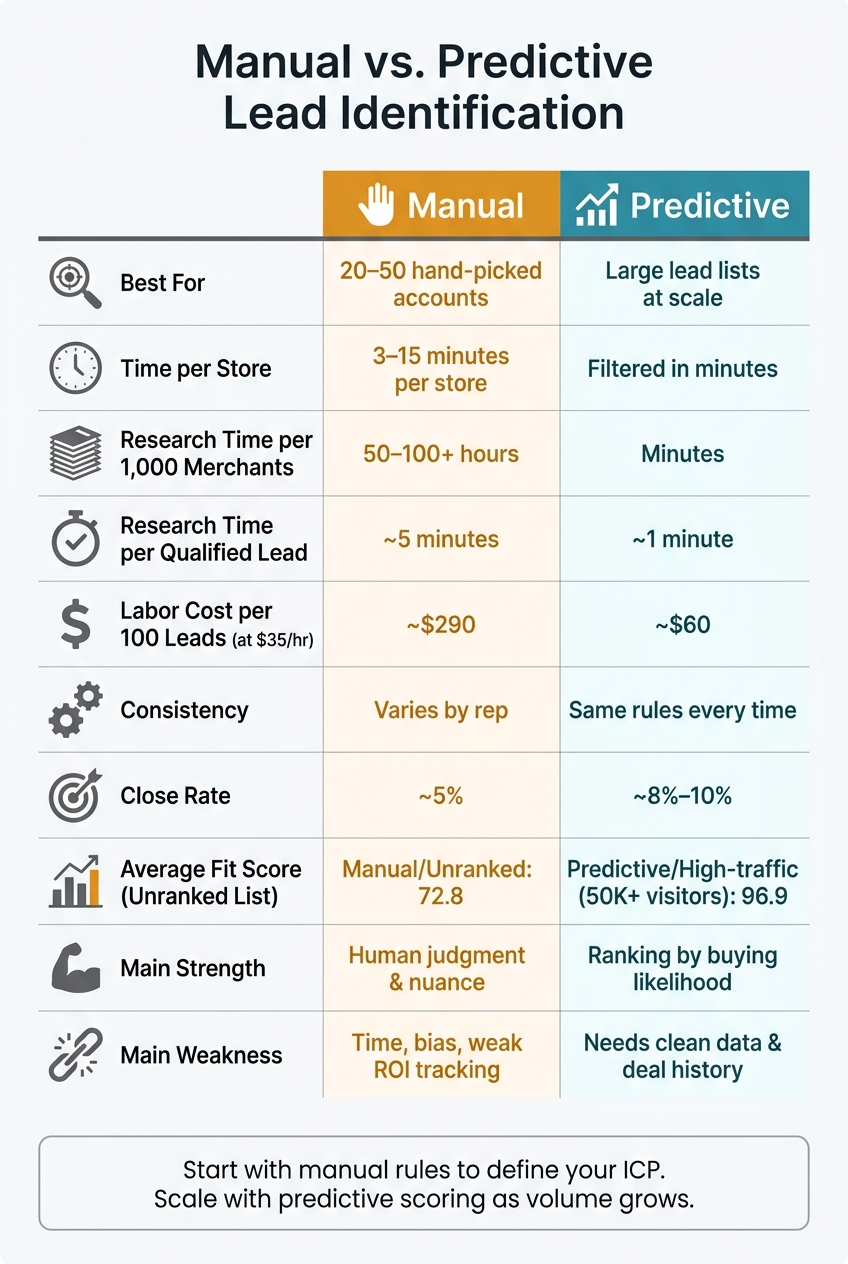
Manual vs. Predictive Lead Identification: Key Metrics Compared
How Manual Lead Identification Works
The typical manual workflow for qualifying stores
Manual prospecting usually looks like this: find stores, check them one by one, make a call on fit based on site quality, tech stack, and pricing, then drop a hot, warm, or cold label into a spreadsheet or CRM. In plain English, the rep is deciding store by store.
That process takes 5–15 minutes per store for a quick review and up to 70–105 minutes for a deeper one. At 300 stores per month, even a 10-minute average turns into about 50 hours before outreach even begins. [2] And that’s just the time side of it.
The bigger issue is consistency. When qualification depends on personal judgment instead of a shared rubric, two reps can look at the same store and come away with very different scores. That gets expensive fast once the list starts growing.
Where manual methods still hold up
Manual lead identification still works in a few cases. It tends to hold up when the target list is small and tightly defined.
For example, a founder hand-picking 20–50 key accounts per month in a narrow niche - like U.S.-based Shopify beauty brands running influencer-heavy DTC - can spot details that software may miss. Things like brand aesthetics, founder story, and community positioning can matter a lot there.
It also fits new agencies that don’t yet have enough deal history to build scoring rules with confidence. At that stage, manual prospecting is less about scale and more about learning. You’re figuring out what a good client looks like before turning that process into a system.
The same logic applies when a deal needs a clear, easy-to-explain reason behind it. For strategic partnerships or co-marketing, a checklist-based approach is often easier to defend.
The main limits: time, bias, and weak ROI tracking
Manual identification starts to crack once volume goes up. Sales reps spend 60% of their time on non-selling work, and research plus prep takes about 14% of the workweek. [2][3] For agencies, that means time spent researching instead of time spent selling.
There’s also a bias problem. Manual scoring often leans toward stores that look like past wins. That can shrink the pipeline and bury better-fit prospects in less polished niches.
Then there’s ROI tracking. Without a feedback loop that connects early scores to actual close rates, teams are left guessing. And if you’re guessing, it’s hard to know when to hire, when to buy better tools, or when to shift toward segments that bring in more revenue. [3][4] That’s the gap predictive systems are built to close.
sbb-itb-61169e3
How Predictive Lead Identification Works
When manual review starts dragging, the next move is figuring out which signals should matter most. That’s where predictive scoring comes in.
Instead of doing a basic fit check, predictive scoring gives more weight to the signals most tied to a closed deal. It swaps gut feel for a structured model built from real merchant data and past won/lost outcomes.
Signals that point to better ecommerce prospects
After a store passes your basic fit filter, traffic is usually the first hard signal worth scoring. From there, the most useful signals fall into five groups. The key is to treat them as layers, not one-off checks.
| Scoring Layer | What to Measure | Why It Matters |
|---|---|---|
| Fit | Category, geography | Confirms the store matches your ICP |
| Budget | Shopify Plus status, paid theme, app/pixel depth | Shows the merchant invests in growth |
| Pain | Missing app category, mismatched stack | Gives a specific reason to reach out |
| Reachability | Verified email, decision-maker role | Determines if the account is actionable |
| Timing | Recent app changes, new store, active ads | Helps choose who to contact now |
Pain signals should carry the most weight. Why? Because they give you a clear reason to start the conversation. Broad fit matters, but it doesn’t do much on its own.
A high-traffic store with active ad pixels but no visible email app is a stronger target than a store that only fits your category. For lifecycle agencies, the top signal is a store with 50K+ monthly visitors, active ad pixels, and no visible email app.[1]
Why StoreCensus fits this workflow
At scale, predictive scoring needs a system that can surface these signals on the spot. StoreCensus lets you search 6M+ Shopify and WooCommerce stores by revenue, tech stack, theme, country, and growth signals. It also surfaces decision-maker contacts and real-time store changes.
In plain terms, you can filter for stores in your target revenue band, check whether they use the apps and tools that hint at budget, and flag the stores where your service fills a clear gap in their stack.
For example, filtering for 50K+ traffic + a 95+ score + verified contact cuts a raw list down to 67,228 stores with 100% verified-contact coverage.[1] That turns a giant spreadsheet into a list you can actually work.
What predictive scoring requires
This only works if the data underneath it stays clean.
Before scoring leads, you need clean CRM stages, enough closed-won and closed-lost history, and a feedback loop that updates the model based on campaign results. Without that setup, the model drifts and stops being useful.[1]
Manual vs. Predictive: Efficiency, Accuracy, and ROI
Speed and effort at list building
Once your scoring rules are set and the data is ready, the gap becomes pretty obvious.
An SDR researching Shopify or WooCommerce stores by hand usually spends 3–6 minutes per store. That means checking the site, guessing revenue, looking through the tech stack, and trying to find a decision-maker email. At that rate, qualifying 1,000 merchants takes 50–100+ hours. In plain English, that’s a full week or more of research time for just one list.
A predictive workflow changes the math. You set the filters once, and the list shows up in minutes. Better yet, it stays current as signals shift.
Accuracy, consistency, and prioritization quality
Speed is nice. But consistency is where manual scoring starts to fall apart.
One SDR may treat $50,000/month as the revenue cutoff. Another may only go after stores doing $200,000+. One person marks a store down for missing email automation. Someone else skips right past that same signal. When people are under pressure, they miss things. They skip steps, read traffic data the wrong way, or make calls that don’t stay steady across a full campaign. At scale, manual scoring misses too many good-fit accounts.
Predictive systems don’t have that problem. They apply the same logic to every record, every time. So if your ICP is a U.S. Shopify store with a recent positive growth trend and no visible CRO tooling, that exact filter runs the same way across 6 million stores.
It also spots signal combinations that people often miss. For example, a store might cross a revenue threshold and add a lifecycle marketing app at the same time, or show other recent tech stack changes. Those small shifts matter. The end result is a ranked list where the top accounts are much closer to your best-fit profile, not just the ones a researcher happened to catch.
ROI impact on agency pipeline
The biggest gap shows up in labor cost and close rate.
| Metric | Manual | Predictive |
|---|---|---|
| Research time per qualified lead | ~5 min | ~1 min |
| Labor cost per 100 leads (at $35/hr) | ~$290 | ~$60 |
Manual lists often close at around 5%. Tightly filtered predictive lists can hit 8%–10%. That lift comes from better fit, not luck.
When to Use Each Approach and How to Make the Switch
When manual is still enough
Manual research makes sense when your list is small and tightly scoped. It's a good fit for small ABM lists and niches where qualification depends on human judgment, subtle context, and details that don't show up cleanly in data.
But that starts to crack once volume picks up. If more leads are coming in, or different reps begin calling the same kind of account in different ways, it's time to move that same ICP into a scoring system.
When predictive becomes the better choice
Predictive scoring starts to make more sense when list-building eats into selling time. If you're going after larger Shopify or WooCommerce segments, updating lists often, or managing multiple SDRs who each qualify leads a bit differently, manual work will slow the team down and create uneven results.
It also starts to matter once you have enough won-and-lost history to test your filters against. At that stage, compare your filters with closed-won and closed-lost data. That's where a tool like StoreCensus helps. It lets you filter millions of Shopify and WooCommerce stores by revenue, tech stack, growth signals, and contacts.
Instead of reviewing leads one by one, you get a repeatable way to rank who should get attention first.
Conclusion: Start with manual rules, then move to predictive systems
Start with manual rules to shape your ICP. Then, as volume grows, swap spreadsheet prospecting for predictive prioritization. Set the rules by hand first. Scale them with predictive systems after that.
FAQs
When should I switch to predictive lead scoring?
Make the switch when manual work starts slowing you down.
A few clear signs:
- Your team can only handle 20–50 leads per day
- More than 60% of team time goes to research
- You’re scaling to hundreds or thousands of leads
- You need faster replies during key sales windows
- You want to cut qualification costs by 60–80%
- You need a steadier way to deal with 22.5% annual data decay through more consistent, real-time prioritization
At that point, manual methods stop being enough. They eat up time, slow response speed, and make it harder to focus on the leads most likely to convert.
What data do I need before using predictive scoring?
Before you use predictive scoring, you need structured data the model can actually work with. If the data is thin or messy, the score won’t mean much.
That usually includes firmographic and technographic details like company revenue, industry, and tech stack. You’ll also want verified decision-maker contact information and behavioral signals such as traffic patterns, recent app installs, or growth milestones.
StoreCensus can provide these data points, which helps make automated lead prioritization more accurate and useful in day-to-day sales work.
Can manual and predictive lead identification work together?
Yes. They usually work best side by side.
Predictive analytics and automation take care of the data-heavy work, like research, lead scoring, and tracking real-time signals. That frees up your team to do what people still do best: build relationships, handle objections, and close deals.
StoreCensus fits this hybrid model well. It helps teams spot high-intent stores using 25+ data points, so reps can spend more of their time on the prospects most likely to convert.