2026 Data on Ecommerce Packaging Waste Reduction
2026 data shows right-sizing, AI cartonization, recycled and reusable packaging can cut ecommerce waste, costs, and emissions.

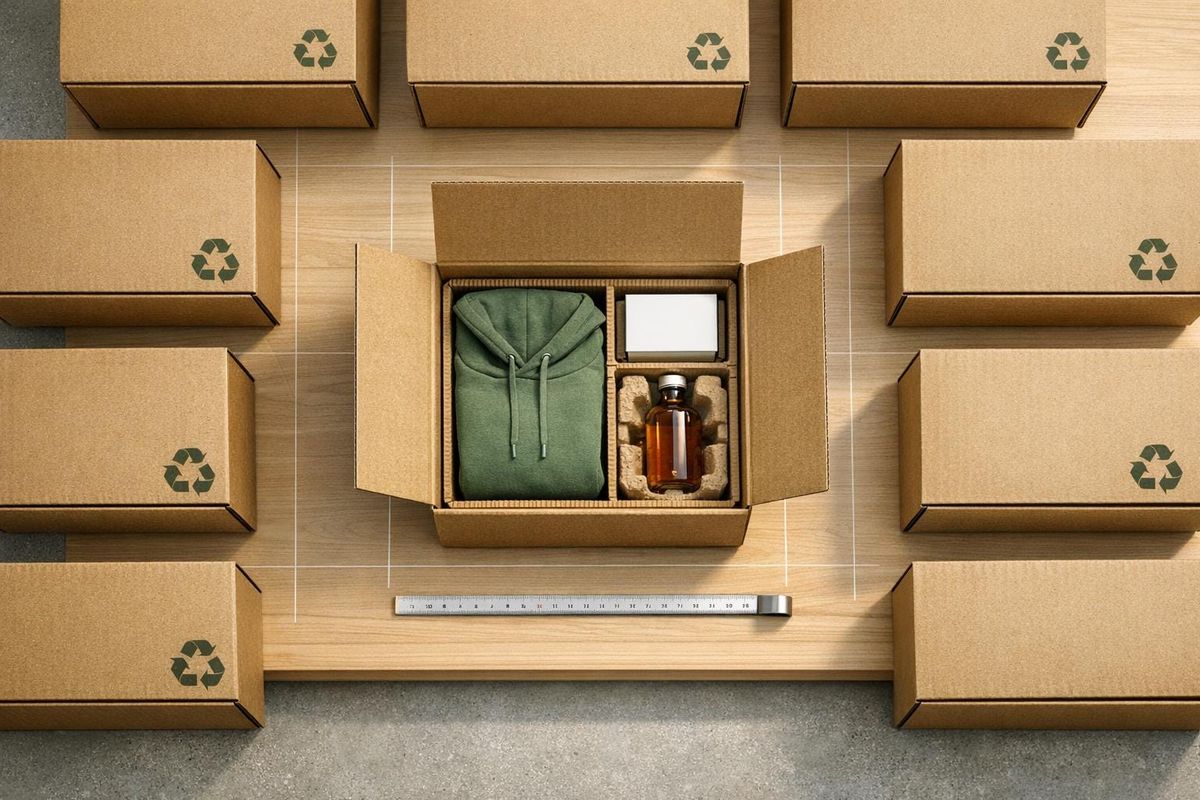
Ecommerce packaging waste is a growing challenge, with 86 million tons generated annually in the U.S. alone. Packaging now accounts for 30% of municipal solid waste by weight, driven by the $92.4 billion global ecommerce packaging market. Inefficiencies like 40% empty space in packages inflate costs and environmental impacts.
Key findings from 2026 include:
- Shipping Costs: 78% of shipments are billed on dimensional weight, costing brands $0.50–$2.00 per shipment due to oversized packaging.
- Customer Expectations: 89% of shoppers dislike excessive packaging, and two-thirds base repeat purchases on packaging quality.
- Sustainability Progress: Only 35% of brands use recycled or biodegradable materials, but 47% have set packaging goals by 2028.
- Innovations: AI-powered right-sizing tools cut package volume by 43%, reducing cardboard use by 47%. Reusable packaging models can cut waste by 93%.
- Regulations: The EU’s Packaging Waste Regulation (effective August 2026) limits empty space in packages to 40%.
Actionable insights for merchants:
- Right-size packaging to reduce void space and dimensional weight costs.
- Switch to recycled or lightweight materials to cut costs and improve brand perception.
- Explore reusable packaging systems, especially in subscription-based models.
- Audit packaging costs - 68% of brands haven’t done so, missing potential savings of 22%.
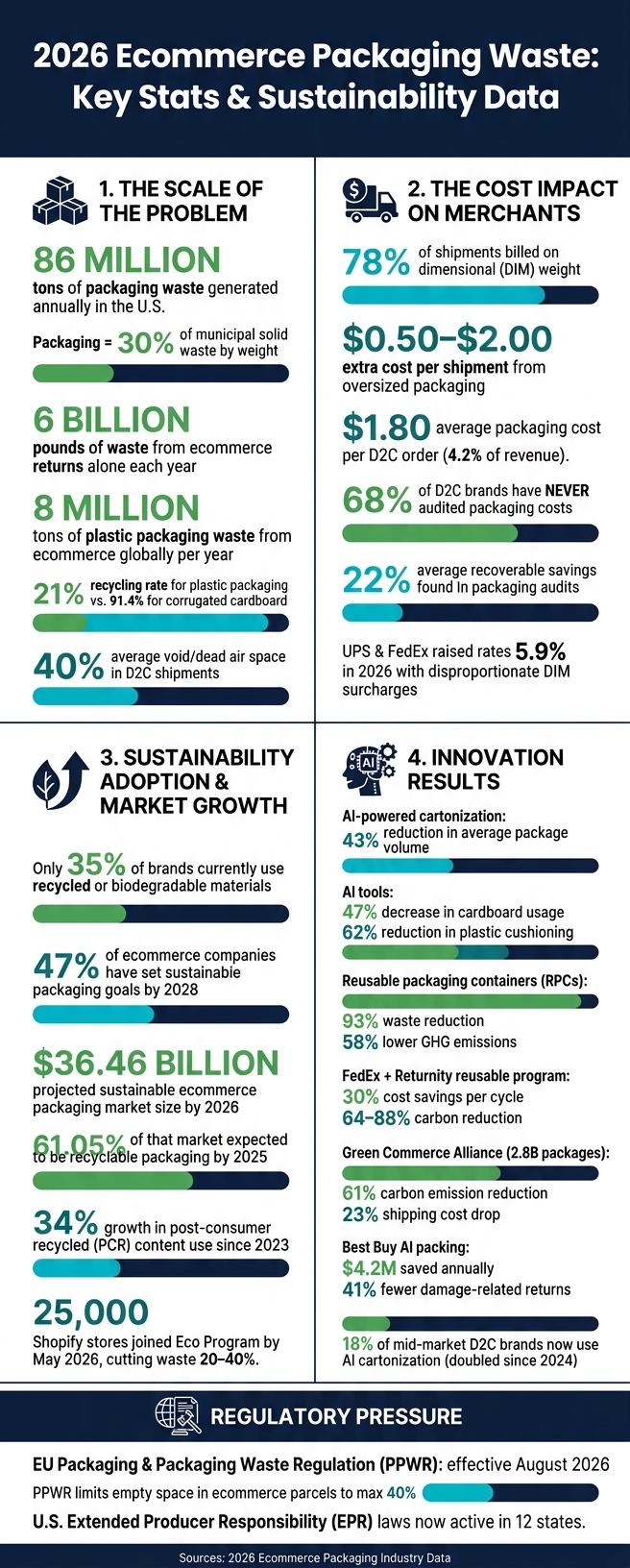
2026 Ecommerce Packaging Waste: Key Stats & Sustainability Data
2026 Global Data on Ecommerce Packaging Waste
How Much Packaging Waste Ecommerce Produces
Ecommerce packaging waste continues to grow, presenting a major challenge but also an opportunity for smarter solutions. For instance, ecommerce returns alone generate a staggering 6 billion pounds of waste annually. On a global scale, ecommerce contributes 8 million tons of plastic packaging waste each year. The recycling rate for plastic packaging sits at just 21%, a stark contrast to the 91.4% recycling rate for corrugated cardboard.
Amazon has shifted half of its shipments to flexible packaging instead of traditional boxes. Meanwhile, Georgia-Pacific has ramped up production of its EarthKraft recyclable mailers, producing 3 billion units by March 2026, up from 1 billion in June 2023 - a threefold increase in less than three years.
These numbers highlight both the scale of the problem and the growing push toward sustainable alternatives.
How Far Sustainable Packaging Has Spread
Currently, only 35% of brands use recycled or biodegradable packaging. However, there’s a growing commitment to change: 47% of ecommerce companies worldwide have established clear goals for sustainable packaging. Among direct-to-consumer (D2C) brands, 46% have set formal sustainability targets for packaging, aiming for completion by 2028.
The market for sustainable ecommerce packaging reflects this shift. By 2026, it’s projected to hit $36.46 billion, with recyclable packaging expected to account for 61.05% of the market by 2025. Shopify’s Eco Program has also made a notable impact, with 25,000 stores signing up by May 2026. Participating merchants have managed to cut packaging waste by 20% to 40%. Additionally, the use of post-consumer recycled (PCR) content in packaging has risen by 34% since 2023.
These trends signal a steady move toward more eco-conscious practices across the industry.
Measured Reductions in Waste and Emissions
From January 2025 to March 2026, the Green Commerce Alliance - which includes major players like ShipBob, Amazon, and DHL - handled over 2.8 billion packages through eco-optimized networks. This effort led to a 61% reduction in carbon emissions and a 23% drop in shipping costs for participating retailers.
"The math is simple: smaller, smarter packaging means more units per truck, fewer delivery routes, and dramatically lower per-unit costs." - David Chen, Operations Director, FulfillmentForward
Right-sizing initiatives have made a significant impact, reducing material usage by an average of 28% per brand. AI-powered systems have further contributed by cutting cardboard usage by 47% and plastic cushioning materials by 62%. These advancements highlight the tangible benefits of adopting smarter packaging strategies, laying a solid groundwork for further improvements and success stories in the industry.
Packaging Innovations That Are Cutting Waste
The rise of ecommerce has brought with it a surge in packaging waste, but new solutions are stepping up to address this challenge. From smarter sizing to material changes and reusable systems, these strategies are helping to tackle waste across the supply chain.
Right-Sized and On-Demand Packaging
One of the biggest culprits of waste isn't the packaging itself but the empty space inside. On average, direct-to-consumer (D2C) shipments contain about 40% dead air. Right-sizing systems are designed to eliminate this inefficiency.
AI-powered cartonization tools are leading the charge. These platforms analyze product dimensions and shipping rules in real time to determine the smallest possible container for each shipment. The results are impressive: a 43% reduction in average package volume and a 47% decrease in cardboard usage. For instance, Best Buy adopted predictive packing across 12 distribution centers in 2026, cutting damage-related returns by 41% and saving $4.2 million annually in materials.
Regulations are also driving change. The European Union's Packaging and Packaging Waste Regulation (PPWR), effective August 2026, limits empty space in ecommerce parcels to 40%.
"The EU's Packaging and Packaging Waste Regulation (PPWR) will have a significant impact, accelerating the shift toward fit-for-purpose packaging and the elimination of empty space across the supply chain." - Arco Berkenbosch, Chief Innovation Officer, Smurfit Westrock
While optimizing package sizes is a big step, many companies are also exploring better materials to further reduce waste.
Recycled and Lightweight Materials
Material choices play a key role in reducing the environmental footprint of packaging. In 2026, many retailers moved from corrugated boxes to lightweight fiber mailers, especially gusseted designs that can handle bulkier items without requiring additional padding. These changes reflect a growing industry preference for flexible, low-impact options.
Switching to 100% recycled corrugated material typically adds only 8–15% to costs, but right-sizing efficiencies often offset this increase. Since 2023, the use of post-consumer recycled (PCR) content has grown by 34%. Corrugated cardboard, with its 91.4% recycling rate, remains one of the most eco-friendly packaging materials available.
"The consumer pressure to not have so much packaging waste and to ship exactly the right size every time is going to also help drive adoption of this format." - Ann Marie Wilson, General Manager for WaveKraft, TemperPack
Reusable Packaging Models
Reusable packaging is gaining ground, particularly in B2B and subscription-based ecommerce, where return logistics are already part of the process. These systems complement right-sizing and material innovations, creating a more sustainable approach to packaging. Reusable packaging containers (RPCs) can reduce waste by 93% and greenhouse gas emissions by 58% compared to single-use cardboard.
In early 2026, FedEx and Returnity launched a reusable shipping program aimed at U.S. apparel retailers. Their containers, designed for up to 50 reuse cycles and capable of holding up to 50 lbs, delivered 30% cost savings per cycle and cut carbon emissions by 64% to 88% compared to traditional corrugated boxes.
"FedEx made reuse make sense by building the business case, doing the work, and creating a model for how circular logistics can succeed at scale." - Mike Newman, CEO, Returnity
Meanwhile, in the grocery sector, Ocado Retail teamed up with Amcor in May 2026 to introduce refillable containers for online grocery orders. Available in 2 kg (about 4.4 lbs) and 3 kg (about 6.6 lbs) sizes, these containers are designed for 50 to 100 refill cycles. Since its pilot in 2024, the program has exceeded both environmental and operational goals.
Case Studies: Brands and Carriers Cutting Packaging Waste
DTC Brands With Strong Packaging Results
Real-world examples from brands show how packaging changes can lead to measurable improvements - not just in reducing waste but also in streamlining operations.
Take Beauty Bay, for instance. In January 2026, this UK-based online beauty retailer teamed up with Lil Packaging to introduce the Breezebox system. By using integrated internal retention and peel-and-seal closures, the company achieved some impressive results: it eliminated 0.5 tons of plastic tape and 45 tons of void fill annually. On top of that, they cut packing time per parcel from 86 seconds to 55 seconds - a 36% boost in labor efficiency - and nearly eliminated transit damage returns.
Meanwhile, SHEIN tackled packaging waste on a massive scale. In 2024, the company reduced the weight of its garment polybags by 0.99 grams and delivery bags by 4.37 grams. These small changes added up to big results: they avoided using 1,797 metric tons of virgin plastic and prevented 6,405 metric tons of CO2e emissions. Plus, over half of their express delivery bags were made from at least 50% GRS-certified recycled plastic.
Meridian Home Products showcased how technology can make a difference. Under the leadership of David Chen, the company rolled out AI-driven predictive packing for its Amazon FBA operations in May 2026. The results? A 34% reduction in inbound shipping costs and an improvement in its inventory performance index from 520 to 680 - all within just six months.
"Clients typically see ROI within 90 days." - Jennifer Martinez, VP of Operations, LogiTech Solutions
While brands focus on refining their own packaging strategies, large logistics providers are scaling these efforts across global supply chains.
Logistics and Carrier Packaging Programs
On the logistics side, major players are rolling out large-scale initiatives to cut packaging waste and improve efficiency.
Amazon has been leading the charge. By 2024, its Ships in Product Packaging (SIPP) program had certified 18 million unique products to ship without an Amazon box, with 12% of global packages being sent without additional packaging. In North America, the percentage of shipments using single-use plastic delivery packaging dropped from 65% in 2023 to 37% in 2024. Additionally, Amazon’s fulfillment centers in Euclid, Ohio, and Shreveport, Louisiana, transitioned to 100% curbside-recyclable, paper-based packaging, eliminating 15 billion plastic air pillows across the region.
"In order to reduce waste, we need to reduce packaging. We use machine learning and automation to create packaging that's made to fit, reducing excess materials while making sure the product remains protected." - Pat Lindner, VP of Mechatronics and Sustainable Packaging, Amazon
Target partnered with Cabka on a three-year project (2022–2025) to replace single-use inbound logistics packaging. The result was the CabCube, a large, reusable foldable container. This innovation slashed return logistics costs by 75% and increased return truck density fourfold.
Here’s a quick look at the outcomes from these initiatives:
| Brand/Provider | Strategy | Measured Impact |
|---|---|---|
| Beauty Bay | Breezebox integrated retention system | 45 tons of void fill eliminated; 36% faster packing |
| SHEIN | Material reduction with recycled plastic bags | 1,797 metric tons of virgin plastic avoided |
| Meridian Home Products | AI predictive packing for FBA | 34% drop in inbound shipping costs |
| Amazon | SIPP & paper-based fulfillment | 15 billion plastic air pillows eliminated |
| Target + Cabka | Reusable foldable containers (CabCube) | 75% reduction in return logistics costs |
sbb-itb-61169e3
What Merchants and Agencies Can Do With This Data
Cost and Logistics Benefits of Cutting Packaging Waste
Direct-to-consumer (D2C) brands typically spend $1.80 per order on packaging materials, representing 4.2% of their revenue. Yet, 68% of these brands have never formally audited their packaging costs, even though audits reveal an average of 22% in recoverable savings.
One of the simplest and most effective steps merchants can take is right-sizing their boxes. On average, D2C packages contain 40% void space, and 78% of shipments are billed based on dimensional (DIM) weight rather than actual weight. This inefficiency is becoming more costly, especially after UPS and FedEx introduced a 5.9% average rate increase in 2026, with DIM surcharges rising disproportionately.
"The math is simple: smaller, smarter packaging means more units per truck, fewer delivery routes, and dramatically lower per-unit costs." - David Chen, Operations Director, FulfillmentForward
Beyond cost savings, sustainable packaging has been shown to improve customer satisfaction by 20% to 30%. Brands that provide proof of their environmental efforts see 18% to 22% higher repeat purchase rates. For example, Ridgeline Supply Co. conducted an A/B test in Q3 2025, showcasing a carbon-neutral shipping badge on their checkout page. The result? The variant with the badge saw an 11% higher conversion rate on mobile.
"We ran an A/B test on our checkout page last Q3 - one variant showed our carbon-neutral shipping badge prominently, the other didn't. The variant with the badge converted 11% higher on mobile. That's not a rounding error. That's a business decision." - Dayna Morales, Head of E-Commerce, Ridgeline Supply Co.
These insights highlight the opportunity for merchants to reduce costs while improving customer loyalty and satisfaction.
Finding Merchants Ready for Packaging Optimization
The next step is identifying which merchants are ready to optimize their packaging. Mid-market D2C brands with annual revenues between $2M and $20M are ideal candidates. These businesses generally allocate 3.5% to 6% of their gross revenue to packaging, have enough order volume to benefit from optimization, but often lack a dedicated procurement team to address inefficiencies.
Certain product categories also reveal higher optimization potential. For instance:
- Home Goods: Median packaging cost per order is $3.40, with high-end costs exceeding $6.00.
- Electronics/Gadgets: Median cost is $3.10, with high-end costs over $5.00.
- Apparel/Accessories: Median cost is much lower at $1.10, but DIM weight exposure is a growing issue as poly mailer usage has increased by 45% since 2023.
| Product Category | Median Packaging Cost Per Order | High-End Range |
|---|---|---|
| Home Goods | $3.40 | $6.00+ |
| Electronics / Gadgets | $3.10 | $5.00+ |
| Food / Beverage | $2.60 | $4.00+ |
| Beauty / Skincare | $2.10 | $3.50+ |
| Apparel / Accessories | $1.10 | $2.00+ |
Merchants processing 1,000 or more monthly orders should also be prioritized. At this scale, AI-powered cartonization becomes feasible, and the savings from automation can quickly add up.
Using StoreCensus to Target the Right Merchants
StoreCensus simplifies the process of finding merchants who are likely to benefit from packaging optimization. With access to over 6 million Shopify and WooCommerce stores, agencies can filter by revenue tier, product category, tech stack, and growth signals to create targeted merchant lists.
For instance, you could filter for Shopify merchants earning between $2M and $10M, operating in Home Goods or Electronics, and not using sustainability tools like the Planet app or EcoCart plugin. This approach identifies businesses large enough to see meaningful savings, operating in high-cost categories, and yet to invest in sustainable practices.
Growth signals provide another layer of precision. Merchants experiencing a recent revenue increase or order volume spike are more likely to feel the strain of inefficient packaging. StoreCensus tracks these changes in real time, allowing agencies to time their outreach strategically. Combined with contact data, this turns hours of manual research into a streamlined, repeatable process. Leveraging tools like StoreCensus makes it easier to extend packaging improvements across the e-commerce landscape.
Conclusion: Where Ecommerce Packaging Is Headed
The data from 2026 makes one thing clear: ecommerce packaging waste isn't just an environmental issue - it’s a business decision. With the global ecommerce packaging market valued at $92.4 billion, inefficiencies like excess void space and DIM-based billing continue to drain profits unnecessarily. Tackling these inefficiencies not only cuts costs but also improves customer retention, making it a win-win for businesses.
What’s different in 2026 is the technology driving these improvements. AI-powered cartonization has seen a sharp rise in adoption, now used by 18% of mid-market D2C brands, doubling since 2024. Meanwhile, fiber-based mailers are rapidly replacing traditional corrugated boxes. For example, Georgia-Pacific reached its 3 billionth EarthKraft mailer milestone in March 2026, up from 1 billion in mid-2023. Companies like Best Buy are leading the way, saving $4.2 million annually by implementing AI-driven predictive packing across 12 distribution centers in 2026. These advancements are reshaping the industry and preparing it for tighter regulations.
Regulatory changes are also accelerating this shift. The EU’s mandates on empty space and U.S. Extended Producer Responsibility (EPR) laws now active in 12 states are putting pressure on businesses to optimize. Brands that delay these changes risk falling behind competitors and facing higher compliance costs. The regulatory landscape is evolving quickly, and inefficiencies are becoming increasingly costly.
For agencies, this transformation presents a clear opportunity to target untapped markets. A staggering 68% of D2C brands have never audited their packaging costs. Tools like StoreCensus make it easier to identify these businesses, allowing you to filter by revenue, product category, and tech stack. High-cost categories like Home Goods and Electronics are ripe for optimization, and the data makes it clear which brands are ready to address their packaging inefficiencies.
FAQs
How do I calculate how much DIM weight is costing me?
To figure out DIM weight costs, start by multiplying your package's external dimensions - length, width, and height (all in inches). Then, divide the result by your carrier's DIM divisor (commonly 139 for many UPS and FedEx services). After calculating the DIM weight, compare it to the package's actual weight. Carriers will charge you based on whichever number is higher. To determine any potential overpayment, consult your carrier’s rate card for the cost difference, then multiply that by the total volume of your orders.
What’s the fastest way to start right-sizing packaging without new equipment?
Switching from rigid boxes to flexible packaging options, such as padded fiber or gusseted mailers, is a fast way to improve efficiency. These packaging types adapt to different product sizes, which minimizes the need for extra filler and reduces shipping volume. Another smart move is to simplify your box inventory by focusing on 8–12 sizes that align with your product range. These changes quickly cut down on both shipping expenses and material waste.
How do reusable packaging programs work for returns and subscriptions?
Reusable packaging programs rely on reverse logistics to gather, clean, and return containers for another cycle of use. In the case of subscriptions and rentals, these systems typically function within a circular supply chain, either managed by the brand itself or through a third-party partner. Achieving high return rates is essential - frequent reuse helps balance out the energy required to produce durable packaging. Stores utilizing StoreCensus can dive into merchant data to fine-tune their supply chain strategies and pinpoint patterns that indicate potential growth opportunities.