Card vs Crypto Checkout for NFT Stores
Match checkout to your buyers: card-first for mainstream/mobile, wallet-first for crypto-native, hybrid for mixed audiences.

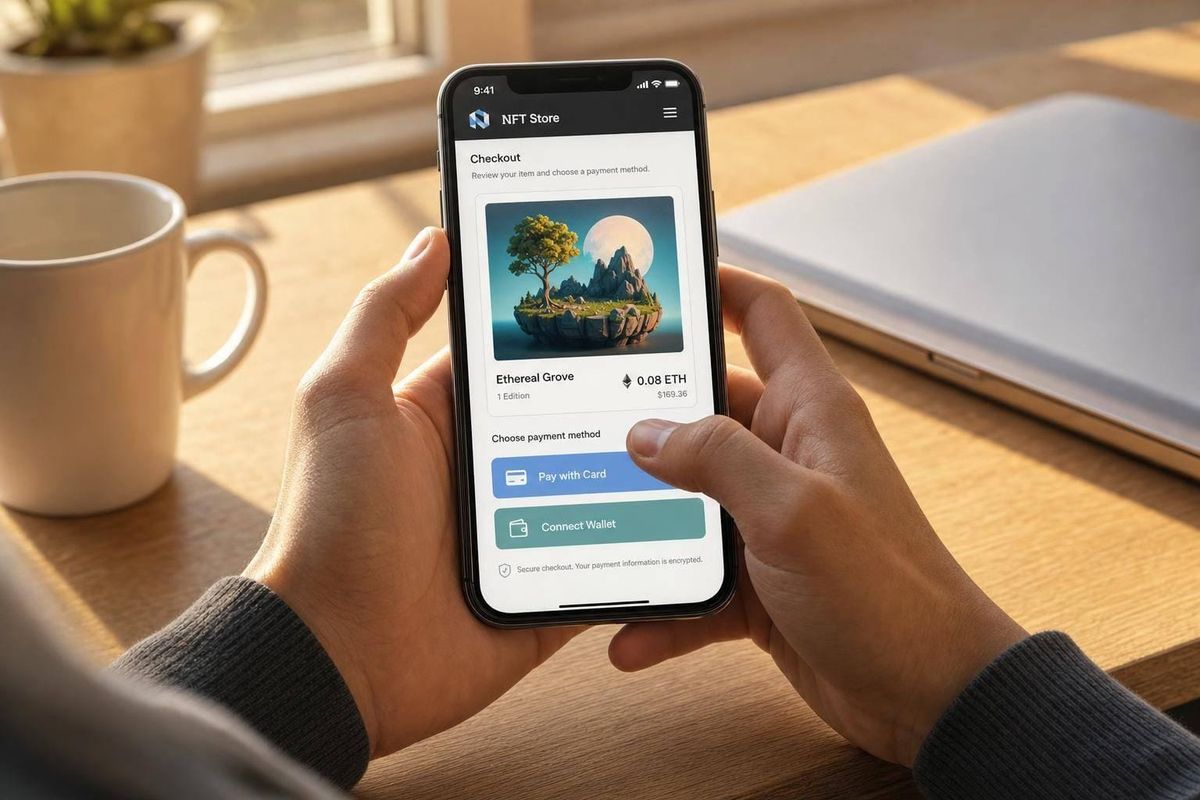
If I had to give one short answer, it would be this: card-first fits mainstream buyers, wallet-first fits crypto-native buyers, and hybrid fits stores that serve both.
I’d make the call based on five things:
- Conversion
- Chargebacks and fraud
- Support load
- Buyer education
- Mobile UX
A few numbers shape the choice fast:
- Shop Pay can convert 50% better than standard guest checkout
- 79% of Shopify traffic is mobile
- Mobile conversion is 37% lower than desktop
- Card payouts can be held for 120 to 180 days
- Wallet payments cut out card chargebacks, but bring more buyer questions
So the tradeoff is simple:
- Card checkout usually gets more people through checkout, mainly on mobile
- Crypto checkout filters for buyers who already know wallets and want onchain settlement
- Hybrid checkout works when you have both groups and can support both flows
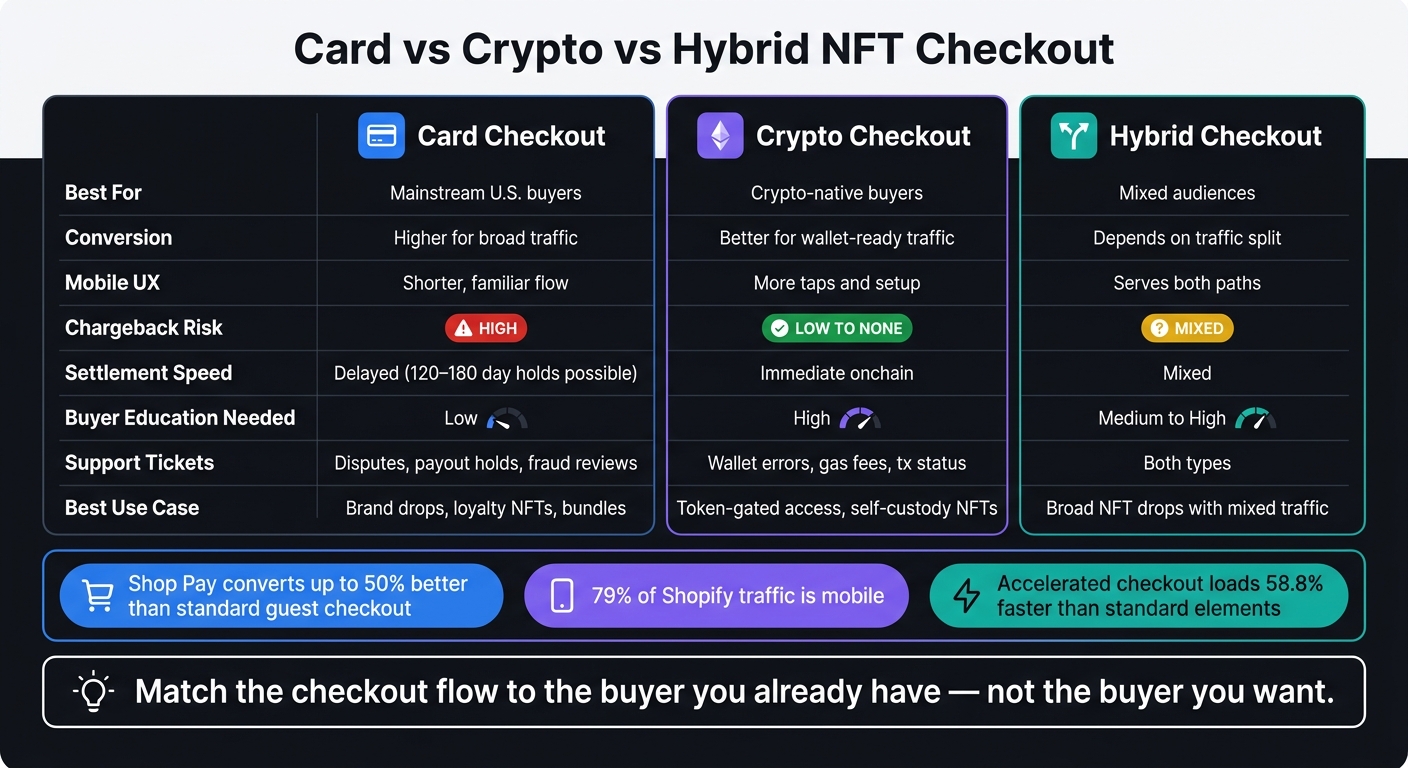
Card vs Crypto vs Hybrid NFT Checkout: Side-by-Side Comparison
Build an NFT Fiat Checkout - Buy NFT with Credit Card (Tutorial)
Quick Comparison
| Criteria | Card Checkout | Crypto Checkout | Hybrid |
|---|---|---|---|
| Best for | Mainstream U.S. buyers | Crypto-native buyers | Mixed audiences |
| Conversion | Higher for broad traffic | Better for wallet-ready traffic | Depends on traffic split |
| Mobile UX | Shorter, more familiar flow | More taps and setup | Can serve both paths |
| Chargebacks | High risk | Low to none | Mixed |
| Support work | Disputes, payout holds, reviews | Wallet help, gas, failed transactions | Both types |
| Buyer education | Low | High | Medium to high |
| Settlement | Can be delayed | Onchain and final | Mixed |
| Best use case | Brand drops, loyalty NFTs, bundles | Token-gated access, self-custody use cases | Broad NFT drops |
If I were advising a store today, I’d keep it simple: match the checkout flow to the buyer you already have, not the buyer you want.
Card checkout vs. wallet-first crypto: what each NFT payment flow looks like
Card-based NFT checkout for Shopify and WooCommerce stores

Card-based NFT checkout looks a lot like any other digital purchase. A buyer clicks Buy Now or Add to Cart and pays in USD with a card or a fast checkout option like Shop Pay, Apple Pay, or Google Pay. Minting usually starts after payment clears [1].
After the sale, the NFT goes to a wallet address the buyer enters, or to a custodial wallet set up for them so the process stays familiar. On mobile, fast checkout matters a lot. Less typing usually means fewer people bail before finishing. That’s a big reason card checkout often feels faster for mainstream buyers: most of the blockchain stuff stays out of sight.
Wallet-first crypto checkout for NFT-native buyers
Wallet-first checkout starts in a very different place: with wallet connection.
The buyer connects a self-custody wallet, usually MetaMask or another Web3 wallet, right at the start. They need to already have ETH or a stablecoin, pick the right network, and approve both the transaction and the gas fee in their wallet.
This flow fits buyers who already use crypto and want onchain settlement. On Shopify, wallet-first setup now depends on Checkout UI Extensions and Shopify Functions, not legacy checkout.liquid changes [1]. For merchants, that usually means more checkout setup than a card-first flow. And those extra prompts can hit harder on mobile, where every extra tap can chip away at completion.
The core flow difference: pay first with card vs. connect first with wallet
The main split is simple: card-first lets the buyer pay first, while wallet-first asks the buyer to connect first.
More steps usually mean more drop-off and more support issues for the store.
| Step | Card-First Checkout | Wallet-First Checkout |
|---|---|---|
| Starting point | Product page → Add to Cart | Product page → Connect Wallet |
| What buyer needs upfront | Credit/debit card | Funded crypto wallet |
| Currency | USD | ETH, stablecoins, or other crypto |
| Blockchain interaction | Happens post-purchase, behind the scenes | Happens during checkout (buyer approves) |
| Gas fees | Not visible to buyer | Buyer pays directly at transaction approval |
| Onchain visibility | Delayed | Immediate |
With card-first, the blockchain steps happen after payment, behind the curtain. The buyer doesn’t see gas fees during checkout. That single difference shapes the tradeoffs around conversion, fraud, support, and mobile performance discussed below.
How card checkout and crypto checkout compare on conversion and mobile UX
Why card checkout usually converts better for mainstream NFT traffic
Once the flow is clear, conversion usually comes down to one thing: how much friction shows up before the buyer can finish.
Card checkout tends to win for mainstream NFT traffic because it asks less from people at the start. Buyers don’t need to connect a wallet, pick a network, or make sense of onchain steps before they can pay. They just move through a checkout flow they already know.
That matters even more on mobile. Accelerated checkout options like Shop Pay, Apple Pay, and Google Pay cut down on manual entry, which is one of the biggest drop-off points on smaller screens. For brand-led NFT drops, a card-first setup usually works better because it feels familiar and fast.
Where wallet-first crypto wins on buyer intent
The picture changes with crypto-native traffic.
Wallet-first tends to convert best when buyers already expect to connect a wallet and complete an onchain transaction. If traffic is coming from Discord, X, or token-gated community traffic, those buyers are more likely to show up with a funded wallet and clear intent to buy.
In that setting, wallet-first doesn’t feel like extra work. It feels normal.
Mobile friction points that affect completion rates
Mobile is where the difference stands out most. Wallet-first adds a step before checkout even starts, while accelerated card checkout stays short and familiar.
Accelerated payment buttons also load 58.8% faster than standard checkout elements [2], which can help cut delay on small screens. For mainstream buyers, that one-tap biometric approval experience is still tough to beat.
| Factor | Card / Accelerated Checkout | Wallet-First Crypto |
|---|---|---|
| Payment familiarity | High - familiar to mainstream buyers | Low - requires crypto wallet familiarity |
| Mobile usability | High - one-tap biometric approval | Lower - wallet connection and network selection |
| Conversion friction | Minimal for existing network users | High for first-time or non-crypto buyers |
| Likely drop-off point | Card verification or fraud review | Wallet connection or network selection |
sbb-itb-61169e3
How card checkout and crypto checkout compare on fraud, support load, and buyer education
Card payments bring buyer familiarity but more disputes and review work
Once conversion is settled, the next issue is day-to-day risk. Card checkout feels familiar to buyers, which helps at the point of sale. But it also brings more dispute risk.
For NFT stores, the biggest problem is chargebacks and legitimate-charge disputes. A buyer can dispute a card charge even after receiving a digital asset.
There’s also a store-level risk that’s easy to miss. Card processors rely on automated risk scoring, and that can trigger merchant reviews [2]. NFT drops are an easy target here. A sudden jump in sales volume looks a lot like the kind of pattern those systems flag. Shopify Payments, for example, can freeze merchant funds for 120 to 180 days to cover potential chargebacks [2]. If you’re running a timed NFT drop, that kind of hold can squeeze cash flow at the worst moment.
Wallet-first crypto lowers chargeback risk but raises onboarding and support friction
Crypto checkout removes card chargebacks, but it moves risk somewhere else: wallet security and user mistakes.
Onchain payments are final. Once a transaction settles, a card network can’t reverse it. That cuts out most chargebacks and legitimate-charge disputes, which is a big plus for sellers of digital goods.
But there’s a catch. The support load doesn’t disappear; it changes shape. Instead of dealing with payment disputes, merchants end up handling buyer confusion. Wallet errors, gas fees, and transaction-status questions become the main ticket types. If your buyers aren’t already crypto-native, that education burden can grow fast and put pressure on a small CX team.
The support tradeoff: fewer payment disputes vs. more buyer hand-holding
The table below shows where each model creates work for the merchant:
| Area | Card Checkout | Wallet-First Crypto |
|---|---|---|
| Chargeback risk | High - especially for digital goods | Low to none - transactions are irreversible |
| Transaction finality | Low - funds can be held for 120–180 days [2] | High - immediate onchain settlement |
| Fraud review workload | High - automated flags and manual evidence handling [2] | Low for payment fraud; higher for phishing/security |
| Common support tickets | Frozen payouts, disputed charges, flagged accounts | Wallet errors, gas fees, and transaction status questions |
| Buyer education | Minimal | Heavy |
In practice, card-first stores use CX time on dispute documents and payout appeals. Crypto-first stores use that same time explaining wallets, gas, and what happened to a transaction. Neither path is free. They just ask for different skills from your support team.
When Shopify and WooCommerce NFT stores should choose card, crypto, or hybrid checkout
After looking at conversion, fraud, and support, the choice mostly comes down to who you're selling to.
Choose card-first when selling NFTs to mainstream U.S. buyers
Card-first checkout is usually the best default for NFT stores aimed at buyers who don't already spend time in crypto. Think premium brand drops, loyalty NFTs paired with physical products, or limited-edition digital collectibles sold to a broad audience. These buyers want checkout to feel like a normal online purchase. No learning curve. No wallet setup. No friction.
If your client gets a lot of mobile traffic and has a small support team, card-first isn't just simpler - it's easier to defend as a business call. That changes when the buyer already expects to pay with a wallet.
Choose wallet-first when the NFT depends on onchain utility
Go with wallet-first when the NFT only makes sense with self-custody, token-gated access, or other onchain actions. In those cases, the wallet isn't just a payment method. It's part of the product.
Dropping wallet-first checkout into a mainstream store will drag down conversion. For many shoppers, it feels like showing up to buy sneakers and being asked to learn a new system at the door. If both groups matter, hybrid checkout is usually the better fit.
Choose hybrid when the store serves both mainstream buyers and crypto-native collectors
Hybrid checkout - with both card and wallet payment paths - works well for stores running broad drops that pull in both audiences. A premium NFT collection can draw mainstream buyers and crypto-native collectors at the same time, and each group should get a checkout path that feels natural.
On Shopify, hybrid setups need Shopify Functions to show the right payment method based on wallet connection state [3]. That extra setup makes sense for stores with mixed traffic. For a store that mostly serves one buyer type, it's probably more than you need.
The table below shows how the choice lines up with the factors that matter most day to day:
| Factor | Card-First | Wallet-First | Hybrid |
|---|---|---|---|
| Audience type | Mainstream U.S. buyers | Crypto-native collectors | Mixed traffic |
| Product positioning | Brand drops, loyalty NFTs, physical bundles | Token-gated access, onchain utility, self-custody | Premium drops with broad reach |
| Mobile traffic mix | High (79%+) | Low to mid | High |
| Fraud tolerance | Lower - chargeback risk applies | Higher - lower chargeback risk | Moderate |
| Support capacity | Needs dispute-handling skills | Needs wallet/onboarding education | Needs both |
Use StoreCensus to find merchants ready for checkout optimization
Agencies can use StoreCensus to find Shopify and WooCommerce merchants already using NFT apps, wallet connectors, or crypto payment gateways. That makes outreach easier because you're starting with stores that already have the right stack in place.
Conclusion: The right NFT checkout depends on your buyers, not your preference
Card checkout works best for mainstream buyers. Wallet-first crypto works best for buyers who already use wallets and want utility-driven NFTs. Neither option wins in every case. The right choice comes down to the buyer profile the store sees most often.
For premium Shopify and WooCommerce stores, the biggest factors are fraud tolerance, support capacity, and traffic mix. Cold traffic usually needs the lowest-friction checkout. Warm email and SMS traffic can handle a few more steps.
For Shopify merchants, timing matters too. Legacy checkout customizations need to move to Checkout Extensibility before Aug. 28, 2026.
A simple rule for agencies advising NFT merchants
Optimize for the buyer the merchant has today, not the one the brand wishes it had. If the store gets cold, mobile-heavy traffic, card-first is usually the lower-friction path. If it serves warm, high-intent buyers, wallet-first can still work, even with extra checkout steps.
Start with the actual traffic data. Match the checkout model to that audience. Then move toward a hybrid setup only when the store has the support capacity and tech stack to run both paths cleanly.
FAQs
How do I know if my buyers are mainstream or crypto-native?
The clearest sign is simple: do your buyers already use crypto wallets, and do they like blockchain-based tools?
If the answer is yes, a wallet-first setup may feel natural. If they lean toward off-chain options like Discord roles for community gating, they’re often more mainstream and may not want to deal with wallet steps.
Merchant feedback points in the same direction. Community-based models often work better for non-crypto users than on-chain NFT verification.
So before you roll out wallet-first checkout, make sure buyers can use the required tools without friction.
What does a hybrid NFT checkout setup require?
A hybrid NFT checkout setup needs access controls in both the cart and the checkout. That matters because users can otherwise skip gated product rules by opening direct links.
It also needs server-side logic or theme app extensions to confirm wallet ownership or membership. On top of that, Shopify metafields can mark which products are gated.
In more complex setups, especially headless WooCommerce builds, you may also need custom tokenization and PCI handling across both the frontend and backend.
How should I test card-first vs wallet-first checkout?
Start by confirming that your audience can actually use crypto wallets. In many cases, the biggest source of friction isn't the offer itself. It's simple unfamiliarity.
Test in a secure development environment so you can isolate changes from live traffic. Focus on placement, checkout logic, and payment method availability. Then run A/B tests for 14 to 30 days so you can account for weekly seasonality and reach 1,000 to 5,000 sessions per placement.