
How UGC Moderation Impacts Shopify Merchant Growth
How moderating reviews, photos, and videos lifts Shopify conversion, cuts returns, and reduces legal risk for merchants.


Yes - moderation changes how UGC affects growth. If I clean up reviews, photos, videos, and Q&A, I can lift conversion, cut returns, lower legal risk, and make paid traffic work harder.
Here’s the short version:
- Visual UGC matters most: video reviews convert 4.1x better than text-only reviews, and photo reviews can drive a 2.6x lift.
- Quality beats volume: about 14.7% of UGC submissions get flagged for issues like spam, off-topic posts, profanity, or competitor branding.
- UGC helps sales when shoppers trust it: shoppers who interact with UGC convert at a 161% higher rate.
- Photos and videos reduce doubt: 91% of shoppers are more likely to buy when reviews include visuals, and customer photos can increase purchase likelihood by 137%.
- Bad moderation has a cost: 85% of shoppers are less likely to buy with no ratings or reviews, and nearly 25% may leave when customer photos are missing or poor.
- There’s legal risk too: as of July 2, 2026, FTC penalties can reach $51,744 per violation for fake or non-compliant review practices.
- The biggest wins usually come from review ranking, verified-buyer badges, and tighter photo/video screening.
- Some stores gain more than others: apparel, home, beauty, health, baby, and food & beverage stores often have more to gain because fit, safety, and product claims matter more.
If I had to put it in one line: moderation is not just cleanup - it helps turn UGC into sales proof that shoppers can use.
The article below explains where those gains come from, what poor moderation costs, and which merchant setups tend to get the most from this work.
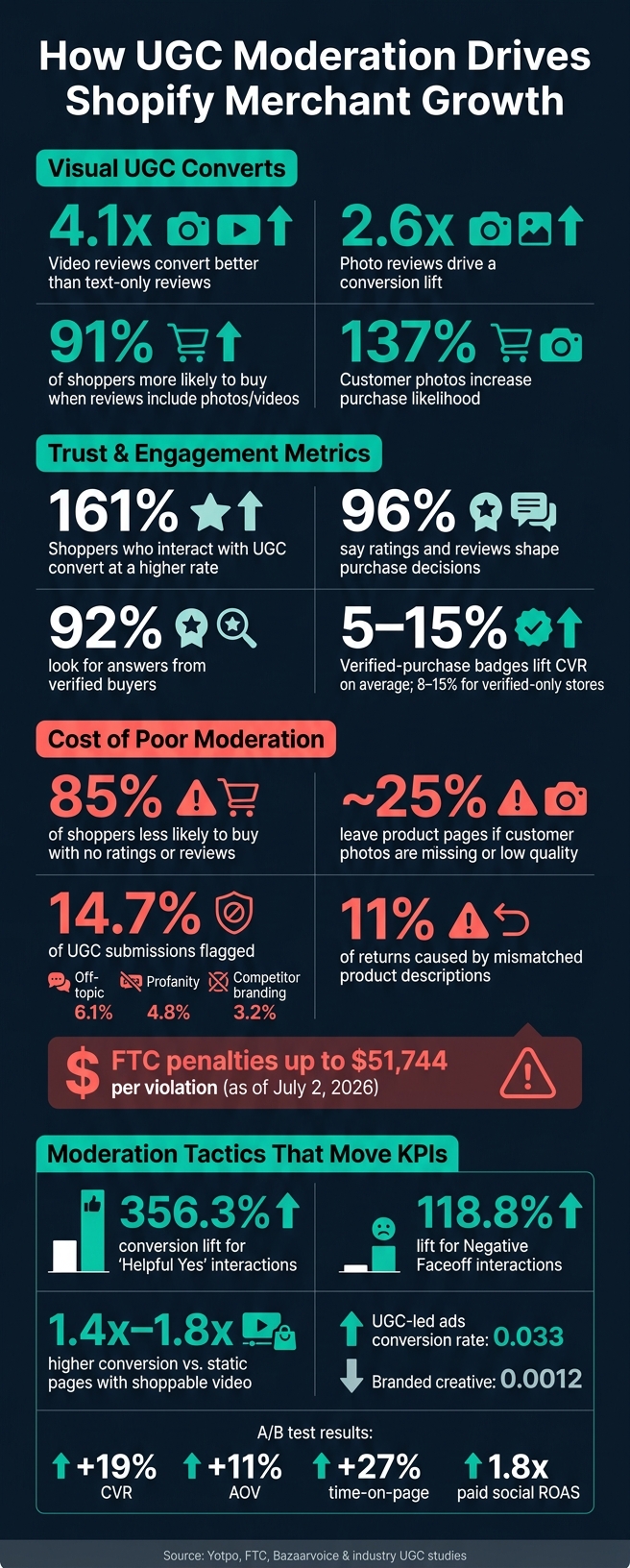
UGC Moderation Impact on Shopify Merchant Growth: Key Stats
How to Turn UGC Into a CVR Uplift Channel for Your Shopify Store

sbb-itb-61169e3
How high-quality UGC affects trust and purchase intent
Shoppers put more weight on customer feedback than brand copy. 96% say ratings and reviews shape purchase decisions, and 92% look for answers from verified buyers on product pages. For Shopify merchants, UGC is a trust signal, not window dressing. When moderation brings forward the best reviews, photos, and videos, that signal starts to change what people do on the product page.
The impact can be big. Shoppers who interact with UGC convert at a 161% higher rate than those who do not. When a page includes credible reviews, photos, or videos, there’s less room for doubt and fewer reasons to pause.
How detailed reviews and customer photos reduce hesitation
UGC works because it fills in the gaps that brand photography often leaves open: fit, scale, texture, and day-to-day use. Studio images show the polished version of a product. Customer photos show what it looks like in actual homes, in natural light, and on different body types. That difference matters.
ThirdLove has more than 100,000 five-star reviews in Yotpo and lets shoppers filter reviews by size to find similar-fit feedback. As cofounder and CEO Heidi Zak said:
"People really, really want to be able to search and filter by like-sized or like-minded people versus hearing us talk about the product. It's really amazing to have our customers talk about the product and their experience."
That kind of proof helps shoppers picture the product in their own lives. 91% of shoppers are more likely to buy when reviews include photos and videos alongside text, and customer photos increase purchase likelihood by 137%. In plain English: visual proof closes the gap between what shoppers see online and what they expect to get.
Which merchant KPIs move when shoppers engage with strong UGC
Those trust gains don’t stay abstract. They show up in page performance, basket size, and paid media results. In A/B testing across 2,000 product detail pages, UGC beat brand creative with a median of 19% in conversion, 11% in AOV, and 27% in time-on-page. UGC creative also delivered 1.8x the paid social ROAS of brand creative.
| KPI | UGC page | Brand-only page |
|---|---|---|
| Conversion Rate | +19% | Baseline |
| Average Order Value | +11% | Baseline |
| Time-on-Page | +27% | Baseline |
| Paid Social ROAS | 1.8x brand creative | Baseline |
Visual UGC can also help cut returns by setting clearer expectations around fit, texture, and scale. For merchants working with thin margins, moderation is a revenue lever, not just a brand-safety task.
What unmoderated UGC costs Shopify merchants
Weak moderation can turn UGC into a problem fast. Spam, fake praise, misleading claims, and off-topic photos don’t just look messy - they make people hesitate. Instead of helping a shopper feel sure, the content gets in the way. And that cost shows up in the numbers.
85% of shoppers are less likely to buy a product with no ratings or reviews, and nearly 25% will leave a product page if customer photos are missing or low quality. For Shopify merchants, that often means lower conversion, more returns, and extra support work.
The damage doesn’t stop on the product page. Returns, support tickets, and search visibility can all take a hit when bad content goes live. 11% of returns are caused by mismatched product descriptions, and misleading UGC around fit, color, or use can make that worse. On top of that, Google can issue Manual Actions when user-generated sections contain spam links or spam text, which can push those pages down in search results.
How fake and low-quality content undermines social proof
It doesn’t take much to shake buyer trust. A few off-topic photos, fake praise, or competitor mentions can be enough to make someone pause and leave. In a study of 8,400 UGC submissions, 14.7% were flagged for issues. That included off-topic content (6.1%), profanity (4.8%), and competitor branding (3.2%).
"One off-brand or inappropriate post can undo months of brand equity in an afternoon." - Rohin Aggarwal, Co-founder, Idukki
Fake positive reviews bring more than buyer doubt. They can also create legal trouble. Under the FTC's 2024 final rule, merchants are liable for knowingly displaying fake positive reviews or suppressing genuine negative reviews. As of 2026, the FTC can levy civil penalties of up to $51,744 per violation for fake or non-compliant review practices. Regulators are also using automated tools more often to spot this kind of content at scale.
Why moderation matters in regulated product categories
The stakes get higher in categories where product claims touch health, safety, or compliance. For merchants in beauty, health, and food and beverage, unmoderated UGC can create legal risk in a hurry. Reviews in these categories may include unsupported health or safety claims. In food and beverage, about 0.5% of unmoderated text reviews contain misinformation or unfounded health claims.
That may sound like a small share, but even a small amount of bad content can cause big problems when shoppers rely on it. In these categories, moderation isn’t just about cleaner content. It helps protect revenue and cut legal exposure.
| Dimension | Unmoderated UGC | Moderated UGC |
|---|---|---|
| Trust signals | Fake praise, spam links, offensive content | Verified-buyer badges, visual proof from real customers |
| Short-term conversion | Nearly 25% of shoppers leave if customer photos are missing or low quality | 5–9% higher add-to-cart rates with customer photos |
| Return rates | Higher; mismatched claims drive 11% of returns | Lower; real-world context sets accurate expectations |
| Legal exposure | High; FTC penalties can reach $51,744 per violation | Lower; documented removal logs and verified reviews |
Moderation tactics with measurable effects on conversion and revenue
Once moderation blocks harm, the next step is simple: use it to drive more sales. The best gains usually come from three places: ranking, verification, and visual curation.
How filtering, ranking, and transparency make reviews more useful
The point of moderation isn't just removing junk. It's making the most useful reviews easy to spot. When shoppers can find the review that answers their question, they buy with less friction.
Helpfulness ranking is a clear case. If shoppers can vote a review as "Helpful", the best reviews move up first. That matters. Shoppers who mark a review Helpful Yes convert 356.3% more often, and even shoppers who mark it Helpful No convert at a 271.9% higher rate. In plain English, people who interact with reviews are showing strong buying intent.
Negative reviews matter too. In many cases, they help close the sale. Showing a "Review Faceoff" - the most helpful positive review next to the most helpful negative review - gives shoppers a fast read on the tradeoff. Shoppers who open the negative faceoff convert 118.8% more often. And shoppers who filter for one-star reviews show a 71.9% conversion lift. That sounds backward at first, but it makes sense: people want to see the downside before they commit.
Verification also works better when it's tied to something real. A "Verified" badge linked to actual Shopify order records carries more weight than a badge based on an email match or self-reporting. Reviews with that kind of order-backed verification lift conversion 5–12% on average versus unbadged reviews. Stores that show only verified reviews see lifts of 8–15%.
| Moderation Tactic | Metric Impacted | Measured Effect |
|---|---|---|
| Helpfulness ranking | Conversion rate | 356.3% lift for "Helpful Yes" interactions |
| Review search & filtering | Conversion rate | 271.9% lift in conversion for search users |
| Verified-purchase badges | Purchase confidence | 5–12% average CVR lift; 8–15% for verified-only stores |
| Negative review transparency | Trust & conversion | 118.8% lift for Negative Faceoff interactions |
| Spam & fake review filtering | Trust / compliance | Prevents FTC violations and trust erosion |
| Visual UGC curation | Return rate / AOV | Reduces fit/color uncertainty and improves ad performance |
How visual UGC moderation affects returns, AOV, and ad performance
Visual UGC does more than make a product page look active. When it's reviewed well, it sets cleaner expectations on fit, color, and scale. That can cut returns. If photo and video submissions are checked for quality and accuracy - and low-quality uploads or images with competitor branding are removed - stores can reduce return rates tied to mismatch and disappointment.
It can also move revenue. Shoppable video on product pages converts 1.4x to 1.8x higher than static pages. Video reviews convert 4.1x better than text-only reviews.
The same content can outperform brand-made ads in paid media too. UGC-led ads post a conversion rate of 0.033, versus 0.0012 for branded creative. That's not a small gap.
There is one catch. AI classifiers still make mistakes in visual moderation. Swimwear and beauty content can get flagged as explicit at about a 14% false-positive rate. That's why these categories need a human check before anything goes live.
For most high-volume Shopify merchants, the workflow is pretty direct:
- AI clears 70–80% of the queue automatically, including spam, profanity, personal data, and competitor logos
- Human reviewers handle the edge cases before approval
That setup keeps turnaround times short without letting weak or risky content slip through.
For agencies, the best ROI tends to come from merchants with enough UGC volume to rank, verify, and curate at scale.
What this means for agencies and growth teams working with Shopify merchants
For agencies, UGC moderation isn't just cleanup work. It's a conversion lever with a direct revenue impact. In many cases, the best-fit merchants can be spotted before you ever reach out.
The next step is figuring out where moderation work is most likely to pay off first.
How to find merchants where moderation work has the highest ROI
The strongest prospects tend to share three traits: enough UGC volume to curate, a category where trust plays a big role, and a tech stack that shows they're already putting money into social proof but haven't tuned it yet.
A strong place to start: merchants spending $5,000+ per month on Meta ads. When ad comment sections go unmoderated, CAC goes up and buyer trust slips. In regulated categories like Beauty, Health, Baby, and Food & Beverage, moderation tends to pay back fast because trust gaps cost more.
These merchant groups stand out most for moderation-led gains:
| Merchant Segment | Common UGC Signals | Moderation Gap | Potential Business Impact |
|---|---|---|---|
| High-Growth DTC | $5,000+ monthly Meta spend; 15–20 new ad creatives/week | Unanswered buying intent in comments; spam takeover | Higher CAC; lost sales in ad comments |
| Regulated (Beauty/Health/Baby/Food & Beverage) | High text review volume; health or safety claims | Unverified claims in high-risk categories | Refund exposure; erosion of high-stakes trust |
| Visual-Heavy (Apparel/Home) | 200+ daily posts; heavy photo/video volume | Competitor logos in backgrounds; unclear rights for reuse | Higher return rates; brand dilution; legal exposure |
StoreCensus makes this practical. You can filter across 6M+ Shopify and WooCommerce stores by revenue band, tech stack, category, and growth signals. So instead of casting a wide net, you can zero in on merchants in the $1 million–$10 million revenue range that already use a review app but still lack structured markup. That's a strong sign that moderation work and UGC systems could have real leverage.
Conclusion: moderation builds trust, and growth follows
Once you've found the right merchants, moderation stops being a theory problem and becomes an execution one.
UGC helps drive growth only when moderation makes it trustworthy, usable, and compliant. Shoppers who interact with UGC convert at a 161% higher rate than those who don't. StoreCensus helps you find those merchant setups and lead with proof.
FAQs
How much UGC is enough to justify moderation?
You don’t need a huge amount of content to make moderation worth it. Even a small set can move the needle: just 10 reviews can drive a 53% conversion uplift.
That’s why moderation matters at any volume. It helps protect brand safety and keeps the content relevant to the shopper. The better approach is to use rights-cleared, high-impact content on product detail pages instead of building a big gallery that no one manages.
What should merchants moderate first for the fastest lift?
Start with automated screening for the most common risks: spam, profanity, and clearly fraudulent reviews. That helps protect brand trust and keeps your site readable and credible, without slowing everything down with manual review.
At the same time, put product detail pages first and make sure each one has at least 10 reviews. That threshold alone can drive a 53% conversion lift.
When should human review be added to AI moderation?
Add human review when AI can’t sort out gray-area content with confidence. That includes things like competitor mentions, products that are partly hidden, or claims that may need a compliance check.
A good setup is simple: let AI handle high-volume, real-time screening, then send flagged edge cases to a human review queue.
It also helps to spot-check what the model already approved. A common best practice is to audit 5% to 10% of auto-approved content each week. That gives teams a way to catch model drift early and keep decisions accurate, consistent, and compliant.