Blockchain and Circular Supply Chains: 2026 Data
2026 snapshot: blockchain in circular ecommerce is niche but growing—enterprise-led traceability in fashion, food, and electronics.

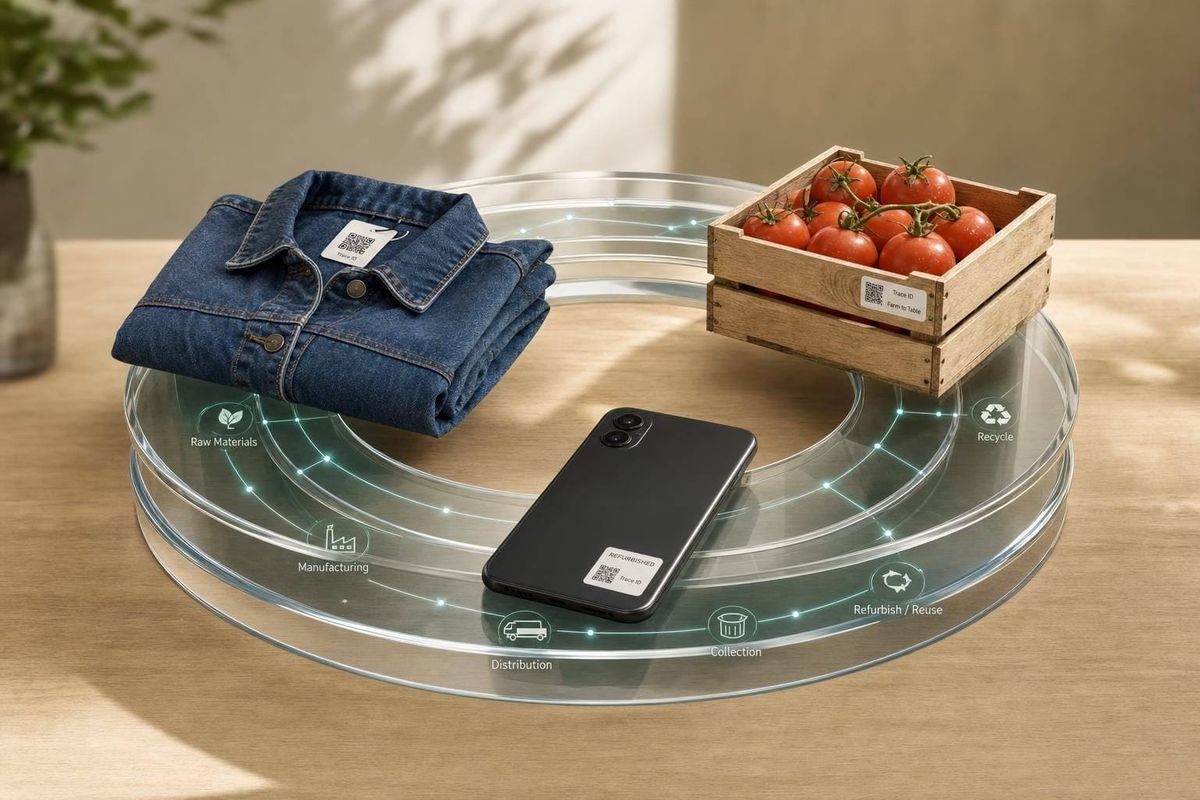
Here’s the short answer: in 2026, blockchain in circular ecommerce is still a small market, but it’s no longer just a test. I see the best fit in enterprise and upper mid-market merchants that already deal with traceability, returns, recycling, repair, and compliance.
The data is pretty clear. The global blockchain supply chain market went from $3.594 billion in 2023 to a projected $4.413 billion in 2026. But usage in circular ecommerce is still concentrated in a few places: fashion, food, and electronics; mainly in Europe, the U.S., and export-led Asia-Pacific; and mostly among larger merchants.
If I were using this data to pick accounts in 2026, I’d keep it simple:
- Go after merchants with proof-heavy use cases, not broad brand claims
- Prioritize EU-facing fashion brands dealing with DPP and EPR rules
- Look at food and beverage sellers with batch traceability or FSMA 204 pressure
- Put electronics brands with repair, resale, or e-waste programs on the list
- De-prioritize most SMBs unless they already show clear traceability or provenance needs
What matters most is not lower cost. It’s faster verification, shared records across partners, and easier compliance work. That’s why blockchain shows up most often in:
- Digital product passports
- Product and batch traceability
- Reverse logistics and returns
- Recycling and material chain-of-custody records
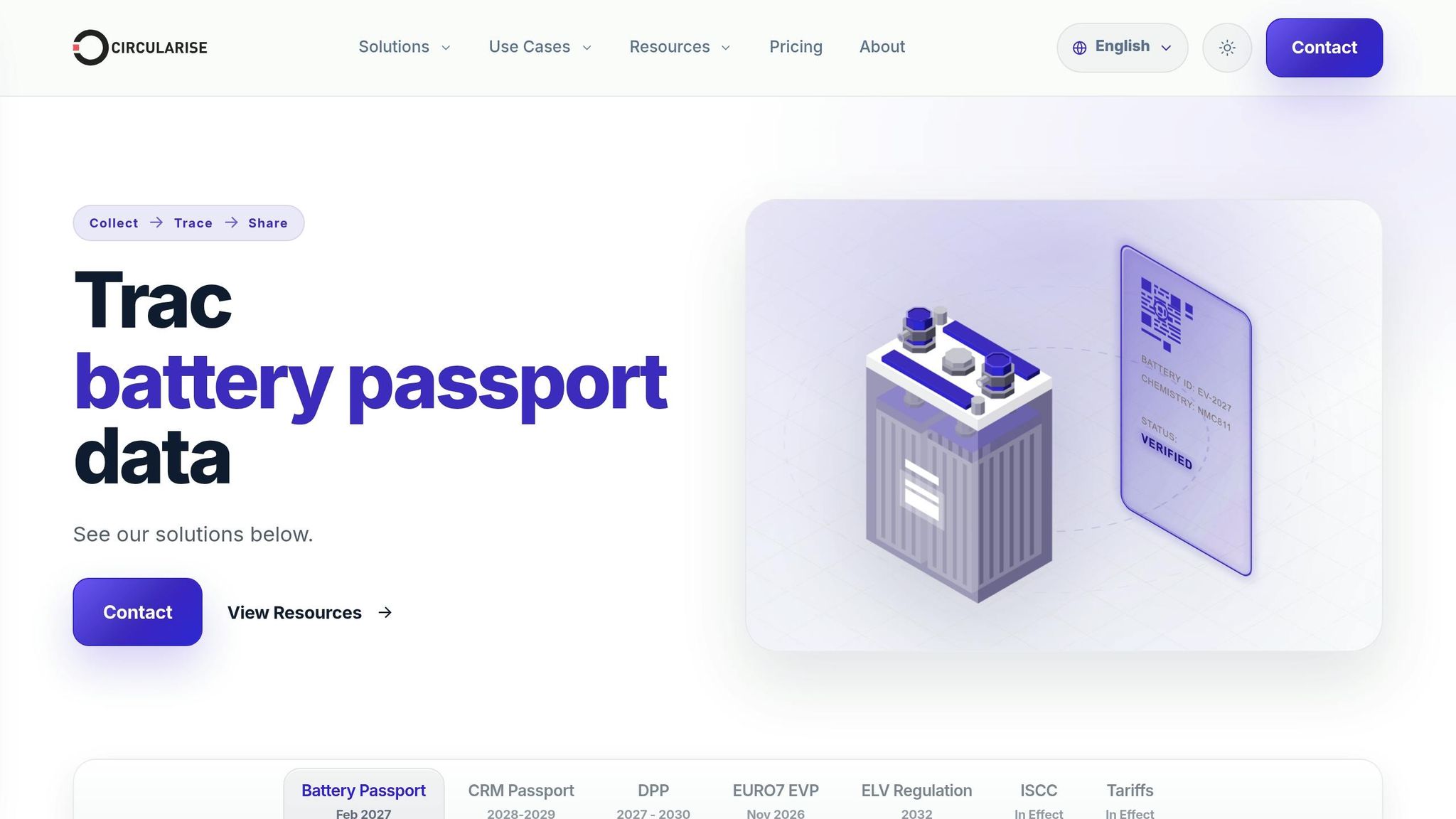
Circularise: Using Blockchain to Accelerate the Circular Economy
Quick comparison
| Area | Where I see the most activity | Main push in 2026 | Best outbound fit |
|---|---|---|---|
| Fashion & apparel | Europe, EU-linked suppliers | DPP and textile rules | Enterprise and mid-market brands selling into the EU |
| Food & grocery | U.S. and global supply chains | FSMA 204, recall tracking, retailer demands | Mid-market and enterprise merchants |
| Electronics | Europe and large enterprise networks | Repair, e-waste, reverse flow tracking | Enterprise brands |
| Beauty & wellness | Smaller but growing segment | Ingredient provenance, anti-counterfeit use cases | Select mid-market brands |
For me, the takeaway is simple: don’t pitch blockchain to every ecommerce brand. Focus on merchants already investing in take-back programs, traceability data, reverse-logistics tools, or compliance work. That’s where the 2026 opportunity sits.
Where blockchain is actually used in circular supply chains
Traceability and digital product passports
The clearest real-use case for blockchain in circular ecommerce is product-level traceability.
In apparel, brands use blockchain to log fiber origin, material composition, chemicals, and end-of-life routing inside an auditable product passport. The main policy push here comes from the EU's Ecodesign working plan (2025–2030). For exporters selling into Europe, DPP readiness is starting to look less like a nice extra and more like a market-access requirement. That shift moves factories with DPP-ready data systems closer to the top of the sourcing list.[4]
In June 2026, the regenerative apparel brand SanjaStories, working with Vestis Labs, launched a DPP trial validated against the CIRPASS-2 model. The passport lets customers add post-purchase events, such as wash cycles and repairs, straight into the product's digital record.[5]
You can see a similar pattern in supplements, CBD, and hemp, where batch-level traceability shows up through QR-linked certificates of analysis.[8][9]
The same idea carries over when products move in reverse through returns, recycling, and resale.
Reverse logistics, returns, and recycling flows
Blockchain tends to matter most in reverse logistics when several parties need to work from the same record. Think suppliers, carriers, and payment systems all trying to match orders, shipment events, and invoices. In those settings, reconciliation disputes can eat up time and money fast.
That helps explain why large enterprises are leaning toward permissioned blockchain networks to keep orders, transportation events, and payments aligned.[6][7] Shared ledgers earn their keep when carriers, suppliers, and finance systems all need to stay in sync.
In July 2026, Volvo Group disclosed a successful pilot on a permissioned blockchain network for transactions among material suppliers and transport companies in Belgium. Led by Ivan Branco, Head of Information Management, the system created a shared ledger for orders and payments to cut reconciliation work across separate systems.[6]
In a separate case, LG CNS and POSCO International deployed digitized receivables on the Injective blockchain using actual commercial invoice data from POSCO's international operations. They plan to move the platform into full production before the end of 2026.[7]
For e-waste and material recovery, Volvo Cars has used blockchain since 2019 to trace cobalt through its battery supply chain. The system records weight and chain of custody across suppliers to verify ethical sourcing.[6]
The pattern is pretty clear: blockchain matters when many parties need one trusted record and the cost of disputes is high.
What the research agrees on and where gaps remain
Across the research, one point keeps showing up: blockchain helps when suppliers, carriers, and recyclers need one reconciled record. Immutable ledgers also make it harder for companies to revise sustainability claims after the fact.[8]
But the weak spots are just as clear.
DPPs only work when factories connect ERP, PLM, supplier portals, and lab data into one auditable record. Doing that work at the design stage is far easier than trying to piece it together later.[4][5] Supplier onboarding is another sticking point, especially for smaller vendors that don't have the technical know-how to join shared ledger systems.[6]
Cost and unclear ROI are still major reasons SMBs have moved more slowly. On top of that, interoperability across blockchain networks remains unsolved at scale.
| Barrier | Who It Affects Most |
|---|---|
| Data quality and system integration | All merchant sizes |
| Supplier onboarding and technical capacity | SMBs and mid-market |
| Cost and unclear ROI | SMBs |
| Interoperability between networks | Enterprise and mid-market |
| Limited blockchain knowledge | Smaller suppliers |
These limits help explain why adoption tends to cluster by product category, country, and merchant size.
sbb-itb-61169e3
Adoption by category, country, and merchant size
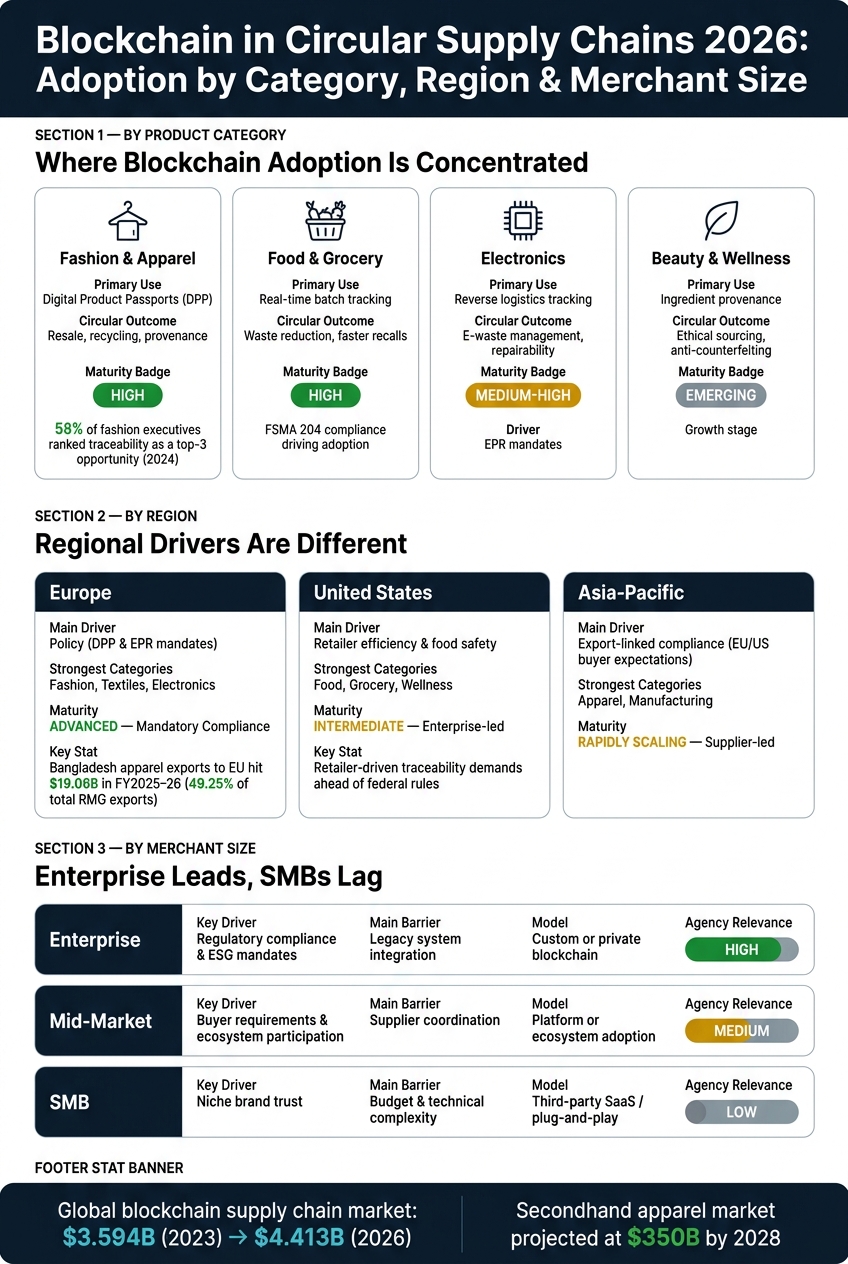
Blockchain in Circular Supply Chains 2026: Adoption by Category, Region & Merchant Size
Adoption tends to bunch up where the pressure is hardest: regulation, buyer demands, or messy reverse logistics.
Category data: food, fashion, and electronics lead adoption
By mid-2026, fashion and food are out front. EU DPP rules and food-safety compliance are pushing both categories ahead.[1][4]
Fashion stands out. In 2024, 58% of fashion executives said traceability was one of their top three opportunities.[10] At the same time, the global secondhand apparel market is projected to hit $350 billion by 2028.[10] But the supply chain is still pretty opaque:
- Only 24% of major brands disclose raw-material suppliers
- Only 34% disclose processing facilities
- Less than 1% of clothing material is recycled back into new clothing[10]
That gap in visibility is exactly where blockchain is showing up.
Electronics is a step behind. Most activity is in enterprise reverse logistics, repairability, and e-waste management. Beauty and wellness is starting to grow around ingredient provenance and anti-counterfeiting.[8]
| Category | Primary Blockchain Use | Circular Outcome | Maturity |
|---|---|---|---|
| Fashion & Apparel | Digital Product Passports (DPP) | Resale, recycling, and provenance verification | High - regulatory mandate |
| Food & Grocery | Real-time batch tracking | Waste reduction and faster safety recalls | High - global standard |
| Electronics | Reverse logistics tracking | E-waste management and repairability | Medium-High - EPR-driven |
| Beauty & Wellness | Ingredient provenance | Ethical sourcing and anti-counterfeiting | Emerging - growth stage |
The pattern is simple: categories move faster when policy pressure is stronger.
Country data: U.S., Europe, and Asia-Pacific follow different drivers
Europe is leading because of policy. The revised EU Waste Framework Directive gives Member States 20 months to transpose the rules and 30 months to launch EPR schemes for textiles and footwear.[4] That clock is ticking. For brands selling into the EU, DPP readiness is moving from a nice-to-have to a requirement.
The U.S. looks different. It is being pushed more by retailers than by regulators. Large retailers are pushing digital traceability demands down their supplier chains, especially in food safety and grocery, often ahead of federal rules.[1] So adoption is showing up more at the enterprise level, but without the same legal push seen in Europe.
Asia-Pacific is being driven by exports. Bangladesh’s apparel exports to the EU reached $19.06 billion in FY2025–26, which was 49.25% of the country’s total ready-made garment exports.[4] For factories tied to those supply chains, DPP readiness is not optional in practice. It’s a business requirement. The region is scaling fast, but the push is coming from EU and U.S. buyer expectations more than local policy.
| Region | Main Driver | Strongest Categories | Maturity Level |
|---|---|---|---|
| Europe | Policy - DPP and EPR mandates | Fashion, textiles, electronics | Advanced - mandatory compliance |
| U.S. | Retailer efficiency and food safety | Food, grocery, wellness | Intermediate - enterprise-led |
| Asia-Pacific | Export-linked compliance | Apparel, manufacturing | Rapidly scaling - supplier-led |
Inside each region, merchant size changes how these rollouts happen.
Merchant size data: enterprise leads, mid-market follows, SMBs lag
Enterprise merchants are leading. At that level, blockchain is now being used as a compliance tool and a way to meet buyer demands. The main headache is integration. Most legacy ERP and PLM systems were never built for circular workflows, so connecting them to blockchain systems takes work.
Mid-market merchants usually come in through ecosystems, supplier portals, or traceability platforms. The hard part here is less about software and more about getting suppliers aligned and keeping data flowing across partners.
SMBs are still behind. Budget limits and technical complexity are the biggest blockers. When smaller merchants do adopt, it is usually for ingredient provenance or counterfeit protection. If they do not already need one of those use cases, blockchain tends to stay low on the priority list.
| Segment | Key Driver | Main Barrier | Common Implementation Model | Agency Relevance |
|---|---|---|---|---|
| Enterprise | Regulatory compliance and ESG mandates | Legacy system integration | Custom or private blockchain | High - complex builds, consulting |
| Mid-Market | Buyer requirements and ecosystem participation | Supplier coordination | Platform or ecosystem adoption | Medium - implementation support |
| SMB | Niche brand trust and market differentiation | Budget and technical complexity | Third-party SaaS, plug-and-play tools | Low - turnkey solutions only |
What the numbers mean for agency positioning and account selection
Use the adoption patterns above to rank merchants that are already paying for circular operations. That concentration gives you a simple outbound rule: go after merchants already funding operational proof, not brand language.
How to read circular supply chain readiness from merchant signals
The clearest signals are structural, not cosmetic. A merchant with a vague "we care about the planet" banner is not a high-fit account.
High-intent signals to look for:
- Structured materials transparency on PDPs, including fiber breakdowns, sourcing origin, and QR-linked product history
- Active take-back, repair, or resale programs
- Refill subscription logic powered by apps like Recharge or Recurpay
- Third-party certification badges such as B Corp, GOTS, Fair Trade, or FSC
- Live impact counters tied to named verification partners like Verra or Veritree
- Sustainability content tied directly to compliance language - "DPP", "EPR", "FSMA 204" - instead of brand storytelling
When merchants move from brand claims to auditable data, they become much stronger fits. Related software spend can also tell you a lot. Carbon-neutral shipping and offset apps often point to a willingness to pay for traceability and reverse-logistics systems.
That gives you a tighter, cleaner target list.
How to build targeted lists inside StoreCensus
Start with category. Then narrow by geography. Then check the tech stack.
In fashion, put EU-facing brands at the top of the list. DPP compliance makes the need concrete. In food, focus on merchants showing farm-to-shelf traceability or organic certifications on their PDPs. For electronics, the best targets are accounts already talking about repairability or e-waste programs.
U.S.-based food merchants are being pushed by FSMA 204 compliance. European-facing fashion brands are under direct regulatory pressure. If you narrow your list to one of those two setups, your outreach stays specific and useful instead of sounding generic.
Inside StoreCensus, you can filter Shopify and WooCommerce stores by the apps they use. Merchants running subscription apps for refills or reverse-logistics tools have already shown circular intent through spend. That's a much stronger buying signal than category alone. After you build the list, StoreCensus shows decision-maker contact data, so you can move straight to outreach without a separate enrichment step.
Which accounts are worth outbound in 2026
The table below turns those signals into account-selection priorities.
| Account Type | Positive Signals | Red Flags | Likely Need | Outreach Priority |
|---|---|---|---|---|
| Enterprise Fashion (EU-facing) | DPP mentions, EPR compliance language, B Corp status, materials breakdown on PDP | Vague "natural" or "green" claims, no sourcing data | Compliance-ready Digital Product Passports | High - regulatory deadline |
| Mid-Market Food & Beverage | Farm-to-shelf traceability, organic certifications, batch-level QR codes, FSMA 204 mentions | No origin data, no sourcing transparency on product pages | Verifiable batch traceability and recall readiness | High - safety and recall urgency |
| Mid-Market Beauty & Wellness | Refill subscription apps, take-back portals, EWG verified badges | Single-use packaging focus, no ingredient transparency | Material provenance to justify premium pricing | Medium-High - growth and LTV focus |
| Enterprise Electronics | Repairability scores, e-waste recycling programs, modular product design | No end-of-life management mentions | Reverse logistics tracking and EPR compliance | Medium - regulatory pressure building |
| SMB / Boutique | Generic eco claims only | No traceability data, low budget | No clear blockchain use case | Low |
For 2026, the priority sits with enterprise and mid-market accounts. In plain terms, your outbound list should stay tight and centered on that smaller group.
Conclusion: The narrow but real 2026 opportunity
The 2026 data points to a narrow but real use case. Blockchain activity is clustered in a small set of categories, regions, and merchant sizes. Most SMBs aren't running their own blockchain systems. Instead, they tend to show up through resale platforms and consignment channels. And that concentration looks a bit different from one region to another.
The U.S. and Europe are moving for different reasons. In Europe, regulation is a big driver. In the U.S., cost pressure is doing more of the work. U.S. tariffs are pushing merchants toward domestic circularity and reclaimed materials as a hedge against rising costs.[3][11] For agencies, the takeaway is pretty clear: the opportunity is in choosing the right merchants, not trying to cover the whole market.
That’s what shapes the best-fit accounts. Focus on enterprise and upper mid-market merchants in fashion, food, and electronics.[2][13][14] Put Europe-facing brands higher on your list if they’re under regulatory pressure, and look closely at U.S. merchants dealing with tariff-led cost inflation.[3][11][14]
Before outreach, look for signs that circular programs are already on the table. Good signals include:
- Take-back or resale pages
- Catalog expansion tied to resale or reuse
- New returns or resale apps
Those markers help confirm circular intent before you reach out.[2][12] Stay inside the concentrated part of the market, and your outreach will feel far more relevant than a broad sweep.
FAQs
Is blockchain worth it without a compliance mandate?
Yes. Even without a mandate, blockchain can help with risk mitigation, smoother day-to-day work, and a stronger market position.
It gives companies a decentralized, tamper-resistant shared record across complex supply chains. That can cut down on errors and fraud that often come from siloed databases.
It also improves end-to-end visibility. In plain English, businesses can see more of what’s happening across the supply chain and respond to rising demand for transparency and ethical sourcing, even without waiting for regulators to force the issue.
What should a merchant have in place before adopting blockchain?
Before adopting blockchain, a merchant should pinpoint the exact supply chain problems they want to fix. That might mean bottlenecks, manual mistakes, or poor visibility into how suppliers are performing.
They should also check whether their current tools can connect with blockchain without creating separate systems that don't talk to each other. And just as important, they need to make sure their audience can actually use the required digital tools, such as crypto wallets or QR code scanners.
How can agencies spot high-fit blockchain prospects in 2026?
Agencies should look past basic firmographics and use StoreCensus to find merchants based on technographic gaps and real-time activity signals.
Focus first on stores that show high intent. That can mean a tech stack upgrade, a growing catalog, or both. These signals usually point to a brand that’s spending money and making changes now, not someday.
Use StoreCensus to filter Shopify and WooCommerce stores for brands that likely have the budget for more advanced services. Then go after tech mismatches and recent app installs. Those moves often suggest the brand is actively trying to fix transparency or sustainability issues.