Top AI Tools for Shopify Revenue Forecasting
Compare top AI tools for Shopify revenue forecasting and choose the right stack for SKU-level and market-level insights.

Running a Shopify store without accurate revenue forecasting can lead to inventory issues, overspending, or financial strain. AI-powered tools now provide Shopify merchants with precise revenue predictions by analyzing sales, marketing, and external tech stack data, reducing forecasting errors from 25–40% (with spreadsheets) to just 5–15%. These tools are essential for store founders, agencies, and large brands to make smarter decisions about inventory, staffing, and marketing budgets. Many of these insights are derived from studying a comprehensive list of Shopify stores to benchmark performance against industry standards.
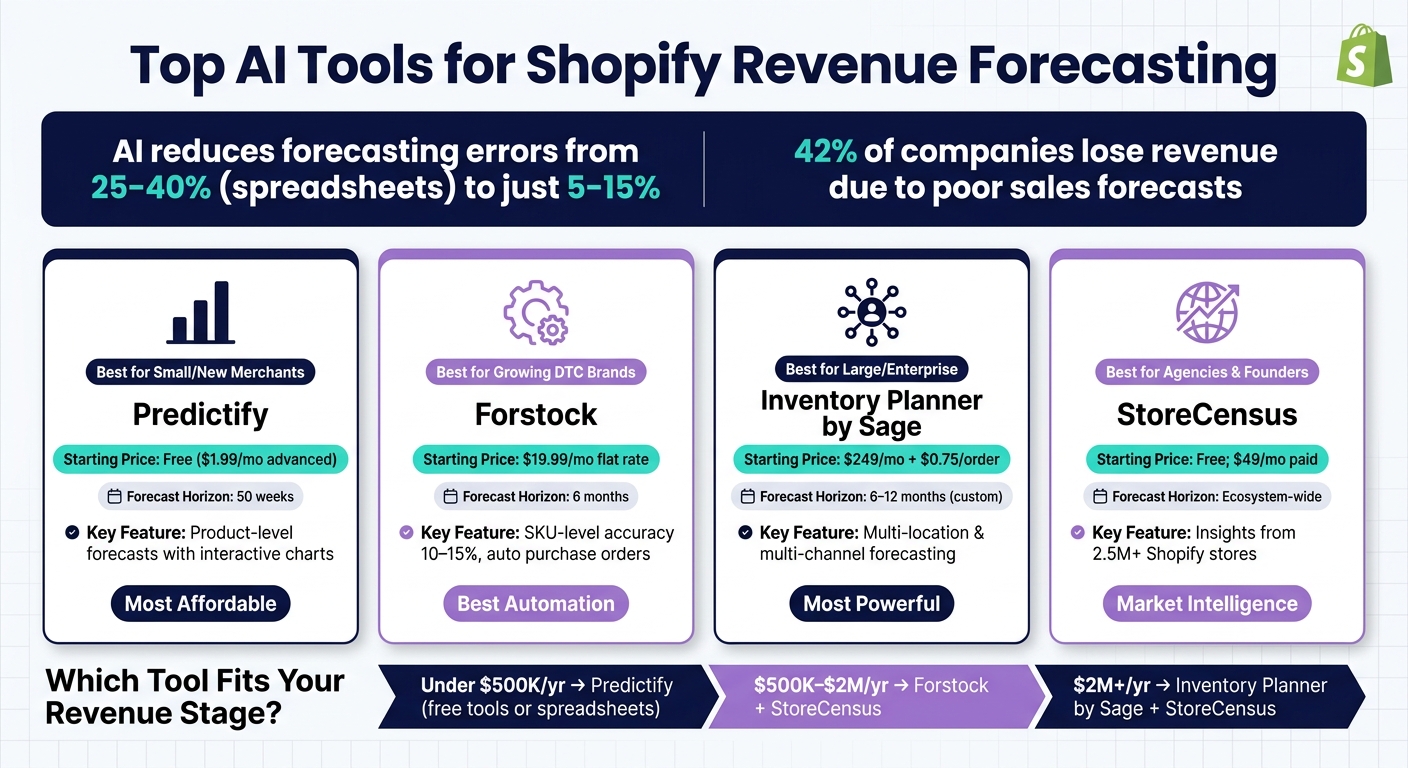
Top AI Tools for Shopify Revenue Forecasting: Side-by-Side Comparison
5-minute Shopify inventory plan: Julius AI analysis

sbb-itb-61169e3
Key Takeaways:
- What They Do: AI tools predict revenue by analyzing historical sales, marketing performance, and trends.
- Who They Help: Shopify-focused agencies, growing store founders, and large brands with complex operations.
- Top Tools:
- Predictify: Affordable, simple forecasts for small merchants ($1.99/month).
- Forstock: SKU-level projections with automated purchase orders ($19.99/month).
- Inventory Planner by Sage: Advanced multi-channel forecasting for large-scale operations ($249/month + $0.75/order).
- StoreCensus: Market-wide insights for agencies and founders, starting at $49/month.
Quick Comparison:
| Tool | Best For | Starting Price | Forecast Horizon |
|---|---|---|---|
| Predictify | Small/new merchants | Free ($1.99/month) | 50 weeks |
| Forstock | Growing DTC brands | $19.99/month (flat rate) | 6 months |
| Inventory Planner | Large/complex operations | $249/month + $0.75/order | Custom/enterprise |
| StoreCensus | Market-level insights | Free; $49/month | Ecosystem-wide |
Choose based on your store's size, revenue, and operational complexity. A layered approach often works best: operational tools for SKU-level precision and broader tools like StoreCensus for market insights.
How AI Revenue Forecasting Works for Shopify Stores
Understanding how forecasting tools operate can help you choose the right one and build confidence in its predictions.
Core Forecasting Methods
AI forecasting tools often use a mix of models to generate accurate predictions. These include ARIMA, SARIMA, Prophet, and Greykite. Each model shines under specific conditions: ARIMA handles stable trends well, Prophet focuses on seasonality and holidays, while Greykite manages irregular patterns effectively. Many tools also apply cohort-based projections, which separate revenue from new and returning customers, predicting income by analyzing how specific customer groups behave over time. Additionally, some platforms use unsupervised learning techniques, such as isolation forests, to detect anomalies like pricing errors or fraud.
"Felix predicts revenue eight weeks ahead, retrained nightly on your accounts. Confidence narrows over time as he learns your business." - Cresva
These models depend heavily on quality data, which we'll explore next.
Key Data Sources Used in Forecasting
The reliability of AI-generated forecasts is directly tied to the data it processes. Here's a breakdown of the key data categories and their roles:
| Data Category | Specific Data Points | Role in Forecasting |
|---|---|---|
| Shopify Core | Orders, AOV, refunds, SKU variants | Establishes baseline demand and identifies trends |
| Marketing | Ad spend (Meta, Google, TikTok), ROAS, email CTR | Helps predict promotional spikes and CAC effects |
| Inventory | Lead times, safety stock, warehouse capacity | Prevents stockouts and overstocking |
| External | Weather, competitor pricing, social sentiment | Adjusts for external, market-driven demand shifts |
| Customer | LTV, churn risk, repeat purchase rates | Enables segment-specific revenue predictions |
Advanced platforms analyze 47+ market variables and can spot emerging trends weeks before they appear in standard analytics tools. This early detection is critical - it lets businesses prepare for trends instead of merely reacting to them.
How to Evaluate AI Forecasting Tools
Once you understand the data and methods behind these tools, evaluating them becomes easier. Look for tools with real-time integration through OAuth or webhooks, as manual CSV uploads quickly become outdated. Focus on options offering SKU-level forecasting rather than broad store-level predictions, as this granularity supports better inventory and purchasing decisions. Lastly, demand confidence intervals instead of single-point estimates. For example, a range of $420,000–$460,000 is far more actionable than a fixed "$440,000." Tools that include predicted vs. actual comparisons also help verify ongoing improvements in accuracy.
StoreCensus for Shopify Revenue Estimation and Forecasting
StoreCensus stands out by offering a broad view of the Shopify ecosystem, drawing insights from over 2 million stores. Unlike tools that focus solely on individual store data and projections, StoreCensus provides a market-level perspective. This allows agencies and business owners to benchmark performance, identify high-potential prospects, and pinpoint growth opportunities ahead of the competition.
How StoreCensus Estimates Shopify Revenue
Instead of revealing specific sales figures, StoreCensus provides revenue estimates in tiers (e.g., $100K–$500K, $1M–$5M). These estimates are based on the formula:
Estimated Monthly Revenue = Monthly Traffic × Conversion Rate × Average Order Value.
The tool further refines these estimates by analyzing factors such as a store's tech stack, ad spend, Shopify Plus status, catalog maturity, and theme type. For instance, a Shopify Plus store using tools like Klaviyo, Gorgias, and Rebuy with over eight tracking pixels often signals higher revenue. To put this in perspective, 76.5% of stores earning $500K–$2M per month are on Shopify Plus, with an average of 6.5 installed apps and 8.6 tracking pixels.
This tiered approach provides actionable insights for agencies and founders alike.
Use Cases for Agencies and Founders
StoreCensus offers practical applications tailored to both agencies and founders:
- For Agencies: Agencies can use revenue tiers to qualify leads and set retainer pricing using a revenue-compounding prospecting engine. For example, monthly retainers typically represent 0.5%–1% of a client's annual revenue. Agencies targeting $2K–$5K retainers should focus on stores earning $100K–$500K annually, while those pitching $15K+ retainers should look for stores generating $10M or more per year.
- For Founders: SaaS creators and app developers can identify gaps in high-revenue stores. For instance, 43.5% of stores with over 1M monthly visitors lack a detected email marketing app. Filtering for stores with over $1M in revenue and no email marketing app can generate Shopify brand prospect lists for high-value outbound outreach with strong ROI potential.
By leveraging these insights, both agencies and founders can develop strategies that directly address market needs.
Practical Workflow Examples
Here are some actionable ways to use StoreCensus data:
- Targeting Under-Invested Stores: Build a list of U.S. Shopify stores in the $500K–$2M/month revenue tier that still use free themes like Dawn. According to StoreCensus, 30.2% of stores in this tier use free themes, signaling an opportunity for a redesign pitch. With data on over 213,000 U.S. Shopify stores, this filter creates a focused and actionable list.
- Optimizing Recurring Revenue: Filter for U.S. stores in the $500K–$2M band with 2+ verified contacts. StoreCensus reports that 83.1% of stores in this tier have at least one verified contact, making them ideal for outbound campaigns. Export the data to a CSV or sync it with tools like Apollo to enrich contact details and execute sequenced campaigns. This tier strikes a balance between list size, reachability, and deal potential.
These workflows showcase how StoreCensus can turn raw data into meaningful strategies for growth and outreach.
Top AI Tools for Shopify Revenue Forecasting
When it comes to projecting future revenue for Shopify stores, a variety of AI tools are available that integrate seamlessly with Shopify data. Whether you're a solo entrepreneur or an agency managing multiple clients, these tools offer tailored solutions. Below, we break down three standout options, highlighting their features, pricing, and forecast horizons to help you choose the best fit.
Predictify
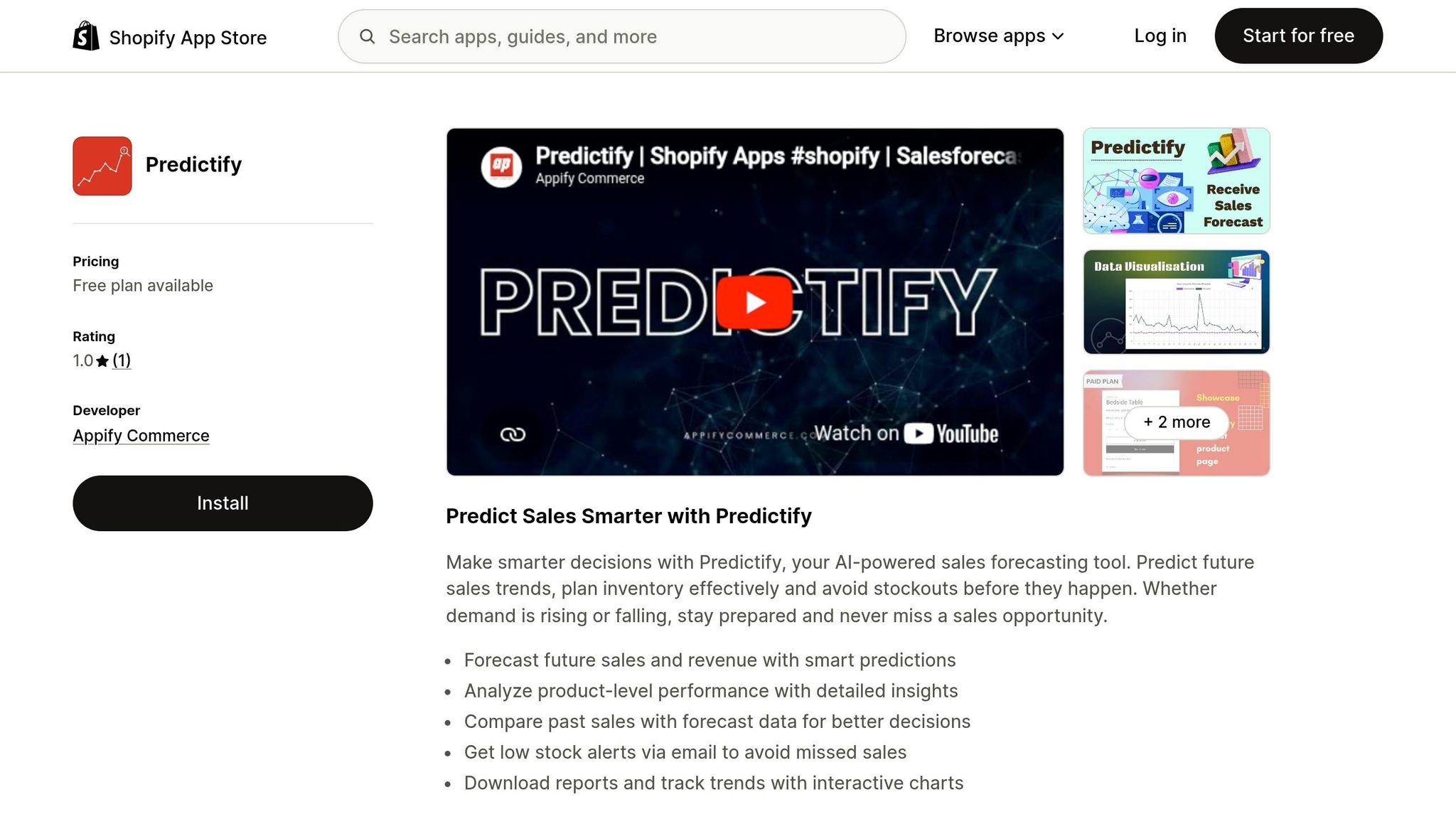
Predictify is a straightforward, budget-friendly option for Shopify merchants looking to dip their toes into revenue forecasting. It uses historical sales data to produce product-level forecasts and presents them with interactive line and bar charts, making trends easy to spot. A validation feature lets users compare predicted sales with actual results over time, offering a way to gauge the tool's reliability.
That said, Predictify has some limitations. It primarily relies on simple sales averages, which can fall short for stores with irregular or seasonal demand patterns. Despite this, its free starter plan and advanced plan priced at just $1.99/month make it an accessible choice for smaller merchants looking to move beyond guesswork.
For a more operationally focused solution, Forstock offers a compelling alternative.
Forstock
Forstock, also listed as Forthcast on the Shopify App Store, takes a practical approach to forecasting. Its machine learning models project demand up to six months ahead, achieving 10–15% accuracy at the SKU level for products with at least six months of sales history. One of its standout features is automation - demand projections are directly converted into draft purchase orders, reducing manual effort.
"We've tested several Shopify apps to improve our repeat purchase flow, but this one stands out because of how well the reorder cycle is actually implemented." - Finole, Forstock user
Priced at a flat $19.99/month for unlimited SKUs, Forstock is ideal for direct-to-consumer brands on the rise. Unlike some enterprise tools, it avoids per-order fees, making it cost-effective for scaling businesses. Additionally, with Shopify's Stocky app set to shut down on August 31, 2026, Forstock provides a timely alternative for merchants seeking a replacement.
Inventory Planner by Sage
Inventory Planner by Sage is designed with large-scale operations in mind. It supports multi-location and multi-channel forecasting, making it a go-to for merchants managing warehouses across states or selling through platforms like Amazon and Shopify simultaneously. Agencies often recommend it for its detailed reporting and customizable planning workflows.
However, this tool comes with a higher price tag. Plans start at $249/month plus a $0.75 per-order fee, which can become costly for high-volume sellers. While its advanced features make it a leader for complex operations, smaller merchants with less than $1M in annual revenue may find it more than they need.
| Tool | Best For | Starting Price | Forecast Horizon |
|---|---|---|---|
| Predictify | New/small merchants | Free ($1.99/mo advanced) | 50 weeks |
| Forstock | Growing DTC brands | $19.99/mo (flat rate) | 6 months |
| Inventory Planner by Sage | Large/enterprise merchants | $249/mo + $0.75/order | Custom/enterprise |
How to Choose the Right AI Revenue Forecasting Stack
Picking the right forecasting tool depends heavily on your store's current performance. A good place to start? Look at your annual revenue, as it dictates the level of complexity your setup requires. Stores making less than $500,000 a year can often get by with free tools or even spreadsheets. But once your revenue hits the $500K–$2M range, basic AI tools start to justify their cost. For stores generating over $2M annually, the sheer volume of data and operational complexity makes a fully AI-powered system a smart choice.
Data maturity matters just as much as revenue. If your store has fewer than three months of sales records, AI tools won’t be much help - you’ll need to rely on industry benchmarks and planned marketing investments instead. However, with a year or more of sales history, seasonally adjusted models become reliable. And if you have two years of data, you can use cohort-based forecasting to separate new customer revenue from returning customer revenue, a powerful tool for managing cash flow.
Your forecasting horizon is another key consideration. Always ensure it extends beyond your longest supplier lead time. For instance, if your supplier requires 90 days to fulfill orders, your forecast should cover at least 120 days to include a safety buffer. Many merchants run into trouble when their tools only forecast 30 days ahead, leaving them unprepared for longer supply chain timelines.
"A forecast is what you expect to happen based on data and trends. A goal is what you want to happen. They should be different numbers." – Shopify Revenue Forecasting Guide
Granularity is also critical. High-level revenue forecasts might work for overall financial planning, but if you’re managing inventory across multiple locations or hundreds of SKUs, you’ll need detailed, SKU- and location-specific data. A tool that only provides a top-line revenue number won’t help you identify which SKU might run out at a specific warehouse. This is why a layered approach to forecasting is often the most effective solution.
Building a Layered Forecasting Stack
No single tool can meet every forecasting need, which is why a layered system works best.
The operational layer focuses on day-to-day needs like SKU-level demand, reorder schedules, and purchase orders. For simpler setups, tools like Predictify (lightweight and free) are a good fit. For growing direct-to-consumer (DTC) brands, Forstock’s automated purchase order generation can make restocking much more efficient.
The intelligence layer provides broader insights that go beyond your store’s operations. This is where StoreCensus excels. Instead of just analyzing your inventory, StoreCensus offers a market-wide view, pulling revenue signals from over 2.5 million Shopify stores. This tool is especially valuable for agencies and founders looking to benchmark clients, spot top Shopify stores, or identify market trends before committing to a strategy. While it doesn’t replace operational tools, it adds valuable context to make your forecasts more actionable.
Comparison Summary of AI Shopify Revenue Forecasting Tools
When choosing a forecasting tool, it’s important to match your selection to your specific goals, the scale of your data, and your budget. Each tool in this comparison serves a distinct purpose, making it easier to align with your business needs.
StoreCensus focuses on market-level insights rather than individual store forecasts. It analyzes data from over 2.5 million Shopify stores, helping agencies and founders identify revenue opportunities, target Shopify stores, and benchmark performance across the ecosystem.
Inventory Planner by Sage is tailored for merchants juggling complex inventory across multiple locations or sales channels. This tool provides operational forecasts over a 6–12 month horizon, making it a critical solution for businesses with intricate inventory management needs.
Below is a comparison table to help you quickly evaluate which tool aligns best with your requirements:
Comparison Table
| Tool | Primary Focus | Forecasting Scope | Best For | Starting Price |
|---|---|---|---|---|
| StoreCensus | Market-level revenue insights | Ecosystem-wide (2.5M+ stores) | Agencies, founders, and sales teams prospecting Shopify merchants | Free; paid plans from $49/mo |
| Inventory Planner by Sage | Multi-channel inventory & cash flow | 6–12 months | Established merchants with complex inventory needs | From $249/mo |
These tools aren’t mutually exclusive - they can work together to create a well-rounded forecasting strategy. By combining StoreCensus for external market intelligence with Inventory Planner by Sage for operational precision, businesses can make more informed and confident decisions.
Conclusion: Key Takeaways
Revenue forecasting plays a critical role for Shopify merchants and agencies looking to grow. Missteps in forecasting can lead to serious financial consequences - 42% of companies report losing revenue due to poor sales forecasts, and inventory mismanagement costs the global economy over $1.1 trillion each year. These figures highlight the importance of getting forecasting right.
Each tool mentioned in this guide addresses specific challenges in forecasting, making a multi-faceted approach essential. For instance, Inventory Planner by Sage helps merchants achieve precision when managing complex, multi-channel inventory over a 6–12 month period. This kind of operational accuracy is indispensable for businesses handling intricate supply chains.
For agencies and founders in the U.S., StoreCensus provides valuable external market insights, benchmarking performance against over 2.5 million Shopify stores. It offers tiered revenue estimates, making it easier to identify potential clients with real budgets. Plus, its pricing is accessible, starting with a free plan and paid options from $49/month.
"Revenue band should be the first cut, not the last... that is the difference between a list of random ecommerce URLs and a prospect list with real budget." - StoreInspect Team
FAQs
How much sales history do I need for AI forecasting to be useful?
Most AI forecasting tools require 3 to 12 months of sales data to deliver accurate predictions. However, some tools can function with just 90 days of data by leveraging transfer learning techniques. That said, the quality of forecasts generally improves with more historical data. For precise SKU-level forecasts, it’s best to have at least 6 months of data to identify demand patterns and seasonal trends effectively.
What data sources should I connect to improve forecast accuracy?
To improve the accuracy of your forecasts, link your Shopify store through an API. This connection gives you access to critical internal data, such as SKU-level sales history, inventory levels, return rates, and trends in average order value. You can also integrate marketing platforms like Klaviyo, Google Ads, Meta, and TikTok to gain insights into promotional campaigns and ad spend.
In addition to internal data, incorporating external factors can make your predictions even sharper. For example, you can factor in weather patterns, Google Trends, and broader economic indicators. Adding supply chain details, such as supplier lead times, further enhances the precision of your forecasting.
Should I use StoreCensus alongside an inventory forecasting tool?
StoreCensus works hand-in-hand with inventory forecasting tools. While inventory tools handle the nuts and bolts of operations - like managing reorder points and supplier lead times - StoreCensus focuses on delivering broader eCommerce insights. With StoreCensus, you can dive into industry trends, monitor Shopify growth indicators, and perform prospect research. Together, these tools bridge strategic intelligence with everyday supply chain management, helping you make more informed decisions.