
Which Behavior Signals Matter Most for Outbound?
Direct requests and verified storefront or tech changes should get outbound priority—rank signals to book qualified agency meetings.

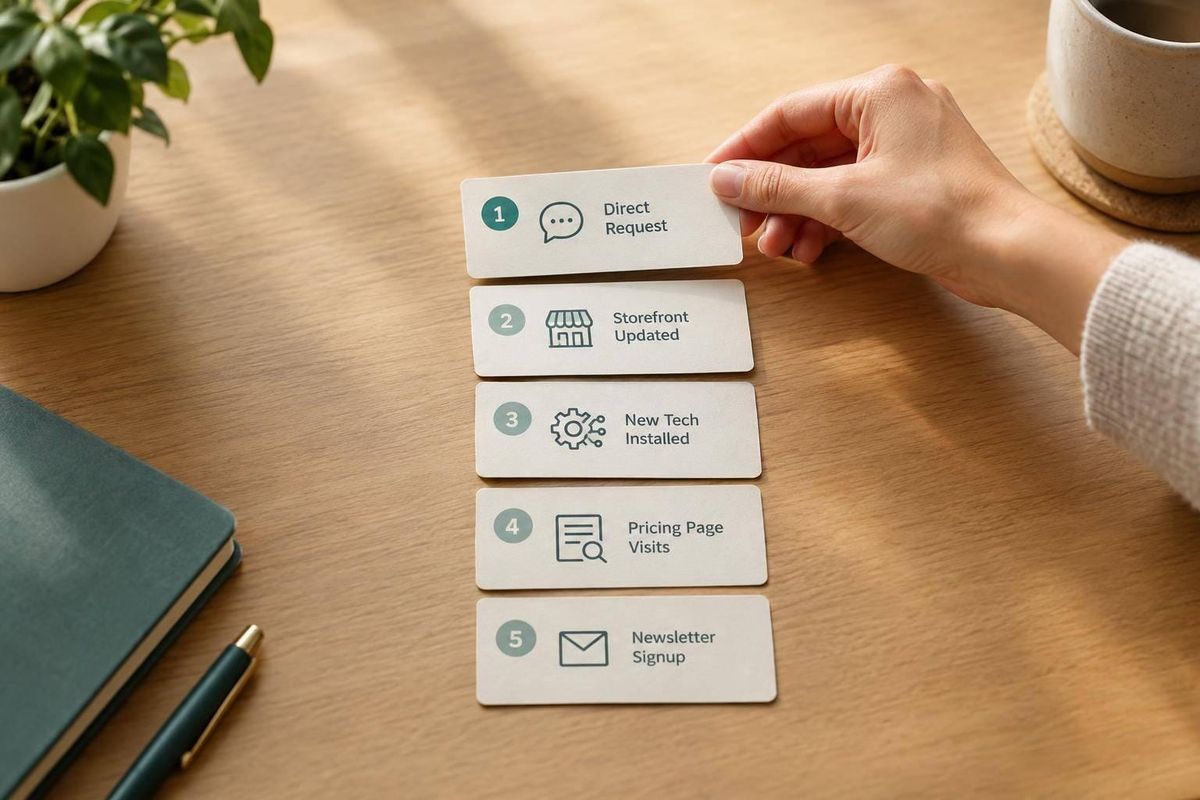
I prioritize direct requests first, then verified business changes that match my service. If someone asks for help, I answer the same business day. For cold outreach, I verify the event before treating it as a reason to contact them.
Here’s my starting order - not a proven conversion ranking:
- Direct requests: Answer the question, then check scope, budget, and timing.
- Technology or storefront changes: Confirm what changed and ask what work remains.
- Growth or market expansion: Tie a dated launch or catalog change to one service.
- Role-specific hiring: Look for named projects where outside support could help.
- Light engagement or research: Keep isolated clicks, downloads, and views in nurture until another trigger appears.
Quick Comparison
| Signal | What it tells me | Starting action |
|---|---|---|
| Direct request | Someone is asking for help | Reply the same business day |
| Verified technology change | Work may be underway | Verify, then contact within a few business days |
| Growth or expansion | New work may need support | Check launch status and service fit |
| Role-specific hiring | A team is adding capacity | Confirm the role and named project |
| Light engagement | Someone has topic interest | Educate; wait for another trigger |
I change that order by service: storefront changes for design and development, retention tools for lifecycle, and market or catalog launches for SEO and paid media.
My rule: <u>verify the change, use a lawful contact route, and measure qualified meetings - not clicks</u>. I compare results per 100 contacted accounts as a starting point, not proof, before changing the ranking.
1. First-Party Evaluation and Direct Requests
Buying Intent
First-party signals call for the fastest response when a prospect directly asks for help. Prioritize consultation requests, RFPs, and replies asking for examples or a next step. Keep direct requests separate from research behavior. Downloads and webinar attendance count as research - not buying intent - unless the person asks for help. Before spending sales time, match the request to the right service line.
Agency Fit
Qualify the stated need before booking a call. For design and development, check scope, platform, and launch details for Shopify stores. For lifecycle, ask about retention goals, CRM details, and data-access requirements. SEO calls for organic-growth objectives and technical constraints; paid media calls for acquisition targets, tracking details, and capacity to produce ads. Give a specific problem, timeline, and budget more weight than a completed form.
Outreach Timing
A relevant reply matters more than a fast one. Answer the request rather than pushing for a meeting. Route replies to a human follow-up queue, and address the question asked. Before writing an RFP response, confirm the decision process, stakeholders, budget, and deadline. Use downloads and webinars to educate, then wait for a reply or follow-up question before pitching a call.
Evidence Reliability
Keep the original request or reply, timestamp, company, role, stated need, preferred contact channel, and response status. Track the request source, consent, and event attendance separately. Collect only lawfully obtained data, explain how you'll use it, and get consent where required. A page visit is not permission to contact someone.
sbb-itb-61169e3
How to Use Intent Signals to Book More Meetings (Without Wasting Time)
2. Technology and Storefront Changes
When no one asks directly, verified store changes are the next strongest outbound trigger - especially when they’re recent and tied to a live project.
Buying Intent
Focus on verified changes that point to active work, not just a new app install. A replacement, migration, or group of related changes usually signals a project in progress. A lone app or plugin could be a trial, default integration, or inactive script - not buying intent.[2][3][5][6]
Agency Fit
Match the change to your service and the merchant’s size, catalog, and growth plans. Treat each likely objective below as something to ask about, not a diagnosis.
| Change | Likely business objective | Agency model | False-positive risk | Opening question |
|---|---|---|---|---|
| Email or SMS platform added or replaced | Lifecycle automation, segmentation, retention | Lifecycle/CRM | High: trial, duplicate script, or default integration | What lifecycle work prompted the switch? |
| Analytics, attribution, or server-side tracking added | Better measurement, paid acquisition optimization, reporting | Paid media, analytics | Medium-high: may be installed for a client or agency report | What decisions should this setup improve? |
| Reviews, search, or personalization added | Discovery, merchandising, or conversion improvement | Design/CRO, SEO | Medium-high: limited experiment or unused app | What shopping problem is this solving? |
| Subscription tools added | Recurring revenue, replenishment, customer lifetime value | Lifecycle/CRM, development | Medium: tool may be installed before launch or abandoned | What subscription work is underway? |
| Theme replaced | Redesign, rebrand, mobile UX, merchandising | Design/development | Medium: minor visual update or staging artifact | What prompted the redesign? |
| Shopify–WooCommerce migration | Replatforming, scalability, control, or international expansion | Development, technical SEO | Medium: project may already be complete | What migration work remains? |
| Checkout, hosting, CDN, or performance stack changed | Speed, reliability, or payment flexibility | Development, CRO, paid media | Medium: maintenance or platform defaults | What constraint prompted the infrastructure change? |
Outreach Timing
Follow up within a few business days of verified migrations, theme replacements, or coordinated multi-tool changes. For isolated active additions, take a softer approach over one to three weeks. If an installation is your only evidence, wait for another indicator.[4][5]
Evidence Reliability
Confirm the change with a current script or plugin fingerprint, plus visible storefront behavior or a second public indicator. Check the production site, not staging. A fast homepage doesn’t prove that product pages, the cart, or checkout perform well.[2][3][6][7]
Label verified recent migrations and coordinated multi-tool changes high reliability. Newly detected active apps or plugins with supporting evidence are medium; static stack presence or one-off installations are low. These labels describe the change - not buying intent.[5]
If the change points to expansion rather than day-to-day operations, growth is the next signal to weigh.
3. Store Growth and Market Expansion
Buying Intent
When expansion is visible, shift from maintenance signals to growth signals. Prioritize dated launches over catalog growth, funding, leadership changes, and estimated revenue movement. A technology change paired with expansion gives you a stronger reason to offer implementation work and request a meeting.
Growth alone doesn’t prove agency demand. It also doesn’t confirm budget, priorities, or a need for outside help.
Agency Fit
Match each growth signal to one deliverable, then verify the event. Skip the generic growth pitch. The table separates what each signal suggests from the proof you still need.
| Signal | Inferred need | Strongest agency fit | Urgency | Evidence required |
|---|---|---|---|---|
| New country or marketplace launch | Localization, channel setup, SEO, paid acquisition, lifecycle changes | SEO, paid media, lifecycle, design/development | High before launch and shortly after going live | Dated announcement, live localized pages, currency, shipping, or marketplace URL |
| Major catalog expansion | Navigation, templates, search, SEO architecture, launch campaigns, segmentation | Design/development, SEO, lifecycle, paid media | High within 4–8 weeks of observation | New collections, SKU count change, product-launch evidence, sitemap or email |
| Estimated revenue-tier movement | Scaling, analytics, conversion optimization, stack review | Design/development, lifecycle, paid media | Medium; higher when backed by other evidence | Dated estimate plus traffic, catalog, hiring, or technology evidence |
| Funding announcement | Implementation support for funded launches or expansion | Any model, depending on the announced plan | Medium; often months after the round | Public funding announcement and a specific deployment or hiring signal |
| New growth/ecommerce/marketing hire | Internal capacity gap, implementation roadmap, or vendor coordination | Agency matching the role’s function | Medium to high after the hire starts | Dated job post, employee announcement, role scope, or team page |
| Leadership change | Implementation support for a new leader’s expansion or repositioning plan | Agency aligned with the leader’s remit | Medium; validate before pitching | Company announcement, executive post, or updated leadership page |
Outreach Timing
Contact market-launch prospects during planning or roughly two to six weeks after launch, when implementation gaps become visible. Act as soon as you verify catalog expansion. Navigation, SEO, merchandising, and campaign work can begin immediately.
For revenue-tier movement, wait for evidence of active investment. After funding, look for a concrete initiative in the following months instead of sending generic congratulations. Contact new specialist hires several weeks after they start, when their priorities and internal constraints are clearer.[8]
Evidence Reliability
Confirm two signals before assigning high priority, including one dated change you can observe directly. Record the source, affected market or category, likely owner, and launch status: announced, live, or scaled.
Check for stale job posts and signs that expansion has stalled or reversed, such as removed localized pages, discontinued products, or declining site activity. Hiring may mean the company plans to handle the work internally - not bring in an agency.
Use estimated revenue only to prioritize prospects. Don’t lead with it. Base your outreach on verified expansion and ask which implementation work still needs support.
Next, compare these signals by agency model, timing, and reliability.
4. Role-Specific Hiring
Hiring can reveal expansion plans before the website does. Read the responsibilities to find the project behind the role.
Buying Intent
Hiring signals capacity, not intent.[9][10] A vacancy becomes useful when it names a project your agency can support. Rank it below direct requests unless the responsibilities point to that kind of work. A role tied to lifecycle automation tells you more than a generic marketing title.
Agency Fit
Use the responsibilities to match the hiring signal to your service line.
| Hiring responsibility | Likely initiative | Agency fit | Outbound priority |
|---|---|---|---|
| Lead a Shopify theme rebuild | Storefront modernization | Design/development | High with a confirmed project |
| Own Klaviyo flows and segmentation | Lifecycle implementation | Lifecycle/CRM | High with matching stack |
| Grow organic traffic in international markets | Market expansion | SEO | High with confirmed target markets |
| Own a six-figure monthly ad budget | Acquisition investment | Paid media | High fit; outsourcing remains unproven |
| No named initiative | Unclear | Unclear | Low; weak outbound evidence |
Titles describe the role broadly. Responsibilities point to the work.
Outreach Timing
Reach out within several business days of verifying that a relevant posting is active. Offer a defined implementation sprint, specialist work, or temporary support. Once the hire starts, shift the conversation to helping them deliver their roadmap after onboarding.
Evidence Reliability
Check the original posting date, whether the vacancy is still open, the named responsibilities, and the company’s careers page. Record when you first saw the posting and last checked it. Ignore evergreen roles and stale reposts.
5. Light Engagement and Topic Research
Buying Intent
When stronger signals are missing, treat light engagement as a secondary cue. A single download, webinar attendance, like, or view shows interest - not intent. These actions carry less weight than direct requests, technology changes, growth, and hiring when judging readiness for a meeting.
Agency Fit
Use topic interest to sort nurture content by agency service: UX and conversion for design; retention, email, and loyalty for lifecycle; technical SEO and catalog architecture for SEO; acquisition and attribution for paid media. Topic relevance helps establish fit, not timing.
Outreach Timing
Keep isolated actions in nurture. Escalate only when repeated, relevant behavior comes with a separate business trigger. A direct consultation request calls for prompt follow-up. Personalize outreach around the business event, not private browsing behavior. Use light engagement to prioritize nurture - not to override verified business changes.
Evidence Reliability
Record the source, timestamp, topic, confidence in the contact’s identity, and consent status. Follow privacy and suppression requirements. Anonymous account traffic does not identify a person. Commercial email must also meet CAN-SPAM requirements: accurate sender information, a physical address, and an opt-out mechanism.[11][12] Treat these signals as supporting evidence only when a stronger trigger is present.
Compare Signals by Agency Model, Timing, and Reliability
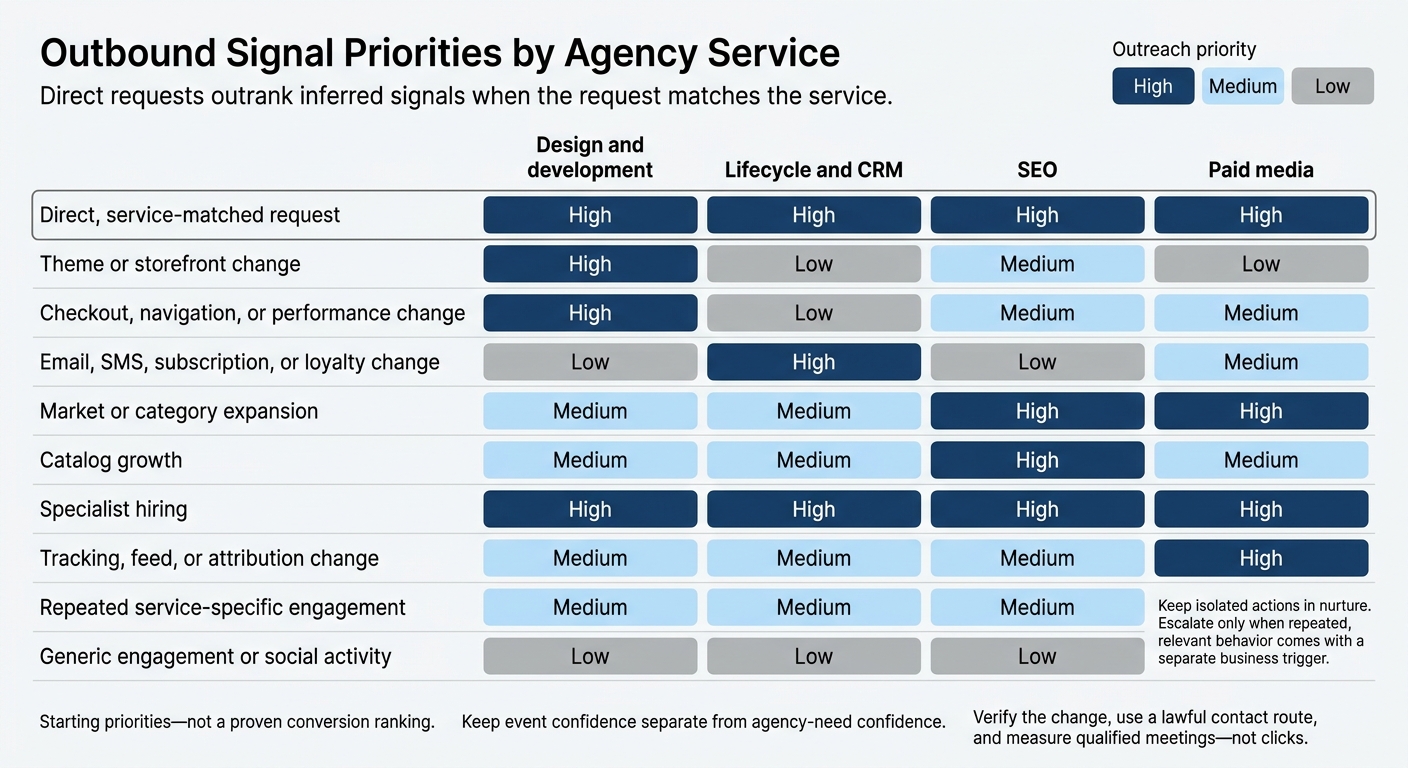
Outbound Signal Priorities by Agency Service
Use these tables to set outreach priorities by signal strength and service line.
Buying Intent: Direct Requests vs. Inferred Needs
| Signal | Buying intent | What it does not prove |
|---|---|---|
| Direct consultation request, RFP, or reply asking for help | Very high | Service fit, budget, or decision-making authority |
| Repeated visits to pricing or service pages | High | Permission to contact, buying authority, or an agency search |
| Repeated case-study, service-page, webinar, or event engagement | Medium | An active project or decision-maker involvement |
| Relevant storefront, technology, or catalog change | Medium | Agency need, recency, or dissatisfaction |
| Role-specific hiring | Medium | An open role, lack of outside support, or available budget |
| Growth, expansion, or assortment changes | Medium to low | Profitable, funded, sustained growth or agency need |
| Generic social activity, content consumption, or a single email open | Low | Meaningful intent, identity, timing, or willingness to engage |
Design and Development: Start With Storefront Changes
Put theme or redesign changes first, followed by checkout, navigation, merchandising, or performance changes; complex app changes; growth paired with specialist hiring; and broad engagement.
Check the date, scope, and launch status. A redesign might mean the work is already done, another agency handles it, or the merchant dislikes the result. Offer a focused review - not a presumed rebuild.
Lifecycle and CRM: Start With Retention Stack Changes
Start with email, SMS, subscription, loyalty, or customer-data platform changes. Next come retention or CRM hiring; catalog, market, or customer growth; repeated engagement with retention content; and generic traffic or social activity.
Check that the technology is active and fits the business model. A stack change gives you a reason to ask a discovery question, not to claim that retention is failing.
SEO: Start With Market and Catalog Expansion
Put market or category expansion first, followed by catalog growth; SEO or content hiring; platform, theme, or information-architecture changes; and general technology adoption.
Confirm that expansion is live or about to launch, and identify the markets or categories involved. For migrations, check redirects and indexability without assuming traffic has dropped.
Paid Media: Start With Launches and Acquisition Investment
Start with market launches or assortment expansion, followed by acquisition hiring; tracking, feed, analytics, or attribution changes; faster growth backed by another signal; and general engagement.
Check launch timing, target markets, current roles, and whether tracking changes are active. Existing ads don't prove budget, dissatisfaction, or a need for an agency.
Service fit matters alongside signal strength. The same event can carry different weight for each agency model.
Signal Priorities Across Agency Models
Direct requests outrank inferred signals when the request matches the service.
| Signal | Design and development | Lifecycle and CRM | SEO | Paid media |
|---|---|---|---|---|
| Direct, service-matched request | High | High | High | High |
| Theme or storefront change | High | Low | Medium | Low |
| Checkout, navigation, or performance change | High | Low | Medium | Medium |
| Email, SMS, subscription, or loyalty change | Low | High | Low | Medium |
| Market or category expansion | Medium | Medium | High | High |
| Catalog growth | Medium | Medium | High | Medium |
| Specialist hiring | High | High | High | High |
| Tracking, feed, or attribution change | Medium | Medium | Medium | High |
| Repeated service-specific engagement | Medium | Medium | Medium | Medium |
| Generic engagement or social activity | Low | Low | Low | Low |
Priority tells you which signals to pursue. Timing tells you when to act.
When to Follow Up on Each Signal
| Behavior | Intent | Starting response time | Action |
|---|---|---|---|
| Direct request, RFP, or reply | Very high | Immediately or same business day | Address the stated need; confirm scope, authority, timeline, and budget process |
| Repeated, lawfully identifiable pricing evaluation | High | Promptly after reviewing context | Offer a relevant answer or diagnostic without suggesting that contact was requested |
| Repeated service-page, case-study, event, or webinar engagement | Medium | Within one business day | Reference the topic and offer a useful next step |
| Relevant storefront or technology change | Medium | Within a few business days after verification | Lead with an observation tied to the specific change |
| Hiring or expansion signal | Medium | Within a few business days | Connect the offer to the stated initiative |
| Isolated engagement or generic activity | Low | Nurture or corroborate first | Share educational or low-pressure content |
Verification helps separate an actual event from a buying need.
How to Verify Each Signal
Keep event confidence separate from agency-need confidence. Record the source, event date, and detection date. A change you've just detected may have happened months ago.
Public technology or advertising activity can show that a tool or campaign exists. It can't establish private performance problems, budget, dissatisfaction, or a desire to hire an agency.
Privacy protections and automation can distort email opens, so an open alone shouldn't trigger urgent outreach. Commercial outreach should follow applicable privacy and email requirements, including accurate sender information and a working opt-out mechanism.[1]
Compare qualified meetings per 100 accounts by signal, using similar audiences and outreach conditions.
Build a Ranked Outbound Queue
Build one queue per service, using the ranking above to create a daily working queue. Define fit by platform, geography, category, revenue band, and service need. For each account, log the source URL or platform, observation date, signal type, change observed, contact evidence, confidence, and next action.
Verify the trigger and likely decision-maker. Then score the account, assign a service-specific task, and schedule follow-up.
Use a 0–8 internal score, with 0–2 points for each factor:
- Fit: How closely the account matches your target profile.
- Behavior: Observable activity.
- Trigger relevance: How closely the event connects to your service.
- Lawful contactability: A verified decision-maker and a permitted business contact route.
Count each event once, even if several tools detect it. The goal is to rank accounts by meeting potential, not signal volume.
Use these tiers to turn signal strength into queue priority.
| Signal tier | Minimum evidence | Outreach priority | Agency use case |
|---|---|---|---|
| Tier 1 | A direct request, or a relevant technology/storefront change verified by dated evidence and connected to the service | Same day; personalized task after qualification | Design: theme change; lifecycle: retention-stack change; SEO: international expansion; paid media: acquisition-stack change |
| Tier 2 | A specialist hire, market expansion, or repeated related behavior, preferably supported by a second dated source or verified decision-maker | Within 1–3 business days; targeted but lower urgency | SEO: catalog growth; lifecycle: CRM hiring; paid media: acquisition hiring |
| Tier 3 | Isolated engagement, generic hiring, or broad research without a clear service connection | Nurture, monitor, or batch outreach | Early-stage research across all agency models |
A high score alone isn't enough. Require lawful contactability plus either one strong signal and fit, or two related medium signals and a verified decision-maker.
Track priority, intent, and outcome separately. A verified technology change may warrant prompt outreach, even when buying intent is unknown.
Keep stable fit separate from signal recency. For example, an operating rule for a verified technology signal could give it full weight for 14 days, reduce its weight after 30 days, and move it to monitoring after 60 days unless new evidence appears.
Update the queue daily. Each task should name the question, evidence, contact, channel, owner, and next review date. Keep the original score unchanged for later comparison.
Conclusion: Track Qualified Meetings by Signal
Measure signals by qualified meetings, not activity volume. Fit and urgency rankings matter only when they lead to the right meetings for your service.
For each signal–offer pair within each service line, track booked, held, and disqualified meetings, plus qualified opportunities per distinct contacted account. Track response time, show rate, and disqualification rate separately so you can tell no-shows from poor fit.
Define qualification before outreach: account fit, a relevant decision-maker, a stated problem, and a next step. Wait for a meaningful sample before changing rankings. 100 contacted accounts per major signal–offer pair is a useful starting point - not proof.[13] Bookings alone don’t validate a signal.
Keep audience fit, messaging, channel, and follow-up comparable. Record overlapping signals, show counts alongside percentages, and label small samples as directional.
FAQs
How do I prioritize accounts with conflicting signals?
Score fit and timing separately, using signal type, recency, revenue band, and tech-stack fit.
Give Priority A to accounts with both a clear service gap and urgency. Accounts with strong social activity but a weak stack gap fall into Priority B. Move accounts with older signals or poor merchant fit into weekly batches or nurture.
Tune the weights - for example, 60% app-stack fit and 40% social intent - and update them weekly.
What should I do when strong signals produce no replies?
No replies? Treat that as a signal to fix your funnel, not a failure on the prospect’s part. Check that your niche includes qualified prospects who fit your service tier. Swap generic templates for outreach that references the merchant’s specific situation or a recent business event.
Test different subject lines, include relevant case studies, and try reaching out through LinkedIn or direct calls. If you still don’t get replies, offer a free audit to make it easier for prospects to take the first step.
How can I test signal rankings with a small prospect list?
Start with a pilot campaign of 100–200 prospects. Score each prospect from 0–100 based on firmographic fit, such as revenue and traffic, and behavioral intent signals, such as app changes or social activity. For example, give fit a 60% weight and intent a 40% weight.
Run outreach, then track reply, meeting, and win rates by signal category. Use those results to pinpoint which triggers drive revenue and fine-tune your rankings before scaling.