Auth0 Wallet Login: NFT Commerce Use Cases
Use Auth0 only when you need lasting customer accounts; separate login, wallet control, and server-checked NFT ownership.


I’d add Auth0 to NFT commerce only when you need a lasting customer account - not just a wallet login. Keep three checks separate: customer login, wallet control, and NFT ownership. A wallet signature proves control; it does not prove the shopper owns a qualifying NFT.
Here’s how I’d choose your setup:
- Auth0-centered: Start with account login and request wallet proof only for NFT access.
- Wallet-native: Use a signed login message for wallet-only claims, without an extra account step.
- Hybrid: Link a verified wallet to an existing Shopify or WooCommerce customer record for repeat purchases, support, and loyalty.
My rule for granting NFT perks: <u>check ownership before checkout or redemption</u>, enforce eligibility on the server, and prevent duplicate claims. Keep wallet links, login sessions, and transaction approvals separate.
Before adding Auth0, I’d compare its costs and extra login steps with your account needs. Account recovery cannot recover a lost wallet. StoreCensus can help find merchants to assess, but I’d confirm their checkout limits and identity needs before recommending a setup.
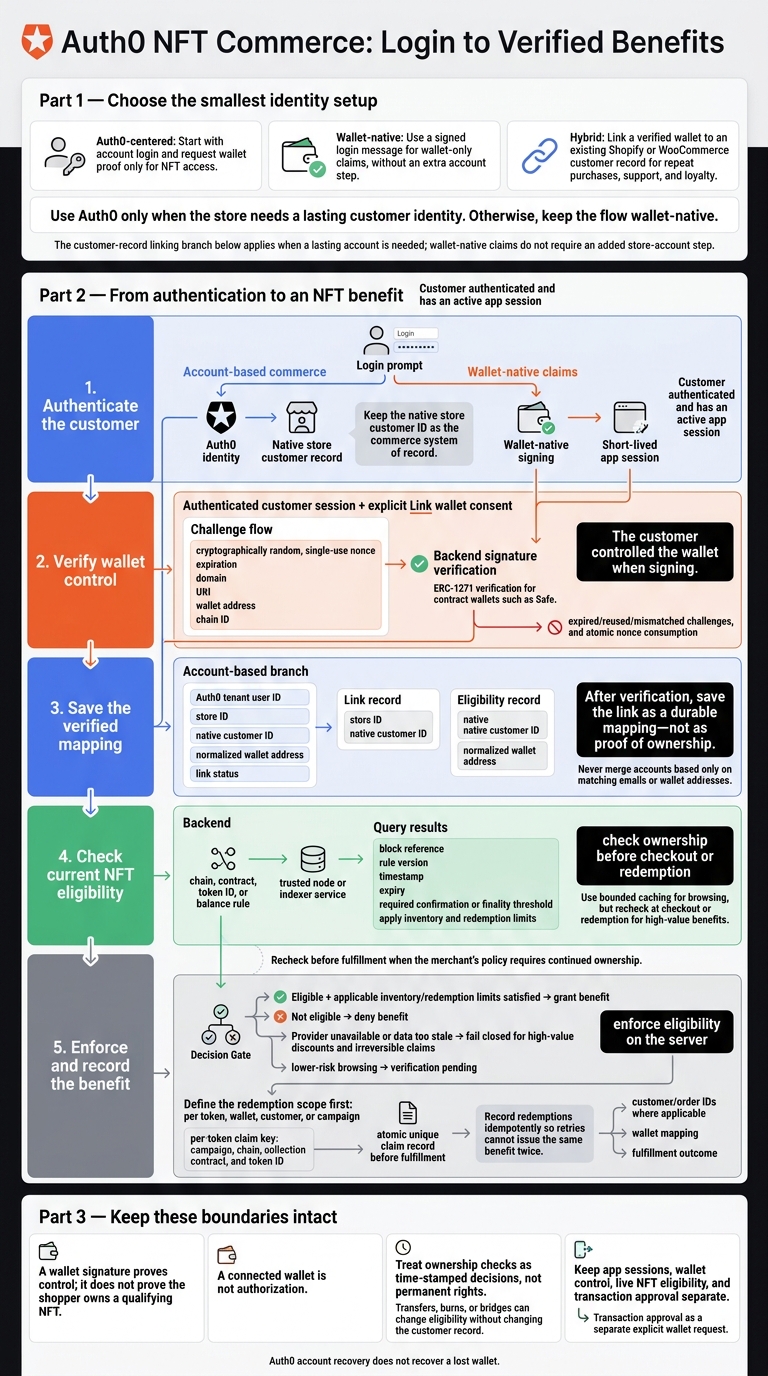
Auth0 NFT Commerce: Login to Verified Benefits
Wallet Login Architecture: From Signature to App Session | Module 3.3
sbb-itb-61169e3
Link Wallets to Existing Customer Records
Once Auth0 is part of your stack, link wallet control to the existing customer record.
Keep the native store customer ID as the commerce system of record for orders, fulfillment, and support. Map the Auth0 identity to that record. An Auth0 login does not automatically replace a native store account.[9] For Shopify, use customer metafields or an app-managed database. For WooCommerce, use customer or WordPress user IDs through an approved plugin or REST integration.[5][7]
Verify Wallet Control Before Linking
Require an authenticated customer session and explicit Link wallet consent. Issue a signed challenge that includes a cryptographically random, single-use nonce, expiration, domain, URI, wallet address, and chain ID.
Verify those values server-side against the pending request, then atomically mark the nonce as consumed. Reject expired, reused, or mismatched challenges. For contract wallets such as Safe accounts, support ERC-1271 verification instead of relying only on standard signature recovery.[3]
Save the Auth0 tenant user ID, store ID, native customer ID, normalized wallet address, and link status. Never merge accounts based only on matching emails or wallet addresses. Resolve duplicates through authenticated consent and a conflict workflow.
Give each additional wallet its own verified mapping, and require a separate recovery method for replacement. Unlinking should revoke the mapping, invalidate cached eligibility where appropriate, and preserve the audit trail and commerce history. Auth0 account linking joins identities in identities; it does not sync store records.[6][8]
After verification, save the link as a durable mapping - not as proof of ownership.
Keep Customer Records Separate From Ownership Checks
Keep the wallet link and NFT entitlement check in separate records:
- Link record: Consent, verification time, wallet type, verification method, challenge ID, nonce consumption, and link/unlink events.
- Eligibility record: Contract, chain, token ID or quantity, rule, result, check time, block reference, and expiration time.
Treat ownership checks as time-stamped decisions, not permanent rights. A token transfer, burn, or bridge can change eligibility without changing the customer record.
Connect each decision and redemption to customer and order IDs, the wallet mapping, and the fulfillment outcome. Shopify can retain an approved customer/order metafield or app-managed reference. WooCommerce can use approved order metadata.[4][7]
Collect shipping details at checkout and marketing consent through the merchant consent flow. A wallet signature does not authorize support access or account recovery.
Linking a wallet alone does not grant eligibility; session rules determine what happens next.
Separate Login Sessions From NFT Eligibility
A connected wallet is not authorization. Keep login, wallet proof, and NFT eligibility separate in backend logic. Linking a wallet does not make session validity and NFT eligibility the same check.
| Check | What it proves | When it runs | Where results live | Which system enforces it |
|---|---|---|---|---|
| Customer login | The customer authenticated and has an active app session | Login, renewal, and risk-triggered reauthentication | Auth0 and app sessions; server-side session record | Auth0 and app session middleware |
| Wallet proof | The customer controlled the wallet when signing | Wallet linking, primary-wallet changes, and sensitive challenges | Wallet-link and challenge records | Backend wallet-signature verifier |
| NFT eligibility | The verified wallet meets the chain, contract, token ID, or balance rule | Gated access, checkout, claims, and redemptions | Short-lived eligibility cache entry or redemption record | Backend authorization service using a node or trusted indexer |
Session status controls access. Ownership checks control benefits.
Set Session and Wallet-Link Rules
Treat Auth0, app, and store sessions as separate layers. Use short-lived access tokens with protected renewal. Auth0 refresh-token rotation invalidates the refresh token used to obtain a new pair.[13] Validate tokens server-side, and enforce app idle timeouts, absolute lifetimes, and revocation state.
Auth0 logout does not end app or store sessions. After wallet unlinking or a security event, revoke dependent app sessions and Auth0 refresh tokens, then clear eligibility caches.[10][11][12]
For sensitive changes, such as replacing the primary wallet or transferring benefits, require a new authentication check, new wallet proof, or both. Set explicit challenge expiration and attempt limits. Rate-limit challenge issuance and verification by customer, IP, device, and wallet.
Keep transaction approvals separate from login signatures. Transfers and token approvals need their own explicit wallet request. Session rules limit access, but ownership still needs verification when a customer uses a benefit.
Check Ownership Before Each Benefit
Use the session to identify the customer, then recheck the wallet on-chain before granting value. Retrieve active verified wallets and load the chain, contract, token ID, or balance rule. Query a trusted node or indexer service, check the required confirmation or finality threshold, and apply inventory and redemption limits.
Record the decision with its block reference, rule version, timestamp, and expiry. Use bounded caching for browsing, but recheck at checkout or redemption for high-value benefits. Recheck before fulfillment when the merchant’s policy requires continued ownership. Record redemptions idempotently so retries cannot issue the same benefit twice.
Do not treat Auth0 session claims or Actions output as ownership authorization. Define benefit rules before launch:
- Transfers end current-holder eligibility. Burns remove eligibility unless burn-based rights are explicit.
- Wrapped assets require an approved contract. Staking and escrow require a documented beneficial-owner rule.
Marketplace listings and connected wallets do not qualify a customer. Wait for chain finality before making irreversible grants.
If the provider is unavailable or its data is too stale, fail closed for high-value discounts and irreversible claims. For lower-risk browsing, show verification pending rather than confirmed eligibility.
Match the Login Flow to the Commerce Use Case
Once login, wallet proof, and ownership are separate, choose the flow based on what the shopper needs to do next.
Restrict Products and Discounts to NFT Holders
Use Auth0 only when the store needs a lasting customer identity. Otherwise, keep the flow wallet-native. Shopify customer-account extensions work with new customer accounts, not legacy accounts.[14] Shopify Functions can run custom discount logic. But the customer-account Discount API is read-only - it cannot check NFT eligibility on its own.[15][17]
Hiding a product doesn't prevent checkout. Check that the cart or checkout step can reject buyers who don't qualify. For WooCommerce, confirm where the plugin enforces its rules: at the cart, checkout, or order-validation step.[16] Coupon Restrictions can limit coupons by customer status, user role, country, or ZIP code, but these rules don't check NFT ownership.[18]
Connect short-lived eligibility to the mechanism that enforces access. For scarce benefits or benefits that can transfer between owners, check ownership again at purchase. Record the qualifying wallet, collection contract, chain, decision time, and result on the order.
Connect NFT Claims to Fulfillment and Loyalty Records
When an NFT benefit becomes a claim, the focus moves from access to fulfillment. Link the claim to the existing order and customer ID.
Define the redemption scope first: per token, wallet, customer, or campaign. Give each claim a key that cannot be duplicated, and write it atomically before sending the fulfillment request. If the request is retried, return the existing claim rather than creating another.
For a per-token limit, include the campaign, chain, collection contract, and token ID in the claim key. Decide whether redeemed status stays with a transferred token so the new owner cannot claim a reward that's already been used. Keep earned loyalty history separate from benefits tied to current ownership.
Skip Extra Accounts for Wallet-Only Claims
For single-use claims, every extra account step should earn its place. If the claim is wallet-only, use wallet-native authentication and a short-lived app session. Use the signature only for login. On-chain actions need a separate transaction prompt.
Ask for email, shipping details, or an account only when fulfillment, support, tax, fraud, or legal rules require them. WooCommerce lets merchants configure guest checkout and account creation, so check that the chosen integration follows those settings.[16]
Before adding Auth0, compare login completion, claim conversion, abandonment at the account step, and support contacts per claim. Add Auth0 only when it solves a specific customer-record problem.
Conclusion: Add Auth0 Only for an Identity Need
Match the login flow to the use case, then add Auth0 only if identity is the bottleneck. Choose the smallest identity setup that meets the merchant’s needs. Keep wallet-only interactions wallet-native. For repeat commerce, link verified wallets to existing Shopify or WooCommerce customer records instead of replacing the store’s account system.
Keep app sessions, wallet control, live NFT eligibility, and transaction approval separate. Auth0 account recovery does not recover a lost wallet. Check that separation before choosing Auth0.
Assess the Merchant Before Recommending Auth0
Recommend Auth0 only when centralized login, social login, recovery, roles, or single sign-on across apps provides measurable value.[20] Confirm which systems share customer identity, whether existing accounts can meet that need, and where the merchant can enforce NFT benefits.
Compare setup and running costs with the expected benefit - not just Auth0’s MAU-based pricing. Include account linking, wallet changes, ownership checks, support load, and abandonment caused by extra login steps.[19] Preserve customer IDs, order history, and loyalty balances when linking identities.
Use StoreCensus to identify Shopify and WooCommerce merchants by platform, revenue tier, and tech stack.[2] Treat those signals as starting points for discovery, not proof of wallet adoption or login gaps. Before recommending Auth0, confirm account constraints, NFT utility, account-recovery needs, and tolerance for extra checkout steps.
FAQs
How do I know if Auth0 justifies extra login steps?
Auth0’s extra login steps make sense only for high-intent, crypto-native buyers who expect to connect wallets and complete on-chain transactions, such as visitors from Discord or X [1].
Skip these steps for mainstream audiences who mostly browse on mobile. Every extra tap increases the risk of cart abandonment [1]. Before adding them, check how familiar your audience is with wallets and test the flow in a secure environment for 14 to 30 days [1].
How can I safely replace a customer's lost wallet?
With self-custody, merchants can’t recover a lost wallet because they don’t hold the customer’s private keys. If a customer loses wallet access, they also lose access to the identity and assets tied to that address.
The customer must create a new wallet and link it to their existing customer record. Agencies should recommend a clear recovery process that verifies the customer’s identity through email or platform-specific authentication before linking the new address.
How can I prevent NFT transfers from enabling duplicate claims?
Verify NFT ownership on the server before finalizing a claim. Check on-chain, in real time, that the wallet holds the required NFT [1]. Client-side checks alone aren’t enough: users can bypass gating rules through direct links [1].
For complex or headless builds, add this check to your custom tokenization and backend logic. This keeps claim state consistent and prevents transferred NFTs from being used to claim rewards more than once [1].