
Analyzing Competitor Product Tags for Insights
Competitor product tags reveal catalog priorities and SEO gaps—audit tags, reduce sprawl, and use metafields to boost search.

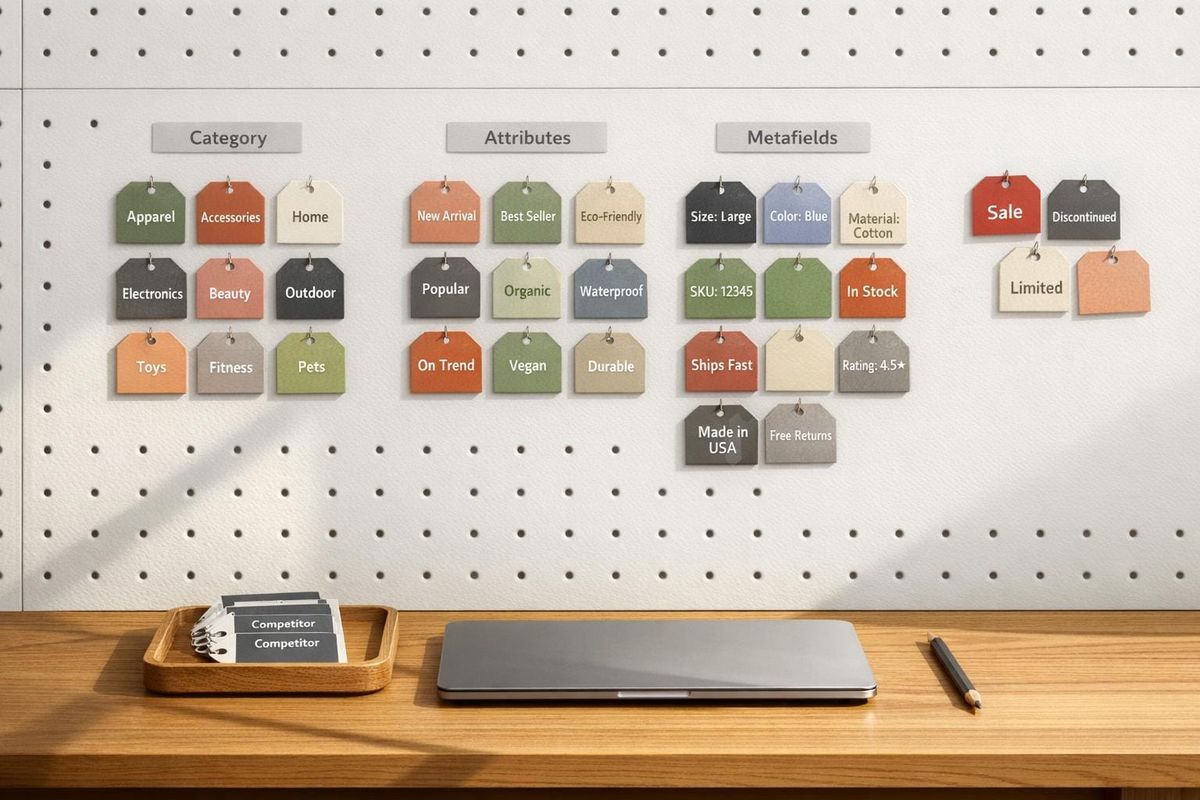
Competitor product tags are more than just labels - they're a window into catalog priorities, customer needs, and market strategies. Here's why they matter and how to use them effectively:
- Tags impact searchability: 45% of shoppers use site search first, and poor tagging can drive 48% of them to competitors.
- Competitor insights: Tags reveal trends like revenue changes, catalog shifts, and SEO strategies.
- Common gaps: Issues like inconsistent formatting, overuse, and SEO challenges (e.g., duplicate URLs from tags) can hurt performance.
- Best practices: Use tags for sales strategies and metafields for product details. Stick to standardized naming conventions like
prefix:valueto avoid clutter.
Key Takeaway: Audit and refine your tagging strategy to improve search visibility, reduce clutter, and stay ahead of competitors. This approach ensures your products meet customer needs and align with search behavior.
1. StoreCensus
StoreCensus simplifies store intelligence by tagging key events and tech stack attributes, helping businesses identify strategic priorities.
Tagging Patterns
StoreCensus uses event-based tags like "App Added", "Revenue Change", "Tech Update," and "Theme Change" to track activity across a comprehensive list of Shopify stores. Each tag is timestamped, creating a searchable record of competitive moves.
The tags are designed to be clear and action-oriented. Instead of just showing what exists, they focus on what has changed, making it easier for users to act on the data when monitoring competitors.
Tagging Gaps
One downside is that StoreCensus focuses solely on Shopify stores, leaving out competitors using platforms like Magento or BigCommerce.
Additionally, its weekly scanning cycle might overlook short-term promotions or rapid shifts, which could be critical for some businesses.
Catalog Strategy
StoreCensus transforms store activity into structured signals by tagging events like app installations, revenue changes, or theme updates. These tags act as early indicators of strategic shifts.
"We noticed a competitor's revenue band dropped two months before they started discounting heavily. StoreCensus basically gave us a leading indicator." – Head of Growth, DTC Brand
This event-driven system offers a way to analyze how competitors organize their strategies through product tags, providing valuable insights into market behavior.
sbb-itb-61169e3
2. Competitor A
Competitor A takes a different approach compared to systems that rely solely on event-driven signals. It uses a broader, layered tagging method that provides deeper insights into how its catalog is organized using competitor analysis strategies.
Tagging Patterns
Competitor A employs a combined tagging system, packing category labels, audience details, product attributes, and operational instructions into a single field. For instance, tags like gift-under-50, b2b-only, dropship, and do-not-discount are used alongside merchandising tags such as spring-2026 or staff-picks.
To avoid issues with case sensitivity, Competitor A sticks to standardized conventions like lowercase hyphenated or snake_case formats. This prevents scenarios where variations like Sale, sale, and SALE create separate reporting categories.
Tags also serve as inputs for backend automation. For example, a dropship tag might direct orders to a specific fulfillment route, while a do-not-discount tag ensures certain promotions don’t apply to tagged products.
Despite these structured standards, scaling introduces its own set of challenges.
Tagging Gaps
One major issue is inconsistency at scale. Variations in casing or formatting, such as material_leather versus leather, can fragment the catalog. Over time, this weakens both filtering accuracy and reporting reliability.
Another concern is overly granular tagging. Applying tags to just one or two products creates clutter and makes navigation difficult. Research shows that high-performing stores typically use 5 to 12 tags per product. Exceeding 30 tags often signals over-automation, which can reduce admin search performance by 30% to 60%.
"A customer who can't find what they're looking for doesn't ask for help - they leave." - Talk Shop
Additionally, storing permanent attributes like material or dimensions as flat tags instead of structured metafields can lead to data inconsistencies. Lauren Harris, Head of Delivery at Blink, highlights this risk:
"If you don't provide the facts in your metafields, the AI will fill those gaps with its own (often incorrect) narrative."
Catalog Strategy
Competitor A uses tags to enable agile merchandising, powering Smart Collections that update automatically based on tag presence. For example, a new-in tag can instantly populate a "New Arrivals" collection. However, this setup generates additional URLs that can overwhelm crawl budgets if canonical tags aren’t properly applied. Without canonical tags linking back to parent collections, keyword cannibalization becomes a growing issue as the catalog expands.
While Competitor A’s tagging system is operationally effective, its complexity can lead to technical challenges over time. This layered yet intricate approach highlights the need for continued refinement as tagging strategies evolve.
3. Competitor B
Competitor B takes a technical, brand-focused approach. Their strategy revolves around detailed product specifications and manufacturer names, rather than prioritizing merchandising states or fulfillment logic.
Tagging Patterns
Competitor B’s tagging system is all about precision. Their tags focus on technical attributes like DAC, amplifier, bluetooth, and wired, combined with brand identifiers. This dual-path setup appeals to both casual browsers looking through broad categories like "Home Audio" and those searching for specific specs or brands.
Their naming conventions are heavily SEO-focused. Tags are lowercase, hyphenated, and concise (1–4 words). They also account for search variations by including both singular and plural forms, such as headphone and headphones, to capture a wider range of search queries. It's a clear example of a search-first approach.
Tagging Gaps
However, this precision-driven strategy has its downsides. Key product attributes - like driver size, impedance, and connector type - are stored as flat tags instead of more structured metafields. Why does this matter? Tags aren’t easily parsed by AI search tools or formatted for platforms like Google Shopping in machine-readable ways.
This also creates an SEO challenge. Shopify generates a unique URL for every tag (e.g., /collections/headphones/bluetooth). For a catalog with 2,000 products averaging 7 tags each, that means 1,500 to 4,000 extra URLs. Many of these pages end up being thin or near-duplicates, which can strain crawl budgets. Without canonical tags directing back to the main collection, this could snowball into a bigger SEO issue.
"If an attribute defines what the product IS, it belongs in a metafield. If it defines how you are currently SELLING the product, keep it as a tag." - Lauren Harris
Catalog Strategy
Competitor B leans heavily on depth over breadth in their catalog strategy. For instance, their Electronics category averages 3,879 products per store. At this scale, their technical tagging system works well for filtering and navigation. But even with this structure, 98.8% of high-traffic Electronics stores show measurable gaps in search and filtering capabilities. This highlights a common issue: even well-structured tagging systems often fail to fully meet customer needs.
Ultimately, Competitor B’s approach caters to experienced buyers who know exactly what they’re looking for. However, it may leave less informed customers struggling without additional context or guidance. By adopting a more standardized taxonomy and leveraging metafields effectively, these gaps could be addressed, offering a more balanced experience for all shoppers. This analysis builds on earlier observations and sets the stage for a deeper evaluation of their methods.
Pros and Cons
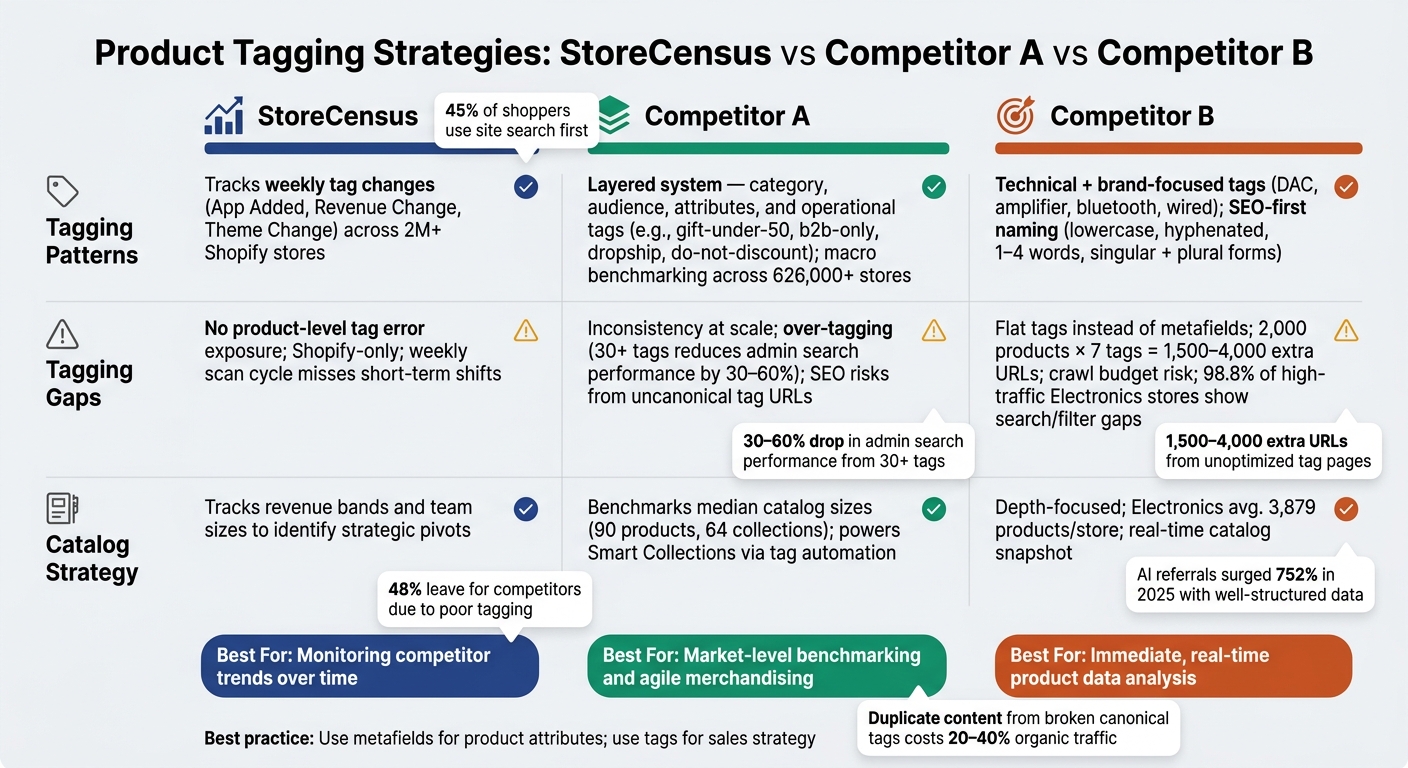
StoreCensus vs Competitor A vs Competitor B: Product Tagging Strategy Comparison
The table below highlights the strengths and limitations of three platforms - StoreCensus, Competitor A, and Competitor B - focusing on tagging patterns, gap management, and catalog strategy. These comparisons are based on insights from competitor analyses across three key metrics.
| StoreCensus | Competitor A | Competitor B | |
|---|---|---|---|
| Tagging Patterns | Tracks weekly tag changes, helping identify strategic shifts over time | Offers macro-level benchmarking across 626,000+ stores, showcasing category-wide tag and app trends | Provides real-time product data, including current tags and metadata |
| Tagging Gaps | Flags tech stack changes but doesn't expose individual product-level tag errors | Highlights broad app gaps (e.g., 98.1% of stores lack subscription tools) but lacks granular tag details | Doesn't provide detailed historical gap analysis |
| Catalog Strategy | Tracks shifts in revenue bands and team sizes to identify strategic pivots | Benchmarks median catalog sizes (90 products across 64 collections), revealing market-level opportunities | Offers a snapshot of current catalog details for immediate analysis |
Each platform has its strengths, but none is all-encompassing. StoreCensus is ideal for tracking trends over time, such as when competitors install new apps or adjust product counts, though it doesn't dive into individual product tag structures. Competitor A shines in macro-level benchmarking, which is great for assessing market size and ecosystem-wide gaps but may fall short for detailed catalog decisions. Meanwhile, Competitor B provides real-time data for immediate insights, though it risks inefficiencies - like crawl budget issues - if canonical tags are poorly managed.
"Duplicate content from broken canonical tags costs Shopify stores 20–40% of their organic traffic." - Ira Bodnar, Ryze AI
To get the most out of these tools, use a combination. Monitor competitors' changes, benchmark market trends, and analyze individual store structures. This data is particularly useful for agencies looking to find and target Shopify stores with high-growth potential. This multi-faceted approach is essential for improving product tagging and refining catalog strategies across the Shopify ecosystem.
Conclusion
Studying competitor product tags can uncover strategic focuses, SEO gaps, and actionable insights. However, there’s no one-size-fits-all approach. Combining the analysis of trends over time, market benchmarks, and real-time data offers a more complete understanding of competitive tagging strategies. This reinforces a key takeaway: effective tagging is essential to reaching customers who rely on search.
One major takeaway is the gap between current and optimized tagging. For instance, a catalog of 2,000 products with 7 tags each could result in 1,500 to 4,000 extra low-value URLs. This highlights the need for a focused and efficient tagging strategy to avoid unnecessary clutter and improve performance.
A good rule of thumb? Use metafields to describe your products and tags to drive your sales strategy. Mixing these two functions leads to tag sprawl, making scaling efforts more challenging. A standardized naming convention, like prefix:value (e.g., material:leather or collection:summer-2026), ensures tags remain machine-readable and automated collections stay dependable.
The data tells a compelling story. In 2025, AI referrals surged by 752%, driven by well-structured product data. This shows how structured data not only boosts merchandising but also enhances search visibility.
"The products AI systems can clearly understand are the products they confidently recommend." - Nic Dunn, CEO, Charle Agency
To turn tagging chaos into a competitive edge, start with a thorough audit. Eliminate unnecessary tags, resolve canonical issues, and align your products with Shopify's Standard Product Taxonomy. These steps can give you a significant advantage over competitors who haven’t yet optimized their tag structures.
FAQs
How can I quickly audit a competitor’s product tags at scale?
If you're looking to analyze competitor product tags efficiently, automated Shopify scraping tools are your best friend. These tools can tap into public JSON endpoints to extract data directly from a competitor's storefront URL. This means you can pull entire product catalogs, including titles, variants, and tags, and export them in formats like JSON or CSV.
The real advantage? These tools allow you to process multiple store URLs in batches, giving you a clearer picture of how competitors organize their products. You'll gain insights into their categorization, navigation structures, and tagging strategies - all of which can help refine your own approach.
When should I use tags vs metafields in Shopify?
Tags are perfect for quick, temporary needs in merchandising or backend automation. For example, you can use tags to mark products as new arrivals, on sale, or seasonal. Since tags are unstructured text, they’re flexible and ideal for grouping products, filtering collections, or triggering workflows like Shopify Flow.
Metafields, on the other hand, are your go-to for permanent, structured product data. Think of things like product dimensions, materials, or care instructions. Metafields not only enhance SEO but also allow for advanced storefront filtering and ensure that your data is machine-readable - making it useful for AI tools and reporting systems.
How do I prevent tag URLs from hurting my SEO?
Shopify automatically generates URLs for product tags, which can sometimes result in thin or duplicate content. This can negatively impact your SEO performance. To address this, consider these steps:
- Apply a
noindex, followdirective: Update yourtheme.liquidfile to ensure tag pages are not indexed by search engines. - Use canonical tags: Direct search engines to the main collection pages by adding canonical tags, avoiding duplicate content issues.
- Turn popular tags into optimized collection pages: For tags that drive significant traffic, create dedicated, well-optimized collection pages.
- Perform regular audits: Keep an eye on your tags and monitor performance using Google Search Console to ensure everything stays on track.
Taking these actions can help maintain a clean and effective SEO strategy on Shopify.