Complete Guide to Building a $1M Shopify Store
Learn a 3-step Shopify store plan that covers product research, store setup, SEO, ads, email, and scaling from $0 to $1M a year.

Launching an ecommerce brand is easier than ever from a technical standpoint - and harder than ever from a competition standpoint. The barriers to opening a Shopify store are low. The barriers to building a profitable one are not.
That’s what makes this framework useful.
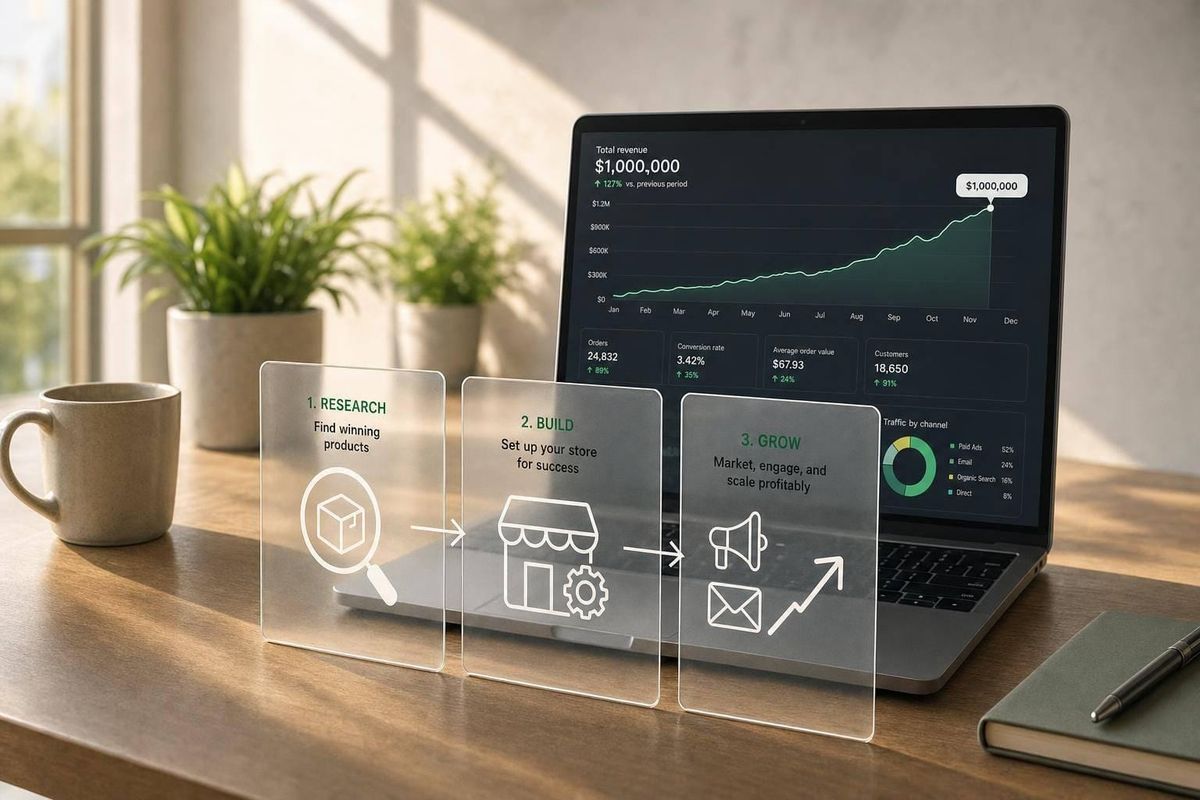
In the video, the creator lays out a three-phase path for growing a Shopify business from zero to $10,000 per month, then to $50,000 per month, and ultimately to roughly $1 million per year. The value isn’t in any single tactic. It’s in the sequencing: get the fundamentals right first, then improve efficiency, then expand distribution and capacity.
For agencies and Shopify ecosystem operators, this is also a revealing playbook. It shows where fast-growing merchants typically need help: store setup, product page optimization, paid media, email automation, analytics, SEO, and expansion strategy. In other words, it maps closely to the service stack many agencies already sell.
This article transforms the video into a clearer operating model, adds context around what matters most at each stage, and highlights where execution - not information - is usually the differentiator.
Key Takeaways
- The first $10,000/month is usually the hardest, because that phase requires building the full foundation: product, store, traffic, conversion, and retention systems.
- Product economics matter early. A store with weak margins has very little room to buy traffic and still grow.
- Shopify speed and simplicity are strategic advantages, especially for founders who need to focus on selling rather than debugging infrastructure.
- Paid ads drive early learning faster than SEO alone, but SEO should begin early because it compounds over time.
- Conversion systems are not optional. Reviews, email capture, abandonment flows, shipping clarity, and risk-reduction policies all improve revenue from the same traffic.
- Growth from $10K to $50K/month comes from refinement, especially AOV increases, stronger product pages, better segmentation, and tighter ad allocation.
- Email can become a major revenue channel, not just a support channel, once the list is large enough and campaigns are consistent.
- Scaling to $1M/year requires more than more ad spend. It usually demands operational leverage: delegation, new channels, and geographic or marketplace expansion.
- The real constraint shifts over time - from finding product-market fit, to improving economics, to expanding organizational capacity.
- For service providers, the biggest merchant opportunities often appear at stage transitions, when existing systems stop being enough.
sbb-itb-61169e3
The Core Idea: Build in Three Phases
The video organizes growth into three stages:
- Startup phase: $0 to $10,000/month
- Growth phase: $10,000 to $50,000/month
- Scale phase: $50,000/month to a $1M annual run rate
That structure is useful because ecommerce problems change as revenue grows.
A new store needs traction.
A growing store needs efficiency.
A scaling store needs leverage.
Founders often fail by solving the wrong problem for their stage. For example, a pre-revenue store obsessing over advanced hiring plans is skipping ahead. A $40K/month store still relying on a bare-bones product page is under-investing in basics.
Phase 1: From Zero to $10,000/Month
According to the video, this is the most work-intensive phase - and that tracks with reality. At this stage, the business is not really being "optimized." It’s being assembled.
Start With Product Selection, Not Platform Features
The speaker makes a straightforward point: you need something worth selling before anything else matters.
His advice is to begin with a product area you care about, then validate demand by looking at trend and marketplace signals. The suggested research sources include:
The underlying logic is smart: passion is not a substitute for demand, but it can help a founder persist through the slow early months. More importantly, the recommended process goes beyond "find a trending product." It pushes founders to identify flaws in existing offers by reading customer reviews and then improving the product.
That’s a meaningful distinction. Competing on novelty alone is fragile. Competing on a better offer is more durable.
Margin Is a Strategic Filter
One of the strongest ideas in the video is the emphasis on economics. The speaker recommends aiming for roughly 60% to 70% gross margin, especially because ecommerce growth usually depends on paid acquisition.
That’s not just a financial recommendation - it’s a growth constraint. If a product has weak margins, a merchant may never be able to spend enough on ads to learn, scale, and retain customers profitably.
He also favors small, high-value products, largely because they are easier and cheaper to ship. That logic remains powerful in 2026. Shipping cost, delivery complexity, and return burden can quietly destroy unit economics, especially for early-stage brands.
For agencies, this is a useful diagnostic point: merchants with weak contribution margins often blame poor ad performance when the real problem is structural.
Why Shopify Is the Default Starting Point
The video strongly recommends Shopify over more technically demanding alternatives. The reasoning is simple: founders need to reduce technical friction and focus on selling.
That aligns with what most operators see in the market. Shopify’s advantage is not just app availability. It’s speed to execution. A founder can launch faster, integrate tools faster, and spend less time solving platform-level issues.
For early-stage brands, that matters. Every hour spent managing avoidable technical complexity is an hour not spent on product, creative, conversion, or customer acquisition.
Build Product Pages Like a Sales Asset
The speaker stresses that product setup matters, especially:
- High-quality product photos
- Strong product descriptions
- Multiple images per product
- A legitimate, optimized theme
This may sound basic, but it’s one of the most common weak points in small stores. Many new brands treat product pages as placeholders. In practice, the product page is often the entire sales experience.
A prospect on mobile may never visit an About page, category page, or blog. They hit an ad, land on a product page, and decide there.
That means the page must answer four questions quickly:
- What is this?
- Why is it better?
- Can I trust this brand?
- What happens if it doesn’t work for me?
The video covers parts of this directly and hints at the rest through later discussion of reviews, FAQs, guarantees, and shipping clarity.
Install Tracking Before You Need It
An important operational recommendation is to create social accounts early and install ad pixels as soon as possible.
That’s less about organic posting and more about data collection. Pixels help platforms learn from site visitors, even before campaigns are fully mature. For new stores, delayed tracking setup means delayed optimization.
In practical terms, merchants that wait to instrument the business usually end up learning more slowly and wasting more early ad spend.
Capture Traffic You Can’t Convert Yet
The video notes that only a small percentage of visitors buy on the first visit. That makes email capture essential from day one.
The suggested setup centers on:
- A popup or lead capture form
- Ecommerce email automation
- Welcome flows
- Cart abandonment flows
- Winback sequences
This is one of the clearest examples of why retention systems belong in the startup phase, not later. If 98 out of 100 visitors leave without buying, the business needs a mechanism to continue the conversation.
For agencies, this is often an easy source of upside. Many small merchants run paid ads before building even basic lifecycle marketing.
Test the Store on Mobile - Seriously
The mobile testing anecdote in the video points to a larger truth: minor UX issues can have major revenue consequences.
The example given is a chat widget blocking the add-to-cart button on mobile. Whether or not that exact issue is common, the lesson is universal. A store can appear functional from the founder’s desktop and still be broken where most traffic actually converts.
At minimum, merchants should test:
- Homepage
- Collection pages
- Product pages
- Cart
- Checkout handoff
- Popup behavior
- Sticky buttons
- Chat widgets
- Mobile loading and layout
In many ecommerce niches, mobile isn’t just important - it’s dominant.
Traffic in the Startup Phase: Fast Feedback vs. Long-Term Compounding
Once the store is operational, the video turns to customer acquisition through three channels:
- SEO
- Google Ads
- Meta Ads
That mix is sensible because it balances short-term demand capture with long-term discoverability.
SEO: Plant Early, Harvest Later
The speaker compares SEO to planting a seed, which is a useful framing. SEO rarely solves an immediate traction problem for a new store, but stores that ignore it entirely often regret the delay.
The recommendation is to start with keyword research and optimize collection pages early. That’s practical because collection pages often have commercial intent and can support category-level rankings.
For Shopify-focused service providers, this is a reminder that "SEO for ecommerce" is usually not the same as generic blog-first SEO. Information content matters later, but initial gains often come from:
- Collection architecture
- On-page category optimization
- Internal linking
- Crawl efficiency
- Merchant-specific product and category language
Google Ads for Demand Capture
The video recommends Google Performance Max in the beginning.
The strategic idea is that Google can help merchants reach buyers with active commercial intent. Someone searching for a product category is often further down the funnel than someone casually browsing social media.
That said, the video does not go deep into feed quality, asset groups, exclusions, or campaign segmentation. Those details are not specified in the video, but they matter greatly in practice. Performance Max can work well, though results depend heavily on clean product data, conversion tracking, and enough signal volume.
Meta Ads for Demand Creation
By contrast, Meta is presented as a brand awareness and discovery engine. That framing is accurate. Meta often helps brands reach people who are not actively searching but may still respond to creative, offer, or problem-solution positioning.
A smart insight from the video is the distinction between:
- Brand capture via Google
- Brand awareness via Meta
That’s a useful mental model for founders. Search captures existing intent. Social helps create it.
The mention of using the Meta Ads Library to study competitors is also valuable, especially for creative research. The real opportunity isn’t to duplicate ads blindly - it’s to identify patterns:
- What angles competitors repeat
- Which offers seem persistent
- What product benefits are emphasized
- Which formats appear most often
Persistence in creative is often a clue. Brands usually keep spending on ads that work.
Conversion Optimization: The Difference Between Traffic and Revenue
Getting traffic is only half the job. The video puts meaningful emphasis on conversion rate optimization, and rightly so.
Reviews Build Credibility Fast
The speaker recommends adding a review app and collecting customer feedback early.
This matters because social proof reduces uncertainty. New brands lack the built-in trust of marketplaces like Amazon, so they need visible proof that other customers had a good experience.
Reviews are especially important for first-time brands because they do three jobs at once:
- They build trust
- They answer objections
- They add fresh, customer-generated language to product pages
Lifecycle Email Is a Revenue Engine
The recommended automation stack includes:
- Welcome series
- Cart abandonment
- Winback flow
That’s a sensible minimum. These automations work because they target intent at different stages. A welcome flow introduces the brand. Abandonment messages recover interrupted purchases. Winback campaigns reactivate older buyers.
What’s worth emphasizing is that automation isn’t just a retention tactic. For many brands, it improves paid media efficiency too. If a portion of non-buying traffic is later recovered by email, the effective value of each click goes up.
Shipping Clarity Reduces Friction
The video’s advice on shipping is practical:
- Free shipping if possible
- Otherwise, flat-rate transparency
- Clear delivery timing
- No surprises
This is one of the least glamorous and most important conversion variables in ecommerce. Confusing shipping terms or late-stage cost surprises routinely damage checkout completion.
The comparison to customer expectations shaped by Amazon is especially relevant. Whether a store can match those standards or not, customers now expect to know two things with confidence:
- How much shipping costs
- When the order will arrive
Risk Reversal Belongs on the Product Page
The speaker also highlights warranties, return policies, and money-back guarantees as tools to reduce buyer hesitation.
That’s not just customer service language. It’s conversion strategy.
A shopper evaluating an unfamiliar brand is mentally asking: what happens if this goes wrong? Strong policies, clearly presented, reduce perceived downside and help push uncertain buyers forward.
Phase 2: From $10,000 to $50,000/Month
The video describes the growth phase as doing many of the same things, only better. That’s a good summary.
At this stage, the store has likely proven that people will buy. The next question is whether the model can become more efficient and predictable.
Raise Average Order Value Before Chasing Endless New Traffic
One of the first recommendations in this stage is to focus on average order value (AOV) through:
- Upsells
- Cross-sells
- Add-ons
- Bundles
This is one of the healthiest ways to grow because it extracts more revenue from existing demand. Instead of asking paid media to do all the work, the store increases the value of each conversion.
That matters because acquisition costs usually rise over time. Brands that can raise AOV often preserve profitability longer than brands that rely only on more traffic.
From an agency perspective, this is often a high-ROI engagement area. Many brands want more leads or more sessions when they really need better monetization per visitor.
Enrich Product Pages With Video and FAQs
The video recommends adding:
- Product videos
- User-generated content
- Frequently asked questions
This reflects an important maturity shift. Once a store has real customers, it gains access to stronger trust assets. User-generated content is especially valuable because it demonstrates real-world use in a way polished brand photography often cannot.
FAQs are equally important because they compress the sales cycle. If the same questions keep appearing in support or pre-purchase messages, those answers belong on the page.
This is a recurring theme throughout the playbook: listen to what customers reveal, then bake the answers into the experience.
Use Shopify Analytics to Diagnose Funnel Leaks
A particularly useful part of the video is the focus on funnel metrics inside Shopify analytics:
- Add-to-cart rate
- Reach checkout rate
- Purchase conversion rate
These metrics help identify where friction lives.
For example:
- Low add-to-cart rate may indicate weak product-market fit, poor pricing, low trust, or weak creative-to-page alignment.
- Strong add-to-cart but weak checkout progression may point to shipping surprises, hidden fees, or cart UX friction.
- Strong checkout starts but weak purchase completion may suggest payment issues, trust gaps, or unnecessary checkout obstacles.
The video doesn’t spell out that diagnostic framework, but it’s the natural extension of the metrics being discussed.
Scale Ads With Better Allocation, Not Blind Budget Increases
In the growth phase, the speaker recommends splitting winning products into their own campaigns and spending more on what has already shown traction.
That is a more mature approach than simply "increase budget." The real scaling principle is:
separate winners, cut laggards, and reinvest into proven demand
This applies to both Google and Meta. As product-level data improves, merchants can get more precise with creative, offers, and spend distribution.
The repeated use of competitor ad research also becomes more useful here, because the brand now has internal performance data to compare against market patterns.
Email Becomes a Primary Revenue Channel
One of the stronger claims in the video is that regular campaign emails can drive a meaningful share of monthly revenue. That’s believable, especially for stores with a healthy subscriber base and repeat-purchase potential.
The creator mentions frequent sending and revenue contribution from email campaigns. The exact performance will vary by category, purchase cycle, and list quality, but the larger point is sound: email is often underused by growing brands.
At this stage, email should not be limited to automations. It should also include campaigns built around:
- Product education
- New arrivals
- Offers
- Social proof
- Behind-the-scenes brand stories
- Content-driven engagement
The suggestion to repurpose blog content into email is especially efficient. It helps merchants maintain touchpoints without inventing every campaign from scratch.
Expand SEO Beyond Collections Into Content
In the growth stage, the video recommends writing regular blog content based on keyword research.
That’s a natural next step. Once core commercial pages are optimized, informational content can broaden search visibility, support internal linking, and build topical authority.
Still, one blog per month should be seen as a minimum cadence, not a guaranteed growth engine. Quality, intent alignment, and relevance matter more than sheer output.
For agencies using prospecting tools like StoreCensus, this is a strong qualification angle: a merchant may already have traffic and ads running, but weak or nonexistent blog and collection SEO often signals a clear service opportunity.
Phase 3: From $50,000/Month to a $1M Annual Run Rate
Once a store approaches mid-five-figure monthly revenue, the constraints become more operational.
The video frames this phase around three ideas:
- Increasing traffic
- Expanding capability
- Selling in more places
That’s a practical way to think about scale because growth at this level is usually limited by channel concentration, founder bandwidth, or narrow distribution.
Add More Traffic Sources Carefully
The speaker suggests expanding beyond Google and Meta into channels like:
- TikTok Ads
- Bing
The broader principle is channel diversification. Relying on only one or two acquisition sources increases business risk and caps upside.
That said, not every channel fits every product. The right question is not "Which channels exist?" but "Which channels align with customer behavior, creative format, and economics?"
The video does not specify a testing framework for new channels, but in practice the strongest expansion usually comes from disciplined experimentation rather than opening every faucet at once.
Understand Customer Lifetime Value Before You Scale Aggressively
One of the most important scale-stage recommendations is to understand:
- Customer lifetime value (LTV)
- How much you can spend to acquire a customer
This is where many brands either mature or stall.
If a merchant only thinks in first-order ROI, they may underinvest in acquisition. If they overestimate lifetime value, they may scale unprofitably. The key is to know what a customer is worth over time and then align ad spend with that reality.
This is especially crucial for repeat-purchase categories like supplements, beauty, or consumables. A customer who buys once may be marginally profitable; a customer who buys four times can transform the ad model.
Buy Back the Founder’s Time
The video’s advice to start delegating is not glamorous, but it may be the most important scale step.
The recommended hires include:
- Customer service
- Graphic design
- Ad management
This reflects a classic ecommerce transition: the founder must stop being the bottleneck.
When a business reaches this stage, the highest-value work usually shifts toward:
- Strategic decision-making
- Product development
- channel expansion
- team management
- financial oversight
If the founder is still trapped in inboxes, creative production, and campaign setup, scale will be constrained no matter how good the product is.
Interestingly, the speaker says he prefers in-house hires over agencies. That won’t be true for every business, but it does reveal an important buyer signal for service providers: as merchants scale, they often reconsider which functions they want externalized versus brought closer to the business.
Expand Beyond the Storefront
The final scale lever in the video is multi-channel and multi-region expansion:
- Amazon
- Walmart
- eBay
- Additional countries or regions
This is one of the biggest jumps in the entire framework because it shifts the business from "one store, one channel" to a more distributed commerce model.
The logic is sound: once an offer works in one market, the next gains often come from replicating that success where similar demand already exists.
Of course, the operational complexity rises too. Marketplace requirements, localization, fulfillment, tax considerations, and inventory coordination all become more demanding. Those implementation details are not specified in the video, but they are the real challenge behind marketplace and international growth.
Still, the strategic principle is right: after proving the machine in one place, replicate it rather than reinventing it.
What This Framework Gets Right
There are several reasons this playbook is useful.
1. It prioritizes sequencing
Too many ecommerce guides treat every tactic as equally urgent. This framework doesn’t. It recognizes that new stores need foundations, growing stores need efficiency, and scaling stores need systems.
2. It balances acquisition with conversion
The video doesn’t pretend traffic alone solves everything. It repeatedly returns to reviews, email, mobile UX, shipping, FAQs, and risk removal - all of which increase the value of existing traffic.
3. It treats analytics as a decision tool
Rather than discussing growth in abstract terms, it points merchants toward concrete metrics like funnel conversion rates and customer value.
4. It acknowledges operational scaling
A store does not become a $1M business through ads alone. Team structure, delegation, and channel expansion matter.
Where Merchants Should Be Cautious
No framework is universal, and this one should be applied thoughtfully.
Product quality is assumed, not deeply examined
The video emphasizes product selection and improvement, but the long-term success of any brand depends heavily on product-market fit, customer experience, and repeat purchase behavior. Those factors are implied more than fully explored.
Paid ads are presented as an early accelerator
That’s often true, but early ad success depends heavily on creative quality, pricing, landing page strength, and margin structure. Ads don’t fix weak fundamentals.
Scaling by adding channels sounds simpler than it is
Selling on Amazon or internationally can absolutely unlock growth, but each new channel adds operational and strategic complexity. Expansion should follow proven economics, not precede them.
What Agencies and Shopify Partners Can Learn From This
For StoreCensus-style users - agencies and partners working with Shopify and WooCommerce merchants - this framework is more than founder advice. It’s a service map.
Each stage creates visible signals:
Startup-stage merchants often need:
- Theme and storefront setup
- Product page optimization
- Klaviyo implementation
- tracking and pixel setup
- launch ad campaigns
- review and trust layer setup
Growth-stage merchants often need:
- AOV optimization
- CRO testing
- lifecycle segmentation
- feed and campaign restructuring
- SEO content planning
- analytics interpretation
Scale-stage merchants often need:
- channel diversification
- advanced retention strategy
- LTV and CAC modeling
- team and workflow systems
- marketplace rollout
- international expansion support
For prospecting, the implication is straightforward: the best opportunities often come from identifying what a merchant has not yet installed or matured for their current revenue tier. A $500K/year brand without lifecycle flows, reviews, or serious CRO is far more actionable than a generic ecommerce lead.
Final Thoughts
The most valuable idea in the video is not any single tool or tactic. It’s the idea that ecommerce growth is staged, and each stage demands a different kind of discipline.
In the beginning, success comes from building the foundation correctly.
In the middle, it comes from improving economics and conversion.
At scale, it comes from leverage - more channels, better systems, and more capacity.
If there is a unifying lesson here, it’s this: stores do not usually fail because they lack access to tactics. They fail because they apply the wrong tactic at the wrong time, or never fully execute the basics.
A million-dollar Shopify store is rarely built on one breakthrough. More often, it’s the result of getting the fundamentals right, then repeating what works with increasing precision.
Source: "How I Build $1m+ Ecommerce Stores (step by step guide)" - Brendan Gillen, YouTube, Sep 3, 2024 - https://www.youtube.com/watch?v=QG8QKMRZ9fo