Shopify Segmentation Data: Insights for Email Success
Segmentation is essential: use Shopify purchase and behavior data to send targeted emails that boost opens, conversions, and revenue.

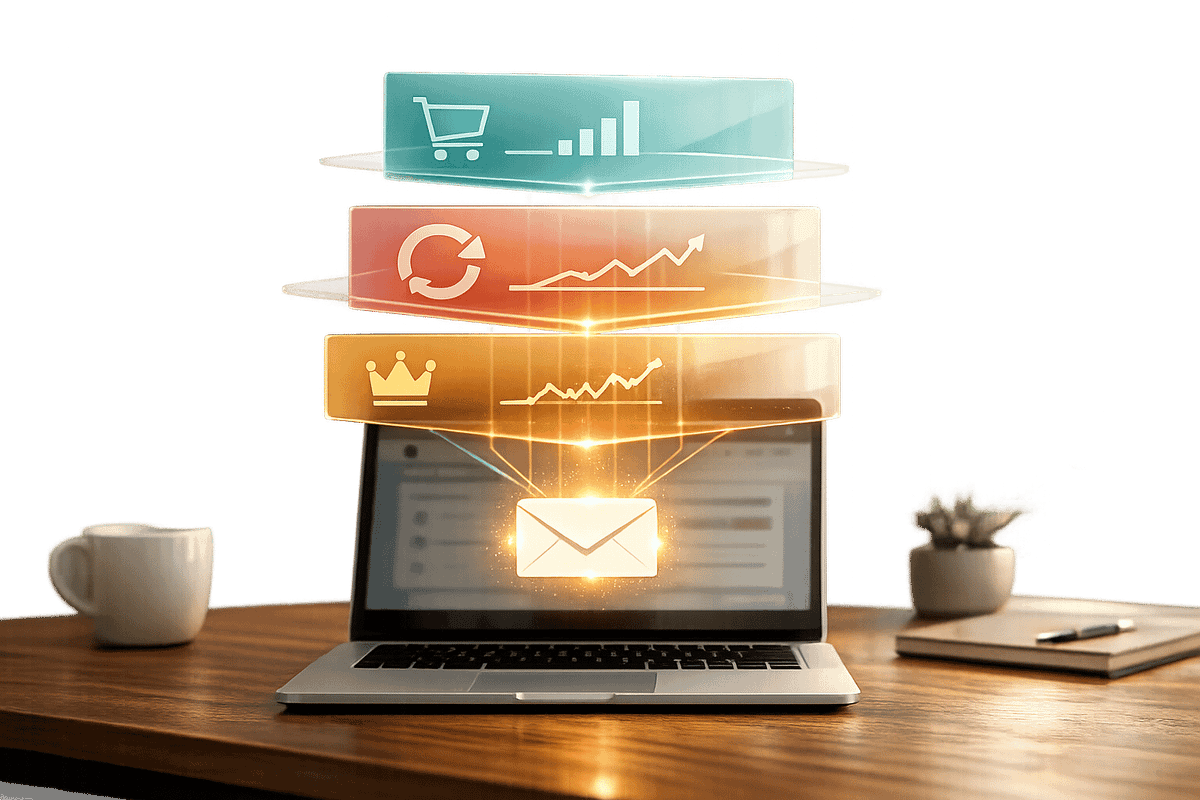
Sending the same email to everyone on your list is a mistake. Why? A first-time buyer and a loyal customer have different needs, and treating them the same reduces engagement and revenue. Shopify segmentation solves this by dividing your audience into smaller groups based on behaviors like purchase history, browsing habits, and engagement levels.
Here’s what you need to know:
- Segmentation boosts results: Over 90% of marketers say it improves email performance, with segmented campaigns generating $36–$42 for every $1 spent.
- Behavioral emails perform better: Triggered emails drive 10x more revenue than generic blasts.
- Retention matters: The average repeat purchase rate is only 18–19%, so targeting first-time buyers with follow-ups can increase loyalty.
- Data is key: Shopify tracks purchase history and browsing behavior, but adding tools like quizzes or surveys can fill in gaps for deeper personalization.
The takeaway? Start simple - segment non-buyers, first-time buyers, and repeat customers. Use Shopify’s built-in tools and focus on behavioral triggers to make your emails relevant and profitable. Segmentation doesn’t just improve performance; it ensures your emails resonate with your audience.
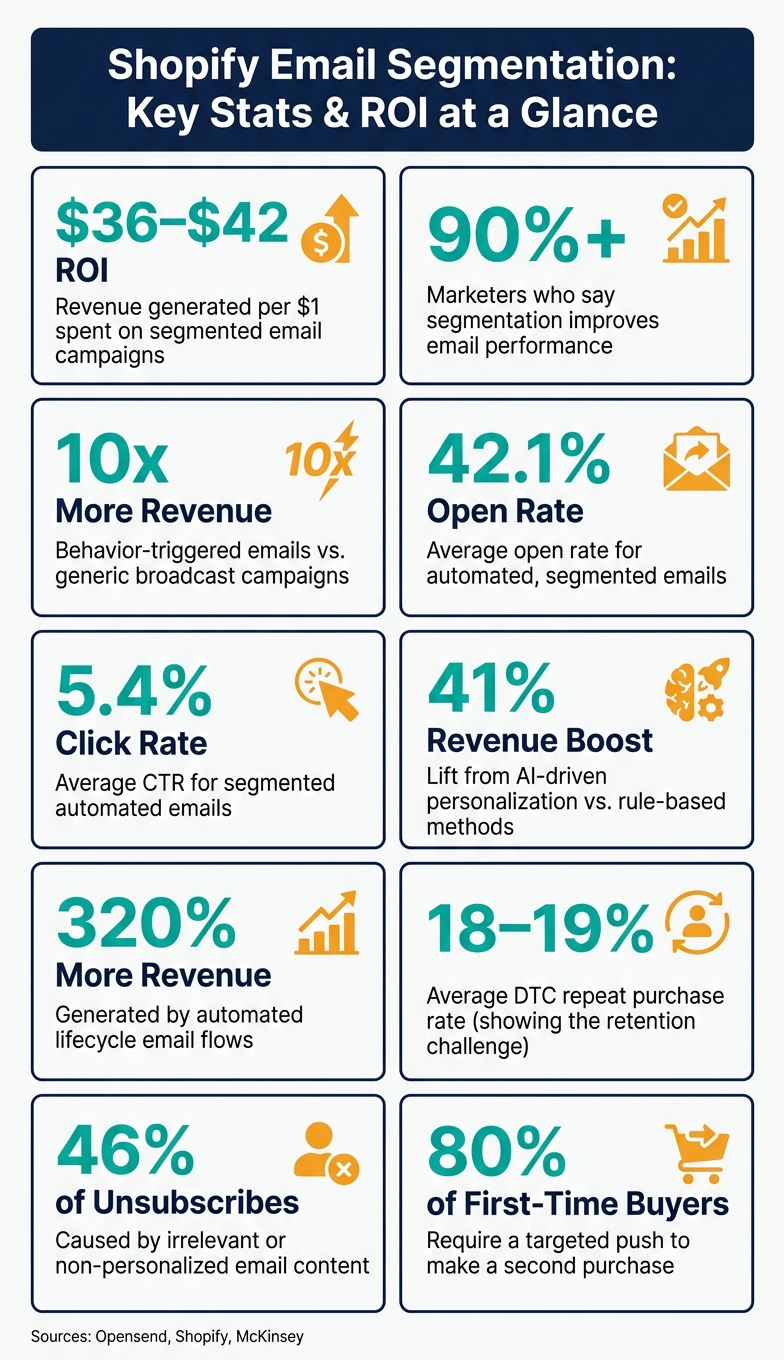
Shopify Email Segmentation: Key Stats & ROI at a Glance
How to automate customer segmentation emails in Shopify | Shopify Flow
sbb-itb-61169e3
Understanding Shopify Segmentation Data
Effective segmentation starts with examining available data and spotting any gaps. Shopify merchants have access to a variety of data types, each playing a unique role in shaping a strong email strategy.
Core Data Sources for Segmentation
One of the most valuable data points is purchase history. Shopify tracks this automatically, giving you insights into who bought what, when they bought it, and how often they return. This information is perfect for retention emails, cross-sell suggestions, and replenishment reminders - all without requiring additional setup.
Another key data source is browsing and cart behavior, which captures moments of high intent, such as abandoned checkouts, product views, or collection browsing. These actions signal interest - sometimes all that's needed is the right nudge. Behavioral triggers based on this data often outperform generic email blasts in driving revenue.
Email engagement data - such as opens, clicks, and inactivity - helps you understand who’s engaged and who’s not. Treating active subscribers the same as lapsed ones can lead to quick unsubscribes. In fact, research shows that 46% of unsubscribes happen when recipients feel the emails are irrelevant.
Geographic data, pulled from shipping addresses or IPs, enables region-specific offers. For merchants looking to dig deeper, external data - like quiz results, loyalty app insights from tools like Yotpo or Smile, or customer support interactions - can help create highly tailored micro-segments.
While Shopify’s built-in tools cover a lot, some segmentation efforts may require collecting additional data.
Data Reliability and Accessibility
Shopify’s native data, such as purchase history and cart activity, is highly reliable because it’s integrated directly into the platform and updates automatically. However, collecting more detailed information - such as demographics like age, gender, or lifestyle preferences - requires proactive effort. These details aren’t part of Shopify’s default data set and must be gathered through methods like sign-up forms, post-purchase surveys, or interactive quizzes.
This gap in data collection is significant. For instance, 20% of marketers report that their biggest challenge in running segmented campaigns is gathering enough data. A straightforward solution is to add a few targeted fields to your pop-ups or welcome forms to capture relevant interests early. This small step can yield big rewards as your email list grows.
| Data Type | Source | Reliability | Primary Use |
|---|---|---|---|
| Purchase History | Shopify Native | High | Retention, VIP, replenishment |
| Browsing Behavior | Storefront Scripts | Very High | Abandoned cart/browse recovery |
| Email Engagement | Email Service Provider | Medium | Re-engagement, list health |
| Geographic Data | Shipping/IP Address | Medium | Localized offers, seasonal relevance |
| Predictive Spend | Shopify AI | High | Targeting high-LTV customers |
| External Data | Quizzes/Loyalty Apps | High | Hyper-personalization |
Proven Shopify Segmentation Models
Once you’ve got reliable Shopify data in hand, the next step is to make it work for you by applying segmentation models that boost email relevance. Different customer segments align with various stages of their journey, and these targeted approaches can transform your email campaigns into powerful tools.
Demographic and Geographic Segments
Segmenting by location is a straightforward yet effective strategy for Shopify merchants. Grouping customers by country, state, or city helps ensure your offers are relevant. For merchants with physical stores, this approach can also drive foot traffic through invitations to local events or region-specific promotions.
Adding demographic factors like age and gender takes personalization a step further. This is especially useful for brands selling gender-specific products like apparel or skincare. For example, Kent Brushes ran a gender-targeted Black Friday campaign and saw an 88.9% open rate for women and 73.7% for men, compared to just 54.5% for a generic message. The products didn’t change - only the messaging did.
Behavioral and Lifecycle Segments
Behavioral and lifecycle segmentation is where email marketing becomes especially impactful. You can divide your audience into groups such as non-buyers, first-time buyers, and repeat customers (see the table below).
Consider this: the average direct-to-consumer (DTC) repeat purchase rate is just 18–19%, meaning most first-time buyers won’t return without a concerted effort. Post-purchase emails that educate buyers or suggest complementary products are key to retaining these customers. Meanwhile, repeat buyers respond well to VIP perks like early access, loyalty rewards, or reminders for replenishing products.
High-intent segments, such as cart and browse abandoners, also deserve attention. Represent, a luxury streetwear brand, sent automated cart abandonment emails during Black Friday without offering discounts and still achieved an 8.3% purchase rate. The lesson? Sometimes a simple, well-timed reminder is enough.
Beyond purchasing behavior, tracking engagement levels and frequency can fine-tune your targeting even further.
Engagement and Purchase Frequency Segments
Engagement history and purchase frequency provide valuable insights into your customers’ needs. Shopify’s built-in tools let you segment by recent activity and buying patterns, including a Predicted Spend feature that uses machine learning to classify customers into high, medium, and low future-value tiers.
For VIP customers - those who’ve placed multiple orders or spent above a certain amount - offering exclusive experiences is a smart move. CityLocs, a custom apparel retailer, gave VIPs early access to discounts 3–4 days ahead of the general public, resulting in fewer customer service issues and better production planning during busy periods. For lapsed customers, win-back campaigns featuring "we missed you" messages can work wonders - 45% of subscribers who receive a win-back email go on to open future emails.
| Segment | Target Audience | Recommended Approach |
|---|---|---|
| Non-Buyers | Subscribers with 0 orders | Highlight social proof, bestsellers, or first-purchase incentives |
| First-Time Buyers | Exactly 1 order | Send post-purchase tips, cross-sell suggestions, or second-order nudges |
| Repeat Buyers (VIP) | 2+ orders or high spend | Offer early access, loyalty rewards, or replenishment reminders |
| Cart Abandoners | Started checkout but didn’t finish | Use gentle reminders or free shipping offers - discounts aren’t always necessary |
| Lapsed Customers | No purchase in 30–90+ days | Send win-back offers or "we missed you" emails |
| Geographic | Customers in specific regions or climates | Tailor offers to seasonal needs or promote local events |
Measuring the Impact of Segmentation on Email Performance
Creating segments is just the beginning - understanding their impact is where the real value lies. That means focusing on the numbers that matter most.
Core Performance Metrics
When it comes to email performance, four key metrics tell the story: open rates, click-through rates (CTR), conversion rates, and revenue per recipient. These numbers reveal how well your emails are being seen, engaged with, and driving results.
Segmented email campaigns consistently outperform the norm. For instance, automated, segmented emails boast an average open rate of 42.1% and a click rate of 5.4%, both significantly higher than typical benchmarks. Behavior-triggered emails go even further, generating 10x more revenue than standard broadcast campaigns. Add AI-driven personalization into the mix, and you'll see even better results: a 41% revenue boost and 13.44% higher CTR compared to traditional rule-based methods.
"90% of marketers confirming that subscriber segmentation boosts performance, the data makes one thing clear: personalized, targeted emails outperform batch-and-blast approaches in every measurable category." - Opensend
Another metric to watch is average order value (AOV). Automated email flows can deliver a 36% higher AOV compared to non-automated campaigns. So, segmentation not only attracts more buyers but often encourages them to spend more.
Tracking these metrics doesn’t just measure success - it also provides insights to refine deliverability and maintain list health.
Deliverability and List Health
Strong performance metrics also highlight the importance of keeping your audience engaged. Sending relevant, well-targeted emails ensures that inbox providers notice your efforts positively. This is key to maintaining strong deliverability and a healthy sender reputation.
"46% of unsubscribes are caused by irrelevant or non-personalized content reaching subscribers. This statistic highlights the cost of inadequate segmentation - not just missed opportunities but active destruction of hard-won subscriber relationships." - Opensend
The solution? Focus high-frequency emails on your most engaged segments, while less active subscribers should receive occasional win-back campaigns. Regularly clean your email list by removing bounced or inactive addresses. This keeps your sender reputation intact and ensures your segmentation data remains reliable.
Segmentation Type vs. Email Impact: Comparison Table
Different segmentation strategies deliver different results. Here's a quick look at how they compare:
| Segmentation Type | Data Required | Measurable Impact |
|---|---|---|
| Behavioral / Triggered | Browsing history, cart additions, product views | 10x greater revenue vs. standard campaigns |
| Automated Flows | Lifecycle triggers (welcome, win-back, post-purchase) | 320% more revenue; 42.1% average open rates |
| AI-Driven / Predictive | Purchase patterns, predicted spend tiers | 41% revenue increase; 13.44% higher CTR |
| Lifecycle (First-time vs. Repeat) | Purchase history, order frequency | Increases repeat purchase rate above DTC avg of 18–19% |
| Demographic / Geographic | Location, age, gender | Improved relevance; reduced unsubscribe rates |
| Engagement-Level | Open and click history | Protects deliverability; reduces the 46% irrelevance-driven unsubscribe rate |
The takeaway? Segments based on customer behavior tend to deliver the strongest results. While demographic data can be a good starting point, behavioral and predictive approaches often lead to better outcomes. For example, businesses using behavioral segmentation report 14% higher growth rates compared to those relying solely on demographic data.
Shopify Segmentation Research and Findings
Recurring Themes from Research
Studies consistently highlight two important trends: personalized emails enhance retention, and behavioral insights outperform simple demographic data.
For instance, 80% of consumers prefer brands that offer tailored experiences. Similarly, McKinsey reports that 71% of customers expect personalized interactions, and 76% feel frustrated when those expectations aren't met. The takeaway? Generic emails often lead to disengagement.
"72% of marketers identify message personalization as the most effective email marketing strategy available." - Opensend
Another critical insight revolves around second purchases. Nearly 80% of first-time buyers require a targeted push to make a second purchase. And once they do, they’re much more likely to make a third. This makes first-time buyers a prime focus for Shopify email campaigns with high ROI potential.
These findings provide the foundation for actionable case studies that showcase how segmentation can work in practice.
Case Studies and Practical Applications
A study of 564,770 Shopify stores revealed that 99.6% of stores have visible app or pixel data that could be used for personalization and segmentation. Yet, much of this data remains untapped.
When this information is aligned with targeted outreach, the results can be transformative. For example, among stores with over 50,000 monthly visitors, 71,746 run paid media campaigns but lack an email capture app, and 130,759 have over 100 products but no search app. These gaps highlight opportunities for tailored campaigns.
| Personalization Angle | 50K+ Traffic Stores | Practical Application |
|---|---|---|
| Paid media, no visible email app | 71,746 | Lifecycle and retention services |
| 100+ products, no visible search app | 130,759 | Merchandising or search optimization |
| Reviews app, no upsell app | 76,954 | CRO or AOV-boosting strategies |
| Shopify Plus on a free theme | 42,707 | High-end design or custom development |
The strategy is simple: match the observed signal to the right offer. By focusing on observable store behavior instead of generic list filters, brands can craft messages that resonate deeply.
"Real Shopify cold email personalization uses a visible business signal: the store runs paid ads but no visible email capture, sells hundreds of products without a search app, uses Mailchimp without visible Klaviyo, or runs Meta Pixel without a visible attribution layer." - StoreInspect Team
Additionally, micro-cohort strategies - grouping customers based on highly specific behaviors - can increase engagement rates by 25–40%. This reinforces the importance of precise segmentation over broad, generalized audience targeting.
How StoreCensus Supports Shopify Segmentation
Data Collection and Filtering
Segmentation starts with quality data, and StoreCensus delivers exactly that. It tracks an impressive 2,847,392 Shopify stores across 25+ structured data points, updating weekly with a 99.2% accuracy rate. This reliable dataset enables users to perform precise segmentation on a large scale.
With StoreCensus, users can filter stores by technology stack (apps and themes they use), estimated revenue, traffic levels, geographic location, and product catalog size. This allows you to pinpoint stores based on their operational behavior using Shopify brand prospect lists.
One standout feature is install-gap analysis, which identifies stores missing essential tools. For example, filtering for stores with over 100,000 monthly visitors that use Meta Pixel but lack an analytics app uncovers 122,819 stores perfectly suited for attribution or tracking services. This kind of segmentation, based entirely on observable data, creates ready-to-target groups and ensures dynamic updates in real time.
Real-Time Store Monitoring
Static lists are a thing of the past. StoreCensus uses real-time monitoring to track changes across the Shopify ecosystem, including app installs, app removals, theme updates, and product catalog growth. These updates trigger automated outreach workflows, enabling users to reach prospects immediately when a relevant signal appears. This approach has been shown to deliver 3–5x higher response rates compared to traditional cold outreach.
For instance, if a merchant uninstalls a critical app or expands their product catalog, StoreCensus captures this as a live buying signal. Reaching out within hours of such changes offers a far more compelling conversation than a generic pitch sent weeks later. These real-time insights integrate seamlessly into targeted outreach strategies, ensuring businesses stay ahead.
Practical Applications for Segmentation
StoreCensus turns raw data into actionable targeting for agencies, SaaS founders, and Shopify app developers. The platform integrates directly with outreach tools like Apollo, Instantly.ai, and Smartlead.ai, allowing segmented lists to flow directly into email sequences without the need for manual exporting.
Here’s how it works: first, define your ideal store profile using filters like tech stack, revenue, or category. Then, focus on contact enrichment. Since only 1.1% of stores have a verified outreach-role contact, spending time on contact research before qualifying accounts can be inefficient. StoreCensus's Decision Maker Finder simplifies this by identifying key roles like Founder, CEO, or Marketing Lead within an already-qualified store segment.
"Store data gives you relevance. Contact enrichment gives you reachability." - StoreInspect Team
Conclusion
The numbers don't lie - segmentation is a game-changer for Shopify email marketing. Segmented campaigns generate $36–$42 for every $1 spent, proving their incredible ROI. Plus, more than 90% of marketers agree that breaking down subscriber lists into smaller, targeted groups improves email performance.
Getting started doesn't have to be complicated. Begin with simple segments like non-buyers, first-time buyers, and repeat buyers. From there, you can introduce behavioral triggers to replace generic emails with personalized messages. This shift can lead to 10x more revenue per email, while also making your audience feel more connected to your brand.
Keeping your segments updated and relevant is just as important. Clean, accurate lists help maintain your sender reputation and avoid the dreaded 46% unsubscribe rate caused by irrelevant content.
For those looking to take segmentation to the next level, advanced tools can make all the difference. If you're an agency, SaaS founder, or app developer working with Shopify merchants, StoreCensus offers a powerful edge. With 99.6% of Shopify stores revealing app or pixel data publicly, it’s possible to create precise, behavior-driven outreach segments at scale - no guesswork or tedious manual work required.
FAQs
Which Shopify segments should I start with first?
Start by focusing on Shopify segments such as customer behavior and purchase history to craft messages that align with individual buying habits and preferences. Another smart approach is segmenting by lifecycle stages, like new customers, repeat buyers, or even lapsed customers, to deliver more relevant communication. You can also tap into demographic data, such as location or age, to create campaigns that feel more personal. As your data pool grows, consider diving into advanced segments, such as product preferences or engagement signals, to fine-tune your strategy even further.
What triggers are best for Shopify behavioral emails?
Shopify behavioral emails work best when they’re triggered by specific customer actions and engagement patterns. Some of the most effective triggers include:
- Abandoned checkouts: Sending reminders to customers who leave items in their cart without completing the purchase.
- Email engagement signals: Following up with customers who recently opened an email or have been inactive for a while.
- Browsing behavior: Reaching out to shoppers who viewed products or collections but didn’t make a purchase.
These triggers help deliver messages at the right moment, making them more relevant and increasing the chances of conversion. For an extra layer of personalization, advanced segmentation can incorporate store-related signals, such as app installations or recent design updates, to tailor the messaging even further.
How do I measure ROI from email segmentation?
To gauge the ROI of email segmentation, it's essential to monitor key metrics like revenue per email, conversion rates, and overall ROI. Dive deeper into segment-specific data, such as revenue generated by each segment, open rates, and click-through rates. Regularly analyzing these numbers allows you to spot your most effective segments and fine-tune your campaigns for better results.
Additionally, keeping an eye on automation benchmarks and industry trends can provide valuable insights to refine your strategy and boost the impact of your email marketing efforts.