Data Enrichment for Better Outreach Results
Turn basic contact lists into enriched, real-time profiles to improve targeting, personalize outreach, boost response rates, and shorten sales cycles.

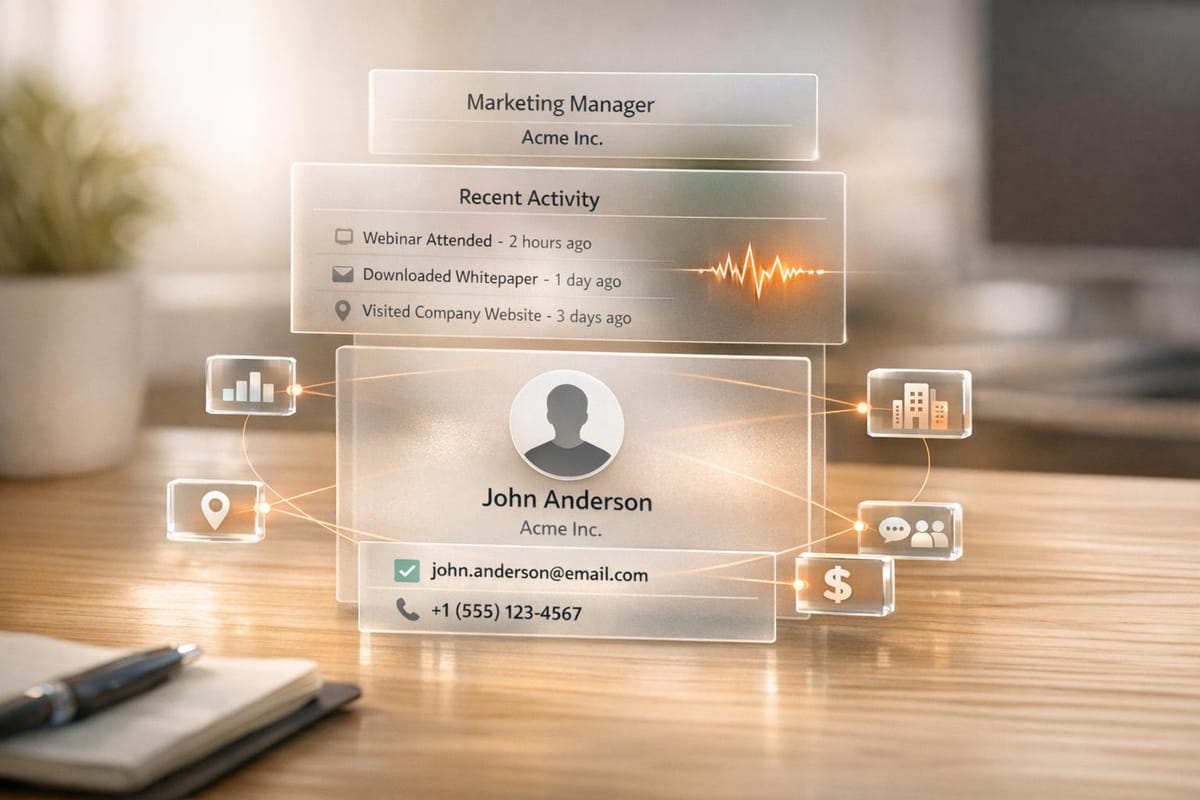
Data enrichment transforms basic contact lists into detailed profiles by adding external details like revenue, tech stacks, or behavioral insights. This approach creates highly targeted outreach campaigns, increasing response rates from 2–3% to 18–25% and shortening sales cycles by nearly 50%. Without enriched data, businesses risk wasting resources on poor targeting, generic messaging, and missed follow-ups, losing up to 70% of qualified leads.
Key advantages include:
- Improved segmentation: Focus on prospects with specific needs (e.g., tech gaps, revenue tiers).
- Higher personalization: Tailored messages based on real-time insights like platform changes.
- Increased efficiency: Save 60% of lead research time and boost conversions by 45%.
Using tools like StoreCensus, teams gain access to real-time data on over 2.5M ecommerce stores, including 25+ data points, ensuring timely and precise outreach. The result? A 233% increase in revenue from the same prospecting efforts. Data enrichment isn't just useful - it’s essential for effective, scalable outreach.
Go-To-Market Data Enrichment: Practical Strategies to Drive Business Value
Problems With Outreach Without Data Enrichment
Launching outreach campaigns with basic contact lists often leads to what some call a "prospecting tax" - starting from scratch every month. Without systems to track, nurture, or re-engage leads, as much as 70% of qualified prospects vanish into thin air. The problem isn’t about the number of leads; it’s about the lack of enriched data to make those leads actionable.
Without data enrichment, outreach efforts suffer from generic messaging, wasted resources, and lost opportunities for meaningful follow-ups.
Generic Messages That Fall Flat
When you don’t have access to detailed data - like a prospect’s technology stack or revenue figures - your outreach emails end up sounding generic. This spray-and-pray approach not only damages your sender reputation but also wastes time and energy. For example, without knowing what tools a prospect uses or identifying gaps in their setup, teams rely on one-size-fits-all templates. Unsurprisingly, these emails are ignored, leading to response rates of just 1–3%, compared to the 15–25% that personalized, data-driven outreach can achieve.
The lack of specificity doesn’t just hurt engagement; it also undermines your ability to effectively target the right leads.
Poor Targeting Drains Resources
When outreach lacks detailed filtering, sales teams end up treating all leads the same - spending equal time on both low-value and high-value prospects. The result? 85% of the list often proves to be a poor fit for the product or service being offered. This misalignment drains budgets and prevents teams from focusing on the leads that actually have the potential to convert.
Here’s a comparison that shows the stark difference:
| Approach | Effort | Resulting Clients | Close Rate |
|---|---|---|---|
| Equal Time (No Enrichment) | 100 leads × 1 hour each | 10 clients | 10% |
| Prioritized (With Enrichment) | 100 leads (prioritized) | 17 clients | 17% (70% improvement) |
By failing to prioritize, teams not only waste resources but also miss out on valuable opportunities to nurture high-potential leads.
Missed Follow-Ups and Lost Conversions
A lack of enriched data doesn’t just hurt initial outreach - it also cripples follow-up efforts. Without detailed insights, teams lose the context needed to re-engage leads months later. This creates a follow-up void, where 40% of leads who initially say "not right now" are never contacted again because they’re buried in static spreadsheets. Worse, 60% of top prospects aren’t ready to buy for 3–12 months. Without data-driven nurturing systems, these potential deals slip through the cracks.
"The average agency loses 70% of qualified leads not because of bad outreach, but because of catastrophic follow-up failure." - StoreCensus
In short, failing to invest in data enrichment means outreach efforts are doomed to inefficiency, from initial contact to follow-up. The losses compound over time, impacting response rates, conversion rates, and ultimately, revenue.
How Data Enrichment Improves Outreach
Data enrichment takes outreach from being a scattershot effort to a finely tuned strategy. Instead of sending out generic messages to massive Shopify brand prospect lists, teams can use enriched data to precisely segment their audience, craft messages tailored to specific needs, and focus resources on high-potential leads. This approach minimizes wasted effort, ensures timely outreach, and maximizes conversions. Let’s dive into how enriched data enhances segmentation, personalization, and overall efficiency.
Better Audience Segmentation and Lead Scoring
Enriched data allows for incredibly precise filtering - far beyond basic demographics. For instance, instead of targeting all Shopify stores, teams can zero in on stores earning $1M–$5M, using specific tools like ReCharge but lacking others like Klaviyo, or those actively running Facebook ads or launching new products.
This level of detail also improves lead scoring. By analyzing attributes like budget, technical gaps, and business scale, teams can assign leads a rating (e.g., 1–5 stars) and focus their efforts accordingly. For example, dedicating 60% of time to 5-star leads while ignoring 1-star prospects can boost results by 70% compared to treating all leads equally.
Take Sarah, an email agency owner, as an example. Using StoreCensus, she targeted Shopify beauty brands earning $1M–$5M that used ReCharge but lacked Klaviyo. By addressing this specific need, she converted 25% of her qualified leads within five months. By the end of her first year, she had 14 clients and achieved $84,000 in monthly recurring revenue (MRR) through a systematic follow-up process.
Enriched data also shines in gap analysis. Instead of just identifying what a store has, it highlights what’s missing. For example, a high-traffic store without email automation presents a clear opportunity. This insight helps teams segment leads based on solvable problems.
Another advantage is tracking lead status - like "Contacted", "Replied", or "Negotiating" - and automating follow-ups. This ensures no opportunities are lost due to oversight.
| Lead Rating | Criteria | Time Investment | Expected Close Rate |
|---|---|---|---|
| ⭐⭐⭐⭐⭐ | Perfect fit: budget + need + timing | 60% of time | 40–60% |
| ⭐⭐⭐⭐ | Good fit: 3 of 4 criteria met | 25% of time | 20–30% |
| ⭐⭐⭐ | Potential: needs nurturing | 10% of time | 5–10% |
| ⭐⭐ | Weak fit: long-term play | 5% of time | 1–3% |
| ⭐ | Poor fit: archive | 0% of time | <1% |
Personalized Campaigns That Get Responses
Once segmentation is refined, enriched data makes personalization far more effective. It moves beyond basic tactics like inserting a first name into an email. Instead, it enables teams to address specific, verifiable needs based on a prospect’s tools, revenue, or business activity.
For example, knowing a prospect uses ReCharge but not Klaviyo allows teams to craft a pitch around that gap. This kind of targeted messaging achieves response rates between 18–25%, compared to just 2–3% for generic outreach. In fact, personalization through enriched data can boost response rates by up to 200%.
Trigger-based outreach takes this further. By monitoring real-time data changes - like a store uninstalling a competitor’s app or hitting a new revenue milestone - teams can send perfectly timed messages when a prospect is most likely to act. This approach can deliver response rates three to five times higher than standard cold outreach.
Consider Marcus, who runs a Meta Ads agency for DTC brands. By targeting apparel brands with high traffic and active Meta Pixels, he tailored his messaging to align with their specific business profiles. Over the course of a year, he grew his client base to 12 and achieved $95,000 in MRR by leveraging enriched data to maintain a pipeline of over 150 tracked prospects.
Revenue-tier alignment is another benefit. A store making $50,000 annually has very different needs than one generating $5M. Enriched data ensures messaging and offers are scaled appropriately for each revenue tier.
Finally, referencing growth signals - like active Facebook ads or recent product launches - helps outreach stand out in crowded inboxes. Mentioning real-time insights creates a "pattern interruption" that grabs attention.
Higher ROI Through Improved Efficiency
Data enrichment eliminates inefficiencies, often referred to as the "prospecting tax." Instead of losing leads in disorganized spreadsheets, enriched data creates a "compounding pipeline." This approach can yield 10 clients from 300 leads per quarter, compared to just 3 clients with generic data - a 233% increase in revenue from the same effort.
Prioritization is key to these efficiency gains. For example, spending 100 hours treating all leads equally might result in 10 clients (a 10% close rate). But focusing on 5-star leads during the same time frame could generate 17 clients - a 70% improvement.
"The best prospecting system isn't about finding more leads. It's about losing fewer of the ones you already found." – StoreCensus
Enriched data also identifies "transition moments" - like rebrands or new product launches - allowing outreach to align with critical decision-making periods.
The financial impact is hard to ignore. Bad data costs companies an estimated $3.1 trillion annually. In contrast, enrichment-driven targeting delivers three times higher conversion rates and saves 60% of the time typically spent on lead research. Access to verified decision-makers and firmographic insights also shortens the sales cycle by nearly 50%.
For ecommerce teams, platforms like StoreCensus offer real-time insights on over 2.5 million stores, enriched with more than 25 structured data points. These include technology stacks, installed apps, and growth signals, eliminating the need for manual research and enabling precise, timely outreach.
Side-by-Side Comparison: Outreach Without vs. With Data Enrichment
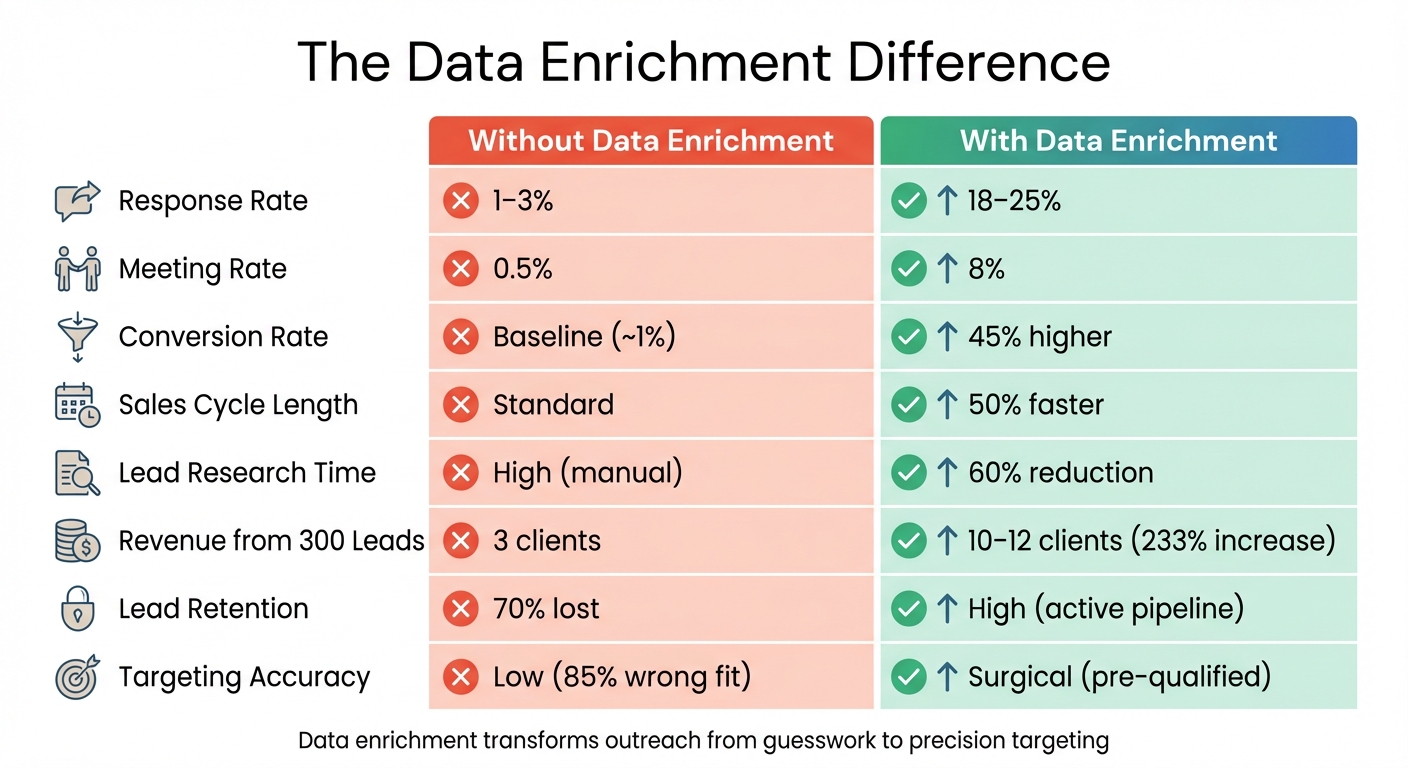
Outreach Performance: With vs Without Data Enrichment
This section dives into the clear advantages of using enriched data in outreach efforts, quantifying the improvements in targeting and outcomes. The difference between generic outreach and campaigns powered by enriched data is striking.
When teams rely on basic contact lists and untargeted outreach, the results are underwhelming - response rates hover around 1–3%, and meeting rates are a mere 0.5%. However, with enriched data, which filters prospects based on factors like technology gaps, revenue tiers, and business signals, response rates soar to 18–25%, and meeting rates climb to 8%.
The revenue impact tells a similar story. Traditional prospecting methods often lose 70% of qualified leads due to poor follow-up and tracking systems. For example, out of 300 leads, a team might close just 3 clients. In contrast, a streamlined pipeline enhanced by enriched data can yield 10–12 clients from the same 300 leads - more than tripling results.
Data enrichment also addresses inefficiencies in manual lead research, reducing prospecting time by about 60%. By focusing outreach on Ideal Customer Profile (ICP) contacts, teams can work more effectively, saving time and boosting productivity. These gains don't just improve efficiency - they deliver measurable growth in revenue.
The cost of poor data quality is staggering, with companies losing $3.1 trillion annually. On the flip side, organizations leveraging enriched data see a 45% higher conversion rate and a sales cycle that's 50% faster. For ecommerce teams, tools like StoreCensus provide real-time insights on over 2.5 million stores, complete with 25+ data points, such as technology stacks, revenue estimates, and growth trends. This eliminates guesswork and the need for tedious manual research.
The table below highlights the key metrics that showcase these differences:
Key Metrics Comparison Table
| Metric | Without Data Enrichment | With Data Enrichment |
|---|---|---|
| Response Rate | 1–3% | 18–25% |
| Meeting Rate | 0.5% | 8% |
| Conversion Rate | Baseline (~1%) | 45% higher |
| Sales Cycle Length | Standard | 50% faster |
| Lead Research Time | High (manual) | 60% reduction |
| Revenue from 300 Leads | 3 clients | 10–12 clients (233% increase) |
| Lead Retention | 70% lost | High (active pipeline) |
| Targeting Accuracy | Low (85% wrong fit) | Surgical (pre-qualified) |
How to Add Data Enrichment to Your Ecommerce Outreach
Incorporating enriched data into your ecommerce outreach strategy doesn’t mean reinventing the wheel. It’s about making a few focused adjustments: sourcing accurate data, targeting based on relevant signals, and automating outreach to connect with prospects at the right time. Let’s break these steps down.
Use Accurate and Current Data Sources
The foundation of data enrichment is reliable and up-to-date information. Using outdated or incorrect data not only wastes your time but can also harm your reputation. Imagine referencing a technology a store no longer uses or reaching out with invalid contact details - it’s not a good look.
Tools like StoreCensus make this process seamless. They monitor over 2.5 million ecommerce stores with a 99.2% accuracy rate, updating profiles weekly. This includes over 25 structured data points such as revenue estimates, installed apps, traffic levels, and SMTP-verified contact information for decision-makers. Unlike purchased lists that often have bounce rates exceeding 40%, platforms designed for ecommerce intelligence eliminate the guesswork and inefficiency of manual research.
Here’s the payoff: when you reference a store’s actual tech setup or recent changes, you’re showing you’ve done your homework. That kind of personalization builds trust and sets you apart from generic outreach.
Target Based on Technology Stack and Activity Signals
Effective outreach focuses on specific needs. Instead of casting a wide net, zero in on prospects with clear gaps or growth indicators. For example, instead of targeting all “Shopify beauty stores,” you could refine your search to stores using ReCharge for subscriptions but lacking Klaviyo for email marketing. This precise targeting ensures your service directly addresses their needs.
Real-world examples have shown that targeting based on specific tech gaps and using lead scoring systems can lead to conversion rates of 25% or higher for qualified leads.
Another critical factor is aligning your pricing with your target’s revenue. For instance, if your service costs between $5,000 and $10,000, focus on stores earning $1 million to $5 million. These businesses are more likely to have both the need and the budget for your services.
Once you’ve identified the right prospects, the next step is to ensure your outreach happens at the perfect time.
Automate Outreach With Real-Time Monitoring
The reality is, many qualified leads slip through the cracks due to poor follow-up systems - up to 70%, in fact. Real-time monitoring solves this problem by triggering outreach as soon as a store shows buying intent.
For example, set up alerts for specific actions like uninstalling a competitor’s app, adopting a technology that complements your service, or moving into a higher revenue tier. These changes often signal that a store is actively considering new solutions. Outreach triggered by these real-time signals can achieve response rates 3–5 times higher than generic cold emails.
"When a store matches your trigger criteria, they're in an active buying cycle. Your message arrives exactly when they need it most." - StoreCensus
Automation also helps you nurture leads over time. Research shows that 60% of high-quality prospects aren’t ready to buy immediately, often taking 3–12 months to make a decision. Automated reminders ensure you stay on their radar, re-engaging them at the right moment - like just before a competitor’s contract renewal. This approach can generate 233% more revenue from the same prospecting effort by maintaining a steady pipeline.
StoreCensus offers automation tools starting at $39/month with integrations for platforms like Apollo.io, Instantly.ai, and Smartlead.ai. These tools ensure that the enriched data you’ve gathered continues to work for you throughout the entire sales process.
Conclusion
Integrating data enrichment into your outreach strategy can completely change how effective your efforts are. By focusing on stores that show clear buying signals at the right time, data enrichment shifts outreach from a broad, generic approach to one that is precise and impactful. The results speak for themselves: businesses see higher engagement, improved conversion rates, and greater overall efficiency.
But the benefits go beyond just finding better leads. The true strength of data enrichment lies in its ability to help retain those leads. Without proper tracking and nurturing, traditional outreach methods can lose up to 70% of qualified prospects. Enriched data solves this issue by attaching critical insights - like tech stack information, revenue brackets, and recent updates - to each prospect throughout the sales cycle. This method can lead to a staggering 233% increase in revenue from the same prospecting efforts. It’s a smarter, more targeted way to build and maintain a strong customer pipeline.
Using tools like StoreCensus allows teams to shift from simply reacting to opportunities to actively driving revenue through well-informed, proactive outreach.
FAQs
What data should I enrich first for outreach?
To get a clearer picture of a store’s status and potential, start by gathering detailed data. Look into elements like the technology stack they’re using, recent activity signals (such as app installations or removals), revenue estimates, and contact details for key decision-makers. These insights are invaluable for pinpointing high-intent leads. Plus, they allow for personalized and well-timed outreach to the right individual, which can significantly increase response rates and make your campaigns more effective.
How do I score and prioritize enriched leads?
To effectively score and prioritize leads, rely on real-time data signals and structured scoring approaches. Pay attention to critical factors such as revenue range, geographic location, and technology stack. Combine these with intent signals, like app installs or store updates, to get a clearer picture of engagement. Assign scores to leads based on these elements, and focus your outreach on those with the highest combined scores. This method ensures your efforts are targeted and increases the chances of successful conversions.
What triggers should start real-time outreach?
Real-time outreach works best when it’s tied to specific changes in a store’s activity. Think about triggers like app installs or removals, updates to the store’s design, hitting revenue milestones, or other noticeable behavior shifts. By leveraging real-time data to detect these moments, you can ensure your engagement is both timely and relevant.