SQL vs NoSQL: Scalability for Ecommerce Platforms
Compare SQL and NoSQL scalability for ecommerce: vertical vs horizontal scaling, consistency trade-offs, and when hybrid architectures are the best fit.


When choosing a database for your ecommerce platform, the decision between SQL and NoSQL boils down to scalability and performance needs. Here's a quick summary:
- SQL: Best for structured data, financial transactions, and situations requiring strong data integrity (ACID compliance). It scales vertically (upgrading server power) but can become costly and hit performance limits.
- NoSQL: Ideal for unstructured or flexible data, like product catalogs or user sessions. It scales horizontally (adding more servers), making it better suited for handling traffic surges and unpredictable growth.
Key Considerations:
- Traffic Patterns: SQL works well for steady growth, while NoSQL handles seasonal spikes better.
- Data Structure: SQL uses predefined schemas, making it precise but rigid. NoSQL offers schema-less flexibility for dynamic data.
- Cost: SQL scaling can get expensive; NoSQL's horizontal scaling is often more cost-effective.
- Use Cases: Hybrid setups combining SQL for transactions and NoSQL for catalogs or caching are increasingly common.
Quick Comparison:
| Feature | SQL | NoSQL |
|---|---|---|
| Scaling Method | Vertical (Scale-up) | Horizontal (Scale-out) |
| Cost | Higher at scale | Lower at scale |
| Consistency | Strong (ACID) | Eventual (BASE) |
| Schema | Fixed | Flexible |
| Performance | Complex queries | High-volume read/write |
For most ecommerce platforms, the right choice depends on your growth strategy, team expertise, and data needs. Hybrid architectures often provide a balanced solution for scaling effectively.
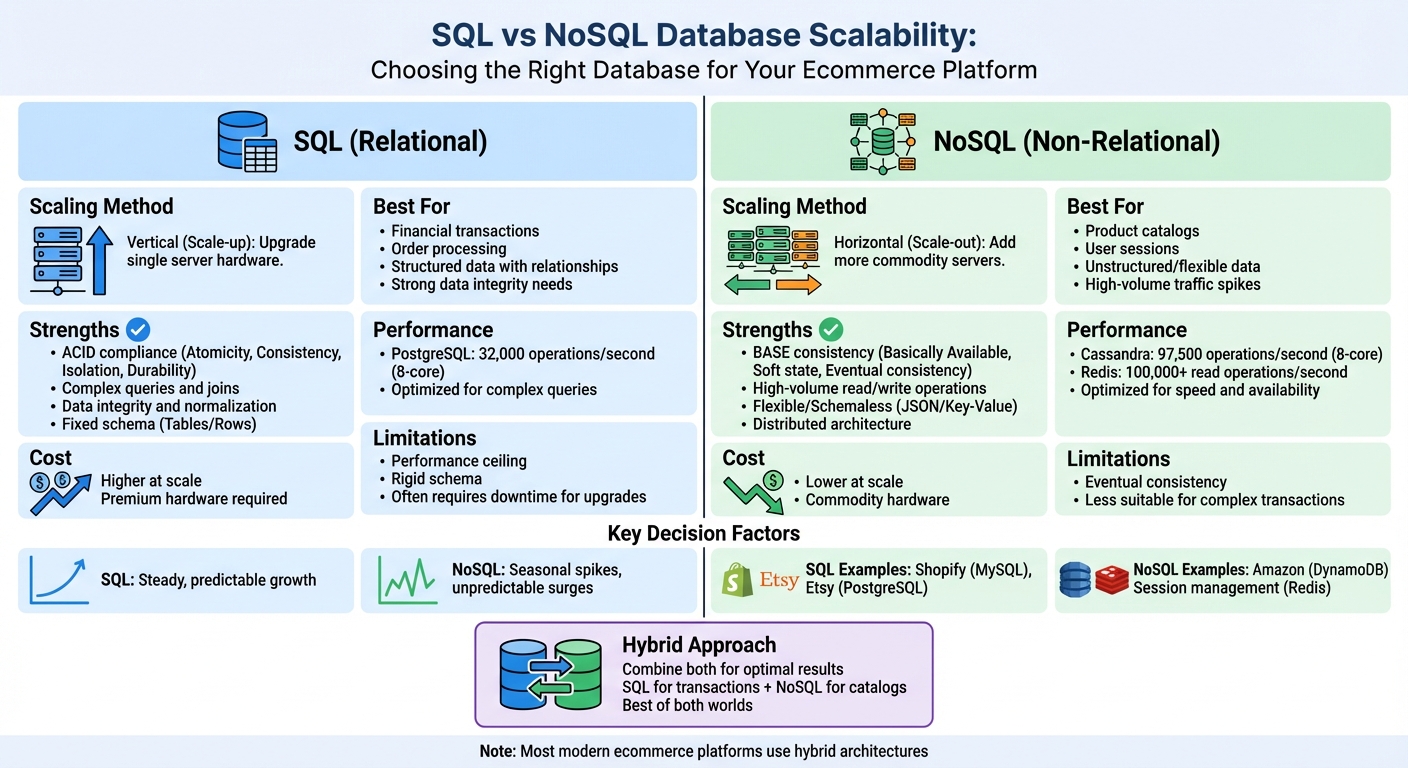
SQL vs NoSQL Database Scalability Comparison for Ecommerce
SQL vs NoSQL | System Design | Which Database to Choose & When?
What Scalability Means for Ecommerce Platforms
In ecommerce, scalability refers to how well your database can handle rapid increases in data and user activity. It ensures your site stays fast and reliable, even during sudden traffic spikes or significant catalog expansions - like when traffic triples during a flash sale or when your product inventory grows from 1,000 to 100,000 items.
A scalable database is crucial because it directly impacts site performance, transaction success rates, and cart abandonment. If your database can't keep up, customers may face slow page loads, failed checkouts, or error messages - issues that can quickly lead to lost sales and frustrated users.
"In 2026, building scalable databases requires more than just picking SQL or NoSQL - it's about aligning your database choice with your application needs, expected growth, and data complexity." - Trilochan Bodas, CodeDote Technologies
Vertical vs. Horizontal Scaling
There are two main ways to scale a database: vertical scaling and horizontal scaling.
- Vertical scaling (or scaling up) involves adding more resources - like CPU, RAM, or faster storage - to a single server. It’s relatively simple to implement but has limitations. Eventually, you’ll hit a hard cap on how much hardware you can add, and costs can skyrocket as you approach the maximum capacity of a single machine.
- Horizontal scaling (or scaling out) takes a different approach. It involves adding more servers or nodes to a cluster that works together as one system. This method often improves performance in a near-linear way as you add machines. It’s also typically more cost-effective since you can use multiple affordable servers instead of investing in high-end enterprise hardware.
These two approaches highlight the different challenges of managing traffic surges and growing product catalogs in ecommerce.
Why Scalability Matters for Ecommerce
Certain scenarios put your database's scalability to the test:
- Seasonal traffic spikes: Events like Black Friday or flash sales bring a flood of users and transactions all at once. Your database needs to handle these surges without crashing.
- Product catalog expansion: Adding new products - especially those with varied attributes like size, color, or technical specs - can strain a rigid database structure. Without flexibility, even routine updates can become massive restructuring efforts.
- Global reach: Serving customers worldwide requires low-latency access, no matter their location. This means your database must efficiently sync data across multiple global nodes.
Choosing between vertical and horizontal scaling isn’t just a technical decision - it’s a strategic one. Vertical scaling may work for smaller, more predictable growth, but horizontal scaling is essential for handling the rapid, unpredictable growth patterns that are common in modern ecommerce.
SQL Databases: Strengths and Scaling Limitations
SQL databases rely on structured, predefined schemas to manage relational data effectively. They play a critical role in ecommerce by organizing data like customer profiles, orders, and inventory with precision and efficiency.
One of SQL's standout features for ecommerce is its ACID compliance, which guarantees that essential transactions - such as processing payments or updating inventory - are either completed entirely or not at all. As Jeff Zoldy from Snowdog highlights:
"SQL databases adhere to Atomicity, Consistency, Isolation, and Durability (ACID) principles, ensuring that transactions - like order placements - either complete fully or not at all".
This reliability is crucial for handling sensitive financial data and meeting regulatory requirements.
SQL databases also shine when it comes to data analysis. Their advanced querying capabilities, including powerful joins and aggregations, allow businesses to dive into customer purchasing habits, uncover trends, and generate detailed reports. For example, platforms like Shopify (using MySQL) and Etsy (using PostgreSQL) rely on SQL databases to manage their transactional data. A study conducted in February 2025 even showed that relational databases outperform NoSQL systems in CPU speed, memory usage, and overall efficiency when processing large-scale ecommerce datasets. However, despite these strengths, SQL databases face notable challenges when scaling for rapid growth.
SQL Strengths for Ecommerce
Beyond their transactional reliability, SQL databases bring additional advantages to ecommerce:
- Data Integrity and Normalization: These features help reduce redundancy and maintain consistency across the platform.
- Structured Design: SQL's schema-based approach simplifies managing complex relationships, such as linking customers to their order histories or tracking inventory across multiple warehouses.
- Security Features: SQL databases support robust security measures, including role-based permissions and encryption, which are critical for protecting sensitive data.
Vertical Scaling Limitations
While SQL systems excel in many areas, they encounter significant hurdles when it comes to scaling. Most SQL databases rely on vertical scaling, which involves upgrading a single server by adding more CPU power, memory, or faster storage. Though effective initially, this approach becomes increasingly expensive and eventually hits a performance ceiling. As Jeff Zoldy puts it:
"Vertical scaling works initially but soon becomes cost prohibitive".
Horizontal scaling, or sharding, is an alternative, but it introduces additional complexity. Sharding can make maintaining ACID compliance more challenging, increase the risk of failures, and complicate database management. Moreover, SQL's rigid schemas can slow down growth. For example, adding new product attributes or adjusting the database structure often requires careful planning and migration, which can disrupt development and limit flexibility. This rigidity can be especially problematic during high-demand periods, like seasonal sales.
To address these scaling issues, many ecommerce platforms incorporate caching layers (e.g., Redis or Varnish) to ease the load on their primary SQL database. They also optimize queries and indexes to improve performance before resorting to expensive hardware upgrades. Still, for businesses experiencing rapid or unpredictable growth, relying solely on vertical scaling may not be a practical long-term solution.
NoSQL Databases: Flexibility and Horizontal Scaling
NoSQL databases are designed to scale by spreading data across multiple servers rather than depending on a single, powerful machine. This approach, known as horizontal scaling, allows ecommerce platforms to handle growing traffic by adding cost-effective hardware instead of investing in expensive high-performance servers. As Kshitij Sharma points out:
"NoSQL databases are generally more efficient at scale because of their horizontal scalability, which permits them to share data across less expensive, commodity hardware."
This setup becomes especially useful during unpredictable traffic surges, such as Black Friday or flash sales, when demand can skyrocket without warning.
Another key benefit of NoSQL databases is their schema-less design. Developers can easily adapt and expand product catalogs by adding new attributes - like "material" or "sustainability rating" - without having to overhaul the entire database structure. This flexibility is essential when managing millions of SKUs with diverse and evolving features. Additionally, the distributed nature of NoSQL systems enhances fault tolerance. If one server goes offline, others pick up the slack, ensuring uninterrupted service - a critical requirement for online retailers.
Horizontal Scaling Advantages
Scaling horizontally by adding servers provides clear benefits for growing ecommerce platforms. For instance, NoSQL databases like Cassandra can handle approximately 97,500 operations per second on an 8-core setup, compared to PostgreSQL's 32,000 operations per second. Similarly, Redis, an in-memory key-value store, excels in high-speed scenarios, processing over 100,000 read operations per second.
That said, many NoSQL systems prioritize eventual consistency over strict ACID compliance. While this trade-off may not suit critical transactional data, it works well for less sensitive information, such as product catalogs or user reviews. These performance advantages make NoSQL databases a practical choice for various ecommerce applications.
NoSQL Use Cases in Ecommerce
Different NoSQL database types are tailored for specific ecommerce needs:
- Document databases like MongoDB and Couchbase handle diverse product attributes, making them ideal for managing catalogs.
- Key-value stores such as Redis excel at managing sessions and shopping carts.
- Columnar databases are perfect for real-time analytics.
For example, a document database can easily accommodate a catalog where clothing items include fields like "size" and "color", while electronics require attributes such as "processor speed" and "warranty period." This eliminates the need for costly database restructuring. On the other hand, Redis can cache frequently accessed data - like session IDs or product recommendations - reducing load times without putting extra strain on core systems.
SQL vs NoSQL: Scalability Comparison
The scalability of SQL and NoSQL databases plays a crucial role in determining their suitability for different use cases. SQL databases rely on vertical scaling, which involves upgrading the existing hardware (like adding more CPU or RAM). While effective, this approach can get expensive as traffic grows. In contrast, NoSQL databases use horizontal scaling, allowing systems to handle more traffic by adding cost-efficient, standard servers to the network.
SQL databases are known for their strict adherence to ACID (Atomicity, Consistency, Isolation, Durability) principles, ensuring that every transaction is either fully completed or not executed at all. NoSQL, on the other hand, follows BASE (Basically Available, Soft state, Eventual consistency) principles, focusing on speed and availability. This means that certain updates, like inventory changes, may sync with a short delay. Additionally, SQL's rigid, predefined schema can slow down processes like adding new product attributes, while NoSQL's dynamic schema allows fields to be added on the fly without the need to restructure the database.
Performance metrics also highlight the differences between these systems. For instance, PostgreSQL, a popular SQL database, can handle around 32,000 operations per second on an 8-core setup. On similar hardware, Cassandra, a NoSQL database, achieves approximately 97,500 operations per second. In fully in-memory setups, Redis, another NoSQL option, processes over 100,000 read operations per second. However, as Kshitij Sharma points out:
"SQL databases are typically vertically scalable... modern SQL databases such as PostgreSQL and MySQL provide horizontal scalability via replication and sharding, although this can be difficult to implement."
Comparison Table: Key Scalability Metrics
| Feature | SQL (Relational) | NoSQL (Non-Relational) |
|---|---|---|
| Scaling Method | Vertical (Scale-up) | Horizontal (Scale-out) |
| Cost Trajectory | High at scale (Premium hardware) | Lower at scale (Commodity hardware) |
| Consistency | Strong ACID compliance | Eventual consistency (BASE) |
| Performance | Complex queries and joins | High-volume read/write |
| Infrastructure | Centralized architecture | Distributed architecture |
| Schema Flexibility | Fixed schema (Tables/Rows) | Flexible/Schemaless (JSON/Key-Value) |
| Maintenance | Often requires downtime for upgrades | Rolling upgrades with no downtime |
These distinctions are essential when choosing the right database for your business needs, especially as your ecommerce platform scales and evolves. Each system offers unique advantages, so understanding their strengths and limitations can help you make an informed decision.
Hybrid Architectures: Using SQL and NoSQL Together
Many ecommerce platforms rely on hybrid architectures that combine the strengths of SQL and NoSQL databases. In these setups, SQL handles critical operations like orders and payments, ensuring data accuracy with its robust ACID compliance. At the same time, NoSQL takes charge of managing unstructured, high-volume data, such as product catalogs, user reviews, and real-time session tracking - areas where flexibility and speed are key.
This combination offers clear performance advantages. For instance, tests show that MongoDB can execute an update query in just 0.0021 seconds, compared to MySQL's 0.0987 seconds for the same task. By offloading functions like product searches and session management to NoSQL, platforms can maintain fast response times, even during heavy traffic. As Zoolatech explains:
"For most businesses, a hybrid approach - SQL for mission-critical operations and NoSQL for catalog management and personalization - delivers the best results."
By leveraging the unique strengths of each database type, hybrid architectures enable ecommerce platforms to scale effectively and handle growth with confidence.
Common Hybrid Use Cases
Hybrid setups are particularly effective in addressing the varied data needs of ecommerce. Relational databases are ideal for tasks like order processing, inventory management, and financial transactions, where maintaining data integrity is non-negotiable. On the other hand, NoSQL databases excel in handling dynamic and evolving datasets, such as product catalogs, user reviews, and clickstream data.
To further enhance performance, many platforms integrate caching solutions like Redis. By storing frequently accessed data and user sessions in a key-value store, caching reduces latency, improves responsiveness, and eases the load on primary transactional databases.
Industry Examples of Hybrid Architectures
Several leading ecommerce companies showcase the power of hybrid architectures. Shopify, for instance, uses MySQL as its core database, supported by caching layers and distributed systems to ensure consistent performance. Amazon pairs SQL databases for transaction handling with DynamoDB, a NoSQL solution, to manage its massive global product catalog. Similarly, Etsy combines PostgreSQL with Elasticsearch to enable fast and efficient search capabilities.
Cloud providers have also embraced the hybrid model, offering tools that simplify implementation. AWS Aurora Serverless, for example, allows SQL databases to scale on-demand during seasonal peaks, while NoSQL components handle surges in user-generated content. Platforms like AWS, Azure, and Google Cloud make it easier than ever for businesses to adopt hybrid architectures, supporting both scalability and high performance as ecommerce needs grow.
Choosing the Right Database for Your Ecommerce Growth
When deciding between SQL and NoSQL databases for your ecommerce platform, the key is aligning your database architecture with your growth strategy and operational needs. Your choice should consider how your business scales, the expertise of your team, and the nature of your traffic patterns. Let’s break down how each approach fits different growth scenarios.
SQL for Predictable Growth
If your ecommerce platform experiences steady and predictable growth, SQL databases are a strong choice. They handle consistent capacity demands effectively, especially when paired with proper indexing, regular audits, and strategic caching.
SQL is particularly suited for businesses prioritizing data integrity, such as those managing financial transactions or inventory. Its long-standing ecosystem also means finding skilled SQL administrators is generally easier compared to sourcing NoSQL specialists.
NoSQL for Rapid or Seasonal Growth
For businesses dealing with sharp seasonal traffic spikes, such as Black Friday or holiday sales, NoSQL offers unmatched flexibility. Its ability to quickly scale up by adding nodes during peak times - and scale down afterward - makes it a cost-effective solution for handling unpredictable growth patterns.
NoSQL’s schema-less design is another advantage, enabling faster feature rollouts. For instance, adding new product attributes like "sustainability rating" or "carbon footprint" doesn’t require disruptive schema migrations. This makes NoSQL ideal for platforms that frequently experiment with catalog features or expand into new product categories.
Factors to Consider in Decision-Making
Team expertise plays a critical role. If your developers are already skilled in relational databases, transitioning to NoSQL may introduce training costs and operational risks.
Your cloud infrastructure is another important factor. Cloud services like AWS, Azure, and Google Cloud simplify scalability, offering robust managed solutions that reduce the complexity of on-premise setups. However, integrating NoSQL into an existing relational database core often requires custom development or middleware.
Before making a switch, conduct a performance audit to pinpoint bottlenecks. Issues like slow query execution, inadequate indexing, or server resource limitations may be resolved by optimizing your current SQL setup. In many cases, fine-tuning your existing system can yield better results than migrating to a completely new database architecture.
Ultimately, your database strategy has a direct impact on your platform’s ability to scale and perform effectively.
Conclusion
When deciding between SQL and NoSQL for your ecommerce platform, the goal isn’t to pick one over the other - it’s to match your database architecture to your platform’s specific needs and growth plans. SQL databases are ideal for core transactional processes where maintaining data integrity is critical. On the other hand, NoSQL shines when managing rapid scaling and adapting to flexible data structures during periods of unpredictable growth.
Experts agree that scalable database design depends on aligning your architecture with the complexity of your application and its growth trajectory. Many successful ecommerce platforms now adopt hybrid architectures, combining the strengths of both systems. For example, SQL often serves as the reliable backbone for orders and payments, while NoSQL handles tasks like product searches, session management, and real-time analytics. This tailored approach has been proven effective across various ecommerce implementations, demonstrating the importance of strategy over a one-size-fits-all solution.
Before considering a database migration, assess your team’s expertise, cloud infrastructure, and growth patterns - whether they’re steady or seasonal. A thorough performance audit is also crucial. Often, optimizing your existing database can resolve bottlenecks without the need for a costly overhaul.
Regardless of the choice you make, continuous monitoring is key. Tools like StoreCensus help ecommerce businesses stay informed by tracking technology stack changes across over 2.5 million stores. This platform provides insights into how competitors and leading stores evolve their infrastructure, empowering you to make data-driven decisions about your own tech stack.
The database strategy you choose today will shape your platform’s ability to scale tomorrow. Make informed decisions, keep a close eye on performance, and remain flexible as your business grows.
FAQs
Which ecommerce data should stay in SQL vs move to NoSQL?
For ecommerce platforms, SQL works best when you need strong consistency, structured relationships, and transactional integrity. This makes it ideal for managing data like customer profiles, orders, payments, and product details. With its structured schemas and ACID compliance, SQL ensures that your data remains accurate and reliable.
On the other hand, NoSQL shines when dealing with flexible, semi-structured, or fast-changing data. Think of user activity, reviews, session data, or inventory logs. Its schema-less design and ability to scale make it perfect for handling large, dynamic datasets, especially when real-time updates and personalization are key.
When should I switch from vertical scaling to horizontal scaling?
When your eCommerce platform's database hits the ceiling with vertical scaling - adding more CPU, RAM, or storage to a single server - it’s time to consider horizontal scaling. Vertical scaling works well with SQL databases, but as your data grows, efficiency can take a hit. On the other hand, NoSQL databases thrive in horizontal scaling by spreading data across multiple servers. This approach is perfect for handling rapid growth or traffic spikes, which are common in fast-growing eCommerce platforms.
How do I maintain accurate inventory and checkout with NoSQL?
NoSQL databases are perfect for managing dynamic, high-volume data, making them a strong choice for inventory and checkout systems. Their flexible schemas allow you to adapt to changing data structures without the need for complex migrations.
To ensure your inventory updates stay consistent during high-traffic periods, real-time data synchronization and atomic operations are key. These features allow changes to be applied instantly and reliably, reducing errors when multiple users interact with the system simultaneously.
For added protection against issues like overselling, you can use transaction management techniques such as write-ahead logs or distributed locking. These methods help maintain accurate stock levels and ensure smooth checkouts, even during peak usage.