How Social Signals Identify High-Intent Leads
Analyze comments, shares, and mentions to detect buying intent, score leads, and combine social + ecommerce signals for timely outreach and better conversions.


Social signals - like comments, shares, and mentions on platforms such as LinkedIn, Twitter, and Reddit - can reveal when potential buyers are ready to make a purchase. By analyzing these real-time interactions, sales teams can identify prospects actively seeking solutions, comparing vendors, or expressing dissatisfaction with current tools. This approach moves beyond static lead lists, focusing instead on behavioral insights that indicate immediate buying intent.
Key takeaways:
- High-intent signals: Phrases like “best tool for” or complaints about current vendors signal readiness to buy.
- Social listening tools: Track keywords, competitor mentions, and influencer interactions to find leads.
- Prioritize engagement: Focus on detailed discussions and multi-platform activity over likes or general comments.
- Lead scoring: Separate high-intent leads needing direct outreach from medium/low-intent ones better suited for nurturing.
Using tools like StoreCensus, businesses can combine social signals with ecommerce data to target leads effectively and act at the right time. This method ensures outreach aligns with a prospect’s readiness to buy, improving conversion rates and saving time.
From Social Signals to Sales: How to Turn Mentions into Customers
Using Social Listening to Find Influencer-Driven Intent
Influencers play a major role in shaping buying decisions in ecommerce, and their followers often reveal their interest in purchasing through how they engage with content. For example, when someone comments on an influencer's product recommendation, they’re signaling that they’re ready to explore options. The tricky part? Recognizing these moments at scale.
You can uncover these prospects by monitoring public forums, comment sections, and social platforms where people discuss solutions. Replies often indicate the strongest buying intent. Picture this: a founder responding to an influencer’s tweet about email marketing tools with, “We need something before our Black Friday launch.” That’s a much clearer sign of intent compared to someone who simply liked the post. Such insights connect influencer activity with actionable lead generation.
Setting Up Social Listening Tools
To catch these real-time signals, social listening tools are essential. Start by configuring your tools to track industry leaders who align with your ideal customer profile. For instance, if you’re targeting Shopify store owners, focus on ecommerce influencers, SaaS founders, and agency leaders who frequently discuss growth strategies.
Use keyword and hashtag tracking to zero in on phrases that show clear intent. Terms like “best tool for,” “any alternative to,” or “what should we use for,” paired with your product category, are goldmines for identifying potential leads. Don’t forget to track competitor interactions - when prospects engage with a competitor’s social media post or leave a review on platforms like G2, they’re likely evaluating alternatives. AI-powered tools can simplify this process by monitoring multiple platforms at once, including LinkedIn, Reddit, Slack groups, and niche forums, saving you from hours of manual research.
It’s also worth keeping an eye on new followers, LinkedIn profile visits, and engagement with your company’s posts or employee content. While these signals may indicate lower intent compared to competitor-related activity, they still contribute to understanding where a prospect is in their buying journey.
Once your tools are in place, the next step is to refine your approach by analyzing how prospects engage with content.
Identifying High-Engagement Patterns
Not all engagement is created equal. A post with 10,000 likes might not lead to a single sale, but a 50-comment thread about implementation challenges could be packed with high-intent leads. Prioritize conversation depth over vanity metrics. Look for prospects asking detailed questions about implementation, budget considerations, or urgent timelines in their comments.
Watch for multi-platform activity from the same company. If a prospect is engaging with content across LinkedIn, Twitter, and Reddit simultaneously, it’s often a sign that their organization is actively evaluating solutions. Similarly, track conversations where people search for or discuss “alternatives to [Competitor Name]” in forums or Slack groups. These niche communities are where decision-makers often turn for peer advice.
Sort these signals by intent level to guide your outreach efforts. Competitor-related engagement should be treated as high-intent, while new followers or profile visits fall into the low-to-medium intent category. When possible, combine this social engagement data with website behavior. For example, if a lead visits your pricing page after engaging with an influencer’s post, they should be a top priority. These patterns of engagement will directly shape your lead qualification strategies, as explored later in this article.
Social Signal Indicators of Purchase Intent
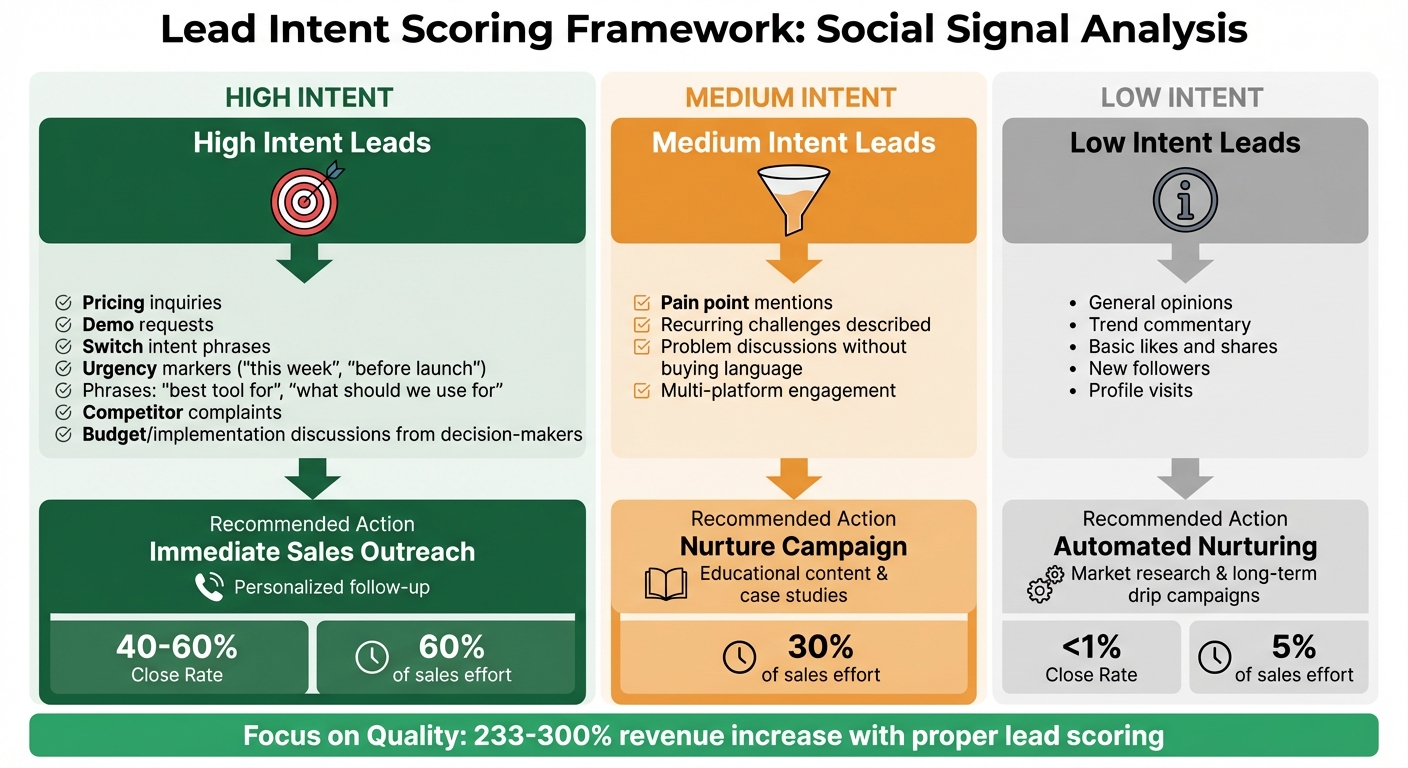
Lead Intent Scoring Framework: High vs Medium vs Low Intent Signals
High-Impact Social Signals
Social media can reveal a lot about a prospect's readiness to buy, especially through the language they use. Posts with phrases like "best tool for" or "what should we use for" show they're actively searching for solutions. Words like "need", "must", or "before launch" suggest they’re working under a deadline. If someone openly complains about their current vendor or asks for alternatives (a sign of switch intent), it's clear they’re ready to make a change. When discussions shift to topics like integration, implementation, or budget - especially when these come from decision-makers like founders or team leads - it’s a strong signal they’ve moved past just being aware of options.
Certain keywords in comments also highlight purchase intent. For example, comments like "Links" on social media posts or questions like "where to buy" show immediate interest. Using influencer discount codes or engaging with product demos and unboxings are other key indicators of readiness. A great example is lifestyle creator Indy Belle's summer outfit Instagram Reel. By encouraging viewers to comment "Links", she turned casual interest into active intent, leading to over 1 million views, 23,100 likes, and more than 6,300 comments.
These signals provide a solid foundation for identifying and scoring lead intent. Platforms like StoreCensus use real-time monitoring to act on these insights, ensuring outreach happens at the right moment and with the right message.
How to Score Low vs. High Intent Leads
With these social signals in mind, a scoring model can help separate high-intent leads from those who need more nurturing. High-intent behaviors - like asking about pricing, requesting demos, or showing urgency - call for immediate and personalized outreach from sales. Medium-intent signals, such as mentioning pain points or recurring challenges without clear buying language, are better handled with educational content or case studies. On the other hand, low-intent signals, like general opinions, trend discussions, or basic likes and shares, are useful for market research and long-term automated nurturing.
| Signal Quality | Indicators | Recommended Action |
|---|---|---|
| High Intent | Pricing inquiries, demo requests, switch intent, urgency markers (e.g., "this week") | Immediate sales outreach with personalized follow-up |
| Medium Intent | Descriptions of pain points or recurring blockers without explicit buying language | Nurture via educational content or case studies |
| Low Intent | Broad opinions, trend commentary, or simple likes and shares | Use for market research and long-term automated nurturing |
For ecommerce businesses, the STAMP framework offers a detailed way to score leads. This method evaluates factors like Size (traffic volume), Tech stack sophistication, Activity (pixels and ads), Multiple contacts available, and Pain points (gaps in their setup). For instance, a store with 10,000–50,000 visitors, premium apps, active ad campaigns, three or more decision-makers, and visible gaps in their setup could achieve a top score of 100 points - marking it as a high-priority lead.
Improving Lead Qualification with StoreCensus
Combining Social Signals with StoreCensus Filters
Social signals show interest, but StoreCensus takes it further by revealing when leads are ready to buy. Together, they create a system that removes guesswork and targets leads when they're most likely to convert.
For instance, you can identify brands with active social engagement but missing essential backend tools. Picture a Shopify beauty brand running Meta Pixel campaigns, attracting 25,000 monthly visitors, but not using Klaviyo for email marketing. They’re driving traffic but missing the tools to keep those visitors engaged and coming back.
Take Sarah, who runs an email marketing agency for subscription brands. She used StoreCensus to filter Shopify beauty brands earning Shopify beauty brands earning $1M–$5M annuallyM–$5M annually, using ReCharge but not Klaviyo. By Month 5, she had converted 25% of her leads. By Month 12, she was generating $84,000 in monthly revenue from 14 clients.
To prioritize leads effectively, apply the STAMP framework - Size, Tech stack, Activity, Multiple contacts, and Pain points. StoreCensus makes this easier by providing direct access to social profiles like LinkedIn, Twitter, and Instagram, as well as verified decision-maker contacts, such as founders and CMOs. This ensures you're reaching the right person on the right platform.
Another example is Marcus, who runs a Meta ads agency for DTC apparel brands. He used StoreCensus to find Shopify stores with Meta Pixel and high traffic in 2024. By refining his pitch to focus on improving ROAS, he converted prospects over a 2–4 month sales cycle. Within a year, he had 12 clients and was earning $95,000 in monthly recurring revenue. Using real-time monitoring, you can seize opportunities like these as soon as store changes happen.
Real-Time Monitoring for Social-Driven Store Changes
StoreCensus’s real-time monitoring ensures you stay ahead by capturing key changes, such as app installs or design updates. These changes can indicate growth investments or potential frustrations, giving you the perfect moment to engage. For example, when a store installs a new app after a surge in social-driven traffic, it signals they're scaling up. On the other hand, removing an app might suggest they’re looking for alternatives. Acting quickly eliminates the roughly 70% lead loss that often occurs with manual follow-ups and spreadsheets.
By combining these insights with earlier methods, you can confirm when a lead is ready for follow-up. Here are some common trigger scenarios and suggested outreach timelines:
| Trigger Scenario | Recommended Timeline | Outreach Approach |
|---|---|---|
| App Install Gap | Immediately upon detection | "Noticed you're using [App A] but not [App B]. Most brands see [X%] gain by connecting them." |
| Product Launch | 2 weeks after launch | "Congrats on launch! Ready to tackle [specific problem]?" |
| Contract Lock-In | 2 weeks before end | "Your contract ends soon. Ready to explore alternatives?" |
| Budget Timing | 1st week of new quarter | "Budget should be refreshed now. Still interested?" |
For example, imagine a DTC apparel brand running ads consistently for over 30 days - a sign of sustained profitability. StoreCensus detects they’ve just installed a new checkout app. This signals they’re optimizing their funnel, making it the perfect time to reach out. Waiting weeks could mean missing your chance entirely.
Automating Outreach and Measuring Results
Automated outreach takes the insights gained from real-time monitoring and turns them into timely, actionable engagement.
Trigger-Based Outreach Automation
StoreCensus connects seamlessly with your CRM and sales tools to transform real-time store updates into immediate actions. For instance, when a high-intent signal is detected - like a new app installation or a design update - automated workflows can handle tasks such as sending personalized emails, updating lead statuses, or assigning tasks to your sales team.
The secret lies in status-based tracking, which organizes leads into clear stages: Contacted, Replied, Negotiating, Closed, and Rejected. For leads that aren't ready to move forward, automated reminders can keep the conversation alive. Say a prospect mentions being tied to a competitor’s contract - set a reminder for two weeks before that contract ends. If budget constraints are the issue, schedule a follow-up for the start of the next quarter when budgets typically refresh.
This approach creates a pipeline that re-engages leads over time, potentially boosting revenue by 233% to 300%. Even rejected leads shouldn’t be overlooked. A simple six-month automated reminder to reassess their tech stack or growth signals can reveal new opportunities as their needs evolve.
Tracking and Refining Lead Generation Strategies
Success isn’t just about closing deals. It’s about understanding where to focus your efforts. Use the STAMP framework to score leads effectively. Then, allocate your time based on close rates. For example, five-star leads with a 40–60% close rate should get the majority of your attention - around 60%. Meanwhile, one-star leads with less than a 1% close rate aren’t worth pursuing.
With a solid lead-scoring system and automation in place, scaling becomes more efficient. StoreCensus offers pricing that starts at $49 per month for Shopify store prospecting, with options scaling up to $199 per month for higher-volume needs. To fine-tune your targeting, keep an eye on effective filters and social signals, all powered by real-time, continuously updated data.
Key Takeaways for Identifying High-Intent Leads
Pairing social signals with ecommerce data lets you zero in on the right prospects. Instead of chasing endless cold leads, focus on stores that show clear buying intent through their tech stack and growth trends.
The STAMP framework is a quick way to spot high-potential leads. It evaluates key factors like size, tech sophistication, activity, multiple contacts, and pain points. For example, stores with 10,000–50,000 monthly visitors are ideal - they have the budget for your services, but their founders are still approachable. Watch for mismatches too, like stores using ReCharge for subscriptions but skipping Klaviyo for email automation.
Stick to the "Fast No" rule to save time. If a store has two or more red flags - like under 5,000 monthly visitors, no tracking pixels, or missing contact details - move on immediately. Put 60% of your sales energy into five-star leads with a 40–60% close rate, and only 5% into two-star leads that rarely convert. This approach ensures your outreach is guided by data, not guesswork.
Tools like StoreCensus bring this strategy to life by monitoring 2.5 million ecommerce stores in real time. When a high-intent signal appears - like a new app installation, a removed tool, or a site redesign - automated workflows send out personalized outreach. Agencies using this method have seen impressive monthly recurring revenue growth within a year by targeting tech gaps and activity trends.
Focusing on quality over quantity isn’t just smarter - it’s more profitable. With StoreCensus, you can replace hours of manual research with minutes of precise targeting, so you can spend more time closing deals instead of searching for leads.
FAQs
Which social signals predict buying intent?
Social signals that suggest someone is ready to buy often include things like requests for recommendations, questions about switching providers, or discussions comparing options. Language that reflects urgency, budget considerations, or integration requirements can also be strong indicators. Additionally, signs of frustration with current vendors or mentions of ongoing challenges often point to a readiness to make a purchase.
How do I set up social listening to find high-intent leads?
To spot high-intent leads using social listening, focus on monitoring public discussions and online behavior that hint at buyer interest. Leverage tools to keep an eye on forums, review platforms, and social media channels for specific keywords or trends, such as product comparisons or recommendations for vendors. Once identified, prioritize these leads based on their level of urgency. Then, integrate the insights into your CRM or automation workflows to connect with prospects who are actively showing interest in making a purchase.
How can StoreCensus confirm intent with ecommerce data?
StoreCensus determines intent by examining real-time e-commerce signals like app installations, shifts in store activity, and emerging growth trends. These insights are used to rank leads, streamline outreach efforts, and identify top prospects, making lead generation and sales processes more efficient.