
Shopify and AI Chatbots: Social Commerce Insights
Compare Tidio, Gorgias, and Social Intents — learn how AI chatbots boost Shopify sales, automate support, and route social messages into team workflows.

AI chatbots are now a must-have for Shopify merchants. Here's why:
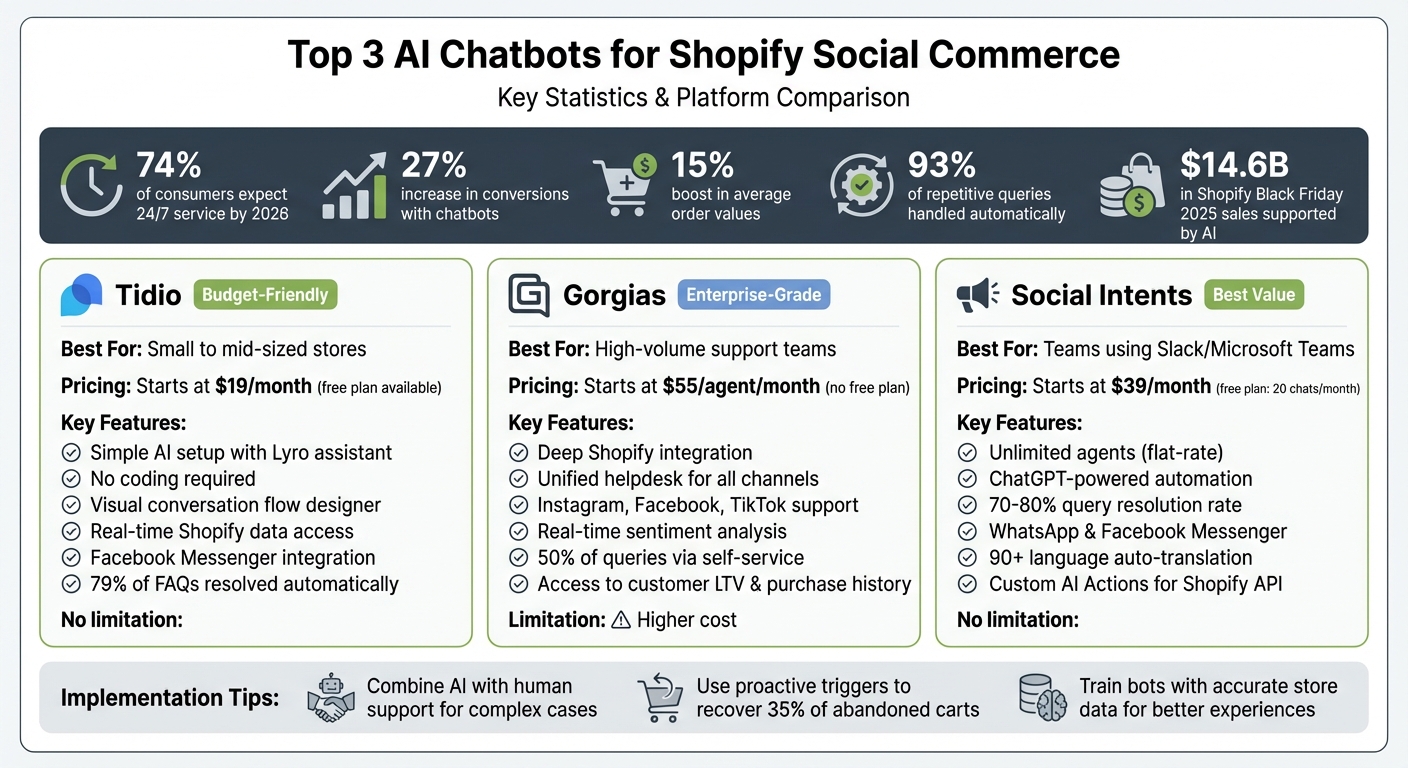
- 24/7 Availability: 74% of consumers expect round-the-clock service by 2026.
- Boosted Sales: Chatbots increase conversions by 27% and average order values by 15%.
- Efficiency: 93% of repetitive queries like "Where is my order?" are handled automatically.
- Scalability: During Shopify's 2025 Black Friday sales ($14.6B), AI reduced the need for large customer support teams.
Top AI Chatbot Options for Shopify

- Tidio: Affordable, user-friendly, integrates with your Shopify tech stack, and offers a free plan.
- Gorgias: Ideal for high-volume stores with deep Shopify integration but comes at a premium.
- Social Intents: Routes chats into Slack/Microsoft Teams with flat-rate pricing and unlimited agents.
Quick Comparison:
| Platform | Best For | Pricing Start | Key Feature | Limitation |
|---|---|---|---|---|
| Tidio | Small to mid-sized stores | $19/month | Free plan + simple AI setup | None |
| Gorgias | High-volume support teams | $55/agent | Advanced Shopify data integration | Higher cost |
| Social Intents | Teams using collaboration tools | $39/month | Unlimited agents with flat-rate pricing | None |
To maximize results, combine AI with human support for complex cases. Use proactive chat triggers to recover abandoned carts and train bots with accurate store data for better customer experiences.
Shopify AI Chatbot Comparison: Tidio vs Gorgias vs Social Intents
5 Best AI Chatbots for Shopify to Increase & Boost Sales (No-Code)
1. TailorTalk
As of March 2026, there’s no documented proof that TailorTalk functions as an AI chatbot platform tailored for Shopify social commerce. Information about its features, pricing, or integration capabilities simply isn’t available.
This lack of transparency makes TailorTalk a poor choice for merchants. Social commerce is growing fast, with sales expected to hit $79.64 billion in 2026. Merchants need reliable tools that can handle high-volume interactions effectively.
A platform with deep Shopify integration is critical. The ability to pull in customer data - like total spend, order history, or tracking numbers - directly into direct messages can elevate casual chats into meaningful sales opportunities. Without solid documentation or case studies, TailorTalk doesn’t meet these expectations.
For merchants seeking dependable solutions, platforms like StoreCensus (https://storecensus.com) can provide valuable insights. StoreCensus tracks which AI chatbot apps are actively being used by successful Shopify stores, offering a clear picture of real-world adoption rather than relying on marketing claims.
Given TailorTalk’s shortcomings, we’ll now focus on platforms with proven track records, starting with Tidio, which offers established integration capabilities.
2. Tidio
Tidio has established itself as a go-to solution for small- to mid-sized Shopify stores aiming to simplify their social commerce interactions. Launched on July 14, 2014, it has grown into an e-commerce-focused tool that combines live chat with AI-driven automation.
Integration Depth
Tidio connects directly with Shopify's backend, allowing it to access real-time data from your product catalog and customer records. This means the chatbot can showcase customer carts, display order histories, and recommend products effortlessly. Even better, it’s incredibly user-friendly - no coding skills are needed. Merchants can visually design conversation flows, making setup a breeze. This deep integration paves the way for streamlined automation.
Automation Features
Tidio’s AI assistant, Lyro, uses natural language processing to handle FAQs and order status inquiries with ease. Research shows that AI chatbots in retail can resolve up to 79% of common customer questions without requiring human involvement. Beyond answering questions, Tidio also supports proactive sales by identifying customer intent and offering tailored product suggestions during chats. For more complex queries, the platform ensures a smooth handoff to human agents through its mobile app.
Pricing
Tidio has a free plan that covers basic chatbot functionality. For those needing more advanced features and higher conversation limits, paid plans start at $19 per month. This pricing structure makes it a wallet-friendly choice for growing businesses.
Social Media Support
Tidio simplifies communication by integrating with platforms like Facebook Messenger and email. This allows merchants to manage all their social commerce conversations from one centralized dashboard.
3. Gorgias
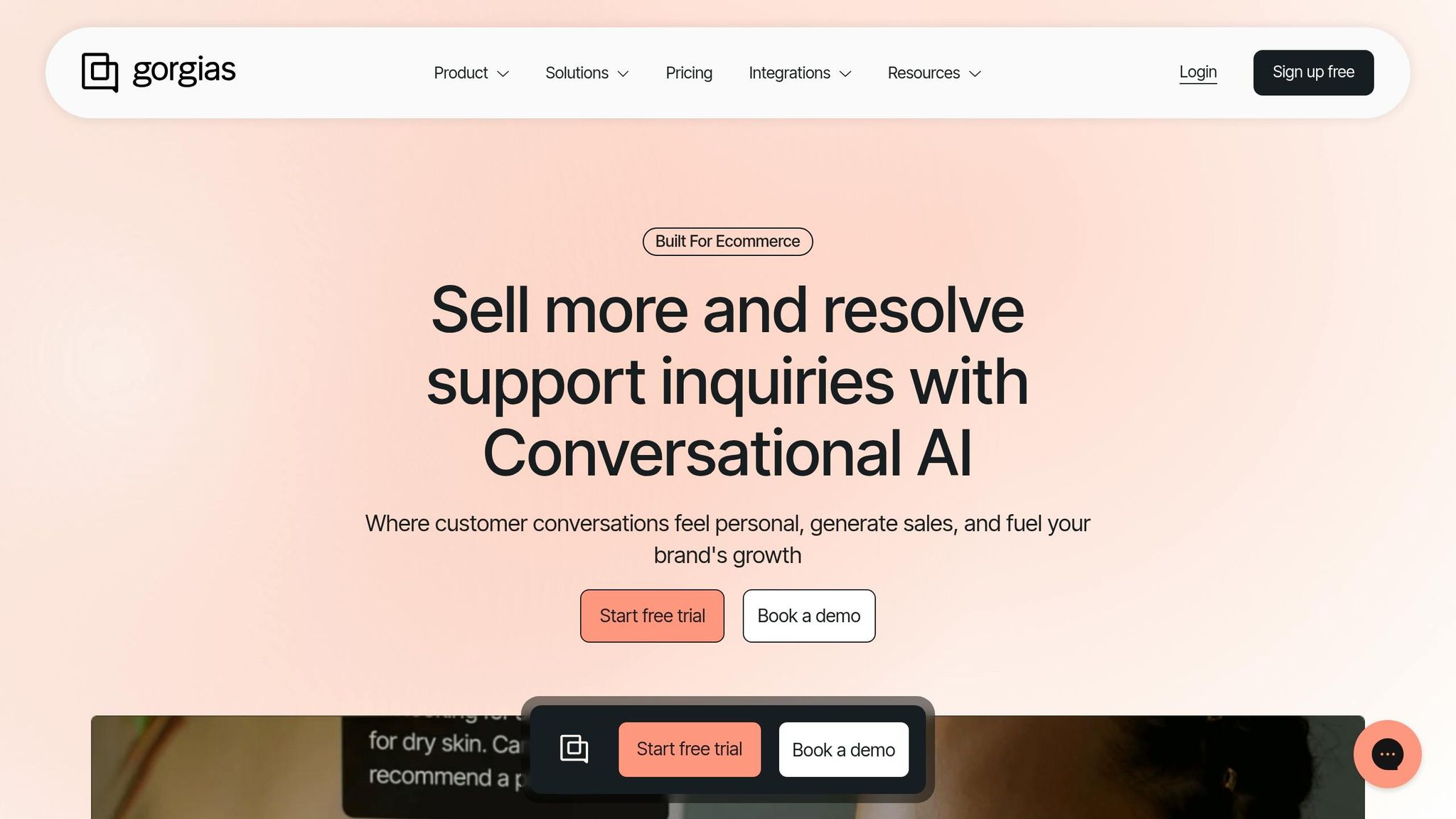
Gorgias takes Shopify customer support up a notch by bringing all social media interactions into a single, centralized helpdesk.
This platform is designed specifically for Shopify merchants managing high volumes of social engagement. It transforms social mentions, comments, and direct messages into support tickets, enabling customer service agents to address issues directly within these platforms.
Integration Depth
Gorgias integrates seamlessly with Shopify, offering a comprehensive view of each customer within its helpdesk. When someone interacts on Instagram or Facebook, agents can instantly access details like purchase history, total spending, and tracking information. This allows teams to quickly identify whether they're assisting a first-time visitor or a repeat VIP customer, ensuring responses are tailored to the individual. Branded as "Built for Shopify", Gorgias pulls in real-time billing, shipping, and order data, supporting both automated and human-led interactions. This tight integration sets the stage for the platform's automation features, which we’ll dive into next.
Automation Features
The platform uses a smart rules engine and AI to handle repetitive queries. For example, when customers mention terms like "shipping" or "return", Gorgias can either send an automated reply or prepare a draft response for agents to review. The company claims that up to 50% of common questions, such as "Where is my order?" can be resolved through self-service options. Additionally, real-time sentiment analysis helps flag negative feedback early. According to industry data, up to 90% of routine social media inquiries can be handled automatically, freeing up agents to tackle more complicated issues.
Social Media Support
A standout feature of Gorgias is its ability to consolidate support tickets from platforms like Instagram, Facebook, TikTok, email, and live chat into one dashboard. Instead of redirecting customers to fill out forms, agents can resolve issues directly within comment threads or direct messages. This is a big deal, especially considering that 73% of consumers say they would switch brands if they don’t get a quick response on social media. By pulling Shopify data into the mix, Gorgias also enables proactive sales strategies. Sales teams can further scale these efforts by using Shopify brand prospect lists to identify high-potential merchants for outreach. For instance, agents can offer personalized discounts or loyalty rewards during social interactions, turning support inquiries into sales opportunities.
Pricing
Gorgias is positioned as a premium solution for businesses with high support demands. There’s no free plan, and pricing starts at $55 per agent per month. This reflects its dual role as both a CRM and helpdesk, rather than just a simple chatbot.
4. Social Intents
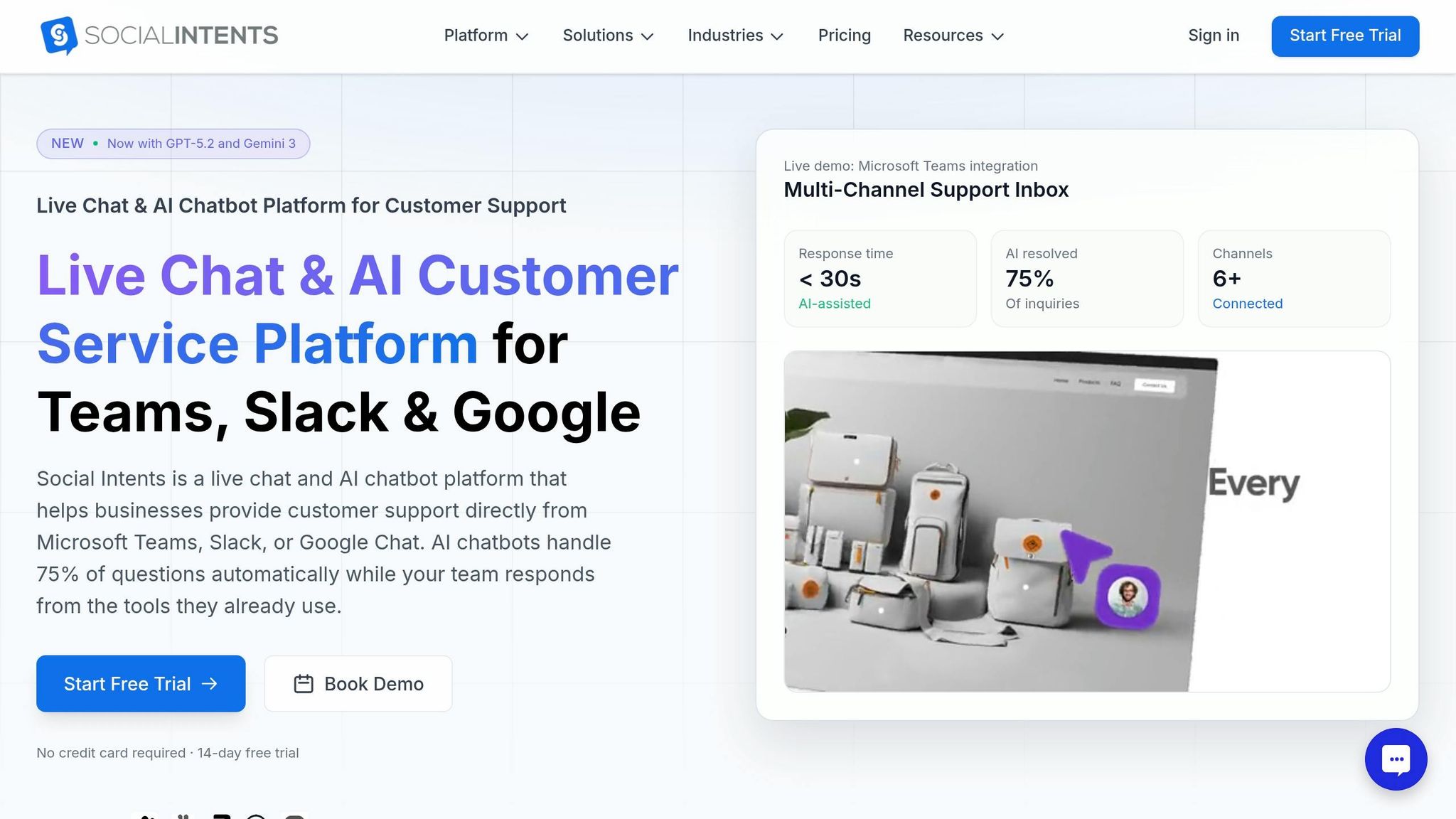
Social Intents integrates live chat directly into popular collaboration tools like Microsoft Teams, Slack, Google Chat, Zoom, and Webex. This approach eliminates the hassle of juggling multiple dashboards by routing Shopify customer conversations straight into these platforms. It streamlines communication, allowing support teams to manage customer inquiries without switching apps.
Integration Depth
The platform connects seamlessly with Shopify using Custom AI Actions that tap into Shopify's API. This enables the chatbot to access real-time order details, share tracking updates, and even generate return labels - all without human involvement. To train the AI, you can direct it to your store's URLs, FAQs, or policy pages. You can also upload PDFs, such as product manuals or warranty details, for added context. The bot handles 70–80% of common queries independently, but if its confidence dips below 60%, the conversation is automatically escalated to a human agent. This robust integration sets the stage for advanced automation.
Automation Features
Social Intents uses ChatGPT to manage routine questions, such as "Where is my order?" According to a 2025 study, AI resolved 93% of customer inquiries on retail platforms without human help. The bot can also collect email addresses during conversations for marketing follow-ups and initiate proactive greetings on high-intent pages. These greetings engage 45% of shoppers, and live chat interactions have been shown to boost average order value by about 10% [4, 1].
Social Media Support
Social Intents extends its capabilities to Facebook Messenger and WhatsApp through add-ons, funneling all social media inquiries into the same Slack or Teams channels used for website chats. This creates a unified communication hub. Additionally, the platform offers real-time auto-translation for over 90 languages, making it easier for agents to assist international customers. With 74% of consumers now expecting 24/7 customer service thanks to AI, this feature ensures businesses can meet those demands. By consolidating scattered customer messages into a single channel, Social Intents simplifies social commerce and ensures efficient support.
Pricing
Social Intents offers pricing plans that cater to businesses of all sizes. For smaller stores, there’s a free plan that includes up to 20 conversations per month. Paid plans start at $39 per month with the Starter plan. The Basic plan, priced at $69 per month, supports 1,000 chats and includes unlimited agents. For $199 per month, the Business plan adds perks like real-time auto-translation. Unlike per-seat pricing models, Social Intents allows unlimited agents starting at the Basic tier, making it a cost-effective choice for growing teams.
Strengths and Weaknesses
Here's a closer look at the standout features and challenges of each platform based on our analysis.
Each platform offers distinct benefits for boosting Shopify social commerce.
Gorgias stands out for its tight Shopify integration, allowing agents to access customer lifetime value (LTV), purchase history, and tracking numbers directly within social media messages and comments. This makes it an excellent option for high-volume support teams needing quick access to detailed customer data. However, its premium pricing structure might be a barrier for some businesses.
Social Intents bridges customer conversations from platforms like Facebook Messenger and WhatsApp into tools like Microsoft Teams and Slack. Its flat-rate pricing with unlimited agents makes it a budget-friendly choice for teams already using these collaboration tools.
Tidio provides an affordable and user-friendly solution, with a free tier and low entry costs, making it ideal for small to mid-sized stores. Its integration simplifies customer interaction management into one convenient platform.
| Platform | Best For | Integration Strength | Pricing Model | Key Limitation |
|---|---|---|---|---|
| Gorgias | High-volume support teams | Deep Shopify integration with customer data in social channels | Premium, per-ticket pricing | Higher cost |
| Social Intents | Teams using Microsoft Teams or Slack | Routes customer conversations to collaboration tools | Flat-rate with unlimited agents | None |
| Tidio | Small to mid-sized stores | Unified customer interaction management | Free tier + affordable monthly rates | None |
When it comes to automation, the platforms also take different approaches. Gorgias includes a rules engine for automating ticket routing and closures, as well as handling refunds and returns. On the other hand, Social Intents leverages Custom AI Actions to retrieve order details and display cart summaries, catering to teams focused on streamlining internal workflows rather than managing complex ticketing systems.
Conclusion
The ideal AI chatbot for your business hinges on factors like your store's size, budget, and the platforms your team already uses. For smaller merchants, Tidio and Social Intents offer free tiers that can efficiently handle repetitive customer inquiries. If your team operates on Slack or Microsoft Teams, Social Intents seamlessly integrates customer messages into your existing workflow, keeping things simple and organized.
For businesses managing high customer volumes, Gorgias stands out with its robust Shopify integration, designed to streamline support and elevate customer service experiences.
To get the most out of your chatbot, focus on practical strategies that improve efficiency and drive conversions. For example:
- Automate common questions like “Where Is My Order?” - these account for 20–40% of support requests.
- Use proactive chat triggers that activate after 30–60 seconds of user inactivity to recover roughly 35% of abandoned carts.
- Train your chatbot with Retrieval-Augmented Generation to ensure it provides accurate answers based on shipping policies and product details.
A hybrid approach works best, where the AI handles routine inquiries while passing complex issues to human agents. This method aligns with the preferences of 89% of consumers. Regularly review metrics like resolution rates and update the bot's knowledge base. Over time, this transforms the chatbot from a simple FAQ assistant into a powerful tool that can increase conversion rates by 23% and boost average order values by 15%.
FAQs
Which Shopify chatbot is best for my store size?
The ideal Shopify chatbot for your store largely depends on your traffic levels and automation requirements. If you're running a smaller store with lighter traffic, a basic AI chatbot can efficiently manage FAQs and provide quick responses. On the other hand, stores with heavier traffic might need more advanced options. These could include features like CRM integration, in-depth analytics, and scalable automation to handle complex interactions. When selecting a chatbot, consider factors like the volume of inquiries, the complexity of customer interactions, and your store's growth strategy.
How do I train a chatbot with my products and policies?
To get your chatbot ready to assist customers with your products and policies, start by feeding it essential data like your store's product catalog, policies, and FAQs. This ensures the bot can provide accurate and tailored responses. Include key details such as stock availability, order tracking, and return guidelines. If you're looking for an easier setup, consider using a no-code AI chatbot builder - it simplifies the process and helps the bot enhance customer interactions while making your operations smoother.
What should my bot automate vs. hand off to humans?
Your bot can take over tasks that are repetitive and time-intensive, such as answering FAQs, tracking orders, or resolving common troubleshooting issues. These predictable activities are perfect for AI, as they help streamline processes and lighten the workload for your team.
However, when it comes to more complex, emotionally delicate, or one-of-a-kind scenarios - like managing complaints or resolving disputes - it's best to involve human agents. Humans are better suited for building trust and ensuring customer satisfaction in these nuanced interactions.