
How Revenue Clustering Improves Lead Targeting
Group prospects by revenue and growth signals to prioritize high-potential ecommerce leads, increase conversions, and cut acquisition costs with real-time data.


Revenue clustering helps businesses focus on the right leads by grouping prospects based on revenue levels and growth signals instead of relying on outdated methods like industry categories or website aesthetics. This approach uses data-driven insights to identify high-potential clients, saving time, reducing costs, and By following proven Shopify store guides, teams can refine their outreach strategy while boosting conversion rates. Here's why it works:
- Traditional targeting misses the mark: Industry-based Shopify brand prospect lists often fail to account for revenue differences. For example, a $5M fashion brand is more similar to a $5M supplement brand than to a $200K fashion brand.
- Data-driven segmentation: Revenue clustering categorizes leads by financial capacity, app usage, growth trends, and marketing activity, achieving up to 85% accuracy.
- Real-time insights: Tools like StoreCensus monitor over 2.5M ecommerce stores, providing weekly updates on revenue shifts, app installations, and other growth indicators.
- Better ROI: Outreach based on revenue data delivers response rates of 18–25%, compared to 2–3% with older methods, while cutting lead costs by up to 75%.
Maximizing Revenue with RevOps: 7 Proven Steps for Predictable and Efficient Growth"
How Revenue Clustering Works
Revenue clustering uses machine learning to analyze multiple data points and group ecommerce stores into segments based on their financial potential. Unlike traditional methods that often rely on assumptions, this approach identifies patterns in the data to create accurate groupings. As new information is collected, the clusters are updated to keep them relevant.
Data Points Used in Revenue Clustering
The system relies on over 25 structured data points to assess a store's financial health. These include metrics like Average Order Value (AOV), SKU volume, and marketing signals such as the use of Meta Pixel and Klaviyo. StoreCensus tracks these metrics across more than 2.5 million ecommerce stores, adding details like installed apps, contact information, growth trends, and historical changes.
For example, a beauty store with 200 SKUs, an average product price of $45, Meta Pixel installed, and Klaviyo for email marketing might fall into the $500K–$1M annual revenue category. Catalog expansion trends are also monitored - active stores saw a 14% increase in average product counts in 2025 - indicating growth that may require advanced tools. By combining these data points with industry classification and competitive rankings, stores are automatically placed into specific revenue clusters.
Technology adoption further highlights a store's maturity. For instance, a store using Meta Pixel, Klaviyo, and a subscription app is likely more advanced than one relying on basic analytics. Additionally, TikTok Pixel adoption grew by 50% year-over-year in 2025, reflecting a focus on younger audiences and social commerce, while Klaviyo usage increased by 26%, showcasing a shift toward retention strategies. These metrics provide a detailed, real-time view of a store’s operations and growth trajectory.
Real-Time Monitoring and Triggered Outreach
Real-time monitoring transforms static lead lists into dynamic systems that detect buying intent as it happens. StoreCensus achieves a 99.2% data accuracy rate through weekly updates and multi-source verification, tracking changes like app installs, design updates, and revenue shifts. For example, when a store moves from the $100K to the $500K revenue tier or adopts a new marketing tool, alerts are triggered immediately.
This approach delivers measurable outcomes - outreach based on real-time data achieves conversion rates three times higher and reduces manual lead research by 60%. Instead of broad cold-calling, sales teams can focus on stores actively scaling or updating their systems. This ensures outreach happens when prospects are most engaged, boosting the effectiveness of lead targeting.
CRM and Workflow Integration
Integrating these insights into CRM platforms streamlines sales workflows. StoreCensus supports CRM integrations and API access, automatically adding enriched lead data to your sales pipeline. This prevents the loss of up to 70% of qualified leads caused by scattered data management.
Revenue clusters are mapped to tailored sales workflows. For instance, high-value clusters ($1M+) might be routed to senior sales reps, while smaller prospects ($100K–$500K) could enter automated nurture sequences. Automated tools track statuses like Contacted, Replied, or Closed, with re-engagement reminders to ensure no lead is overlooked. Integration with over 5,000 apps via Zapier enables actions like Slack notifications, personalized Gmail sequences, or HubSpot lead scoring. This transforms revenue clustering into a fully automated lead generation system, matching prospects with the right sales resources at the perfect time.
Benefits of Revenue Clustering for Lead Targeting
Revenue clustering goes beyond operational precision to deliver real advantages in lead qualification, cost efficiency, and pipeline development.
Better Lead Qualification and Conversion Rates
Revenue clustering reshapes how leads are qualified by grouping stores based on indicators like growth trends, app usage, and transaction behaviors. This ensures your focus is on stores that are both ready and able to invest in your services.
The results speak for themselves. Studies reveal that targeting through clustering can boost conversion rates by 15–40%, leveraging behavioral and value-based segmentation. For example, ecommerce recommendations alone can drive 10–30% of sales. One case study using RFM metrics (recency, frequency, monetary value) identified a "new high-potential" customer segment - stores with moderate purchase frequency but high initial value. Targeted campaigns for this group significantly improved retention and sales. Similarly, an Asian ecommerce platform discovered that 50% of its high-value customers paired products, enabling promotions that increased both sales and repeat purchases.
Lower Costs and Better Resource Allocation
Revenue clustering doesn’t just improve lead qualification - it streamlines costs and resource use. By grouping leads geographically or behaviorally, logistics and acquisition costs can drop by 20%. Focusing on high-intent segments also ensures your ad spend and outreach efforts are more effective. This approach minimizes wasted resources on unqualified leads or prospects that won’t convert for months.
Clustering also maximizes returns from your prospect list. Instead of converting just 3 clients from 300 leads, clustering and tracking can help you convert 10 clients from the same list - resulting in a 233% revenue increase with no additional prospecting effort.
Sales teams benefit, too. They avoid restarting prospecting efforts every month by targeting revenue tiers with the highest close rates. For instance, dedicating 60% of your time to 5-star leads - those that align perfectly with your revenue goals and show strong intent - can lead to close rates of 40–60%, delivering a much stronger return on investment.
Higher Quality Sales Pipelines
Better qualification and resource use ultimately create stronger sales pipelines. Revenue clustering helps build pipelines filled with decision-makers who can act quickly. High-revenue stores often have seasoned operators who understand metrics like CAC (Customer Acquisition Cost) and LTV (Lifetime Value), allowing for faster decisions compared to less experienced prospects. This shortens sales cycles and reduces the need to educate leads on fundamental concepts.
Behavioral clustering also uncovers upsell opportunities, with studies showing that 40% of upsells come from existing customers, while psychographic alignment can boost customer satisfaction by 25%. Tools like StoreCensus CRM integrations and real-time alerts on revenue signals - such as growth or app updates - further enrich pipelines. These features ensure sales reps consistently engage high-quality leads with detailed decision-maker data throughout the sales process.
Additionally, clustering identifies audience groups that traditional demographic methods might overlook. For instance, K-means analysis of revenue-related data like income and home value creates hyper-accurate personas, leading to engagement increases of 30–50%. These insights adapt dynamically to customer behavior, improving loyalty by 20% through feedback loops that refine targeting strategies over time.
Implementing Revenue Clustering with StoreCensus
Using StoreCensus Data for Revenue Clustering
StoreCensus monitors over 2.5 million ecommerce stores, enriching each with more than 25 structured data points. It uses indirect revenue indicators - like growth patterns, app installations and removals, design updates, and business activity metrics - to group stores into revenue categories. For instance, stores can be segmented into bands such as emerging (<$50K/month) or mature (>$500K/month). This allows users to filter stores into specific estimated revenue tiers, like $1M–$5M, $5M–$20M, or $20M+ annually.
Here’s some perspective: only 5% of Shopify stores generate over $1M in annual revenue, while 10% fall between $250,000 and $1M. This makes accurate clustering critical for pinpointing high-value opportunities. By segmenting with precision, businesses can establish a solid foundation for automated and dynamic lead targeting.
Automating Lead Targeting with StoreCensus
StoreCensus takes lead targeting to the next level with automated, real-time alerts for changes like app installations, design updates, or activity spikes. These updates trigger dynamic revenue reclustering. For example, you can get notified when a mid-revenue store shows high-growth signals or adopts premium apps.
The platform’s Evergreen Automations act instantly when a store shifts into a specific revenue cluster or updates its tech stack. Growth teams leveraging these triggers have reported over 25% response rates on outreach by engaging stores at peak intent moments. You can also configure triggers for scenarios like app uninstall gaps, new product launches, or contract renewals. Qualified leads, complete with enriched decision-maker data and revenue cluster tags, are routed directly into your CRM, ensuring your outreach remains timely and focused.
Scaling Lead Generation with StoreCensus
StoreCensus is designed to simplify large-scale lead generation. Its advanced, multi-criteria filtering allows users to sift through the 2.5-million-store database using factors like growth trends, app activity, location, and revenue estimates. From there, you can export your target lists, set up ongoing monitoring, or sync leads directly into your CRM using built-in integrations.
Take this example: In 2025, a 3-person development agency filtered Shopify apparel stores with over 500K monthly visitors. They identified 150 qualified leads, booked three meetings within a week, and closed a $12,000 UX redesign project by the end of the month. This kind of precise filtering, which is central to revenue clustering, drives tangible results. With API access and CRM integrations, sales teams can automatically tag high-revenue prospects, making it easier to prioritize and convert leads based on their revenue potential.
Revenue Clustering vs Traditional Lead Targeting
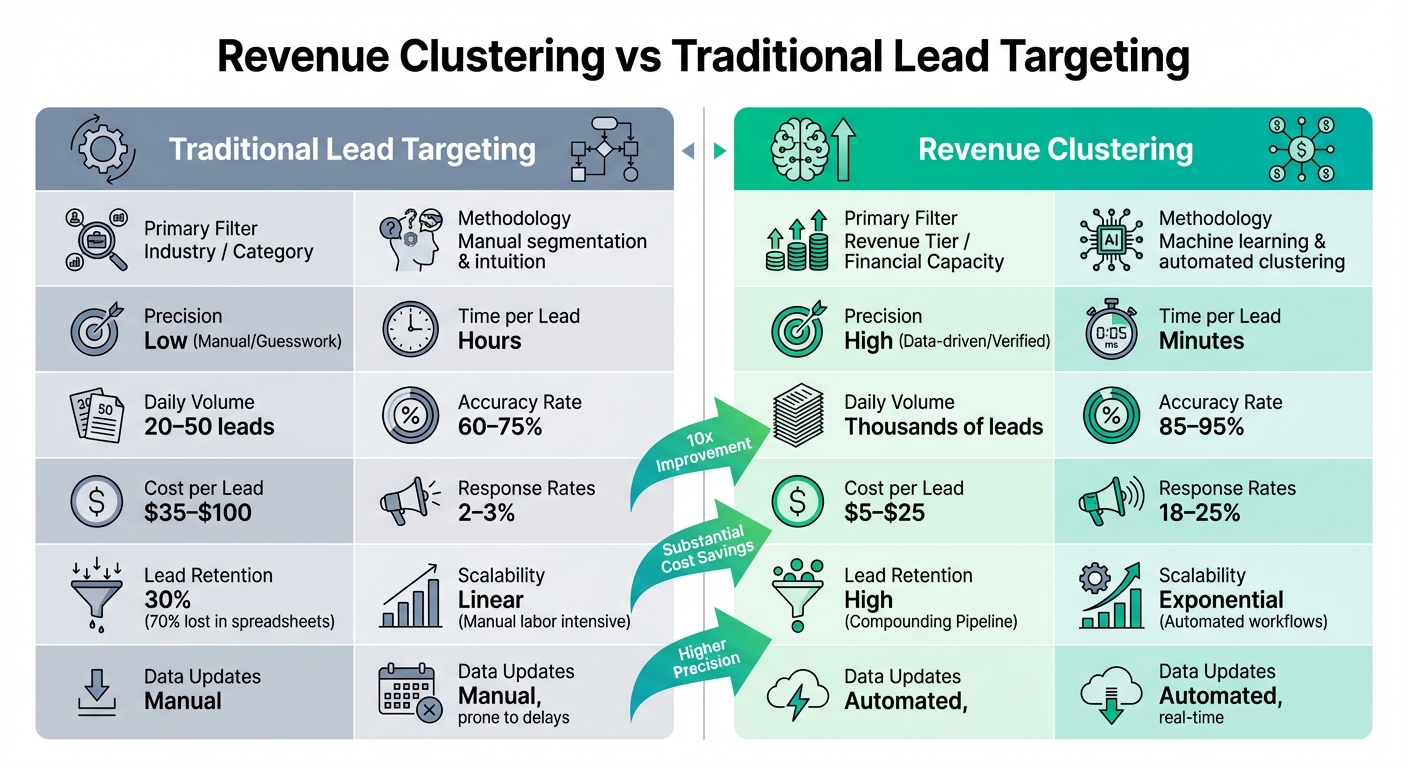
Revenue Clustering vs Traditional Lead Targeting: Performance Metrics Comparison
Traditional lead targeting often categorizes prospects by industry - grouping them as "fashion brands" or "home goods stores." But this approach overlooks a critical factor: a $5M company in any industry has far more in common with another $5M company than with a $200K business in the same field. Revenue clustering flips this script by focusing on financial capacity first, grouping prospects based on their ability to invest rather than what they sell. This shift allows for more precise and efficient lead targeting, especially when aiming for high-value opportunities.
The conventional approach relies heavily on manual processes and outdated data, leading to inefficiencies. In fact, as much as 70% of qualified leads are lost due to poor follow-up systems. Revenue clustering solves this problem by leveraging automation and machine learning to provide real-time updates. It also uncovers hidden patterns - like shared purchasing behaviors, similar tech stacks, and growth signals - that indicate when a prospect is ready to buy. This creates a dynamic pipeline that constantly refreshes lead statuses and triggers timely outreach, resulting in a 233% increase in revenue from the same prospecting efforts.
"The difference between a struggling agency and a thriving one isn't creativity, positioning, or even results. It's client quality. And client quality starts with one thing: revenue." – StoreCensus
The practical differences are striking. Traditional methods may generate 20–50 leads daily with response rates of just 2–3%, while costs can range from $35 to $100 per lead. Revenue clustering, on the other hand, processes thousands of leads in minutes, achieves response rates of 18–25%, and reduces costs to $5–$25 per lead. Accuracy also gets a major boost, jumping from 60–75% with manual methods to 85–95% thanks to automated, real-time data updates. The table below highlights these differences side by side.
Comparison Table: Revenue Clustering vs Traditional Targeting
| Metric | Traditional Lead Targeting | Revenue Clustering |
|---|---|---|
| Primary Filter | Industry / Category | Revenue Tier / Financial Capacity |
| Methodology | Manual segmentation & intuition | Machine learning & automated clustering |
| Precision | Low (Manual/Guesswork) | High (Data-driven/Verified) |
| Time per Lead | Hours | Minutes |
| Daily Volume | 20–50 leads | Thousands of leads |
| Accuracy Rate | 60–75% | 85–95% |
| Cost per Lead | $35–$100 | $5–$25 |
| Response Rates | 2–3% | 18–25% |
| Lead Retention | 30% (70% lost in spreadsheets) | High (Compounding Pipeline) |
| Scalability | Linear (Manual labor intensive) | Exponential (Automated workflows) |
| Data Updates | Manual, prone to delays | Automated, real-time |
Conclusion
Revenue clustering transforms lead generation by replacing guesswork with precise, data-driven insights. Instead of broadly categorizing prospects, this method organizes them based on financial capacity and growth indicators - key factors that predict purchasing behavior, spending potential, and decision speed. The results? Conversion rates improve by 20–30%, and acquisition costs drop by up to 25%. Beyond immediate gains, this approach builds a sales pipeline that grows over time, ensuring fewer missed opportunities and more sustainable strategies.
The impact is evident in measurable outcomes. For instance, agencies targeting ecommerce stores with $100K+ in annual revenue using revenue clustering have reported higher conversion rates and better ROI. Similarly, Shopify app developers who focused on stores in the $200K+ annual recurring revenue tier - grouped by shared app usage - achieved impressive response rates through targeted outreach. This alignment between data and strategy leads to more meaningful engagement.
StoreCensus makes this process even easier. By tracking over 2.5 million stores and analyzing 25+ data points, it allows users to filter prospects by revenue bands, growth trends, and activity signals. With CRM integrations and API access, it automates workflows, eliminating the manual research that often takes up 60% of a sales rep’s time.
Taking a long-term view of lead nurturing - tracking prospects over 3–12 months instead of relying solely on cold outreach - can result in up to 233% more revenue from the same effort. Revenue clustering isn't just a more efficient alternative; it represents a shift in how sales pipelines are built. By defining clear revenue tiers, leveraging StoreCensus data, and automating outreach, you can create a more powerful and scalable sales engine.
FAQs
How accurate are revenue clusters?
Revenue clusters achieve impressive accuracy when they are built using detailed, real-time ecommerce data combined with advanced segmentation methods. Take platforms like StoreCensus, for instance - they maintain precision by monitoring millions of stores and consistently refreshing their data. This method makes it easier to pinpoint high-value prospects with certainty.
What signals show a store is ready to buy?
Key indicators of potential growth and buyer interest include real-time app installations, hitting revenue milestones, and changes in the tech stack. For instance, when a company installs or removes marketing tools, it can signal shifting priorities or emerging needs. Additionally, social media activity and updates to their technology setup often point to a readiness to invest further.
Tools like StoreCensus monitor over 25 data points to pinpoint high-value prospects. This kind of insight allows businesses to time their outreach effectively, increasing the chances of converting leads into customers.
How do I use revenue clusters in my CRM?
To make the most of revenue clusters in your CRM, start by segmenting prospects into revenue tiers based on ecommerce store data. For instance, tools like StoreCensus allow you to filter stores by revenue ranges - such as less than $100K, $100K–$1M, $1M+, or $10M+. Once you've created these lists, import them into your CRM to run targeted campaigns tailored to each tier.
You can also integrate revenue data into your lead scoring or segmentation processes. This helps you focus on high-value leads, set up automated outreach strategies, and keep track of real-time changes in store activity signals for better decision-making.