Paid Ads for B2B Ecommerce Lead Generation
Paid ads for B2B ecommerce drive immediate, measurable leads by targeting decision-makers and using ABM + ecommerce data to lower CPL and boost pipeline.

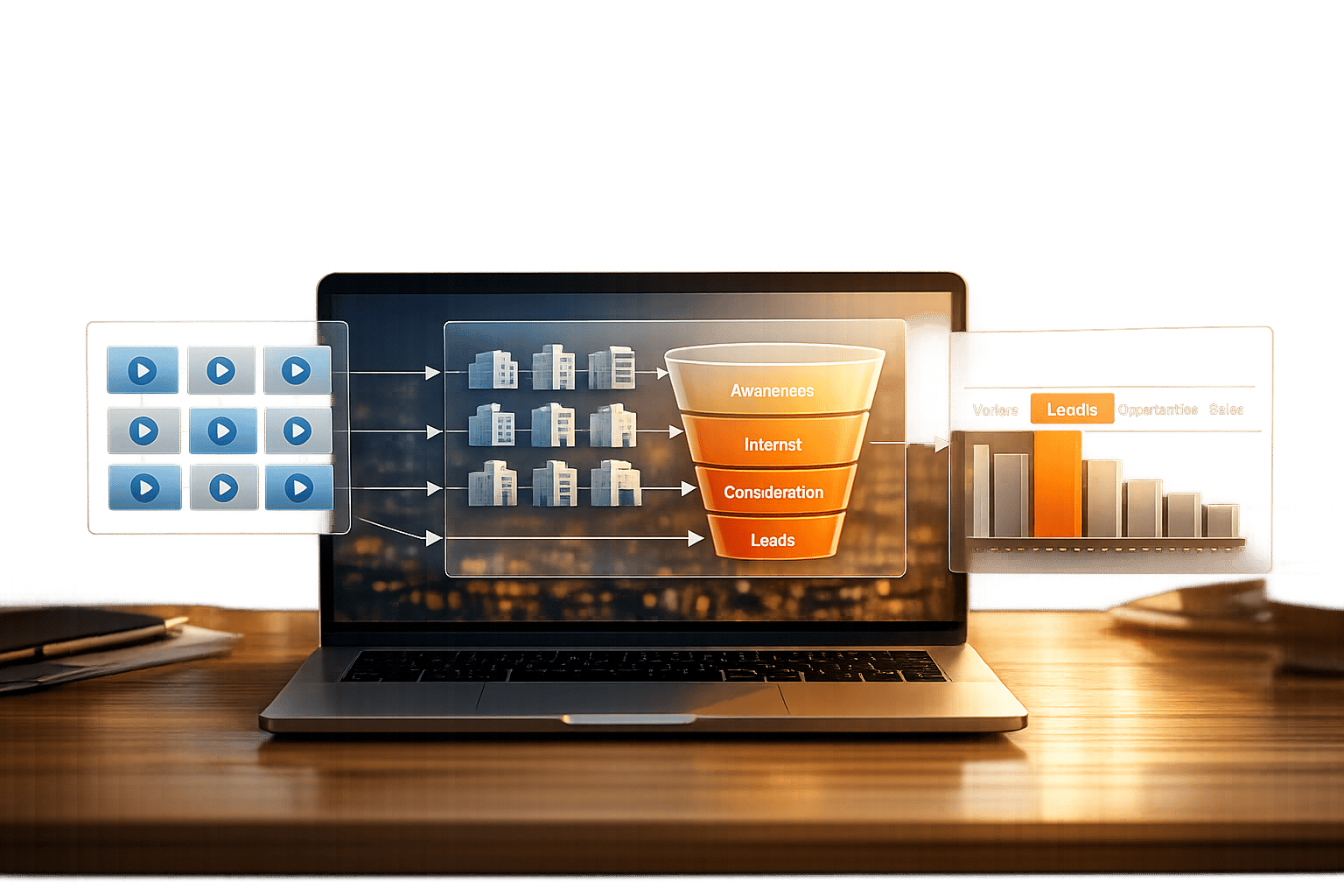
Paid ads are a game-changer for B2B ecommerce. They provide immediate visibility, target decision-makers precisely, and deliver measurable results. Unlike organic strategies that take months, paid campaigns generate leads instantly, making them essential in long sales cycles where decision-makers are already deep into research.
Key Takeaways:
- Quick ROI: Businesses earn $2 for every $1 spent on Google Ads, with PPC converting 50% better than organic traffic.
- Targeting Power: Platforms like LinkedIn and Google allow precise targeting by job title, industry, and company size.
- Proven Results: LinkedIn drives 80% of B2B social leads with conversion rates as high as 15%.
- High Stakes: B2B deals often exceed $20,000, making even high acquisition costs profitable.
Paid ads ensure you're visible when potential buyers are searching for solutions, helping you stay top-of-mind during critical research phases. Let’s break down how to maximize their impact.
5 Proven Strategies For Generating Thousands Of Leads With Google Ads
Why Paid Ads Work for B2B Ecommerce Lead Generation
Paid advertising offers B2B ecommerce companies a fast, scalable, and measurable way to generate leads. Unlike organic strategies that can take months to gain traction, paid ads deliver instant visibility and allow businesses to scale quickly once they identify a profitable cost per lead.
The statistics back this up. LinkedIn, for instance, drives approximately 80% of B2B social leads and boasts conversion rates that are double those of other platforms. On average, B2B search ads convert at a rate of 3.04%, while LinkedIn Lead Gen Forms achieve conversion rates between 10% and 15%. With global B2B digital ad spending expected to hit $48.15 billion by 2026, it's clear that paid ads are a critical tool for reaching decision-makers.
What makes paid ads so effective? They target key decision-makers at the exact moment they’re searching for solutions. A whopping 79% of B2B SaaS companies use PPC for lead generation, and research shows that buyers consume 13 or more pieces of content before engaging with sales. This consistent presence - sometimes called "air cover" - keeps your brand top of mind throughout the buyer’s journey, helping warm up leads before your sales team steps in.
How Paid Ads Target Ecommerce Decision-Makers
Paid advertising platforms excel at pinpointing specific audiences with unmatched precision. They allow businesses to target based on firmographics like industry, company size, and revenue, as well as professional criteria such as job title and seniority. This is crucial in B2B, where the average buying group involves six to ten stakeholders.
To take targeting a step further, you can upload Shopify brand prospect lists or ideal customer profile (ICP) data from your CRM into tools like LinkedIn Matched Audiences or Google Customer Match. This ensures your ads reach the exact companies your sales team is pursuing, avoiding wasted spend on irrelevant audiences. Account-Based Marketing (ABM) strategies further enhance this approach, with ABM campaigns generating up to 208% more revenue and delivering higher ROI for 97% of marketers.
Different ad types serve different purposes. Search ads capture high-intent buyers actively seeking solutions, while display and programmatic ads keep your brand visible across multiple touchpoints during long sales cycles, which can last anywhere from six to twelve months. The trick is tailoring your message: use educational content for cold audiences and direct offers, like demos, for retargeting warmer prospects.
"The 'unit' you're buying is the account, not the impression." - SalesHive
Another way to optimize paid ads is by using negative keywords to filter out unqualified traffic. For example, excluding terms like "jobs", "salary", "entry-level", or "free" helps avoid wasting ad spend, especially when B2B search clicks cost between $3.33 and $5.26 on average.
This level of precision sets the stage for effective campaigns, which we’ll explore in the next sections.
Paid Ads vs. Organic Lead Generation
The key differences between paid and organic lead generation lie in speed, control, and scalability. Organic methods, like SEO, build long-term authority but often take months to deliver results. Paid ads, on the other hand, can start generating leads as soon as the campaign goes live.
| Factor | Paid Ads (PPC) | Organic (SEO/Content) |
|---|---|---|
| Speed | Immediate visibility and leads | Slow; months to build results |
| Control | Precise targeting by job title | Limited; depends on algorithms |
| Scalability | Easily scaled by increasing budget | Requires significant content investment |
| Measurability | Tracks every dollar to leads | Hard to tie sales to content |
While organic strategies don’t require direct ad spend, they demand a heavy investment in content creation and time. Paid ads, though requiring an ongoing budget, offer granular control over who sees your message and when. Combining both approaches allows businesses to capture immediate demand through paid ads while building long-term authority with organic efforts.
Take York Saw and Knife, for example. This industrial blade manufacturer implemented a B2B Google Ads strategy that boosted conversions by 108% while reducing cost-per-conversion by 20%.
"If your paid ads don't create sales conversations, you're not buying demand - you're renting attention with no plan to convert it." - SalesHive
As Google's AI-driven search summaries reduce organic click-through rates, the shift toward paid media is accelerating. Programmatic advertising is expected to account for 82.4% of global digital ad spend by 2025.
Next, we’ll dive into the platforms that help maximize these targeting capabilities.
Choosing the Right Paid Advertising Platforms
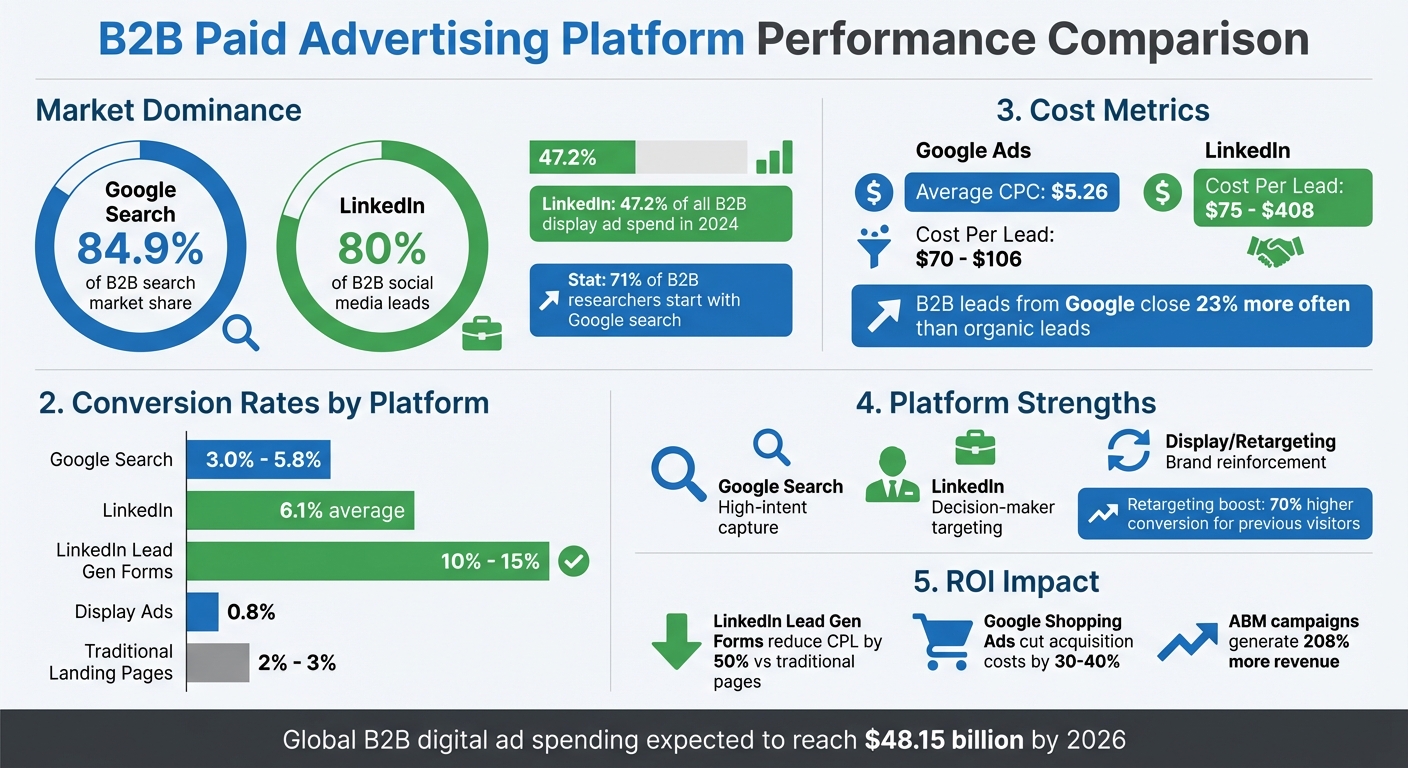
B2B Paid Advertising Platforms Performance Comparison: Conversion Rates and Lead Costs
Every advertising platform has its own strengths in B2B ecommerce lead generation. The trick is knowing how to align those strengths with the stages of the buyer's journey. For instance, Google Search excels at capturing active demand, LinkedIn targets decision-makers, and Display ads keep your brand in front of prospects who have already shown interest.
Here’s why this matters: 71% of B2B researchers start their journey with a Google search, while LinkedIn generates about 80% of all B2B social media leads. Conversion rates also differ: Google Search sees 3.0%–5.8%, LinkedIn averages around 6.1%, and Display ads hover at 0.8%. These stats make it clear - your budget should focus on the platforms that align with your goals.
Think of this like a three-layer system. Google Search captures demand from prospects actively searching for solutions. LinkedIn helps you reach specific job titles and industries, acting as a direct line to decision-makers. Meanwhile, Display ads and retargeting reinforce your brand, keeping you visible to prospects who’ve already engaged with your content. By leveraging each platform’s strengths, you can connect with high-value prospects at the right time.
Google Ads for Search Intent
Google Search is the powerhouse of B2B advertising, capturing prospects precisely when they’re searching for solutions. With 84.9% of the B2B search market, it’s the top choice for decision-makers ready to evaluate vendors. Searches like "B2B ecommerce platform pricing" or "wholesale order management demo" show clear intent, making Google Ads ideal for bottom-of-funnel leads.
The platform offers strong returns. B2B leads from Google close 23% more often than organic leads, with an average cost per lead ranging from $70 to $106. Clicks cost about $5.26 on average, and Google Shopping ads - featuring product images, specs, and prices - can cut acquisition costs by 30%–40% compared to generic search ads.
"If you do it right, paid search can be incredibly lucrative and is actually one of the best ways to grow a B2B business."
– Jacob Baadsgaard, Founder & CEO, Disruptive Advertising
Success hinges on targeting the right keywords. Focus your budget on high-intent terms like "vendor", "platform", "pricing", or "demo" while excluding irrelevant searches with aggressive negative keyword lists (e.g., "free", "jobs", "salary"). A great example: York Saw and Knife, an industrial blade manufacturer, boosted conversions by 108% and reduced cost-per-conversion by 20% through a well-targeted Google Ads strategy.
LinkedIn Ads for B2B Targeting
While Google captures immediate demand, LinkedIn excels at targeting professionals during critical decision-making moments. Its precision targeting lets you filter by job title, seniority, company size, industry, and even specific companies - making it a favorite for Account-Based Marketing (ABM). Notably, 87% of businesses rank ABM as their highest-ROI strategy.
One standout feature on LinkedIn is Lead Gen Forms. These native forms auto-fill with a user’s profile data, cutting friction and significantly improving conversion rates. While typical landing pages convert at 2%–3%, Lead Gen Forms achieve conversion rates of 10%–15% and often lower cost per lead by 50%.
"LinkedIn is generally the go-to platform for B2B marketing given its skew toward professionals and 'work mode' interactions."
– Josh Gallant, Founder, Backstage SEO
Although LinkedIn’s cost per lead ranges from $75 to $408 depending on your niche, the platform’s ability to deliver highly qualified leads often justifies the expense. In fact, LinkedIn is expected to account for 47.2% of all B2B display ad spend in 2024. Use LinkedIn to reach defined buying committees rather than for capturing immediate demand.
Display Ads and Retargeting
Display ads don’t shine when it comes to generating new leads, given their low 0.8% conversion rate. However, retargeting can boost conversion chances by 70% for previous visitors, making it an effective tool for re-engaging prospects who’ve already interacted with your site - especially those who’ve checked out pricing, case studies, or product comparisons.
Display ads serve as a reinforcement tool during long B2B sales cycles, which can last six to twelve months. Always-on retargeting across platforms like the Google Display Network and LinkedIn keeps your brand top of mind. Tailor your ads based on engagement levels - for instance, show different creatives to someone who visited your pricing page multiple times versus someone who browsed briefly.
Emerging formats like Connected TV (CTV) and Over-the-Top (OTT) ads are also gaining traction, with 29.3% year-over-year growth. These formats allow you to reach decision-makers in more casual settings, such as at home. However, they’re better suited for larger companies with big budgets and longer sales cycles.
Building Targeted Campaigns and Ad Content
Once you've chosen your platforms, the next step is crafting campaigns that genuinely connect with B2B ecommerce decision-makers. This means going beyond generic messaging to develop ads, offers, and landing pages tailored to specific audiences at various stages of their buying journey. The difference between an efficient campaign and one that drains your budget often lies in proper segmentation, compelling offers, and a seamless path to conversion.
Audience Segmentation Methods
Effective segmentation begins with firmographic data - details like industry, company size, job title, seniority, and location. For instance, targeting a "Director of Ecommerce" at retail companies with 50–500 employees is far more effective than casting a wide net. You can also segment audiences by their position in the sales funnel. A search for "best place to buy wholesale inventory software" signals high intent, while "ecommerce platform reviews" suggests someone in the early research phase.
CRM data can take segmentation further. Use tools like Matched Audiences or Customer Match lists on platforms like Google and LinkedIn to refine your targets. For Account-Based Marketing (ABM), focus your ad spend on a specific list of target accounts enriched with intent signals. ABM essentially turns paid ads into an extension of your sales team, warming up potential clients before your sales team reaches out.
Keyword categorization is another powerful tool. Divide search terms into categories like generic (e.g., "B2B ecommerce platform"), branded (e.g., "Shopify Plus"), competitor (e.g., "BigCommerce alternative"), and related terms. Tailor messaging and landing pages for each category, and use negative keywords to filter out irrelevant traffic - terms like "jobs", "salary", or "definition" often attract information seekers rather than buyers.
Once your audience segments are in place, the next step is creating ad content that speaks directly to each group.
Creating Ad Creatives and Lead Magnets
Ad creatives play a big role in reducing cost per lead (CPL). A refreshed creative strategy can cut LinkedIn CPL by as much as 80%. The trick is to align your offer with where the buyer is in their journey. Cold audiences often respond better to educational content like webinars or guides, while retargeting or competitor search terms are ideal for high-intent offers like ROI audits, pricing consultations, or diagnostic assessments.
Start with hooks that address specific pain points. For example, instead of a generic "Book a Demo", try something like:
"Struggling with low adoption? Get the top-rated guide used by 500+ teams. Limited access."
This structure - Pain Point + Credibility + Urgency - grabs attention and stands out. Add social proof to your messaging with phrases like "Trusted by IBM, Microsoft" to build credibility.
For lead magnets, go beyond static whitepapers. Interactive tools like ROI calculators, benchmark reports, and diagnostic audits deliver immediate, personalized value and often convert better. Keep in mind that B2B buyers typically engage with 13 or more pieces of content before speaking to sales. Using tools like LinkedIn Lead Gen Forms, which auto-fill with profile data, can reduce friction and achieve conversion rates around 13% - over five times higher than traditional landing pages.
To keep your campaigns fresh, test 3–5 new creative concepts each quarter to avoid fatigue. For video ads, deliver your value proposition within the first 5 seconds to capture busy decision-makers. Replace vague calls-to-action like "Learn More" with specific ones such as "Download the 2026 Ecommerce Security Checklist" or "Get My Free Quote".
Next, ensure your landing pages fulfill the promises made in your ads.
Designing Landing Pages That Convert
Your landing page should match the messaging in your ad to provide a consistent experience for the buyer. If your ad promises "Get a Free ROI Calculator", your landing page headline should repeat the same offer. Misaligned messaging can lead to higher bounce rates and wasted ad spend.
Focus on one primary goal per landing page. Remove navigation menus and secondary calls-to-action to keep visitors focused. Build trust quickly by placing client logos, testimonials, and trust badges (e.g., "Trusted by leading ecommerce brands") prominently above the fold. Keep your copy concise and benefit-driven, focusing on how your solution solves business problems rather than listing features.
Forms are often a sticking point, so keep them short - three fields or fewer is ideal. Forms with more than three fields can reduce conversions by 25%. Ask for only essential details like name, email, and company, and use action-oriented button text such as "Get My Free Audit" instead of a generic "Submit". For more complex offers, break forms into multiple steps with progress indicators to make them feel less daunting.
Technical performance matters too. Ensure your landing pages load quickly and are mobile-friendly. Match your call-to-action with the buyer's stage - use "Request a Demo" for prospects ready to buy and "Download Guide" for those still researching. Include a visible link to your privacy policy to build trust and comply with regulations. Finally, A/B test one element at a time - like headlines, CTA text, or form length - over 14–28 days to account for typical B2B buying cycles.
"If your paid ads don't create sales conversations, you're not buying demand - you're renting attention with no plan to convert it."
– SalesHive
Optimizing and Scaling Your Paid Ad Campaigns
Launching a campaign is just the beginning. To succeed, you need to measure performance, eliminate inefficiencies, and double down on what works. For B2B ecommerce businesses, this means tracking the right metrics, selecting the best bidding models, and using data to make smarter decisions about ad spend.
Budget Planning and Bidding Models
The bidding model you choose should align with your campaign goals. Each option has strengths and weaknesses, and understanding these can help you allocate your budget more effectively.
| Bidding Model | Best Use Case | Pros | Cons |
|---|---|---|---|
| Cost Per Click (CPC) | Driving traffic to demos or high-intent pages | Costs are tied to engagement; easy to control daily spend | High CTR with low conversions can inflate costs |
| Cost Per Lead (CPL) | Generating form submissions or lead capture | Directly tracks acquisition costs; predictable budgeting | Can attract unqualified, low-quality leads |
| Cost Per Mille (CPM) | Building brand awareness or ABM campaigns | Offers broad reach and repeated exposure | Harder to link spend directly to revenue outcomes |
For most B2B ecommerce campaigns, CPC is a good starting point when testing audiences or keywords since you only pay for clicks. Once your landing pages are optimized, CPL becomes more efficient for tracking lead costs. CPM is ideal for Account-Based Marketing (ABM) campaigns targeting high-value accounts with repeated messaging.
To ensure profitability, calculate your Target Cost Per SAL (Sales Accepted Lead) by working backward from your average contract value, close rates, and funnel conversion rates. This metric acts as your guiding benchmark for evaluating campaign success.
"The beauty of the 'Cost Per SAL' is that it distills the evaluation of your paid advertising campaigns into a single core measure of viability."
– FullFunnel
Tracking Campaign Performance
The difference between a successful campaign and a wasted budget lies in tracking the right metrics. Focus on both efficiency metrics (CTR, CPC, conversion rate) and business metrics (Cost Per SAL, pipeline revenue, ROAS). For B2B ecommerce, it’s crucial to monitor leads throughout the entire sales funnel - from Lead-to-MQL, MQL-to-SAL, and so on, until Opportunity-to-Close.
Quality trumps quantity. A low CPL might seem appealing, but if only 10% of those leads are qualified, your true cost per qualified lead skyrockets. Instead, track Qualified Lead Cost (QLC) for a clearer picture of campaign performance. For ecommerce, using Contribution Margin ROAS (cmROAS) offers a more accurate view than revenue-based ROAS, as it factors in costs like fulfillment and processing fees.
To optimize further, integrate offline conversion tracking by importing CRM data - SQLs, opportunities, and closed-won deals - into platforms like Google Ads or LinkedIn. This allows algorithms to optimize for revenue rather than just clicks or form fills. Don’t overlook the importance of speed-to-lead SLAs; leads contacted within 5 minutes convert significantly better than those left waiting.
"The fastest way to waste Google Ads budget isn't a bad keyword - it's a good lead that never gets a fast, relevant follow-up."
– SalesHive
With this foundation of precise tracking, you’ll be ready to scale your campaigns effectively.
Scaling with Data and Automation
Once you’ve optimized performance, automation can help you scale profitably. Start by focusing your budget on high-intent, bottom-of-funnel queries like "software pricing" or "demo" before expanding to broader, educational terms. Use search term reports to identify and exclude low-intent queries such as "free", "jobs", or "research" that waste budget.
After reaching 40–50 conversions, transition to automated bidding strategies like Target CPA or ROAS. This shift builds on earlier optimizations, ensuring your ad spend drives measurable ROI.
Platforms like StoreCensus can help you identify high-intent leads by analyzing real-time ecommerce signals. By targeting businesses that recently installed specific apps or made tech stack changes, you can focus your budget on prospects actively making buying decisions. Automation tools can even trigger outbound workflows, ensuring your sales team engages leads at the perfect moment.
Adding retargeting to high-intent pages can increase conversions by 30–50%. Similarly, LinkedIn Lead Gen Forms are a great way to reduce friction, often converting at around 13% and cutting CPL by over 50% compared to traditional landing pages.
Technical performance also plays a critical role. Pages that load in 1 second convert up to 3× better than those taking 5 seconds, and every extra second of load time can reduce conversion rates by 4–7%. Optimizing page speed is a must to avoid losing ROI.
These strategies deliver real results. For example, Hentys Lawyers doubled their new cases while cutting their budget by 50%, and Medical Aesthetic Supplies reduced ad spend by over 80% without sacrificing performance. The secret? Tracking the right metrics, eliminating waste, and scaling what works.
Using Ecommerce Intelligence to Improve Paid Ads
Paid ad campaigns thrive on precision and timing. The difference between a campaign that drives results and one that drains your budget often boils down to who you're targeting and when you reach them. Relying on generic filters like "ecommerce manager" can leave you with unqualified prospects. This is where ecommerce intelligence tools step in, blending technographic, firmographic, and behavioral data with traditional targeting methods. The result? A sharper focus on companies actively showing buying signals, paving the way for smarter campaign adjustments.
Identifying High-Intent Leads with Ecommerce Data
StoreCensus, for instance, tracks a whopping 2.5 million ecommerce stores and enriches each profile with over 25 structured data points. These include details like installed apps, platform usage, growth trends, and tech updates. This level of detail lets you create highly specific audience segments.
Imagine this: instead of targeting all Shopify stores across the U.S., you narrow it down to stores in California that recently installed a specific email marketing app, have over 100 SKUs, and are actively growing. This kind of targeting ensures your ads reach businesses that align with your ideal customer profile and are already making key technology decisions. You can even spot demand triggers like app installations, design overhauls, or traffic surges - signals that these businesses may be ready to explore new solutions.
By syncing this enriched data with your CRM and uploading it as "Matched Audiences" or "Customer Match" lists on platforms like Google Ads or LinkedIn, you can ensure your ads land in front of decision-makers. Considering that 81% of B2B buyers research independently before reaching out to vendors, engaging them early with tailored messaging becomes a game-changer. These refined audience segments also allow you to tweak campaigns on the fly, keeping them relevant and effective.
Adjusting Campaigns with Real-Time Monitoring
Static audience lists have a shelf life - they can quickly become outdated. A business uninterested last month might now be signaling buying intent through actions like updating its app stack or launching new products. StoreCensus helps you stay ahead by offering real-time monitoring and alerts. It tracks changes like app installations, removals, and store updates, enabling you to act immediately.
For example, if a store updates its app configuration, you can automatically trigger a retargeting campaign with personalized messaging. Or, if a business shows growth indicators like increased traffic or a new product launch, you can boost ad spend for that account while interest is high. Here's why speed matters: engaging a lead within 60 seconds can increase conversion rates by an astonishing 391%. Being this responsive gives you a serious edge over competitors.
This real-time approach also enhances offline conversion tracking. By feeding CRM data - like SQLs, opportunities, and closed-won deals - back into ad platforms, you can train algorithms to optimize for revenue instead of just basic lead metrics like form submissions. This creates a feedback loop that continuously sharpens your paid ad strategy, ensuring your budget is funneled into the accounts most likely to convert.
Conclusion
The success of paid ad campaigns isn't just about running ads - it’s about integrating them strategically and fine-tuning them continuously for better results.
For B2B ecommerce, three principles stand out: precise targeting, data-driven adjustments, and tight collaboration between marketing and sales. Forget generic filters and vanity metrics; the real goal is to spark qualified conversations that lead to actual revenue - not just collecting form submissions.
Here’s the truth: if your paid ads aren’t driving meaningful sales discussions, they’re simply buying attention without creating demand. To make an impact, treat paid ads like an extension of your sales team. This means pulling in CRM data and tracking key offline metrics like SQLs, opportunities, and closed-won deals to measure their true effectiveness.
StoreCensus, the ecommerce intelligence platform we spotlighted, takes this approach further. It layers technographic, firmographic, and behavioral data onto your targeting strategy. Instead of broadly targeting all Shopify stores, you can home in on businesses showing growth signals, installing specific apps, or actively updating their tech stack. With real-time monitoring, you can engage prospects the moment they show intent - whether that’s through an app installation, a design refresh, or other key activities. This level of precision is critical as competition for attention grows.
Paid ads are also getting pricier, with B2B cost-per-lead averages often topping $100. By combining ecommerce intelligence, smart retargeting, and coordinated outbound efforts, you can improve ROI. Multi-channel campaigns, for example, have been shown to boost effectiveness by 31% year-over-year. This kind of integrated strategy transforms paid ads into a reliable driver of revenue growth.
FAQs
How much should I budget to start?
When kicking off paid B2B ad campaigns, it's common for experts to recommend starting with a budget of at least a few thousand dollars per month. This amount provides enough resources to attract valuable leads while giving you room to fine-tune and improve your campaign's performance over time.
Which platform should I run first: Google or LinkedIn?
Choosing between Google Ads and LinkedIn really comes down to your objectives and target audience.
- Google Ads is perfect for reaching people who are actively searching for solutions. It’s all about capturing high-intent leads and achieving quick visibility. If your goal is to get immediate results, this platform is a solid choice.
- LinkedIn, on the other hand, shines when you want to connect with specific industries, job titles, or decision-makers. It’s a great tool for building brand awareness and fostering professional relationships over time.
A smart approach? Start with Google Ads if generating immediate leads is your main focus. Then, layer in LinkedIn to nurture those leads and expand your professional network. Both platforms can work together to support your business goals.
How do I track leads to closed-won revenue?
To connect your leads to closed-won revenue, start by creating detailed UTM parameters for all your campaigns. These parameters help you track where your traffic is coming from and how users behave on your site. Next, integrate your CRM system to properly attribute leads and follow their journey through the sales funnel.
Make it a habit to analyze crucial metrics such as:
- Lead-to-sale conversion rate: Understand how effectively your leads are turning into customers.
- Average order value: Gauge the typical revenue generated per sale.
- Lifetime value (LTV): Measure the total revenue a customer brings over their relationship with your business.
By keeping an eye on these metrics, you can evaluate how well your campaigns are performing and make smarter adjustments to streamline your sales pipeline.