Manual vs Automated Lead Generation: A Comparison
Compare manual and automated lead generation—tradeoffs in personalization, cost, scalability, and how to combine both for better results.

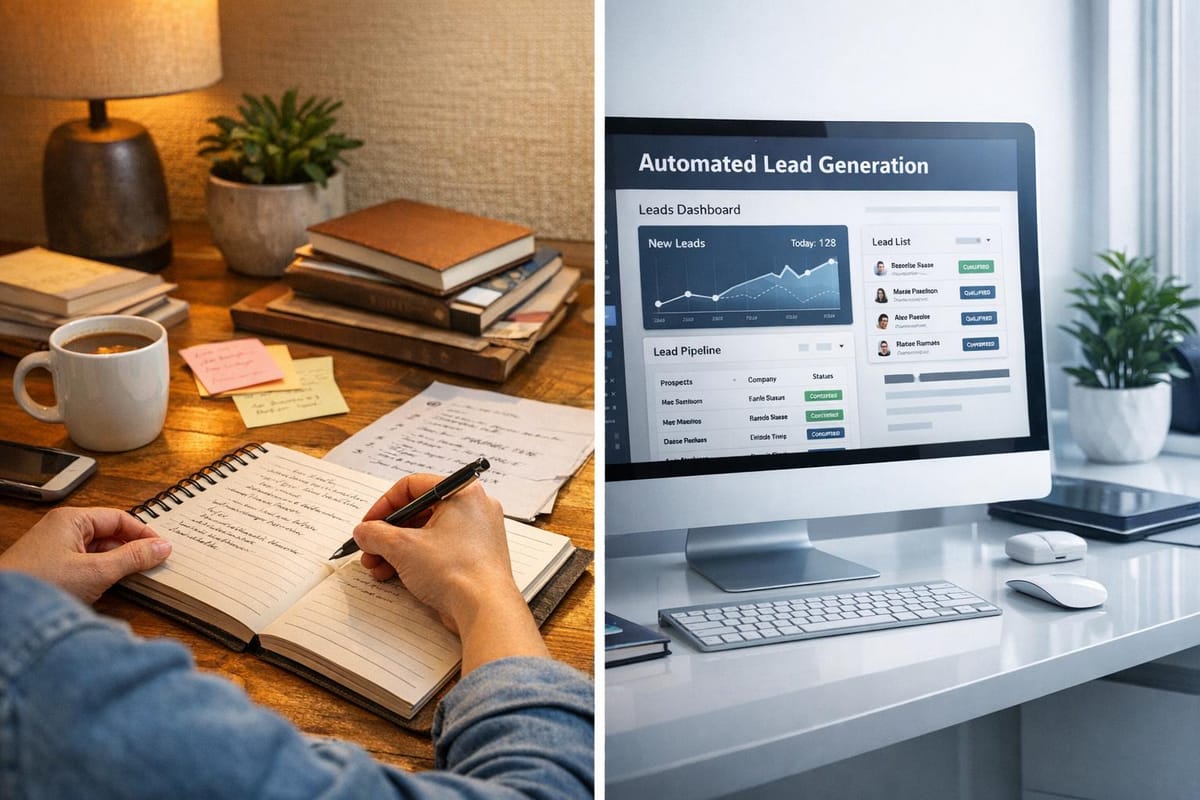
Choosing between manual and automated lead generation boils down to your business needs. Manual methods rely on human effort - ideal for high-value, relationship-driven sales. Automated systems, powered by software and AI, excel at handling large volumes efficiently. Here's a quick breakdown:
- Manual Lead Generation: Focuses on personalized outreach, trust-building, and high-quality leads. Best for smaller-scale, complex B2B sales.
- Automated Lead Generation: Streamlines repetitive tasks, processes leads quickly, and scales effortlessly. Suited for high-volume industries like ecommerce.
Key Stats:
- 80% of marketers using automation report increased lead volumes.
- Companies using manual nurturing see 50% more sales-ready leads at 33% lower costs.
Quick Overview:
- Manual: Time-intensive, personalized, high lead quality, limited scalability.
- Automated: Fast, scalable, consistent, but less personal.
For optimal results, many businesses combine both methods: automation for efficiency and manual efforts for relationship-building.
How I Automate Lead Generation With AI & Automation in n8n (Copy This)
Manual Lead Generation: How It Works
Manual lead generation is all about human effort - no shortcuts, no software doing the heavy lifting. Instead, your team of sales development representatives (SDRs), researchers, and account executives handles every step, from identifying potential leads to building relationships, one conversation at a time.
It starts with prospect research. A team member digs into platforms like LinkedIn or industry directories to find leads that align with your Ideal Customer Profile (ICP). Once the right prospects are identified, the real work begins: crafting personalized outreach. Every email or call is tailored to the prospect’s industry, role, and challenges. Lead qualification follows, using frameworks like BANT (Budget, Authority, Need, Timing) or NOTE during direct conversations. This approach helps uncover details like whether a company recently secured funding or plans to expand its team. Finally, relationship nurturing takes center stage, with consistent follow-ups and personalized guidance to move prospects through the awareness and consideration stages. This hands-on strategy builds trust - critical in complex B2B sales.
Here’s an eye-opener: companies that focus on nurturing leads see 50% more sales-ready leads at a 33% lower cost, and nurtured leads tend to spend 47% more than those who aren’t nurtured.
Steps in Manual Lead Generation
The manual lead generation process depends on human judgment at every stage. Here’s how it typically unfolds:
- Prospect identification: Your research team uses tools like LinkedIn Sales Navigator to filter prospects by job title, company size, industry, or location. This isn’t just about pulling names from a database; the team ensures each prospect has decision-making authority and matches your buyer persona. They verify contact details, job titles, and other information to eliminate errors that automated systems might miss. For instance, if you sell HR software, your team might check if a company employs HR representatives or is actively hiring - both indicators of potential need.
- Contact verification: Tools like Hunter.io, Snov.io, and Aeroleads help find and confirm email addresses and phone numbers while browsing LinkedIn. This step ensures you’re reaching the right person with accurate details.
-
Personalized messaging: After spending 5–15 minutes researching a lead, SDRs craft a tailored message addressing the prospect’s challenges. This process can take up to 30 minutes per message. Unlike generic templates, these messages reflect a deep understanding of the prospect’s pain points. As LinkedIn Sales Solutions explains:
Success in sales often hinges on the quality of connections rather than the quantity.
- Direct outreach: Whether it’s a cold call, a personalized email, or engagement through live chat tools like Intercom or Drift, the outreach is tailored to the prospect’s needs. Tools like Ring.io’s "click-to-call" feature streamline the process while keeping it personal. During these interactions, SDRs ask open-ended questions to uncover needs and gauge interest.
- Lead qualification: Frameworks like BANT or NOTE help assess whether a prospect is worth pursuing. Instead of relying on metrics like website clicks, SDRs ask targeted questions during discovery calls to evaluate budget, authority, need, and timing. This manual approach ensures your pipeline isn’t bogged down with low-quality leads, which is crucial since 71.4% of sales reps report that only half their initial prospects are a good fit.
-
Follow-up and nurturing: SDRs log notes in CRMs like HubSpot, Salesforce, or Pipedrive, set reminders for follow-ups, and maintain ongoing conversations. As Olivia Henkel, Sales Manager at Grovo, advises:
Set aside at least 30 minutes a day to go through your CRM and recheck and backfill information from the day. Make it a ritual.
This detailed, step-by-step approach forms the backbone of manual lead generation.
Advantages of Manual Lead Generation
Manual lead generation shines when it comes to personalization and relationship-building. Since every interaction is human-driven, your team can tailor messages to address specific pain points, reference recent company developments, or adjust pitches based on real-time feedback. This is especially valuable in B2B sales, where decisions often involve multiple stakeholders and longer cycles.
Higher lead quality is another standout benefit. By manually researching and qualifying prospects, your team can weed out poor fits early on - like companies without the budget or decision-making power. This is critical, considering 37% of B2B marketers rank generating high-quality leads as their biggest challenge. Manual outreach also ensures you engage the full decision-making unit, not just a single contact.
Building trust and credibility is easier when prospects interact with someone who genuinely understands their business. As Daniel Nyquist, CMO at Crosslist, puts it:
The key is building genuine relationships and delivering exceptional value so people are eager to tell others about [the brand].
Manual lead generation also offers flexibility. If a prospect raises an objection during a call, your SDR can pivot instantly, address concerns, and propose tailored solutions - something pre-programmed workflows can’t do.
Lastly, this approach is cost-effective for smaller volumes. If you’re targeting a niche market with a handful of high-value accounts, manual outreach often delivers better results than expensive automation tools.
Limitations of Manual Lead Generation
The biggest downside to manual lead generation is time consumption. Researching a single lead takes 5–15 minutes, and crafting a personalized message can take up to 30 minutes. When scaled across dozens or hundreds of prospects, the time investment becomes overwhelming, making this method impractical for businesses needing thousands of leads monthly or operating in high-volume sectors like ecommerce.
Scalability is another hurdle. Manual lead generation is limited by your team’s size and available hours. Expanding outreach means hiring more SDRs, which increases costs for payroll, training, and management. A typical outbound team might require at least a full-time researcher, an SDR, and an email copywriter.
Human error is unavoidable. Even the most careful researchers can make mistakes - typos in email addresses, incorrect job titles, or outdated contact information. These errors can damage your sender reputation, waste resources, and frustrate your sales team. In fact, 45% of sales professionals cite incomplete data as their biggest challenge when managing leads.
Finally, inconsistency can be an issue. Different SDRs bring varying skill levels and communication styles, which can lead to uneven results across the team. These challenges highlight the efficiency and consistency that automation can provide, a topic we’ll dive into next.
Automated Lead Generation: How It Works
Automated lead generation leverages software to streamline how businesses capture, qualify, and nurture leads. By tracking visitor behavior and syncing this data with your CRM, it removes the need for constant human involvement. Brian Solis, Head of Global Innovation at ServiceNow, puts it this way:
Business buyers don't go to work and forget what they do as humans. There's a new normal that blurs the line between B2B and B2C. They just want things personalized.
At its core, automation starts with data collection. Tools identify anonymous website visitors through their company IP addresses, while AI chatbots interact with prospects 24/7. Triggers, like how far a visitor scrolls or their intent to exit a page, prompt pop-ups or forms to engage them at the right moment. Platforms such as Facebook, LinkedIn, and Google Ads further simplify this process with lead form extensions that pull user data directly from their accounts, eliminating the need for external landing pages.
After capturing leads, the system enriches them with firmographic (e.g., company size, industry) and demographic details from third-party databases, ensuring your sales team works with accurate information. Next, AI-driven lead scoring assigns numerical values to prospects based on their engagement - like email opens or page visits - so your team can prioritize high-potential leads. Leads are then segmented into categories like Marketing Qualified Leads (MQLs) or Sales Qualified Leads (SQLs), triggering tailored nurturing sequences based on their actions. All this data syncs seamlessly with CRMs like HubSpot or Salesforce, enabling instant follow-ups.
The results speak for themselves: 64% of marketers now use AI and automation for lead generation, with companies reporting an 80% boost in total leads. AI tools can increase lead numbers by 50% and boost conversion rates by 47%. By automating these steps, businesses minimize manual effort while maximizing efficiency.
Steps in Automated Lead Generation
Automated lead generation relies on software to handle tasks that would otherwise require hours of manual work. Here's how the process unfolds:
- Data Capture: Tools identify visitors by their company IP addresses, and AI chatbots collect contact details while qualifying interest in real time. Triggers like exit-intent pop-ups or scroll-depth forms capture leads at key moments. For instance, Fenty Beauty uses scroll-based lead capture forms offering a 15% discount, followed by automated cart abandonment emails titled "You forgot something" to recover sales.
- Lead Enrichment: Automation tools pull additional firmographic and demographic data from external databases, removing the need for manual research.
- AI-Driven Lead Scoring: Engagement signals, such as resource downloads or page views, are used to score leads, helping your team focus on the most promising prospects.
- Automated Nurturing Sequences: These sequences adapt based on lead behavior, allowing your team to concentrate on tasks requiring human input.
- CRM Integration: Captured data syncs instantly with your CRM, cutting lead processing time from 42 hours to just 5 minutes.
Advantages of Automated Lead Generation
Let’s look at what makes automation so effective.
One of the biggest perks is its speed and scale. Automation tools operate nonstop, capturing and qualifying leads without being limited by business hours. Companies using marketing automation report an 80% increase in lead volume.
Another advantage is real-time data updates. As soon as prospects engage - whether by downloading a resource or visiting a pricing page - the system records the activity and triggers the next step in the nurturing process. Following up within the first minute can boost conversions by up to 391%.
Automation also ensures consistency in lead management. While manual methods often depend on individual performance, automation delivers uniform messaging and timing across all prospects. This consistency achieves a 99% follow-up rate, compared to 60–70% with manual processes. Sales representatives can save over two hours daily by avoiding repetitive tasks, and automated lead enrichment reduces data entry errors by up to 90%.
For ecommerce businesses, tools like StoreCensus provide advanced filtering options - such as filtering by tech stack, revenue, or location - making it easier to target high-potential stores. With real-time updates and built-in automation workflows, you can set up campaigns to run on autopilot. For example, you could automatically add new Shopify stores in the fashion industry with revenues over $100,000 to a nurturing sequence, then export decision-maker details to your CRM for immediate follow-up.
Automated emails further enhance results, increasing click-through rates by up to 199% while cutting marketing costs by 80%. Overall, adopting automation technology can improve marketing ROI by 34%.
Limitations of Automated Lead Generation
Despite its many benefits, automated lead generation isn’t without challenges. One major drawback is reduced personalization. While automation can tailor messages based on behavior, it often lacks the human touch needed to build trust in more complex sales situations. Automated workflows also struggle to adjust dynamically or address unexpected objections as effectively as a skilled salesperson.
Another challenge is the complex initial setup. Configuring lead scoring models, creating nurturing sequences, and integrating automation tools with your CRM requires a significant upfront investment in both time and money. Software licensing costs range from $50 to $500 per user monthly, with full implementations costing anywhere from $10,000 to $100,000. Maintenance can add another 15–20% of licensing costs annually.
There’s also the risk of over-reliance on technology. If a lead scoring model is poorly calibrated, it might prioritize the wrong leads. Additionally, automation can amplify the effects of outdated or inaccurate third-party data.
Finally, automation demands ongoing optimization. Regular A/B testing of subject lines, calls-to-action, and landing page designs is essential to maintain campaign effectiveness. Without this, automated sequences can grow stale and see reduced engagement over time.
Manual vs Automated Lead Generation: Direct Comparison
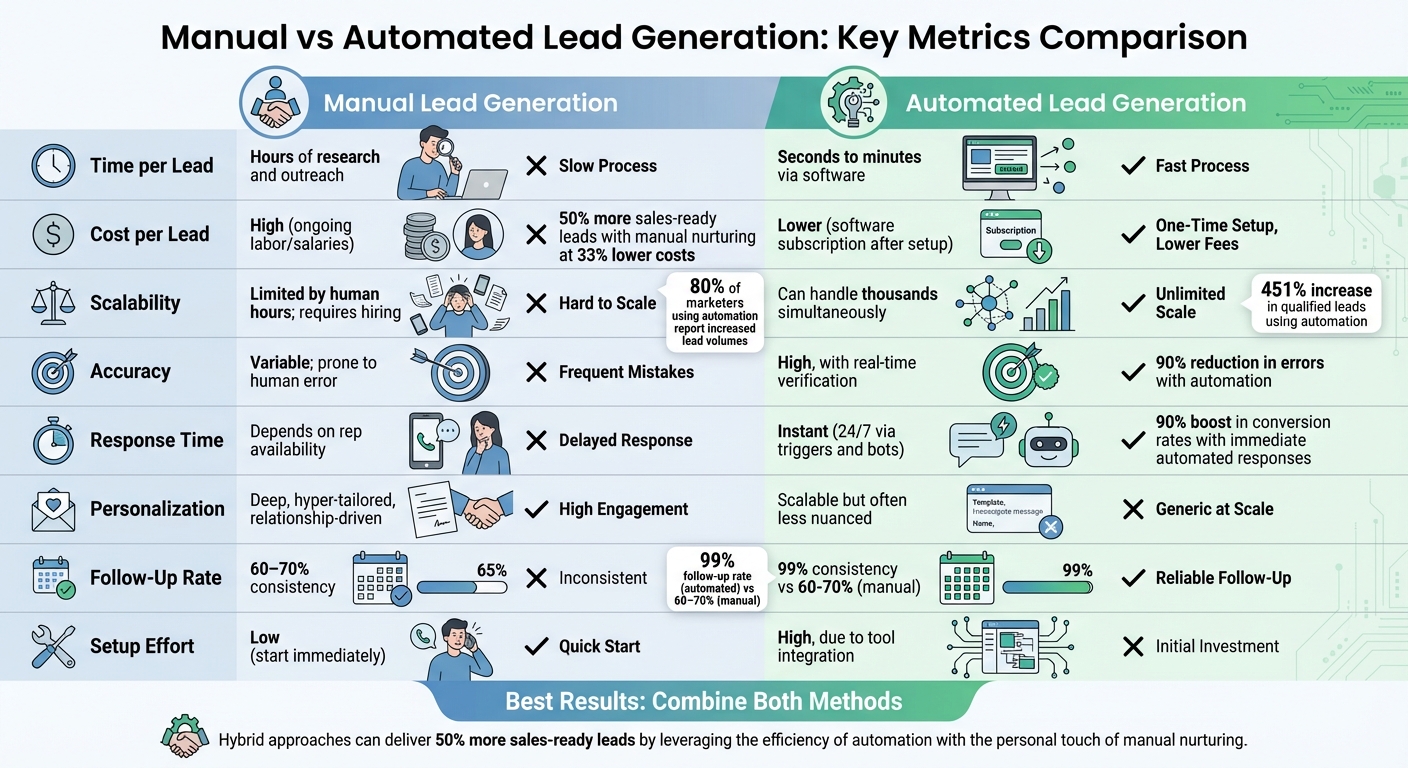
Manual vs Automated Lead Generation: Key Metrics Comparison
Let’s break down the key metrics that directly impact your business outcomes.
With manual lead generation, sales reps often spend hours on each lead. In fact, only about 35% of their time goes toward activities that directly generate revenue. On the other hand, automated systems process leads in seconds, with studies showing a 90% boost in conversion rates when responses are immediate. This stark contrast highlights significant differences in cost, scalability, and accuracy.
Take cost, for example. In 2019, Lead Liaison used manual prospecting to generate 10,440 leads at just $0.78 per qualified lead. However, this approach required ongoing salary expenses. Automation, while demanding a higher upfront investment - ranging from $40/month for basic tools to over $500 per user for enterprise solutions - can slash long-term costs by as much as 80%. These financial dynamics also explain why scalability varies so much between the two.
Manual methods can only scale by hiring more staff, while automated systems can manage thousands of leads at once. Some companies even report a staggering 451% increase in qualified leads using automation.
Accuracy is another area where the two methods diverge. Manual data collection often leads to errors and inconsistent follow-ups. Automated tools, however, maintain a 99% follow-up rate and reduce errors by 90%. That said, automation often falls short in delivering the deep, tailored personalization that manual methods excel at. As Julie Thomas, President and CEO of ValueSelling Associates, points out:
When you understand your prospect's business, their industry, and their role, you can focus your communication on how you can add value and engage with your prospect, rather than pitch to them.
Comparison Table: Manual vs Automated
Here’s a quick snapshot of how manual and automated lead generation stack up against each other:
| Metric | Manual Lead Generation | Automated Lead Generation |
|---|---|---|
| Time per Lead | Hours of research and outreach | Seconds to minutes via software |
| Cost per Lead | High (ongoing labor/salaries) | Lower (software subscription after setup) |
| Scalability | Limited by human hours; requires hiring | Can handle thousands simultaneously |
| Accuracy | Variable; prone to human error | High, with real-time verification |
| Response Time | Depends on rep availability | Instant (24/7 via triggers and bots) |
| Personalization | Deep, hyper-tailored, relationship-driven | Scalable but often less nuanced |
| Follow-Up Rate | 60–70% consistency | 99% consistency |
| Setup Effort | Low (start immediately) | High, due to tool integration |
When to Use Manual or Automated Lead Generation
Deciding between manual and automated lead generation boils down to aligning your sales strategy with your ability to scale effectively.
When to Use Manual Lead Generation
Manual lead generation shines in situations where sales are complex and high-value, particularly when multiple decision-makers are involved. By 2025, the average B2B transaction will involve 13 stakeholders - CFOs, CTOs, procurement teams, and others. Each of these individuals has specific concerns that generic, automated messages simply can't address.
Take enterprise-level B2B sales as an example. For contracts worth six figures or more, trust is built through tailored approaches like personalized demos, detailed proposals, and references that resonate with each stakeholder. As 6sense points out:
69% of sales decisions are made before buyers even talk to a sales rep.
This means the groundwork - building relationships and addressing concerns - becomes critical in these scenarios.
Referral-based selling is another area where manual methods excel. A staggering 92% of consumers trust referrals from friends and peers over other forms of lead generation. A personal phone call to a satisfied client, asking for an introduction to their network, is something that can't be automated. Similarly, trade shows, speaking engagements, and industry events rely on face-to-face interactions to generate leads that automation simply can't replicate.
However, when the sheer volume of leads becomes too overwhelming for manual processes, automation steps in as a game-changer.
When to Use Automated Lead Generation
Automation is indispensable for managing high-volume operations where manual efforts create bottlenecks. If you're tracking thousands of website visitors or managing multiple campaigns simultaneously, automation allows you to scale efficiently without adding to your team.
Consider platforms like StoreCensus, which tracks over 2.5 million stores with more than 25 data points per store. It offers advanced filtering options based on tech stack, revenue, location, and social signals. Handling this level of data manually would be nearly impossible.
Another major advantage of automation is 24/7 engagement. Automated tools like chatbots, triggered email workflows, and instant lead capture forms work tirelessly, even when your team is offline. For instance, SalesRabbit reported a 40% increase in conversion rates and a 50% rise in qualified leads by using automated demo scheduling.
Automation also excels at managing repetitive tasks such as data entry, CRM updates, and initial lead scoring. AI tools can reduce the time sales reps spend on non-selling activities by up to 40%, allowing them to focus on meaningful conversations.
Combining Manual and Automated Methods
The most effective strategy combines both approaches, leveraging the strengths of each. Think of automation as a "copilot" rather than a replacement. While AI handles data-heavy tasks like research, outreach, and lead scoring, human reps focus on building relationships and closing deals.
Automation tools can flag intent signals - like a prospect visiting your pricing page or downloading a whitepaper - and alert a human rep to follow up with a personalized touch. For example, Tactikmedia used Leadfeeder to identify 600 anonymous companies visiting their website and then had their sales team manually reach out to those accounts with customized messaging.
Blending AI-driven research with human follow-up can increase conversion rates by up to 35%. Kayela Young from Martal Group sums it up well:
The best-performing workflows combine AI efficiency with human empathy. While AI handles research and timing, humans personalize interactions and build trust.
For ecommerce, you might use StoreCensus's automated workflows to identify stores that match your ideal customer profile, filtering by revenue, technology stack, or growth signals. Your sales team can then craft personalized outreach for the most promising prospects. This approach has been shown to deliver 50% more sales-ready leads while cutting acquisition costs by 60%.
The key to success is setting clear trigger-based handoffs. Behavioral triggers can signal when leads are ready to move from automated systems to human reps, ensuring your team spends their time on prospects who are genuinely sales-ready.
Conclusion: Choosing the Right Approach for Your Business
Picking the right lead generation method depends on your business goals, available resources, and the scale of your operations. Manual methods shine when you're focusing on high-value accounts that require a personal touch and relationship-building. On the other hand, automation becomes a game-changer when you need to handle hundreds - or even thousands - of leads at once. Both approaches are supported by compelling data.
For example, 80% of marketers using automated lead generation tools report an increase in lead volumes. Additionally, 77% see improved conversion rates after adopting automation. However, automation isn't a magic fix - it requires a clear strategy. Start by defining your Ideal Customer Profile and setting SMART goals, like aiming to "generate 1,000 qualified leads in 60 days", to ensure you're tracking measurable success.
If you're in ecommerce, tools like StoreCensus can simplify lead generation. It tracks 2.5 million stores and offers advanced filtering options, such as tech stack, revenue, and growth indicators. This enables your sales team to focus on personalized outreach for the most promising prospects.
For the best results, consider blending manual and automated methods. Align your sales and marketing teams on what qualifies as a lead, maintain clean and up-to-date data with regular audits, and continuously test your messaging through A/B testing. By combining both strategies, you can tackle a variety of lead generation challenges effectively.
The key is identifying your bottlenecks. If your team can only manage 20–50 leads a day, automation can multiply those efforts and scale to thousands. But for complex, high-value deals that involve multiple decision-makers, manual methods remain indispensable.
FAQs
What’s the best way to combine manual and automated lead generation effectively?
Combining manual and automated lead generation creates a powerful mix of efficiency and personal connection. Automation takes care of repetitive tasks like gathering and refining prospect data, segmenting leads, and ranking them based on your Ideal Customer Profile (ICP). This way, your team can zero in on the most promising prospects without wasting time or energy.
Once automation filters and qualifies the leads, manual efforts - like tailored emails, cold calls, or face-to-face networking - step in to build trust and nurture relationships. Here’s how this balanced approach can work:
- Define your ICP and set clear lead generation goals.
- Leverage automation to collect leads, enhance data, and nurture potential customers.
- Pass high-priority leads to a manual outreach queue for personalized interactions.
- Continuously refine your process, using insights to improve both manual and automated efforts.
This hybrid approach ensures automation handles the heavy lifting while manual outreach focuses on creating meaningful, high-value connections.
What are the main advantages of automating lead generation in high-volume industries?
Automation equips high-volume industries with the speed, precision, and capacity needed to transform massive pools of prospects into qualified leads. By streamlining tasks like data collection, contact enrichment, and outreach, businesses can reclaim countless hours that would otherwise be spent on manual work. This allows sales teams to dedicate their energy to closing deals rather than getting bogged down in repetitive research.
With automated tools, companies can manage thousands of leads at once, making it possible to grow without adding more staff. This not only boosts lead volume but also improves conversion rates. Plus, integrated analytics offer valuable insights for fine-tuning targeting, messaging, and timing, ensuring a more efficient and cost-effective lead generation process. In the fast-moving world of high-volume markets, automation empowers businesses to keep up with demand while driving growth and delivering higher-quality leads.
When is it better to use manual lead generation instead of automation?
Manual lead generation shines when quality takes priority over quantity. It brings a personal touch that fosters trust and builds stronger relationships - especially crucial in high-value or complex sales where decision-makers expect thoughtful, tailored outreach. Unlike automated workflows, a human approach allows for real-time adjustments, nuanced messaging, and addressing specific needs with precision.
This method is particularly effective for niche markets or B2B deals that demand in-depth research and personalization. Sales teams can dive into understanding each prospect’s distinct challenges, crafting messages that resonate, and reaching out through personalized emails, phone calls, or networking efforts. Though it requires more time and effort, the high level of customization often translates into stronger conversion rates, making it an ideal strategy for targeted, high-stakes opportunities.