Data Privacy Laws in Referral Programs
How referral programs must secure consent, minimize data, use DPAs, and respond to GDPR/CCPA requests to avoid fines and protect user privacy.


Referral programs are a popular marketing tool, but they come with serious data privacy challenges. These programs collect personal information like names, emails, and browsing data, which must comply with strict regulations like GDPR and CCPA. Non-compliance can result in hefty fines - up to €20 million under GDPR or $7,988 per violation under CCPA.
Key points to ensure compliance:
- Consent: GDPR requires explicit opt-in, while CCPA allows opt-out. Referred individuals must actively consent before their data is used.
- Data Minimization: Only collect what’s absolutely necessary, like email addresses, and avoid storing unnecessary details.
- Vendor Agreements: Use Data Processing Agreements (DPAs) with third-party tools to ensure they handle data responsibly.
- Security: Protect stored data and delete unnecessary records promptly to reduce breach risks.
- User Rights: Respond to data access or deletion requests within the required timeframes (30 days for GDPR, 45 days for CCPA).
With privacy laws tightening and enforcement increasing, businesses must prioritize compliance to avoid penalties and maintain trust.
How to comply with privacy laws such as GDPR and CCPA?
Common Data Privacy Challenges in Referral Programs
Running a referral program involves juggling data from various sources, which can make staying compliant a tricky task. The challenge isn't just about managing data from existing customers - it's also about handling the personal information of individuals who haven’t opted in, like the friends, family, or colleagues being referred through Shopify brand prospect lists or other outreach methods. Let’s break down the hurdles around consent, storage, and third-party sharing.
Consent and Third-Party Data Collection
One of the toughest issues is getting proper consent from the people who are referred. According to GDPR, you can’t legally process a referred person’s email address for marketing unless they’ve given prior consent. The tricky part? This data is often provided by the referrer, not the referred person, meaning you’re storing information without their direct approval.
"The safest path for referral GDPR compliance regarding referred friends is to avoid collecting their data until they actively opt in." – Viral Loops
The CCPA adds another layer of complexity. It defines "selling" as exchanging personal data for anything of value, which can include referral rewards. If you’re using tools like ad networks or analytics to track referrals, you might inadvertently be "selling" data under California law. On top of that, businesses must honor Global Privacy Control (GPC) signals at the browser level. If a referred person has GPC enabled and your system doesn’t catch it, you could face penalties right away.
Data Storage and Security Risks
Consent isn’t the only hurdle. Storing referral data securely is another significant challenge. Every piece of information you collect - whether it’s an email address, phone number, or transaction history - becomes a potential vulnerability. If your security measures aren’t strong enough, you’re exposing yourself to breaches. The risks are even higher when you’re holding onto data from people who haven’t signed up yet.
Under GDPR, even individuals who haven’t become customers have the right to manage or delete their data within 30 days. Ignoring these requests could land you in non-compliance territory. Regulations also emphasize that you should only collect what’s absolutely necessary. For example, asking for phone numbers or physical addresses for rewards that could be sent via email increases your exposure unnecessarily.
Sharing Data with Third-Party Processors
Once you’ve tackled consent and storage, the next challenge is sharing data with external vendors. Referral programs often rely on third-party platforms like GrowSurf or Extole for management, SendGrid or Twilio for email delivery, and services like Tango Card for rewards. Each vendor you involve adds a layer of compliance risk.
Under GDPR, you’re responsible for everything your processors do with the data. If a vendor mishandles information, you bear the consequences. That’s why having a Data Processing Agreement (DPA) is critical. This contract ensures that third parties follow GDPR and CCPA rules. Without a DPA in place, sharing data can quickly lead to non-compliance.
"The GDPR states that controllers are legally responsible for all acts performed by an applicable processor, therefore, any noncompliance by the processor shall result in a noncompliance by the controller." – Riddle Compliance
Sub-processors add another layer of risk. For example, your referral platform might use AWS for hosting or SendGrid for emails - companies you may not have direct agreements with. It’s crucial to be informed about these sub-processors and have the option to object to their involvement. Without transparency, you could lose control over how data is being handled.
GDPR and CCPA Requirements for Referral Programs
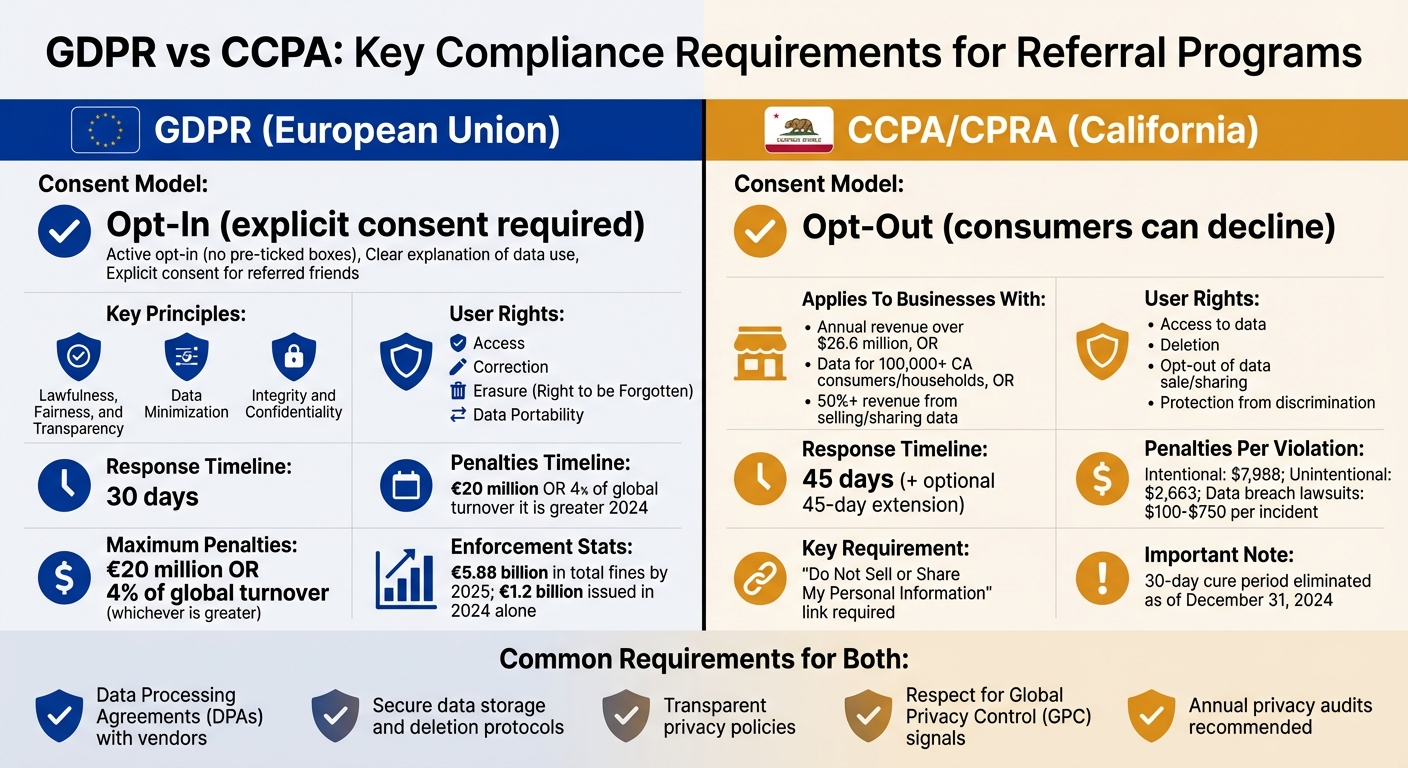
GDPR vs CCPA Compliance Requirements for Referral Programs
When designing a referral program, understanding the regulatory landscape is essential. GDPR operates on an opt-in model, requiring explicit consent, while CCPA adopts an opt-out approach. These differences have a direct impact on how businesses must handle data within their programs.
GDPR Compliance Requirements
The GDPR framework is built on seven principles, including Lawfulness, Fairness, and Transparency, Data Minimization, and Integrity and Confidentiality. To comply, businesses need to secure explicit consent from participants before they join a referral program. Pre-ticked boxes? Not allowed. Users must actively opt in, and you must clearly explain how their data will be used. For referred friends, the rules are even stricter. Sending unsolicited emails to individuals who haven’t opted in violates GDPR. A safer route is referrer-driven sharing - where the referrer sends invites directly through email or social media, and your company collects the friend’s data only after they voluntarily sign up.
Data minimization is another key principle. Only collect what’s absolutely necessary - often just an email address for tracking purposes. Gathering extra details like phone numbers or home addresses, unless essential for fulfilling rewards, can unnecessarily increase your exposure. If you need to track referrals before they sign up, consider using pseudonymization, such as hashing email addresses. This allows you to attribute rewards later without storing identifiable data.
GDPR also grants individuals rights over their data, such as access, correction, erasure (the "Right to be Forgotten"), and data portability. These requests must be fulfilled within 30 days, even if the individual hasn’t become a customer. Failing to comply can result in fines as high as €20 million or 4% of global turnover, whichever is greater. By 2025, GDPR enforcement fines had reached €5.88 billion, with €1.2 billion issued in 2024 alone.
Meanwhile, CCPA introduces its own set of rules, focusing on an opt-out model.
CCPA Compliance Requirements
The CCPA (and its updated version, the CPRA) applies to for-profit businesses meeting certain thresholds, such as annual revenue over $26.6 million, handling data for 100,000+ California consumers or households, or earning 50% or more of revenue from selling or sharing personal data.
Under CCPA, personal information is broadly defined, encompassing identifiers (like names and emails), commercial data (such as purchase history), and online activity (including browsing history). If your referral program uses tools like Facebook Pixel or Google Ads to track referrals, you may be "sharing" data for behavioral advertising, which triggers additional compliance obligations.
California residents have rights including access to their data, deletion, opting out of data sale or sharing, and protection from discriminatory treatment when exercising these rights. To comply, businesses must prominently display a "Do Not Sell or Share My Personal Information" link on their homepage and privacy policy. As of 2025, systems must also honor Global Privacy Control signals sent from browsers, or face penalties.
Consumer requests must be addressed within 45 days, with an optional 45-day extension if the individual is notified. Penalties for non-compliance are steep: intentional violations can cost up to $7,988 per consumer, while unintentional violations are capped at $2,663. The California Privacy Protection Agency has also eliminated the 30-day "cure period" as of December 31, 2024, meaning penalties now apply immediately. In data breach cases, consumers can sue for $100 to $750 per incident or actual damages, whichever is higher.
If you rely on third-party platforms for managing your referral program, written contracts are a must. These agreements should explicitly prohibit vendors from selling or misusing the data for purposes outside the agreed services. Without such safeguards, you could face compliance risks that are out of your control.
How to Achieve Compliance in Referral Programs
Meeting regulatory requirements in referral programs involves more than just ticking boxes - it demands real changes in both your systems and your operations. These measures not only help you stay within the law but also build trust with users, which can positively impact your program's success.
Setting Up Consent Mechanisms
Start with clear and explicit opt-in mechanisms. For example, avoid using pre-ticked boxes, as these violate GDPR. Provide users with transparent information about what data you're collecting, how you plan to use it, and who it will be shared with.
When it comes to referred friends, prioritize their privacy. A good practice is using a referrer-driven method, such as "MailTo" buttons, where email addresses are only collected after the referred friend voluntarily signs up. If you need to collect emails directly, always use a double opt-in process to ensure consent.
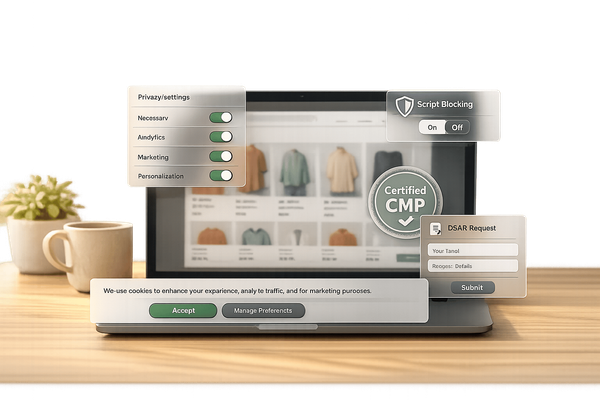
A Consent Management Platform (CMP) can help you manage permissions effectively. It should block tracking pixels and analytics scripts until users explicitly agree. Additionally, every referral email must include a clear "unsubscribe" option, while account settings should allow users to withdraw consent easily.
Finally, make sure to document how data flows through your system to reduce risks and ensure compliance.
Data Mapping and Privacy Controls
Create an inventory of all the data you collect - this might include IP addresses, browser fingerprints, email addresses, and purchase histories. Then, map out how this data moves through your system, including any third-party integrations.
Practice strict data minimization. For instance, if you only need an email address to track referrals, don’t collect unnecessary details. When tracking referrals before a friend signs up, consider hashing email addresses. This approach anonymizes the data while still allowing you to match referrals and rewards later.
Limit the data you store to what’s absolutely necessary, and mask sensitive participant information in public-facing areas. Implement automated workflows to delete inactive marketing data after 12–24 months and analytics data after 26–38 months.
These steps not only help you comply with regulations but also show your customers that their data is handled responsibly.
Vendor Agreements and Employee Training
Compliance doesn’t stop with your internal processes - it extends to your vendors and your team.
For every third-party tool you use, secure a signed Data Processing Agreement (DPA). These agreements should outline data retention policies, security requirements, and prohibit vendors from selling or repurposing your data. If your platform relies on sub-processors like AWS, make sure to document those relationships too.
Set up a secure channel for Data Subject Access Requests (DSARs), such as an online form or a toll-free number. Build internal workflows to ensure you can meet the 45-day response deadline required under CCPA/CPRA. Regularly conduct "mock DSAR drills" to identify and fix any gaps in your process before handling real requests.
Train your marketing, customer service, and IT teams annually on privacy principles. This training should cover consent requirements, DSAR handling, and opt-out request processing. Mistakes by untrained staff can lead to costly penalties - $2,664 per unintentional incident or $7,988 per intentional violation under California's inflation-adjusted penalties for 2025. With privacy laws now enforced in 20 U.S. states, covering roughly 150 million Americans, staying ahead of compliance is more important than ever.
Using StoreCensus for Compliance Monitoring
Managing privacy risks in referral programs can be tricky, especially when dealing with ecommerce stores. To stay on top of things, you need tools that provide clear oversight into how these stores handle data and the technologies they use. That’s where StoreCensus comes in, offering solutions to simplify compliance monitoring.
Tracking Ecommerce Store Data Securely
StoreCensus helps you monitor referral partner activity by providing access to publicly available Shopify store data, such as store names, URLs, categories, and public email addresses. With a database covering over 2.5 million ecommerce stores and boasting a 99.2% data accuracy rate, the platform performs weekly crawls on more than 2 million stores. This allows it to detect updates like changes to a partner's technology stack or the removal of privacy tools.
Additionally, StoreCensus supports compliance efforts with resources like a dedicated "Do Not Sell My Personal Information" page and a data removal tool available at storecensus.com/remove-info.
"Lead Data provided by StoreCensus is gathered from publicly accessible sources and reputable third-party aggregators." – StoreCensus Privacy Policy
Custom Workflows for Privacy Compliance
StoreCensus offers API access and automation tools that let you build custom privacy workflows. For instance, you can create automations to trigger whenever a store’s data changes - like when it moves into a higher revenue category that might require stricter compliance measures.
By integrating StoreCensus with platforms like Zapier, you can automate tasks such as flagging stores in your CRM that fail to meet specific compliance or accessibility standards. These workflows not only cut down on manual monitoring but also ensure your referral network stays aligned with current privacy regulations.
Real-Time Monitoring for Compliance Risks
With StoreCensus, you can receive real-time alerts whenever a store's data meets certain criteria, such as adding or removing specific technologies or making compliance-related changes. The platform also keeps historical snapshots and detailed change histories, enabling you to analyze trends and conduct thorough audits over time.
StoreCensus tracks over 8,300 apps and 1,000 technologies, offering insights into geographic data that help determine which privacy laws - such as GDPR or CCPA - apply to stores in your network. This level of monitoring ensures you’re always equipped to manage compliance risks effectively.
Conclusion
Key Takeaways
Running a compliant referral program means focusing on clear consent processes, secure data management, and well-structured vendor agreements. For example, GDPR requires businesses to gather explicit opt-in consent, while CCPA takes an opt-out approach, giving consumers more control over their personal data. Both regulations require businesses to respond promptly to Data Subject Access Requests (DSARs), allowing individuals to access, correct, or delete their information.
Non-compliance comes with steep consequences. Starting December 31, 2024, California removed its 30-day "cure period", meaning violations now lead to immediate penalties without any grace period.
To stay compliant, businesses should adopt a Consent Management Platform (CMP) to automate consent collection and respect Global Privacy Control (GPC) signals. Additionally, updating vendor agreements with Data Processing Agreements (DPAs), reducing unnecessary data storage, and conducting annual privacy audits are essential steps. These practices lay the groundwork for a legally compliant referral program.
As regulations evolve, businesses that prioritize these compliance measures will be better equipped to navigate the changing landscape.
The Future of Privacy in Referral Programs
Privacy laws are becoming stricter, and the trend shows no signs of slowing down. By 2025, 20 U.S. states will have enacted comprehensive privacy laws, impacting nearly 150 million Americans - about 43% of the population. Starting January 1, 2026, new laws in Indiana, Kentucky, and Rhode Island will take effect, alongside updated CCPA/CPRA regulations that mandate annual cybersecurity audits and risk assessments, particularly for automated decision-making technologies.
The push for stronger privacy protections is clear. Regulators are eliminating grace periods, tightening enforcement, and extending greater protections to minors. For instance, Maryland’s 2025 law bans targeted advertising to individuals under 18 and prohibits the sale of sensitive personal data entirely. Businesses that treat privacy compliance as an ongoing process, rather than a one-time task, will be better positioned to adapt. Tools like StoreCensus can aid in this effort by providing real-time monitoring and compliance tracking across ecommerce platforms.
"GDPR isn't something of which to be afraid. Personally, I see it as a change that, most likely, will improve growth strategies for the better... because of one factor it brings forth – greater trust".
FAQs
Can I email referred friends before they opt in?
No, reaching out to referred friends via email before they explicitly opt in could breach data privacy laws such as GDPR (General Data Protection Regulation) and CCPA (California Consumer Privacy Act). These laws mandate obtaining clear and explicit consent before collecting or using someone's personal data. To remain compliant, always ensure referred friends have given their permission before you contact them.
Do referral rewards count as “selling” data under CCPA?
Referral rewards are generally not considered "selling" data under the CCPA. However, any personal information collected or shared during the referral process must align with privacy laws like the GDPR and CCPA. Proper data handling is crucial to staying within legal boundaries and avoiding compliance issues.
How should I handle data deletion requests for non-customers?
To align with GDPR and CCPA, it’s crucial to establish a straightforward process for managing data deletion requests, even from individuals who aren’t customers. Start by verifying the identity of the person making the request using details like their email address or IP address. Once confirmed, either delete or anonymize their personal data.
Make sure your policies specifically address how deletion requests are handled. Train your team to respond quickly and appropriately, ensuring they understand the importance of compliance. Lastly, document every step taken during the process. This record will be invaluable if you ever face an audit, as it shows your commitment to adhering to these regulations.