How CRM Sync Improves Lead Generation
Real-time CRM sync automates data updates, reduces errors, speeds follow-ups, and boosts lead quality and conversions for streamlined sales pipelines.


CRM sync transforms lead generation by automating data flows, reducing errors, and keeping your sales pipeline accurate and efficient.
Here’s why it matters:
- Outdated data is costly: 70% of CRM data becomes obsolete yearly, leading to wasted time and missed opportunities.
- Manual entry is inefficient: Sales reps spend 21% of their time on data tasks, costing businesses billions annually.
- Slow follow-ups hurt conversions: Responding within 5 minutes increases lead qualification rates by 21x.
With real-time CRM sync, your system updates automatically, ensuring clean, reliable data. This streamlines workflows, improves team coordination, and helps prioritize high-quality leads. Companies using synced CRMs see up to 29% higher sales productivity and 20% better lead conversion rates.
Key benefits of CRM sync include:
- Instant lead updates and enrichment for better targeting.
- Faster lead routing and follow-ups, reducing response times.
- Automated data cleaning to eliminate duplicates and errors.
- Real-time behavioral scoring to focus on leads most likely to convert.
Switching to a synced CRM eliminates manual errors, aligns sales and marketing teams, and accelerates your sales cycle.
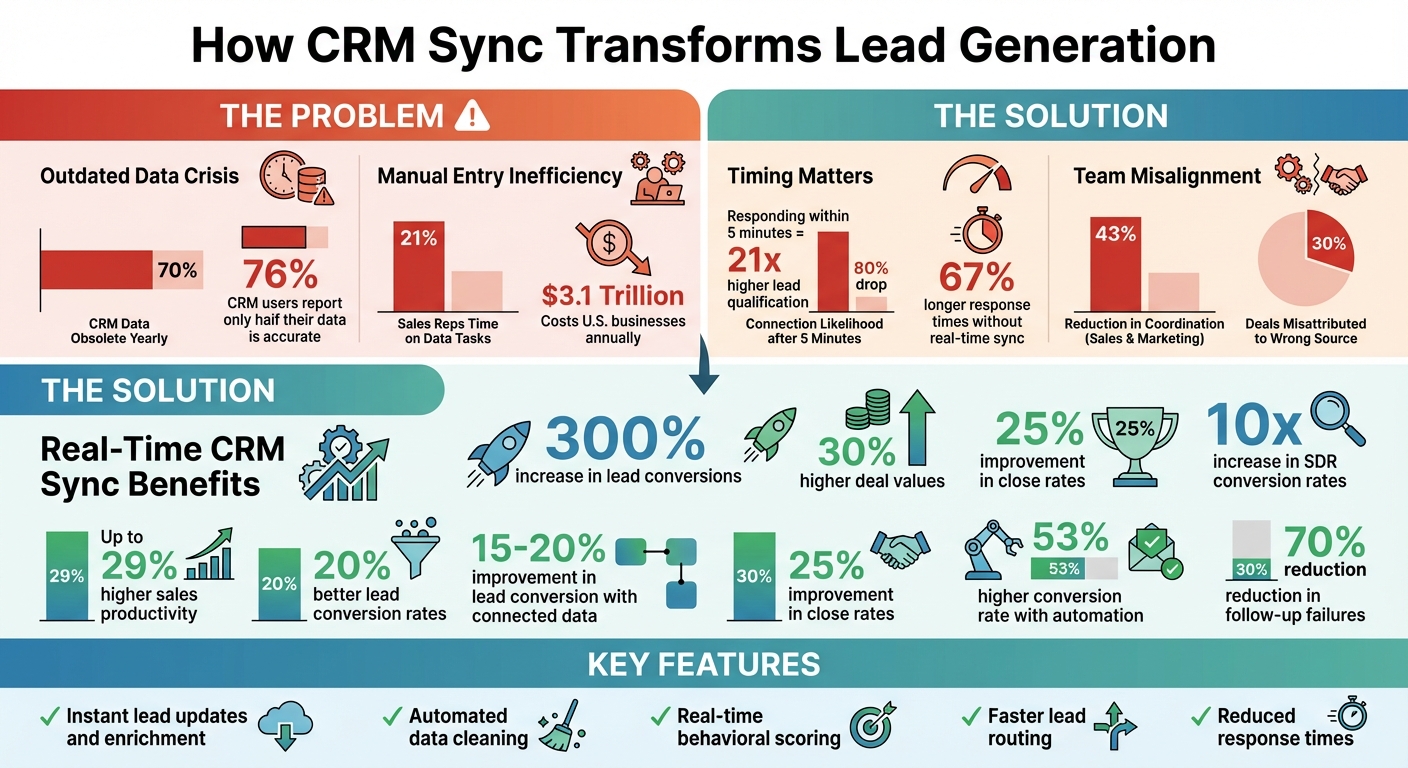
CRM Sync Impact on Lead Generation: Key Statistics and Benefits
Lead Generation and CRM Integrations & Automations | Salesforce, Hubspot, Zoho, and more
Lead Generation Problems in Ecommerce
Ecommerce teams often struggle with outdated information, inefficient processes, and poor coordination between departments when their CRM systems lack real-time synchronization. These challenges can significantly hinder lead generation efforts.
Stale Data
When your CRM doesn’t sync in real time, customer data becomes unreliable shockingly fast - 70% of it can be outdated within just one year. People switch jobs, companies merge or dissolve, and contact details expire. This leaves your sales team wasting valuable time chasing leads that no longer exist. In fact, 76% of CRM users report that only about half of their organization’s data is accurate and complete. This creates "ghost opportunities" - duplicate records and outdated contacts that inflate your pipeline and make accurate revenue forecasting nearly impossible. And when sales reps lose faith in the data, many stop using the CRM entirely, leading to fragmented information silos across the company.
Errors from Manual Data Entry
Manual data entry is not only time-consuming but also riddled with errors that can derail deals. Sales teams lose 21% of their time to manually entering and cleaning up data. Mistakes like duplicate records, typos in company names, and inconsistent formatting can corrupt your database, costing U.S. businesses a staggering $3.1 trillion annually. Worse yet, when platforms aren’t aligned, large portions of qualified leads may never even reach your sales team. This misalignment can result in millions of dollars in missed opportunities and stalled lead scoring.
These errors don’t just disrupt data quality - they also slow down your ability to engage with leads effectively.
Slow Follow-Ups and Misaligned Teams
Timing is everything when it comes to engaging leads. Responding to a lead within five minutes makes your team 21 times more likely to qualify that lead compared to waiting 30 minutes. Miss that critical window, and your chances of connecting drop by 80%. Without real-time CRM sync, data mismatches between platforms lead to 67% longer response times, giving competitors the edge to engage your prospects first.
On top of that, disconnected systems create conflicting data, reducing coordination between sales and marketing teams by 43%. This lack of alignment causes 30% of deals to be misattributed to the wrong source, further complicating your pipeline.
According to Lusha RevOps Blog, "When reps don't trust the data, they stop using it - or worse, they build shadow spreadsheets".
| Problem | Impact on Lead Generation |
|---|---|
| Stale Data | 70% of data becomes outdated yearly; damages credibility |
| Manual Entry | 21% of sales time wasted; $3.1 trillion annual cost |
| Slow Follow-Ups | 80% drop in connection likelihood after 5 minutes |
| Team Misalignment | 43% coordination drop; 30% of deals misattributed |
Real-time CRM synchronization is the key to addressing these issues, paving the way for better lead quality and faster sales cycles.
How Real-Time CRM Sync Solves These Problems
Real-time CRM synchronization completely changes how lead generation works by automating the flow of data between systems. This eliminates the manual errors and delays that often come with traditional processes. Instead of waiting for batch uploads or relying on sales reps to manually transfer information, modern tools use webhooks and APIs to instantly capture, update, and enhance lead records as soon as an event occurs - like a form submission, an email open, or a status change. This automation ensures smoother coordination across all sales channels.
Automatic Data Updates and Two-Way Sync
When a new lead enters your system, webhooks trigger an enrichment process that pulls in verified contact details, job titles, and business information. This happens in seconds, so your sales team has a complete profile ready before they even reach out.
Two-way synchronization keeps everything aligned. For example, if a sales rep updates a lead's status in the CRM, that change is automatically reflected in your marketing automation platform and other tools. This approach eliminates the need for "shadow spreadsheets" and ensures that everyone is working with the same data.
A great example of this is Holmes Murphy, an insurance brokerage that used real-time CRM automation to analyze prospect behavior and improve their renewal process. By automatically flagging at-risk accounts and optimizing email timing, they saved around 44,000 hours and $6.9 million. Considering that sales reps typically spend only 30% of their time selling, with the rest consumed by admin tasks, this kind of efficiency can be a game-changer.
"A webhook is a simple trigger: when a specific event happens, it calls another system to update data automatically." – Lusha
Real-time sync also includes automated data cleaning. It removes duplicate records, validates emails, and even standardizes inconsistent formatting. AI tools can extract key details from vague job titles and summarize lead intent as data flows between systems. This ensures your team works with reliable, clean information from the start.
Better Sales and Marketing Coordination
Real-time sync creates a unified source of data, breaking down silos between teams. Whether it’s form submissions, website visits, or notes from past conversations, everyone has access to the same information. This is crucial because scattered data can force teams to waste up to 20% of their time searching for details instead of acting on them.
Automated lead routing ensures high-value prospects are assigned to the right reps based on factors like territory, product interest, or lead score. Integration with tools like Slack provides instant alerts, allowing reps to follow up while the lead is still engaged.
Behavioral lead scoring happens in real time. For instance, if a prospect opens an email, clicks a link, or visits your pricing page, that engagement updates their lead score immediately. This helps sales teams focus on "hot" leads rather than wasting time on cold ones. Companies using connected customer data often see a 15–20% improvement in lead conversion rates.
Additionally, two-way data flow prevents redundant outreach. If a sales rep marks a lead as "not interested" or "already a customer", that update is shared with marketing, avoiding duplicate communications. Nearly 40% of business leaders report that automation tied to integrated systems significantly reduces operational bottlenecks.
With everyone on the same page, real-time data seamlessly powers the entire sales process.
Integration with Sales Pipelines
Real-time updates and automated routing also enhance sales pipelines by ensuring immediate action. When live CRM data integrates with your workflows, actionable information reaches your team without delay. Unlike periodic batch uploads, real-time webhooks enrich and route inbound records before they even appear in a rep’s queue.
This integration also provides valuable context for outreach. Reps can see which marketing campaigns, social media ads (like those on Facebook, LinkedIn, or TikTok), or content pieces generated each lead. This makes conversations more personalized and relevant, steering away from generic pitches.
Companies that use CRM data effectively can boost sales by up to 29%. Moreover, 74% of salespeople agree that integrated CRM systems improve access to customer data. To make the most of this, configure your sync settings to avoid overwriting valuable manual notes. Instead, focus on filling blank fields or adding new details, so verified information entered by your team remains intact.
| Integration Method | Best For | Technical Skill Required |
|---|---|---|
| Embedded CRM Forms | Clean, perfectly mapped data directly into CRM fields | Low |
| Pre-built Plugins | Basic form-to-CRM synchronization | Low |
| No-Code Tools (Zapier/Make) | Multi-step logic and conditional workflows | Medium |
| Custom API Integration | Full customization and complex sales pipelines | High |
Benefits of CRM Sync for Lead Generation
Real-time CRM synchronization isn't just a convenience - it’s a game-changer for lead generation. By automating updates and streamlining workflows, it not only saves time but also boosts sales by up to 29% and increases lead conversions by an impressive 300%. Let’s dive into the key ways CRM sync transforms lead generation.
Better Lead Quality with Real-Time Scoring
Dynamic lead scoring takes the guesswork out of prioritizing prospects. Every action a prospect takes - whether it’s opening an email, attending a webinar, or downloading a case study - triggers an instant update to their score. This scoring system evaluates both fit (like company size, industry, or job title) and behavior (engagement levels or recent activity). For instance, if a prospect downloads a whitepaper, your sales team knows right away that they’re ready for outreach.
On top of that, real-time sync enriches the lead profile with essential details like phone numbers, social media profiles, and firmographic data, giving your team the context they need to make meaningful connections.
The results speak for themselves: companies with robust lead management tools report up to 30% higher deal values, and automated systems can improve close rates by 25%. Instead of wasting time on cold leads, your team can focus on prospects who are most likely to convert.
Faster Sales Cycles with Instant Alerts
In sales, timing is everything. Real-time CRM sync ensures leads don’t sit idle in a queue. Top-performing teams enrich inbound leads in under a minute, and automated workflows assign qualified leads to the right rep instantly. Notifications via tools like Slack or email ensure the rep is alerted while the prospect is still engaged.
"If a lead isn't followed up on within minutes, someone else will close it." – The Seller, Emerging CRM Trends 2025
This speed isn’t just about being quick - it’s about being strategic. By acting when interest is at its peak, sales development representatives (SDRs) see conversion rates increase by 10X. Real-time sync empowers your team to strike while the iron is hot, turning interest into action before it fades.
Fewer Lost Leads and Higher Conversion Rates
Lost leads can be a silent killer for sales teams, but real-time sync helps ensure no opportunity slips through the cracks. Automated processes capture, enrich, and route every prospect.
One of the unsung heroes of this system is automated data hygiene. It merges duplicate entries, validates email addresses, and standardizes formatting, so your team works with clean, reliable data. This reduces bounce rates and eliminates the need for those unofficial "shadow spreadsheets" that reps often create when they don’t trust the CRM.
Using CRM Sync with StoreCensus
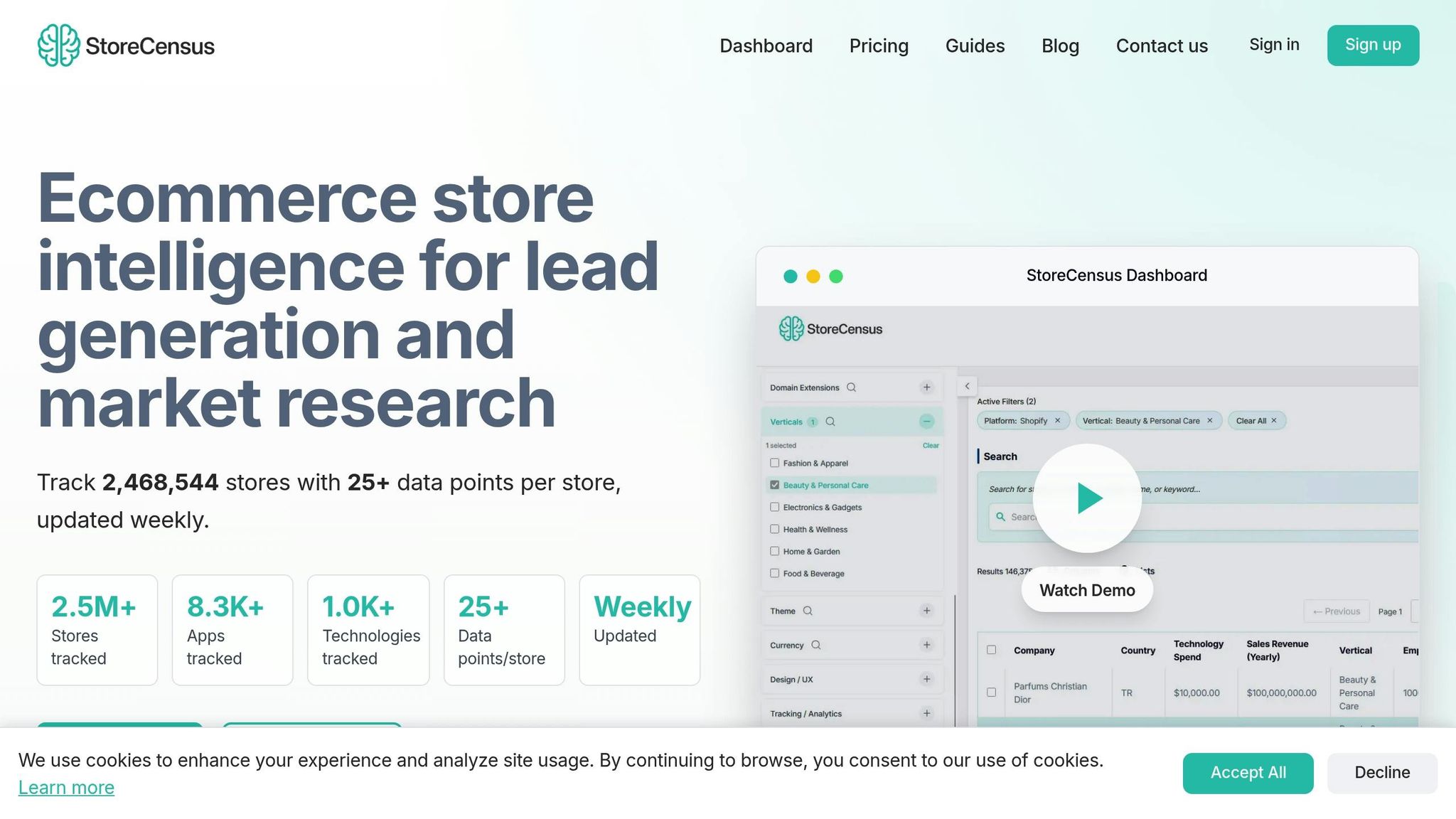
When it comes to ecommerce lead generation, StoreCensus takes CRM synchronization to the next level, offering tools designed to streamline and enhance your sales pipeline.
With StoreCensus, you get real-time CRM updates powered by data from over 2.5 million ecommerce stores, enriched with more than 25 live data points. Forget outdated spreadsheets and static databases - this platform keeps your CRM current with actionable insights like tech stacks, revenue estimates, traffic trends, and product counts.
It integrates effortlessly with your existing tools, allowing your team to manage leads directly. Features like a 1-5 star rating system, status tracking, and automated reminders reduce follow-up failures by 70%. Plus, with a verified 99.2% data accuracy rate for Shopify store data, your team can trust the information they’re using.
Here’s how StoreCensus transforms lead generation into a more efficient and insightful process.
Real-Time Store Monitoring and Data Enrichment
StoreCensus doesn’t just collect data - it continuously monitors ecommerce stores and updates your CRM with the latest insights. Whether a store installs a new app, updates its tech stack, or shows signs of growth, your pipeline reflects these changes instantly. This means your outreach becomes more targeted. For example, instead of sending generic pitches, you can offer tailored solutions, like recommending Klaviyo to a store already running Meta Pixel ads.
The platform automates enrichment across all 25+ data points, including store age, traffic patterns, and product catalog size. For agencies and SaaS founders, this eliminates the need for manual research. And with one-click integration with Apollo, you can further enrich your contacts by accessing decision-maker emails and LinkedIn profiles - keeping everything within your workflow.
Automation Workflows and CRM Integration
StoreCensus pairs real-time updates with automation to keep your leads engaged and your CRM organized.
Automation turns static data into dynamic systems. For instance, trigger-based reminders - like for "Contract Lock-In" or "Product Launch" events - ensure timely follow-ups. These reminders appear as email notifications and in a "Reminders Due" filter, so opportunities never slip through the cracks.
Given that 60% of ecommerce prospects won’t be ready to buy for 3–12 months, long-term tracking is essential. StoreCensus helps you maintain a compounding pipeline by keeping qualified leads in play. Its status management system ensures your team always knows where each lead stands, making it easier to guide prospects through the sales funnel.
Targeted Lead Filtering with Advanced Segmentation
StoreCensus’s advanced filters let you zero in on high-value leads. For example, you can identify "Shopify stores generating $1M–$5M annually that use ReCharge but not Klaviyo". This level of precision turns cold outreach into meaningful conversations about specific challenges you can solve.
The platform’s 1-5 star rating system helps you prioritize your efforts. By focusing 60% of your time on 5-star leads - those with the right budget, needs, timing, and decision-maker access - you can achieve close rates of 40–60% with your top prospects. Combined with insights into tech stack gaps and growth signals, StoreCensus ensures you’re not just finding leads but connecting with the right ones at the right time.
How CRM Sync Improves Ecommerce Sales Pipelines
A synced CRM doesn’t just organize leads - it transforms how sales pipelines function. By introducing a "compounding pipeline", synced systems allow leads to generate value over an extended period, typically 3–12 months. This approach ensures high-potential leads aren't lost in the shuffle, a common issue with traditional methods that reset pipelines monthly. With dynamic updates, sales teams can focus on smarter outbound actions and more tailored engagement strategies.
Increasing Outbound Efficiency
Real-time CRM syncing is a game-changer for outbound efforts. For example, it can trigger personalized outreach when a Shopify store installs ReCharge or crosses $1 million in revenue, cutting down on the 64% of time wasted on manual tasks. Instead of working with outdated lists, outbound teams can act on live ecommerce signals.
Take Sarah, a former email marketer, who scaled her agency to $84,000 in monthly recurring revenue in just one year. How? By targeting Shopify subscription beauty brands generating $1–5 million annually that used ReCharge but not Klaviyo. She used CRM tools to set reminders for deals 3–6 months ahead, like noting when a Klaviyo contract was set to expire in March. This allowed her to capture opportunities through timely, trigger-based outreach.
While automation increases efficiency, the real power lies in refined data, ensuring every outreach effort is sharply focused and impactful.
Enabling Data-Driven Personalization
A synced CRM doesn’t just store data - it enriches it, enabling hyper-targeted messaging. For instance, if the CRM shows a prospect is running Meta Pixel ads but hasn’t adopted Klaviyo, outreach can immediately highlight that email automation gap. Why does this matter? Personalized subject lines can double reply rates, jumping from 3% to 7%.
Even more impressive, predictive models built on enriched data can boost qualified lead conversion rates by 32% and cut average conversion times by 125%. The secret is mapping CRM fields to messaging cues. For example, CFOs can automatically receive ROI-focused content, while operations managers are directed to workflows that emphasize efficiency.
Scaling Revenue Growth
By reducing manual tasks, CRM sync makes scaling easier. Companies using marketing automation tools report a 53% higher conversion rate. Automation takes care of repetitive follow-ups, freeing sales teams to focus on closing deals.
Consider Marcus, who runs a Meta ads agency for direct-to-consumer apparel brands. He grew his business to $95,000 in monthly recurring revenue by leveraging CRM status tracking for 2–4-month sales cycles. His system prioritized prospects based on ad spend and set automated reminders for budget refresh cycles. This turned one-time efforts into a sustainable, growing pipeline.
"The best prospecting system isn't about finding more leads. It's about losing fewer of the ones you already found."
With CRM data driving the process, companies can achieve up to a 29% increase in sales. The key lies in discipline: focusing on top-priority leads, automating where possible, and maintaining data accuracy. Tools like StoreCensus ensure your team always works with reliable, actionable insights, making every step of the sales pipeline more effective.
Conclusion
Real-time CRM synchronization solves common challenges like outdated data, manual entry mistakes, and delayed follow-ups. By offering a unified view of prospects and cutting down the 21% of time sales teams spend on cleaning up data, synced systems empower your team to focus on what matters most - closing deals. This integration streamlines workflows and creates a more efficient, productive sales process.
The impact of effective CRM synchronization is clear: it can drive sales increases of up to 29% and help avoid an estimated $3.1 trillion in lost opportunities. Considering that 70% of data becomes outdated within a year, and quick responses can improve lead qualification rates by 21 times, real-time synchronization is no longer a luxury - it’s a necessity.
"The best prospecting system isn't about finding more leads. It's about losing fewer of the ones you already found." – StoreCensus
StoreCensus addresses this challenge head-on by ensuring every lead is nurtured. It prevents the "leaky bucket" problem, where up to 95% of leads disappear after the first interaction, and helps build a stronger, more sustainable pipeline over a 3–12 month period.
FAQs
How does real-time CRM sync boost lead conversion rates?
Real-time CRM synchronization can significantly improve lead conversion rates by ensuring your sales team always has the most accurate, up-to-date information at their fingertips. With live syncing, key details - like recent interactions, updated contact info, or new decision-makers - are instantly accessible. This means your team can act quickly, adjust their approach, and deliver more personalized outreach. The result? Fewer delays caused by outdated data and a better chance of turning leads into loyal customers.
It also simplifies lead qualification and prioritization. With automatic updates and enriched data, your team can quickly spot high-value prospects and focus their efforts where it matters most. This reduces manual tasks, cuts down on errors, and ensures follow-ups are timely and tailored to each lead's needs. The entire sales process becomes more efficient, paving the way for stronger conversion rates.
What challenges arise from using outdated CRM data?
Outdated CRM data can seriously hinder your business operations. When your information is incorrect or incomplete, you risk missing out on valuable opportunities. It becomes much harder to identify and connect with potential leads, which can directly impact your ability to grow. Plus, inaccurate data often leads to flawed sales forecasts, making it tough to set realistic goals or plan effectively.
On top of that, relying on outdated data can drain your time and resources. Sales and marketing teams might chase leads that are no longer relevant or base their strategies on unreliable information. This not only creates inefficiencies but also affects the quality of decision-making and overall performance. Keeping your CRM data current isn’t just a best practice - it’s a necessity for staying competitive and making smarter business moves.
How does CRM synchronization improve collaboration between sales and marketing teams?
CRM synchronization bridges the gap between sales and marketing by keeping everyone on the same page with accurate, up-to-date information. Real-time syncing takes manual data entry out of the equation, cutting down on errors and freeing up time for more strategic work.
When CRM data is synchronized, both teams can effortlessly follow a lead's journey - from the first interaction all the way to conversion. This shared access encourages better teamwork, enabling personalized outreach, more focused campaigns, and timely follow-ups. The result? Smoother lead management, improved efficiency, and higher conversion rates.