Top Shopify Apps for GDPR and CCPA Compliance
Compare top Shopify apps for GDPR and CCPA compliance, including cookie consent, script blocking, DSAR tools, and Google-certified CMP options.

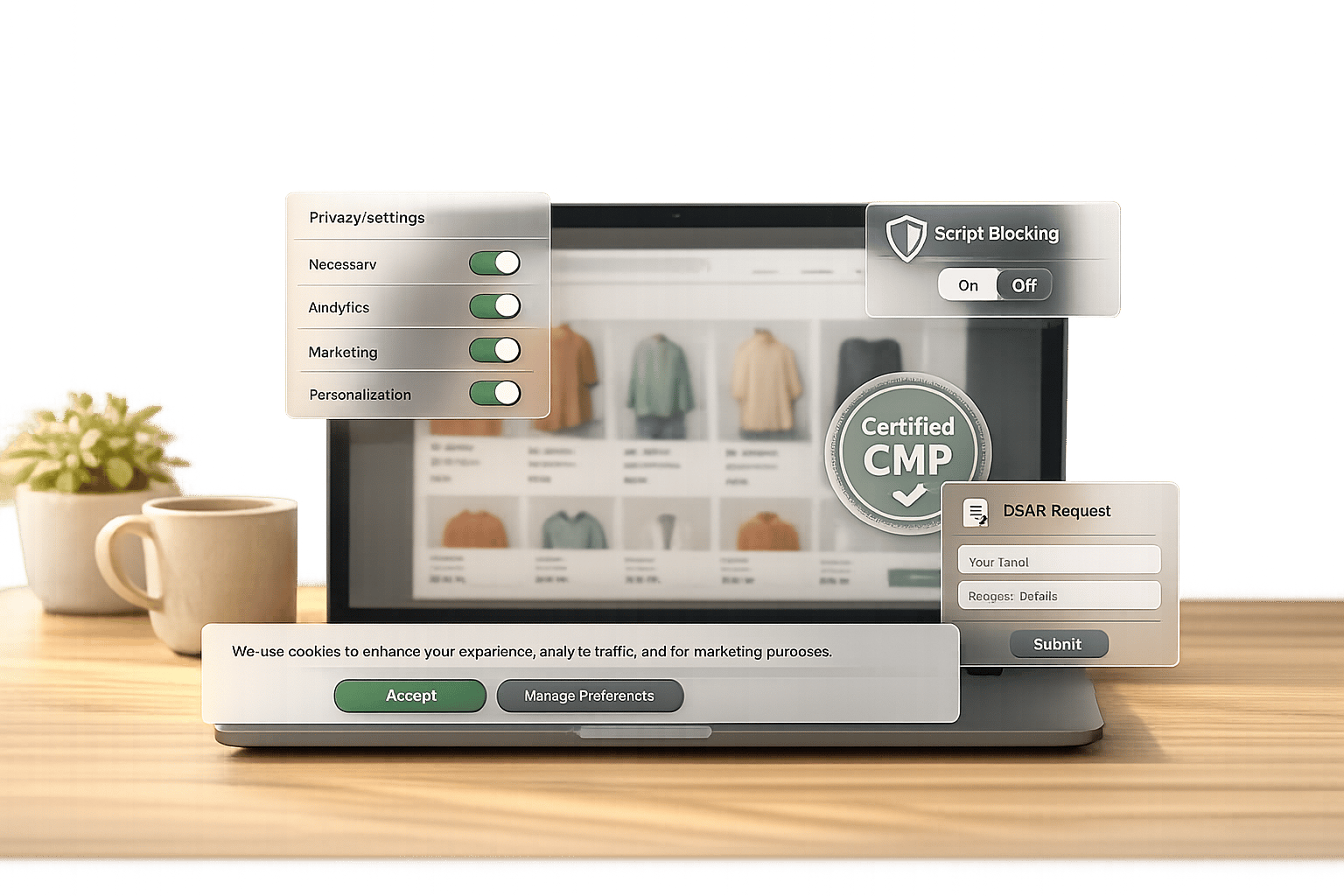
If you're running a Shopify store and serving customers in Europe or California, compliance with GDPR (General Data Protection Regulation) and CCPA (California Consumer Privacy Act) isn't optional - it’s a legal requirement. These regulations mandate cookie consent, data access requests, and opt-out options to protect customer privacy. Non-compliance can lead to fines as high as €20 million or 4% of annual revenue.
The best way to handle these requirements? Use compliance apps. These tools simplify privacy management by automatically tailoring cookie banners, blocking tracking scripts until consent is given, and helping you manage customer data requests. Popular apps like Pandectes, Consentmo, and iubenda integrate with Shopify and advertising platforms to automate compliance tasks.
Key Features to Look For:
- Cookie Consent Management: Customizable banners for GDPR, CCPA, and other laws.
- Script Blocking: Prevents tools like Google Analytics or Meta Pixel from running without consent.
- Regional Targeting: Automatically adjusts banners based on visitor location.
- Data Subject Access Requests (DSAR): Enables customers to view, edit, or delete their data.
- Audit-Ready Logs: Stores proof of consent securely for compliance checks.
Top Picks:
- Pandectes GDPR Compliance: Advanced script blocking, geolocation, and Google-certified.
- Consentmo GDPR Compliance: Combines privacy tools with accessibility features.
- iubenda GDPR Compliance: Focuses on automated legal documentation.
- Shopify Customer Privacy (Native Tool): Basic, free option for minimal compliance needs.
Quick Comparison:
| Feature | Pandectes | Consentmo | iubenda | Shopify Privacy Tool |
|---|---|---|---|---|
| Script Blocking | Yes | Yes | Yes | Limited |
| Regional Targeting | Dynamic Geolocation | Auto-detects Location | Yes | Basic |
| Consent Logs | Detailed | Detailed | Stored in EU | Minimal |
| Integrations | Google, Meta, TikTok | Google, Pixels | Google, Shopify API | Shopify API Only |
| Pricing (Paid Plans) | From $9/month | From $9/month | From $2.99/month | Free |
Choosing the right app depends on your store's size and needs. Free plans work for small stores, but larger businesses may require advanced features like IAB certification or headless store support. Compliance apps not only protect you from fines but also build trust with your customers by respecting their privacy.
Consentmo Feature Recap: Smart Search, Consent Timestamp & More | GDPR Compliance for Shopify
Key Features to Look for in Compliance Apps
When choosing a compliance app for your Shopify store, start with cookie consent management. A good app should allow visitors to customize their preferences for different cookie categories - like marketing, analytics, or functional cookies - rather than forcing them into an all-or-nothing decision. This flexibility ensures compliance while respecting user choices.
Another critical feature is auto-blocking. This ensures that third-party scripts (like Meta Pixel, TikTok Pixel, or Google Analytics) only activate after a user gives consent by clicking "Accept." Without this, a banner might appear, but cookies could still load in the background, defeating the purpose of compliance.
Regional targeting is also key. The app should detect the visitor's location and display the appropriate consent banner based on local laws, whether it's GDPR for the EU, CCPA/CPRA for California, LGPD for Brazil, or PIPEDA for Canada. This ensures that users see the correct options tailored to their region's legal framework.
A Data Subject Access Request (DSAR) portal is another must-have. This feature enables customers to manage their data independently, reducing privacy-related support requests by as much as 40%. Combine this with consent logging and audit trails, which securely store proof of consent (including details like timestamps and IP addresses) to ensure you’re prepared for compliance checks. As CookieFirst highlights:
"Your proof of consent of your webshop visitors is safely stored in European Datacenters"
Finally, look for integration support. The app should work seamlessly with tools like Google Consent Mode v2 (GCM v2), the IAB Transparency and Consent Framework (TCF v2.2 or v3), and Shopify's Customer Privacy API. These integrations ensure that consent signals are properly communicated to analytics and advertising platforms, so data is only collected when authorized. Additionally, automated cookie scanning should run regularly (at least every 30 days) to identify and categorize new trackers from theme updates or app installations.
| Feature Category | What to Look For |
|---|---|
| Consent Display | Customizable banners, preference selectors, mobile-friendly design, and "Do Not Sell" links for CCPA |
| Data Rights | DSAR portals, tools for data deletion/export, and automated admin email alerts |
| Automation | AI-powered cookie scanners, scheduled compliance reports, and auto-blocking for third-party scripts |
| Legal Standards | Compatibility with Google Consent Mode v2, IAB TCF v3, and Shopify's Customer Privacy API |
| Global Reach | Geolocation targeting, language detection, and support for multiple regulations like GDPR, CCPA, and LGPD |
These features set the stage for finding a compliance app that meets your needs while keeping your store legally compliant.
Best Shopify Apps for GDPR and CCPA Compliance
Here’s a closer look at some Shopify apps that help with GDPR and CCPA compliance while keeping your store running smoothly.
Pandectes GDPR Compliance
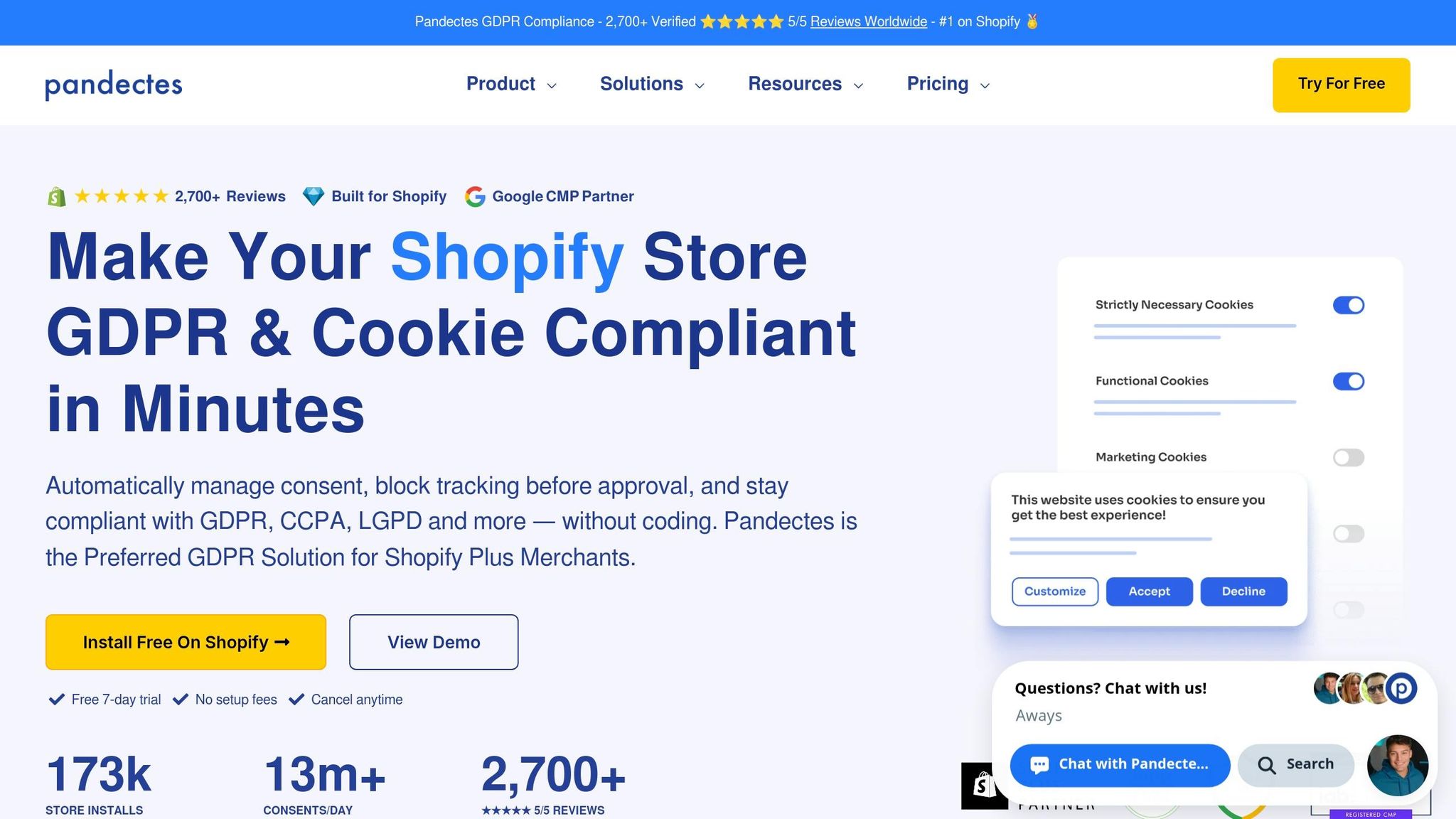
Pandectes is a trusted solution for GDPR, CCPA, and LGPD compliance, used by over 173,000 Shopify stores worldwide and handling 13 million consent requests daily. One standout feature is its AI-powered script auto-blocker, which prevents tools like Meta Pixel and TikTok Pixel from running until visitors provide consent.
The app is Google-certified and supports Google Consent Mode v2, IAB TCF v2.3/v3, and Shopify’s Customer Privacy API. These features make it ideal for merchants running international ad campaigns, especially in regions like the EU or UK, where accurate consent signals are critical for ad performance. Additionally, Pandectes supports headless stores, working seamlessly with Shopify's Hydrogen framework.
Pricing starts with a free plan that includes unlimited banner impressions, geolocation, and data subject access request (DSAR) tools. The Plus plan ($9/month) adds Google Consent Mode v2 and AI cookie scanning. Premium ($25/month) unlocks auto-blocking and custom CSS, while Enterprise ($45/month) includes IAB TCF v2.3 certification and headless support. With over 2,720 reviews and a 5.0-star rating, users commend its detailed configuration options and responsive support team.
Best for: Shopify Plus merchants, headless stores, and businesses running international ad campaigns requiring IAB certification.
Consentmo GDPR Compliance
Consentmo offers a two-in-one solution, combining privacy compliance with an ADA/WCAG accessibility widget. This makes it a great choice for stores aiming to meet both privacy and accessibility requirements in a single app. Its AI-driven cookie scanning detects and categorizes trackers automatically, and banners adjust dynamically based on visitor location - showing GDPR options for EU customers, CCPA for Californians, and PIPEDA for Canadians.
The app also features a dedicated DSAR portal, allowing customers to manage their data independently. Consent logs with timestamps and IP addresses are stored, ensuring audit-ready proof of compliance.
Pricing is similar to Pandectes: a free plan with unlimited impressions, Standard ($9/month) for Google Consent Mode v2, Plus ($29/month) for the accessibility widget, and Enterprise ($44/month) for IAB TCF v2.3 and Shopify Plus checkout banners. With a 5.0-star rating from 1,771 reviews, users appreciate its ease of use and responsive development team.
Best for: Merchants needing both privacy and accessibility compliance or those seeking a streamlined setup with robust automation.
iubenda GDPR Compliance
iubenda specializes in automated legal documentation, generating privacy policies, cookie policies, and terms of service tailored to your store. These documents update automatically as regulations change, eliminating the need for manual adjustments.
The app also supports multi-language consent management, making it ideal for stores operating across different regions. It integrates with Google Consent Mode v2 and provides region-specific banners for GDPR, CCPA, and other frameworks.
Best for: Merchants focused on maintaining accurate legal documentation and operating in multiple regions.
Shopify Customer Privacy (Native Tool)
Shopify’s Customer Privacy tool offers a basic compliance solution, including cookie banners and a "Do Not Sell My Personal Information" page for CCPA. It integrates seamlessly with Shopify’s backend and marketing pixels, making it a no-cost option for stores with straightforward tracking needs.
However, the tool lacks advanced features like automatic script blocking, dynamic geolocation targeting, and audit-ready consent logs. As Alf Trevelyan, Content Specialist at Pandectes, notes:
"While suitable for small-scale operations, it lacks granular control and legal automation required for rigorous privacy audits."
For stores using tools like Google Analytics, Meta Pixel, or TikTok Pixel, pairing this tool with a third-party app is often necessary to ensure compliance.
Best for: Small businesses with minimal tracking or those testing compliance tools before committing to a paid app.
Comparison of GDPR and CCPA Compliance Apps
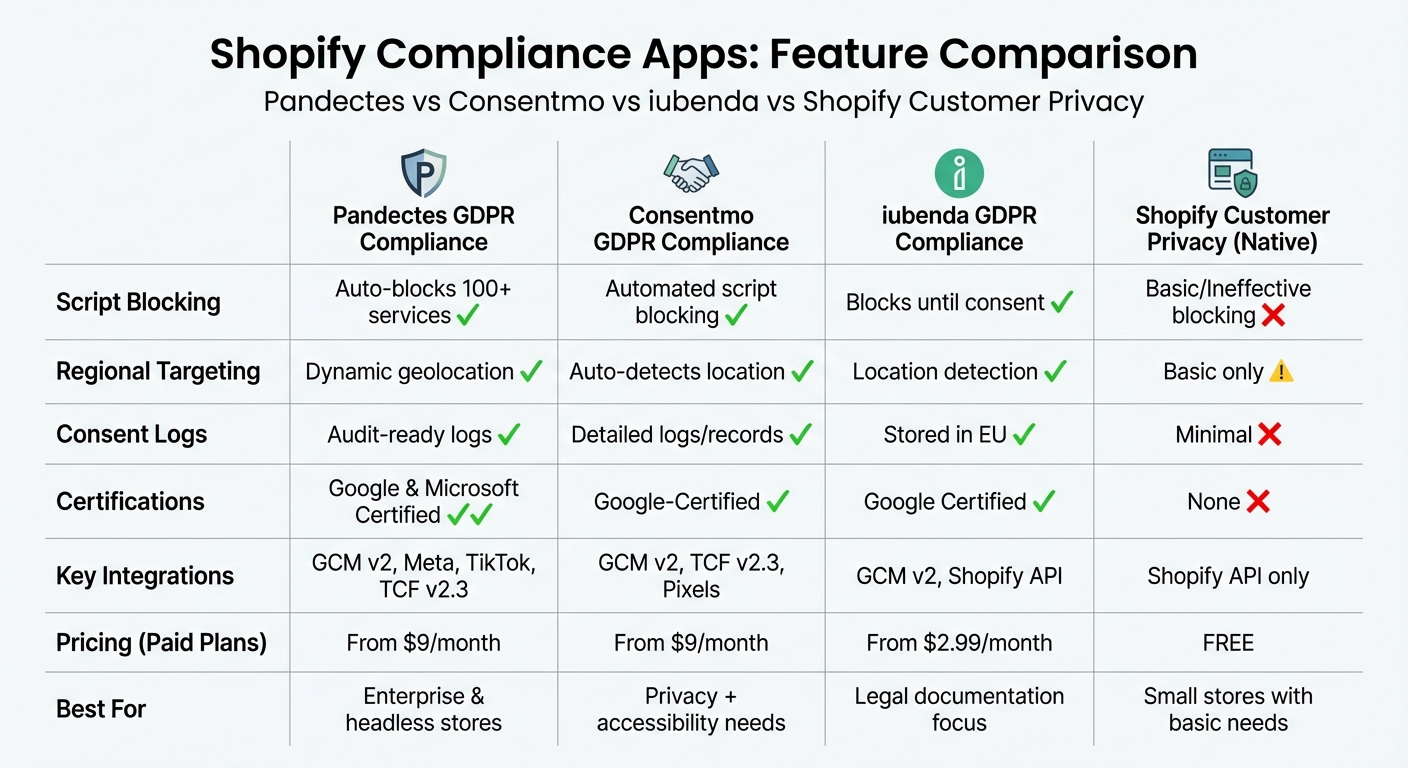
Shopify GDPR and CCPA Compliance Apps Feature Comparison
Comparison Table
When picking a compliance app, it's important to understand how each handles essential features like script blocking, regional targeting, and certifications. Here's a quick comparison of the four main options:
| Feature | Pandectes | Consentmo | iubenda | Shopify Customer Privacy |
|---|---|---|---|---|
| Script Blocking | Auto-blocks 100+ services | Automated script blocking | Blocks until consent | Basic/Ineffective blocking |
| Regional Targeting | Dynamic geolocation | Auto-detects location | Location detection | Basic |
| Consent Logs | Audit-ready logs | Detailed logs/records | Stored in EU | Minimal |
| Certifications | Google & Microsoft Certified | Google-Certified | Google Certified | None |
| Integrations | GCM v2, Meta, TikTok, TCF v2.3 | GCM v2, TCF v2.3, Pixels | GCM v2, Shopify API | Shopify API only |
| Pricing (Paid) | From $9/mo | From $9/mo | From $2.99/mo | Free |
This table outlines the main differences, which we'll break down further below.
Script blocking is a standout feature when comparing these apps. Pandectes leads the way, automatically blocking over 100 services. Consentmo and iubenda also offer automated blocking for major tracking tools. By contrast, Shopify's native tool struggles with basic blocking, allowing some cookies to load before the banner takes effect. This can create compliance gaps, especially for stores running paid ads in regions with strict regulations.
Certifications are another critical factor. To maintain access to advertising features like remarketing in the EEA and UK, Google and Microsoft now require publishers to use a certified Consent Management Platform (CMP). Pandectes, Consentmo, and iubenda meet this requirement, but Shopify's built-in tool does not. For stores relying on international ad campaigns, using a certified CMP is essential to prevent disruptions in ad performance.
Regional targeting also varies significantly. Both Pandectes and Consentmo feature dynamic geolocation to automatically display banners tailored to the visitor’s location. Shopify's tool, however, offers only basic settings, which may not be enough for businesses with a global audience.
Consent log management is equally important for compliance. Pandectes provides audit-ready logs, a key asset for data protection audits. Consentmo goes further, offering detailed records with timestamps and IP addresses. Shopify's native tool, on the other hand, provides only minimal legal proof. This could leave businesses vulnerable during regulatory investigations.
Choosing a compliance app that balances legal requirements with operational efficiency is crucial for keeping your store compliant without sacrificing performance. Each app has its strengths, but the right choice will depend on your specific needs and priorities.
How to Choose the Right Compliance App for Your Store
When selecting a compliance app, your store's size and traffic play a major role in determining the best fit. Here's how to navigate your options based on your store's needs.
For small stores and startups, free plans from apps like Pandectes or Consentmo are a great starting point. These plans often include unlimited banner impressions and basic geolocation features, making them ideal for stores just getting off the ground.
For growing stores with international traffic, you'll need more advanced tools. Look for apps that support Google Consent Mode v2 and automatically adjust banners based on visitor location. For instance, apps should display GDPR notices for EU visitors, CCPA alerts in California, LGPD warnings in Brazil, and PIPEDA information in Canada. These features are critical for staying compliant when advertising globally. Plans with these capabilities typically start at around $9 to $10 per month.
For high-traffic and enterprise-level stores, handling large volumes of visitors (500,000+ per month) requires solutions that prioritize performance and advanced compliance features. Apps like Pandectes offer custom plans for sites with over 2 million monthly visitors. They include tools like IAB TCF v2.3 certification, bot filtering to prevent fake consent logs, and support for headless architectures like Shopify Hydrogen. Expect to pay between $34 and $45 per month for these enterprise-level plans.
For Shopify Plus stores, it's essential to choose an app that supports Checkout Extensibility. This ensures that the consent banner is visible not only on the storefront but also during the checkout process, closing any compliance gaps in the customer journey. Be prepared to invest in higher-tier pricing plans, as this feature is often reserved for premium packages.
If your business relies heavily on advertising, make sure the app is a Google-certified CMP. Shopify Plus merchants should also confirm that the app maintains fast load times and offers 24/7 support. Many apps offer trial periods, which are a great way to test these features before committing. Keep in mind that non-compliance with regulations like GDPR can result in fines as high as €20 million or 4% of annual global turnover, making this decision not just about functionality but also about safeguarding your business.
Conclusion
Managing compliance is no small feat for Shopify stores navigating today’s diverse regulatory landscape. The right app can simplify this process by automatically tailoring cookie banners to your visitors’ regions, shielding your business from hefty fines.
But compliance isn't just about avoiding penalties - it’s also about protecting your advertising dollars. As Consentmo points out:
"Google and Meta now penalize ad accounts linked to non-compliant stores. Installing [a compliance app] first literally protects your ad spend".
Apps certified with Google Consent Mode v2 ensure your tracking pixels activate only after consent is granted. This not only prevents account suspensions but also eliminates wasted ad spending.
Choosing the right app depends on your store’s needs. Smaller stores can start with free plans from options like Pandectes or Consentmo. Larger stores, however, may need enterprise-level features such as IAB TCF v2.3 integration and bot filtering to handle higher traffic and broader international reach.
Compliance apps go beyond just displaying banners. They block scripts until consent is given, maintain audit-ready logs, and even automate DSAR (Data Subject Access Request) processes, enabling customers to manage their data without contacting support.
Before launching your first ad campaign, make sure to install a compliance app, enable automated cookie scans, and block third-party scripts until consent is obtained. These steps not only ensure you meet regulations but also give you a competitive edge by safeguarding both your customers and your business.
FAQs
Do I need GDPR and CCPA compliance if I’m based in the U.S.?
Yes, U.S. businesses are required to follow GDPR-like regulations if they process the personal data of individuals in the EU or in U.S. states with privacy laws such as the California Consumer Privacy Act (CCPA) or its amendment, the California Privacy Rights Act (CPRA). These laws enforce strict data protection rules, even for companies operating outside of their geographic boundaries.
Will a cookie banner alone make my Shopify store compliant?
A cookie banner plays an important role in managing customer consent, but it’s just one piece of the puzzle when it comes to meeting GDPR and CCPA requirements. True compliance also involves strong consent management systems, clear data handling policies, and ensuring accessibility standards are met. To stay compliant, make sure your store covers all these areas thoroughly.
Which compliance features matter most if I run paid ads?
When running paid ads, it's crucial to focus on compliance. This includes managing customer consent for cookies and tracking, being transparent about data collection practices, and adhering to regulations like GDPR and CCPA. To stay on top of these requirements, consider tools that provide features like customizable cookie banners and consent logs. These can help you manage compliance efficiently while maintaining trust with your audience.