Best Practices for Product Catalog Data Enrichment
High-quality, standardized product data—backed by AI, images, and reviews—turns catalogs into revenue-driving assets.


Product catalog data enrichment transforms basic product details into detailed, structured, and searchable assets that improve conversions, reduce returns, and enhance customer experiences. Complete product pages convert 2–3x better, while enriched data boosts search rankings, streamlines operations, and addresses common customer frustrations. Here's a quick summary of what works:
- Audit Your Catalog: Identify missing attributes, errors, and inconsistencies. Focus on high-revenue products and use tools like PIM systems to flag gaps.
- Standardize Data: Keep naming conventions, measurement units, and categories consistent for clarity and easy navigation.
- Add Details and Multimedia: Include all product attributes, high-quality images, and videos to reduce returns and increase sales.
- Leverage AI and Automation: Use AI tools for data cleaning, normalization, and enrichment to save time and improve accuracy.
- Optimize for Search and Sales: Craft keyword-rich product titles and benefit-driven descriptions that align with customer needs.
- Incorporate Reviews and UGC: Display customer reviews, ratings, and photos to build trust and drive purchasing decisions.
- Track Performance: Monitor metrics like conversion rates, click-through rates, and return rates to identify areas for improvement.
Enriched product data isn’t just about adding more information - it’s about making your catalog work harder for your business. By following these steps, you can improve search visibility, enhance the shopping experience, and drive measurable results.
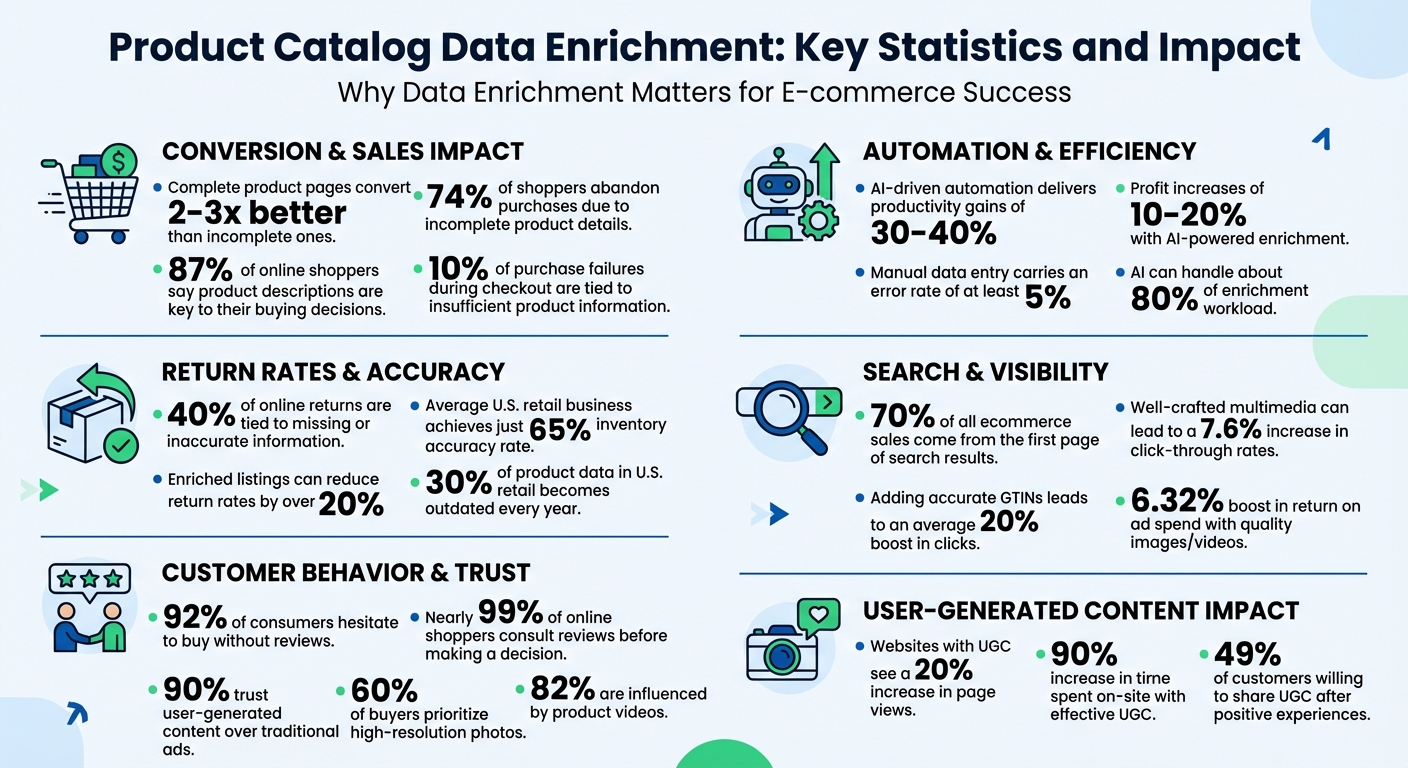
Product Catalog Data Enrichment: Key Statistics and Impact Metrics
Stop Wasting Time! Use AI to Enrich Your Product Data in PIM
Audit Your Current Product Catalog Data
A thorough audit is the first step toward improving your product catalog. Without one, it’s nearly impossible to identify the gaps and errors holding your data back. Here’s a startling statistic: around 30% of product data in U.S. retail becomes outdated every year, and inventory accuracy issues are a common problem for many businesses. That’s not just an operational hiccup - it’s a direct hit to revenue.
Start by zeroing in on missing attributes in your catalog. Focus on the products that matter most - typically the 20% that generate 80% of your revenue. Your Product Information Management (PIM) system can help here. Use it to assign "readiness" scores, flagging items that lack key details like dimensions, materials, or specifications. Don’t stop there - survey your customers and look at return data to uncover which missing details are causing frustrations. This process lays the groundwork for meaningful improvements.
Once you’ve identified what’s missing, turn your attention to errors and inconsistencies. Supplier feeds are often a mess, with variations like "Blue", "Blu", and "Navy" referring to the same color. Use negative filters to find products missing mandatory attributes, like "Material" or "Weight." Statistical audits can also help you catch outliers, such as a misplaced decimal in pricing. Keep in mind, manual errors and poor-quality data don’t just slow you down - they also cost you more in the long run.
To stay on top of your data, create an audit framework that checks for attribute completeness, media presence, SEO elements, and consistency. Schedule these audits at least once every quarter to ensure your data stays fresh and accurate, minimizing the risk of outdated information impacting your sales. Remember, the goal isn’t perfect data - it’s about knowing where to focus your enrichment efforts for the biggest payoff.
"Data enrichment isn't a luxury; it's the foundation of any successful marketing strategy. Whether you're a small team or a global powerhouse, the quality of your data will make or break your efforts."
- Terry Mitchell, Marketing Data Analyst, HP
Standardize Data Formats and Categories
Keeping your catalog consistent isn't just about aesthetics - it's about avoiding potential revenue losses of up to 25%. To achieve this, establish clear rules for product names, measurements, and categories. Here's how you can bring uniformity to your catalog.
Create Consistent Naming Rules
Standardizing product names is a key step in creating a clear and user-friendly catalog. Use a predictable format like: Brand – Product Line/Type – Key Attributes (Color, Size, Material) – Core Benefit. For example, "Nike – Air Max Running Shoes – White, Size 10 – Men's" is much easier to understand than a vague title like "White Nike Shoes Size 10 Men's Air Max."
Stick to uniform attribute names. For instance, always use "Color" instead of alternating terms like "Shade" or "Hue", and "Material" instead of inconsistent alternatives. To handle supplier variations, apply normalization rules - convert terms like "Blu", "Navy", or "Dark Blue" into a standard term such as "Navy Blue". This approach not only improves the catalog's appearance but also ensures accurate filtering, reducing customer frustration.
Standardize Measurement Units
For U.S.-based customers, stick to imperial units - inches, pounds, and Fahrenheit - to avoid confusion. Ensure all dimensions, weights (lb/oz), and volumes (fl oz/gal) follow a single, consistent format across all platforms.
Additionally, use ISO standards to maintain clarity. For currency, follow ISO 4217 (e.g., "15.00 USD"), and for dates, use ISO 8601 (e.g., "2026-01-24"). These standards are especially useful as AI-powered tools and voice assistants rely on structured data for accurate product recommendations.
Organize Products into Standard Categories
A well-structured category hierarchy makes a world of difference. Aim for at least two to three levels, such as "Sports > Clothing > Shoes", to improve filtering and search engine indexing.
Leverage recognized taxonomies like Google Product Category (GPC) to ensure compatibility with marketplaces. When managing product variants, such as different sizes or colors, group them under a single "Primary" product. This reduces duplicate listings in search results and keeps your catalog clean and easy to navigate.
Add Missing Details and Multimedia
Did you know that 74% of shoppers abandon purchases due to incomplete product details? Even more concerning, 40% of online returns are tied to missing or inaccurate information. Addressing these gaps is crucial - not just for reducing returns but also for increasing conversions.
Complete All Product Attributes
Your product listings should leave no room for guesswork. Include essential details like SKU, title, brand, price, availability, and condition. Beyond that, add technical specs such as dimensions (in inches), weight (in lb/oz), material composition, and performance metrics. For specific categories, tailor your approach:
- Fashion: Mention fit types, fabric composition, and care instructions.
- Electronics: Highlight compatibility features like "USB-C compatible" or battery life.
- Health products: List ingredients and note skin type compatibility.
Don’t forget logistical information. Details like shipping weight, average delivery times, and warehouse stock levels help set realistic expectations. These enriched listings can reduce return rates by over 20%, directly impacting your bottom line. But technical details alone won’t seal the deal - pair them with engaging visuals.
Add Product Images and Videos
Shoppers crave visuals. In fact, 60% of buyers prioritize high-resolution photos, and 82% are influenced by product videos. Here’s how to meet those expectations:
- Use high-resolution images from multiple angles - up to 10 additional photos if possible.
- Include 360-degree views to offer a comprehensive look.
- Ensure every product variant (like different colors or materials) has its own specific images.
Avoid placeholder images, watermarks, or text overlays, as they can appear unprofessional. If your description says "Navy Blue Leather", the image should show exactly that - no generic stock photos. Well-crafted multimedia can lead to a 7.6% increase in click-through rates and a 6.32% boost in return on ad spend.
Use Automation and AI for Data Enrichment
Manual data entry is a slow, error-prone process that doesn’t scale well. In fact, the average U.S. retail business achieves just a 65% inventory accuracy rate, while manual data entry into spreadsheets carries an error rate of at least 5%. When you’re managing thousands of SKUs across multiple sales channels, automation isn’t just helpful - it’s essential.
Automate Data Collection and Cleaning
AI-powered tools can take the heavy lifting out of catalog enrichment. Using Natural Language Processing (NLP), these tools can extract details like material, size, and color from unstructured product titles and descriptions. AI image recognition goes even further, analyzing product photos to generate alt text and identify attributes such as texture, finish, and patterns - especially useful when supplier data is incomplete.
Retailers who rely on AI-driven automation for product enrichment report productivity gains of 30–40% and profit increases of 10–20%. These tools also handle tasks like standardizing units of measurement (e.g., converting ounces to grams), fixing formatting inconsistencies, and normalizing supplier data - such as combining variations like "Blu" and "Navy" into a standardized "Navy Blue." Feed management platforms further streamline the process by using rule-based logic to gather data from multiple sources, such as PIM systems, ERP software, or spreadsheets. These platforms identify gaps, correct errors, and generate uniform titles and categories at scale. Beyond internal processes, external data enrichment can elevate catalog accuracy to new heights.
Enrich Catalogs with StoreCensus
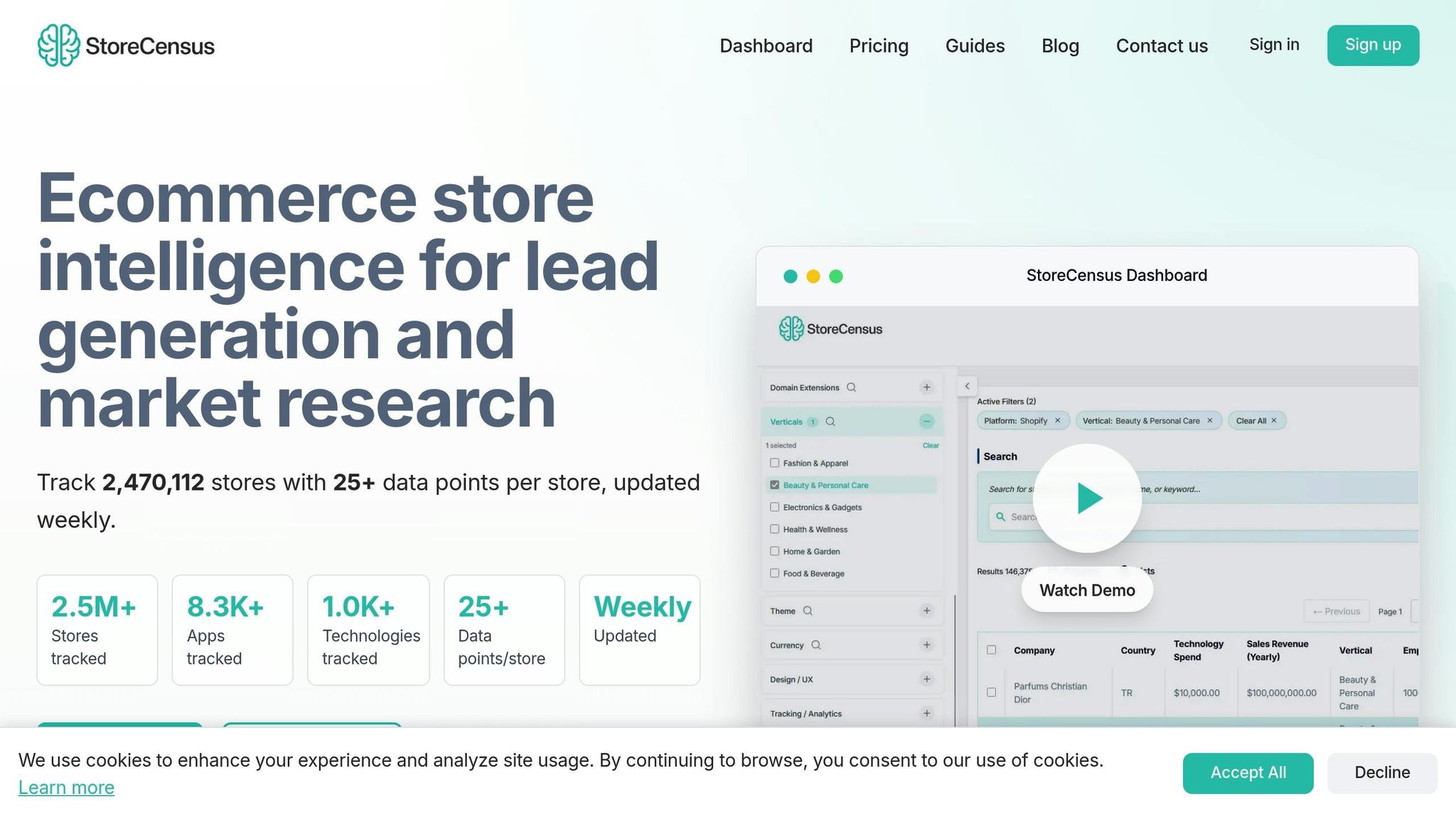
Adding external insights can amplify the benefits of internal data cleaning and organization. StoreCensus, for example, provides market intelligence that helps retailers understand the competitive landscape and uncover growth opportunities. By tracking over 2.5 million ecommerce stores, StoreCensus enriches data with 25+ attributes, including technology stacks (like Shopify or WooCommerce), app usage (e.g., Klaviyo or ReCharge), and store-level metrics such as revenue trends and traffic signals.
This enriched data is especially valuable for businesses selling B2B products or services to other ecommerce stores. By monitoring revenue and traffic trends, you can identify high-growth stores and prioritize which products or catalogs to enhance first for the best return on investment (ROI). StoreCensus also identifies operational gaps, such as missing apps or outdated technology, which enables highly targeted outreach and tailored enrichment strategies.
Manual vs. Automated Enrichment
The contrast between manual and automated data enrichment is striking. Here’s a side-by-side comparison:
| Feature | Manual Enrichment | Automated/AI Enrichment |
|---|---|---|
| Speed | Slow; limited by human labor hours | Fast; processes thousands of SKUs in minutes |
| Accuracy | Prone to human error (5%+ error rate) | High consistency with rule-based validation |
| Scalability | Hard to scale as the catalog grows | Easily scalable across multiple channels |
| Cost | High long-term labor costs | Lower operational costs after setup |
| Ideal Uses | High-ticket or safety-critical items | Bulk attribute extraction, normalization, SEO titles, and image tagging |
A hybrid approach often works best. Automation can handle about 80% of the workload - tasks like extraction, normalization, and bulk attribute population - while a human layer ensures quality for safety-critical or high-value items. For optimal results, set AI auto-fill to operate only when confidence levels exceed 95%, and send lower-confidence data for human review. As Christopher O'Donnell, Founder & CEO of Day.ai, explains:
"Enrichment isn't a feature – this data is necessary and foundational to how the entire system thinks".
Optimize Product Data for Search and Sales
Once your catalog data is enriched, the next step is to fine-tune your product titles and descriptions. This is where well-organized data transforms into higher sales. Did you know that 70% of all ecommerce sales come from the first page of search engine results? That means your product titles and descriptions need to do double duty: rank well in search engines and persuade shoppers to hit "buy." Neglecting this step has real consequences - 10% of purchase failures during checkout are tied to insufficient product information, and 74% of shoppers abandon purchases because they lack the details needed to make an informed choice. Below are strategies to craft titles and descriptions that improve both search rankings and conversions.
Write Better Product Titles
For 2025, stick to this proven formula for product titles: Brand + Product Type + Key Features + Variant (e.g., size, flavor, or pack count). For instance, a title like "Genrise Multivitamin Gummies Sugar-Free with Vitamin D3 90 Count" follows this structure perfectly. Prioritize important details early in the title - this ensures they won’t get cut off in mobile or voice search results.
Incorporate high-intent keywords that reflect actual search terms. Use specific descriptors like "waterproof", "USB-C", or "sulfate-free" rather than generic words like "great" or "quality". Keep titles between 150–170 characters for SEO effectiveness and mobile readability. Avoid promotional phrases like "Best" or "#1", as these can lead to listing suppression. Stick to numerals (e.g., "5-pack" instead of "five pack") and format titles in Title Case consistently.
Write Clear Product Descriptions
Your product descriptions should focus on benefits, not just technical specs. 87% of online shoppers base their buying decisions on product descriptions, and pages with detailed information convert 2–3 times better than those with sparse details. Replace generic manufacturer copy with concise, benefit-driven content. For example, instead of "18-inch plastic wreath", try something more engaging like "Festive holiday wreath to complement any front door... feel the holiday cheer with decorative 'snow'".
To capture shoppers searching for specific solutions, include long-tail keywords naturally within the description. Words like "ergonomic", "winterized", or "compatible with" attract high-intent buyers. Also, make sure your descriptions align with the titles in your ads and marketplace listings. Consistency matters - 40% of shoppers have returned items because the product content was incomplete or inaccurate.
Add Customer Reviews and User Content
Building on catalog enrichment, incorporating customer reviews and user-generated content (UGC) is a powerful way to boost trust and purchasing confidence. Studies reveal that 92% of consumers hesitate to buy without reviews, 90% trust user-generated content over traditional ads, and nearly 99% of online shoppers consult reviews before making a decision. In fact, product reviews influence purchasing choices more than factors like pricing, shipping costs, or even personal recommendations.
To streamline the process, automate the collection and display of reviews. Use post-purchase triggers like automated emails or SMS messages to request reviews and photos shortly after delivery. Add survey links to your "Thank You" page or use pop-ups to gather feedback while the experience is still fresh. If you offer incentives - such as discount codes or loyalty points - ensure they are neutral and not tied to positive reviews. This maintains credibility and keeps you compliant with FTC guidelines. Below are strategies for effectively leveraging reviews and user content.
Display Customer Reviews and Ratings
Showcasing verified reviews directly on product pages builds immediate trust. Platforms like Trustpilot, Yotpo, or Reviews.io allow you to add "verified" badges, which enhance credibility. These tools also support structured data (Schema markup), enabling star ratings to appear directly in search engine results, which can significantly improve click-through rates from organic search.
Transparency is key - display all verified reviews, including negative ones, and apply consistent moderation standards. Consumers value authenticity and expect a balanced mix of opinions. Use AI tools to analyze review sentiment, identify recurring customer concerns, and address them by updating product descriptions or creating dynamic FAQs. For clothing, include detailed information like model measurements (e.g., height, waist, size worn) and fabric stretch details in the review section to help reduce return rates. For technical products, add "compatibility badges" informed by review data, such as "Fits iPhone 15" or "Compatible with RO water systems", to eliminate buyer hesitations.
Add Customer Photos
Beyond written reviews, visual content like customer photos can significantly enhance consumer trust. Seeing products in real-world settings provides valuable context. In fact, websites that incorporate UGC effectively see a 20% increase in page views and a 90% increase in time spent on-site. Encourage customers to share photos and videos along with their reviews - 82% of consumers report being convinced to buy a product after watching a video. Tools like RaveCapture can automate the collection of customer photos and videos via email or SMS, while platforms like Loox specialize in turning Shopify customers into brand advocates through photo reviews.
"UGC is the chorus of voices that vouch for your brand's excellence, offering a refreshing break from traditional advertising." - Harry Truong, Content Marketing Executive, FoxEcom
Display customer photos prominently on product pages using UGC widgets, and amplify their impact by encouraging branded hashtags on platforms like Instagram and TikTok. Establish clear guidelines for publishing user content to ensure it aligns with your brand’s values and maintains authenticity. With 49% of customers willing to share UGC after positive experiences, make it easy for them to contribute and celebrate their submissions by showcasing them prominently.
Track Performance and Update Regularly
Updating your product catalog isn’t a one-time task - it’s an ongoing process. Catalog optimization requires consistent updates to ensure accuracy and relevance. Did you know that the average U.S. retail business reports inventory accuracy rates of just 65%? Outdated or incorrect product data leads to lost sales and frustrated customers. Keeping your data accurate not only increases sales but also improves operational efficiency across all your sales channels. To stay competitive, it’s essential to monitor how your enriched data performs and adjust based on real-world results. This continuous tracking ties directly to earlier strategies for improving catalog accuracy.
Monitor Sales Channel Metrics
Start by focusing on metrics that connect your catalog data to revenue. Keep an eye on conversion rates, click-through rates (CTR), and return on ad spend (ROAS) to understand how your product information impacts purchasing decisions. Beyond sales, evaluate customer engagement metrics like product detail page (PDP) bounce rates, cart abandonment rates, and impressions. These data points help you pinpoint where shoppers lose interest. For example, if a product has a high bounce rate or low conversions, it’s a clear sign that its details need immediate attention.
Each sales channel attracts a unique audience, so it’s important to monitor platform-specific performance. Tools like Google Search Console, Ahrefs, or SEMrush can help you track how product page rankings shift after updating product data. Similarly, platforms like Google Merchant Center or Facebook provide diagnostics to flag upload errors, warnings, or policy violations that might limit your product’s visibility. Adding accurate Global Trade Item Numbers (GTINs) to your product data can lead to an average 20% boost in clicks, so don’t overlook these technical details.
| Metric Category | Key Performance Indicators (KPIs) |
|---|---|
| Sales Performance | Conversion Rate, ROAS, Average Order Value (AOV) |
| Customer Experience | Return Rate, PDP Bounce Rate, Cart Abandonment Rate |
| Discoverability | Search CTR, Impressions, Product Page Rankings (SEO) |
| Operational Efficiency | Time-to-Market, Catalog Creation Time, Inventory Accuracy |
| Data Health | Upload Error Rate, Attribute Completeness Score |
Update Data Based on Results
Once you’ve gathered insights from these metrics, use them to make targeted updates. As mentioned earlier, accurate data helps minimize returns. For instance, if you notice high return rates for specific products due to “fit” or “material feel,” update their descriptions with more precise details like “stretch level,” “fabric density,” or even model measurements. This approach sets clearer expectations for customers, reducing the likelihood of returns.
Real-time inventory updates are another critical factor. Ideally, inventory data should be refreshed constantly - 24/7/365 - to avoid order errors and unnecessary returns. AI-powered tools can handle thousands of updates quickly, saving time compared to manual processes.
How often you review and update your catalog depends on your business needs. For fast-evolving trends, shorter review cycles work best, while longer intervals are suitable for general performance reviews. Plan updates around new product launches, seasonal trends, and promotional periods. Use APIs to synchronize data between your Product Information Management (PIM) system and sales channels in real time, ensuring consistency. To avoid disrupting user experience, schedule intensive updates like metadata refreshes during low-traffic hours. Regularly enriched and accurate product data can reduce return rates by over 20%, making these efforts a valuable investment.
Conclusion
Improving your product catalog is an ongoing process that involves auditing, standardizing, enriching, and refining your data. When you treat your catalog data as a valuable resource, it can significantly boost your performance. For instance, 87% of online shoppers say product descriptions are key to their buying decisions, and enriched content can increase conversion rates by an average of 30%. In short, better data translates to better sales.
To maximize the benefits of data enrichment, it's essential to strike a balance between human input and automation. Combining manual oversight with AI-driven tools can lead to productivity gains of 30–40% and profit increases of 10–20%. However, automation alone isn't enough - it needs to be supported by clear guidelines. Using standardized taxonomies, validation rules, and regular audits ensures your catalog stays accurate as it grows. As the fabric Editorial Team aptly states:
"Product data enrichment isn't just about having more data, but better data".
In addition to refining internal processes, leveraging external tools can further enhance your strategy. Platforms like StoreCensus provide a powerful solution for data enrichment, offering insights on over 2.5 million ecommerce stores with more than 25 data points for each. This makes StoreCensus an excellent resource for market research and for strengthening your CRM with regularly updated store intelligence.
Ultimately, enriched catalog data fuels growth by improving product discovery, creating better customer experiences, and enabling more efficient automation. By consistently auditing, standardizing, and enriching your catalog, you ensure it remains a dynamic asset that evolves alongside your business. Stick to these practices to keep driving success.
FAQs
How does enriching product catalog data help improve search rankings?
Enriching your product catalog data can significantly improve search rankings by ensuring your product information is precise, thorough, and well-organized. When search engines can easily interpret and showcase your products, it increases their visibility to potential buyers.
Focusing on detailed product information - like titles, descriptions, attributes, and categories - makes your listings more aligned with search queries. This not only helps with rankings but also enhances the overall shopping experience, encouraging better engagement and driving more conversions.
How does AI help streamline product data enrichment?
AI takes the hassle out of product data enrichment by tapping into the power of machine learning and natural language processing (NLP). These technologies work together to refine, standardize, and categorize product details, ensuring the information is accurate, complete, and well-organized - all without relying heavily on manual effort.
With AI, missing product attributes can be filled in quickly, descriptions can be improved, and messy, unstructured data can be transformed into clean, searchable formats. This not only cuts down on human error but also saves significant time. Businesses can onboard products faster while keeping data quality consistent. By using AI, ecommerce companies can expand their operations smoothly and stay flexible in a constantly evolving market.
Why is it important to standardize data formats and categories in product catalogs?
Standardizing data formats and categories in product catalogs plays a key role in keeping your inventory consistent and accurate. It streamlines data integration, enhances search capabilities, and helps customers find products more easily.
When your product information is clear and reliable, it doesn't just improve the shopping experience - it can also lead to higher conversion rates. Plus, having standardized data makes operations like inventory management and marketing campaigns run more smoothly by cutting down on errors and inefficiencies.