How to Automate Ecommerce Lead Generation in 2026
Replace manual prospecting: use data enrichment, automated scoring, CRM syncs, and analytics to scale ecommerce lead generation and reclaim hours.

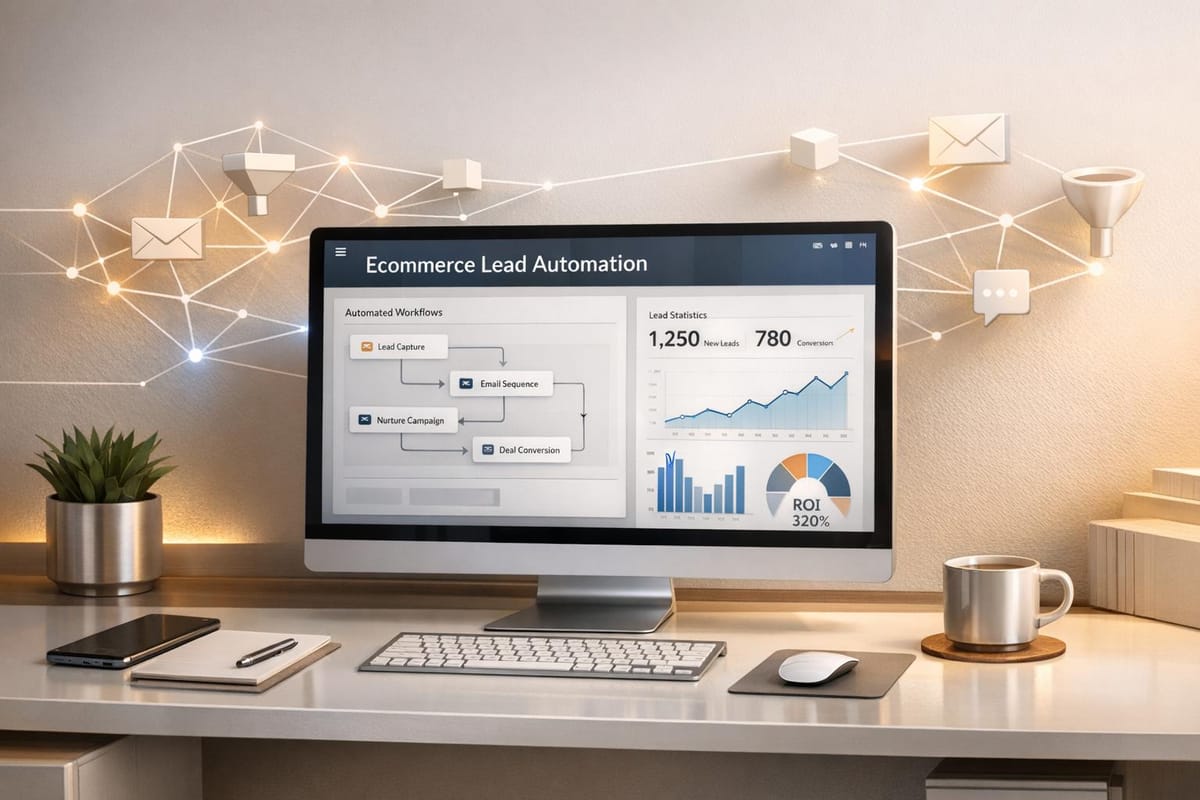
Automation is transforming ecommerce lead generation in 2026. If you're still relying on manual processes like prospect research and CRM updates, you're wasting time and money. Tools like StoreCensus can reduce repetitive tasks, boost qualified leads by 451%, and cut costs by 33%. Here's how automation works:
- Identify leads: Use platforms like StoreCensus to analyze 2.5M+ online stores and filter prospects by revenue, location, or tech stack.
- Enrich data: Update lead details with real-time APIs, ensuring accuracy and saving hours of manual research.
- Automate workflows: Score leads based on actions (e.g., demo requests, page visits) and trigger follow-ups automatically.
- Integrate tools: Sync with CRMs like HubSpot for predictive scoring and multi-channel nurturing.
- Track performance: Use analytics to refine strategies, monitor ROI, and scale efforts with lookalike audiences.
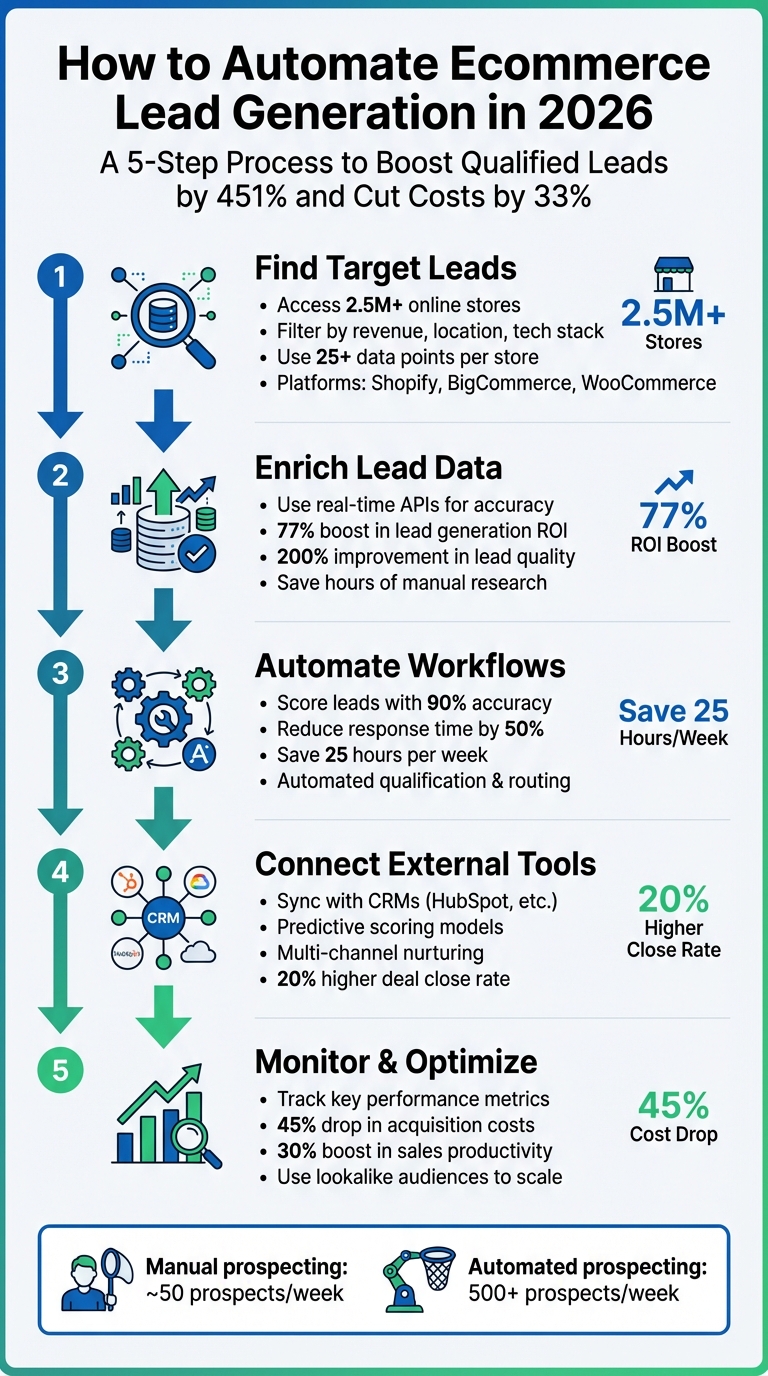
5-Step Ecommerce Lead Generation Automation Process for 2026
16 Insane AI Lead Generation Systems for 2025 (with PROOF!)
Step 1: Find Target Leads with StoreCensus Intelligence
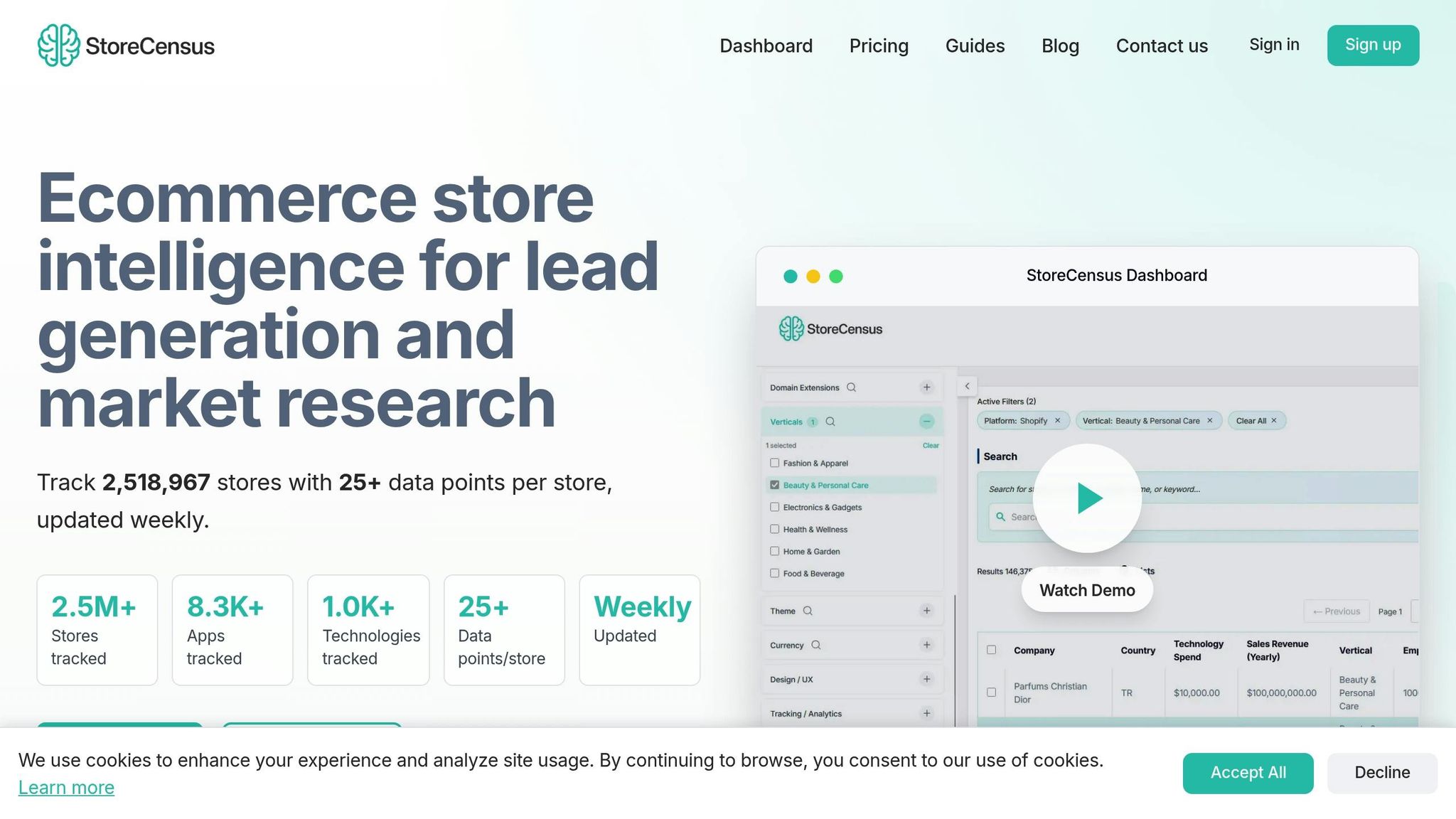
The first step to identifying the right ecommerce leads is having access to a comprehensive database. StoreCensus monitors over 2.5 million online stores across platforms like Shopify, BigCommerce, and WooCommerce. This extensive coverage helps you uncover actionable prospects. Additionally, the platform lets you prioritize leads based on web traffic rankings, allowing you to focus on businesses that already show strong market traction. From there, you can refine your prospect list using advanced filters for a more precise approach.
Use Advanced Filters
StoreCensus takes filtering to the next level with tools that go beyond standard search options. You can narrow down prospects based on technographics - essentially the software and platforms a store relies on. Want to get even more specific? Filter by revenue, recent funding activity, or geographic location to zero in on businesses in key markets. These indicators can help identify stores that are more likely to invest in new solutions.
Build a Targeted List
Once you've fine-tuned your filters, you can build a highly targeted list with precision. Start by selecting relevant ecommerce platforms such as Shopify, BigCommerce, or WooCommerce from the database. Then, layer in firmographic filters like revenue ranges and web traffic rankings to prioritize leads with higher potential. You can also refine your list further by incorporating location data and social media engagement metrics to find brands that are actively engaging with their audiences.
StoreCensus provides over 25 data points for each store, giving you in-depth insights into each prospect's technology stack. This level of detail makes it easier to craft personalized outreach strategies. Once your list is ready, you can export it or integrate it directly into your automation workflows for seamless execution.
Step 2: Enrich Leads with StoreCensus Data Points and API
Raw data alone doesn’t cut it. To truly qualify prospects and personalize your outreach, you need to enrich leads with decision-maker contacts, tech insights, and growth signals.
Here’s the thing: contact databases lose accuracy fast - about 20–25% of data becomes outdated each year as people switch jobs and businesses evolve. That’s why real-time enrichment is a game-changer. It saves your team from hours of manual research on LinkedIn or company websites, ensuring your leads stay accurate and actionable.
Let’s dive into two powerful ways to enrich your leads: leveraging detailed data points for deeper insights and automating bulk enrichment using our API.
Use 25+ Data Points for Lead Insights
StoreCensus provides a wealth of information to help you qualify and segment leads effectively. Here’s what you can tap into:
- Firmographic data: Get a clear picture of a company’s annual revenue, employee range, founding year, and industry classification - key details for determining if a lead fits your ideal customer profile.
- Contact details: Access job titles, seniority levels, LinkedIn profiles, and verified business email addresses to ensure you’re reaching the right decision-makers.
- Technographic insights: Understand the web technologies and software platforms a company uses, allowing you to tailor your pitch to their existing tech stack.
These insights do more than just refine your outreach - they supercharge your lead scoring and segmentation. Companies using enriched data for lead scoring report, on average, a 77% boost in lead generation ROI, with some achieving a staggering 200% improvement in lead quality. Additional features like social media handles, company keywords, and hyper-local location data (down to postal codes) make multi-channel personalization and territory-based campaigns a breeze.
Use the API for Bulk Data Enrichment
If you’re handling high volumes of leads, the API is your go-to for automating enrichment. Tasks that would take hours manually - like updating thousands of records - can be handled in just 15 minutes.
The API works seamlessly with your data warehouse (Snowflake, BigQuery, Redshift, Databricks, or Postgres), centralizing enriched data and conserving CRM API quotas. All enriched data is instantly accessible through the Census Schema, ensuring your team has what they need without delays.
To maintain data accuracy, configure your enrichment settings wisely:
- Use "fill empty values only" for static fields like contact names to preserve manual entries.
- Choose "overwrite existing values" for dynamic fields like job titles or revenue figures to keep information current.
This approach keeps your records accurate while ensuring your team always has the most up-to-date data at their fingertips.
Step 3: Automate Workflows with StoreCensus
After enriching your leads, the next logical step is to automate workflows that handle qualification, scoring, and follow-up. This approach not only saves time but also allows your team to focus on activities that add more value. Did you know that manual lead qualification eats up 40% of a sales team's time? Automation flips the script by using data-driven insights - like historical conversion patterns and intent signals - to score leads with up to 90% accuracy.
Streamline Lead Qualification with Automation
Start by aligning your sales and marketing teams on a qualification framework. Popular models like BANT (Budget, Authority, Need, Timeline) or MEDDIC can provide solid scoring criteria. Once the framework is in place, set up automated scoring protocols to qualify leads efficiently.
StoreCensus makes this process straightforward. You can assign specific point values to high-intent actions:
- +20 for visiting pricing pages
- +30 for confirming C-level engagement
- +50 for interacting with solution content
- +40 for requesting a demo
On the flip side, you can deduct points for actions like email unsubscribes or bounced communications (e.g., -50 points) to maintain a clean and focused pipeline.
"AI shifts lead scoring from subjective assumptions to real-world information by analyzing historical conversion patterns." – DemandScience Blog
When a lead hits a target score - say, 100 points - you can automate the next steps. For example, trigger a 7-day email sequence or route the lead directly to a sales rep, cutting response times by 50%. Keep an eye on the MQL-to-SAL ratio to ensure only high-quality leads make it to your sales team.
After setting up automated qualification, centralize everything using the built-in CRM.
Leverage the Built-In CRM for Seamless Lead Management
Once your qualification system is automated, integrating a CRM ensures smooth transitions and reduces manual errors. StoreCensus's built-in CRM is designed to consolidate all critical lead information - scores, engagement history, firmographics, and decision-maker contacts - into one easy-to-access platform. This eliminates data silos and avoids the hassle of API quotas. Plus, it speeds up lead processing by 30% compared to manual methods.
When a lead moves from Marketing Qualified Lead (MQL) to Sales Qualified Lead (SQL), the CRM automatically routes it to the right sales rep, complete with all the necessary context. This automation saves time and ensures no details are lost in the handoff.
Marketing teams have reported saving an average of 25 hours per week by adopting this approach. Take Veo, for example: their automated lead lifecycle management reduced their cost-per-lead by 20% while boosting conversion rates, fueling faster growth.
"It's helped us accelerate our sales cycle… and saved us thousands of hours, and costs, because we didn't have to hire a developer to make multiple systems talk to each other." – Lars Christensen, Social Ads Specialist, Veo
To keep your pipeline fresh, automate score decay to reflect current intent. Additionally, experiment with different nurture intervals - like 3-day versus 7-day follow-ups - to find what resonates best with your audience.
Step 4: Connect StoreCensus with External Tools
Once you've automated your workflows, it’s time to link StoreCensus to the tools you already use. This integration creates a connected system where enriched lead data moves effortlessly between platforms, cutting out the need for manual data entry. Did you know that 67.8% of marketers store their lead data in a CRM? By integrating StoreCensus with your CRM, you unlock powerful features like predictive scoring and multi-channel nurturing, making your data work harder for you.
Enhance Lead Scoring with Predictive Analytics
Integrating StoreCensus with platforms like HubSpot takes lead scoring to the next level. Instead of relying on basic scoring methods, you can combine enriched data - like company size, tech stack, and revenue estimates - with your CRM's behavioral data to create predictive scoring models. These models help you prioritize leads based on how well they fit your ideal profile and how engaged they are.
A bi-directional sync ensures data flows both ways. For example, if a lead visits your pricing page in HubSpot, their engagement score can update instantly. You can also set up score decay to automatically lower points for inactive leads, ensuring your sales team focuses on the most promising opportunities.
Here’s a real-world example: In 2025, KeepCup implemented HubSpot Marketing Hub with integrated automation and centralized data management. This move boosted their deal close rate by 20% and halved the number of touchpoints needed to close a deal. Co-Founder Abigail Forsyth shared:
"HubSpot has helped us cement the value of data in the business - we're building scalable systems and processes without losing focus on the customer".
Automate Nurturing Campaigns
After refining your lead scoring, seamless integration enables automated, multi-channel nurturing. StoreCensus can sync with your engagement tools to launch personalized campaigns across platforms like email and LinkedIn. By combining firmographic data from StoreCensus with these tools, you can trigger campaigns based on key buying signals.
Using dynamic fields from StoreCensus, you can customize messaging so that every lead gets content tailored to their profile. This level of automation doesn’t just boost engagement - it also saves marketing teams significant time. In fact, it’s estimated that automation like this saves over three days of work per week.
Step 5: Monitor and Optimize Lead Generation with Analytics
Once your automated workflows are up and running, the next crucial step is to track their performance. This is where you gain the ability to fine-tune and expand your lead generation efforts. The secret lies in analyzing the results and making adjustments. StoreCensus analytics provide a detailed breakdown of your lead generation performance, helping you identify weak points, improve targeting, and scale what works. Without these insights, you might overlook key opportunities for improvement. As Ramsha Zafar, Senior Content Writer at involve.me, aptly puts it:
"Automation is only as useful as how much real business value it can provide. If you're getting a ton of leads that never convert, what's the point?"
Track Key Performance Metrics
Begin by focusing on the metrics that reveal how effective your automated workflows are. For example, if your connection acceptance rates fall below 30%, it could mean your targeting is too broad. Similarly, reply rates under 10% may indicate that your messaging isn't resonating with your audience.
StoreCensus analytics can pinpoint exactly where leads are dropping off in your funnel. For instance, if you're scheduling plenty of meetings but seeing a low conversion rate from leads to opportunities, it might suggest a mismatch between your outreach and your ideal customer profile. You can even set up alerts to notify your team when conversion rates dip or lead quality changes. This allows you to respond quickly and avoid wasting additional budget on campaigns that aren't hitting the mark.
Tracking these metrics also helps you compare your return on investment (ROI) across different channels, such as paid ads. A great example comes from 2025, when sports recording company Veo introduced lead management automation and cut their cost-per-lead by 20%.
Armed with this data, you can double down on what works by focusing on high-converting audiences.
Use Lookalike Audiences for Scalability
Once you've identified your top-performing leads, scaling becomes much easier. StoreCensus's lookalike audience feature, available with Growth+ plans, automates this process. It analyzes your most successful leads - taking into account factors like firmographics, tech stack, revenue trends, and behavioral patterns - and builds dynamic audiences that update automatically.
This method goes beyond surface-level demographics, using predictive targeting based on past conversion trends. Companies leveraging AI-driven automation in this way have reported a 45% drop in lead acquisition costs and a 30% boost in sales productivity. To refine your strategy further, test one variable at a time - such as a headline or form length - to identify what drives the best results. As LeadsBridge highlights:
"Pipeline metrics are the foundation of revenue generation, so you also need to find trends"
StoreCensus Pricing Plans: Choose the Right Option for Your Needs
Once you've optimized your lead generation strategy, selecting the right pricing plan becomes essential to fully leverage automation. The right plan can significantly expand your reach. While manual prospecting often limits you to about 50 prospects weekly, automated tools like StoreCensus can help a single user connect with over 500 prospects in one go.
StoreCensus offers paid plans starting between $50 and $100 per user per month, tailored for ecommerce-focused data. Higher-tier plans provide multi-channel outreach capabilities - covering LinkedIn, email, and social media - which can boost response rates by up to 60% compared to single-channel efforts. Additionally, AI-driven personalization can increase the volume of qualified leads by as much as 451%.
Compare StoreCensus Pricing Tiers
Here’s a quick breakdown of StoreCensus pricing tiers to help you find the best fit for your prospecting needs:
| Plan | Price | Lead Credits | Automation Flows | Key Features | Best For |
|---|---|---|---|---|---|
| Free | $0/month | 3 | 0 | 50 actions, basic filters, CSV exports | Testing the platform |
| Starter | $39/month | 4,000 | 2 | Basic filters, CSV exports | Small-scale prospecting |
| Professional | $79/month | 15,000 | 10 | Advanced filters, built-in CRM, API access | Most users seeking the best value |
| Growth | $149/month | 35,000 | 25 | Team access, lookalike audiences, CRM, API | High-volume prospecting |
| Enterprise | $599/month | Unlimited | 50 | Priority support, CRM, API access | Large teams with unlimited needs |
For most ecommerce businesses, the Professional plan at $79/month strikes a great balance between cost and value. It includes 15,000 lead credits, 10 automation flows, and advanced CRM and API access. If you're managing over 500 prospects at a time or need features like lookalike audiences to scale your efforts, the Growth plan at $149/month is a better fit. For even larger teams or complex workflows, the Enterprise plan offers unlimited credits and top-tier support.
These pricing tiers are designed to grow alongside your lead generation needs, offering advanced automation and enrichment features to ensure you get the most out of your investment.
Conclusion
Automating ecommerce lead generation by 2026 isn’t just a time-saver - it’s a game-changer for scaling your business. Sales professionals currently spend nearly 40% of their workweek on repetitive tasks like prospect research and data entry. With automation, you can reclaim 10–15 hours every week. Tools like StoreCensus simplify the process by identifying potential leads with advanced filters, enriching them with detailed data, and automating workflows that handle qualification and outreach across multiple channels.
The impact of AI-driven personalization and automated nurturing is hard to ignore. These technologies can increase qualified leads by up to 451%, reduce costs by 33%, and boost sales productivity by 14.5%. With 75% of companies already using at least one automation tool, adopting these systems is no longer optional if you want to stay competitive.
StoreCensus offers all these capabilities in a single platform. From lead identification and data enrichment to automating multi-channel campaigns and tracking performance with built-in analytics, it’s designed to grow with your business. Whether you’re managing a handful of prospects or hundreds, StoreCensus ensures speed, consistency, and the personalized experience today’s buyers demand.
FAQs
How does StoreCensus enhance the accuracy of ecommerce lead generation?
StoreCensus uses cutting-edge tools like AI-powered data enrichment, predictive analytics, and CRM automation to take the guesswork out of lead generation. By diving deep into customer behavior and preferences, it pinpoints top-quality leads with greater precision, making targeting efforts sharper and more effective.
On top of that, StoreCensus simplifies lead qualification by automating key workflows and syncing effortlessly with your current systems. This allows ecommerce businesses to concentrate on connecting with the right prospects, cutting down wasted time and driving productivity.
What are the benefits of connecting StoreCensus with my current CRM?
Integrating StoreCensus with your current CRM can take your ecommerce operations to the next level by simplifying lead management and boosting customer engagement. When you sync data between StoreCensus and your CRM, you can automatically enhance customer profiles, monitor lead activity, and give your sales team access to the latest, most accurate information.
This connection also automates essential workflows like lead qualification and segmentation, cutting down on manual tasks and saving valuable time. With everything working together seamlessly, you can concentrate on strengthening customer relationships and driving growth more effectively.
How can I keep my lead data accurate and up-to-date?
Keeping your lead data accurate means moving beyond manual imports and embracing automated updates. By leveraging AI-powered tools, you can pull the latest contact and company details directly into your CRM. This automation not only minimizes human error but also keeps your records consistently up-to-date. Set these updates to run on a regular schedule - whether nightly or weekly - so your database reflects real-time changes like updated job titles, email addresses, or shifts in company size.
To take your data quality a step further, create workflows that identify incomplete or outdated fields, perform deduplication checks, and use AI models to regularly evaluate lead viability. Pairing these automated processes with periodic reviews - such as monthly audits or quarterly cleanups - helps catch inconsistencies and ensures your database remains accurate. By blending automation with routine maintenance, you’ll keep your lead data reliable and primed for successful outreach.