Top Tools for Regional Data Enrichment 2025
Compare top regional data enrichment tools, features, coverage, and update frequency to boost lead generation, segmentation, and CRM accuracy.


Regional data enrichment is essential for businesses looking to improve lead generation, market segmentation, and compliance. By adding location-specific details like geographic coordinates, demographics, and administrative data to existing records, companies can reduce inefficiencies and create more targeted outreach strategies. For example, enriched data can help identify high-value prospects, verify customer details, and improve shipping accuracy.
Key Takeaways:
- Why It Matters: 25–30% of B2B data becomes outdated yearly. Enrichment tools automate updates, reducing manual input and improving CRM accuracy.
- Benefits:
- Targeted Lead Generation: Focus on specific regions or industries, like local businesses or high-revenue prospects.
- Improved Segmentation: Group leads by demographics, buying power, or engagement levels.
- Compliance: Verify IP locations, adhere to privacy standards, and reduce fraud.
- Impact: Personalized emails with regional insights see a 152% higher click-through rate. Companies using enriched data grow revenue 40% faster.
Top Features to Look For:
- Geospatial Precision: Accurate geocoding, points of interest (POI) data, and mobility insights.
- Integration: Native CRM integrations (e.g., Salesforce, HubSpot) and flexible APIs for scalability.
- Real-Time Updates: Frequent data refreshes to stay ahead of trends and competitor activity.
Example Tool: StoreCensus
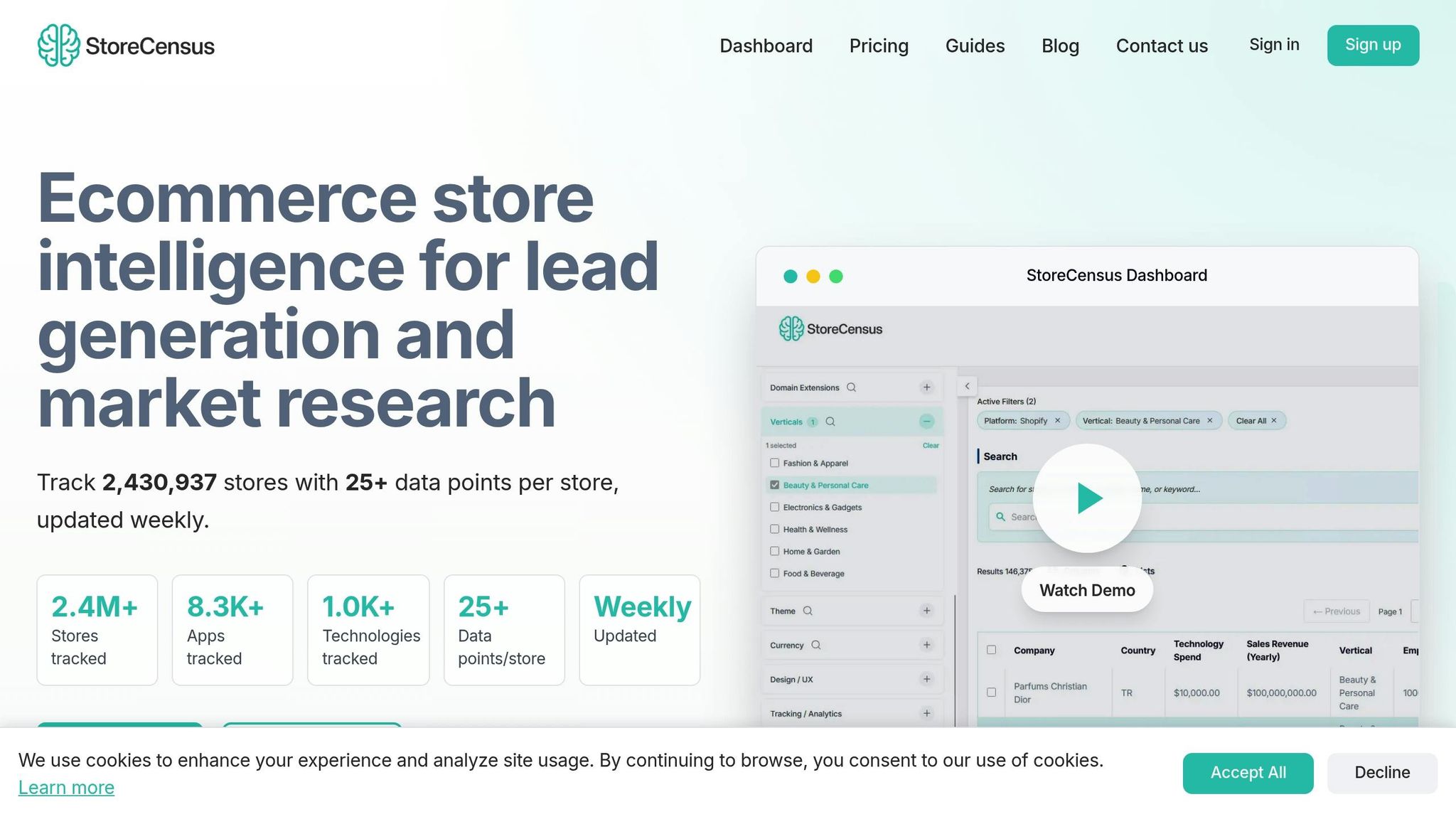
- Tracks 2.4M+ ecommerce stores with weekly updates.
- Offers location-based filtering, revenue estimates, and automation for CRM syncing.
- Boosts outreach response rates by 3-5x through real-time alerts like competitor app uninstalls.
Quick Comparison
| Tool | Regional Coverage | Key Features | Update Frequency | Ecommerce Focus |
|---|---|---|---|---|
| StoreCensus | Global | Revenue estimates, tech stack insights | Weekly | High |
| Facteus | U.S. Only | Transaction volume, spend trends | Daily | Medium |
| SafeGraph | Global | POI polygons, brand affiliations | Monthly | Low |
Regional data enrichment transforms raw information into actionable insights, helping businesses make smarter decisions, reduce errors, and improve efficiency.
What to Look for in Regional Data Enrichment Tools
When evaluating regional data enrichment tools, prioritize geospatial precision, seamless integration, and real-time monitoring. These features are key to turning raw data into actionable insights. Poor data quality costs large corporations nearly $15 million annually in lost time and resources, while data scientists spend about 60% of their time cleaning and organizing data. The right tool eliminates this bottleneck, enabling you to focus on decision-making instead of data prep.
Geospatial and Location Data
The best tools provide comprehensive points of interest (POI) data, detailing everything from hours of operation and product categories to brand affiliations and pricing. This level of detail is crucial, especially since 90% of retail transactions still occur offline. Accurate geocoding is another must-have, converting location descriptions into precise latitude and longitude coordinates for accurate mapping. For advanced applications like site selection or risk assessment, tools offering building footprints (polygons) - which show the actual shape of structures rather than just a single point - are invaluable.
Standardized categorization using NAICS codes (a 6-digit taxonomy) ensures compatibility and simplifies filtering by business type. Adding layers like foot traffic and mobility data allows you to analyze the volume and demographics of visitors to specific locations, offering insights into trade areas and consumer behavior. While 74% of retailers recognize the importance of location analytics, only 45% actively use it to shape their strategies. This gap presents a clear opportunity for early adopters to gain a competitive edge.
Integration and Scalability
Look for tools with native CRM integrations - such as Salesforce, HubSpot, or Zoho - that automatically refresh data to support both real-time workflows and periodic batch updates. Tools with flexible APIs allow developers to seamlessly integrate regional intelligence into custom dashboards or third-party applications.
For businesses expecting growth, scalability is critical. Enterprise-grade tools should handle bulk enrichment, processing millions of records at once to support large-scale campaigns like outbound marketing or Account-Based Marketing (ABM) programs. Companies leveraging enriched data for advanced personalization see revenue growth 40% faster than those that don’t. Additionally, enriched CRM data can reduce the time sales teams spend on manual research by up to 75%. Opt for tools with "conservative update rules" that fill in missing fields without overwriting verified internal data. As your data needs expand, real-time monitoring becomes even more essential.
Real-Time Updates and Monitoring
Regional data is always changing. In 2021 alone, over 8,100 retail stores opened across the U.S.. Real-time monitoring enables you to stay ahead of demand surges, seasonal trends, and competitor activity, such as store openings or closures. For inventory management, these tools help brands track demand trends by geography and predict stock duration with metrics like "inventory days".
"When the dataset is good, we can trust it to make business decisions. Working with SafeGraph data has made our jobs much easier in this regard." - Andy Stevens, Chief Data Officer, Clear Channel Europe
Frequent updates - ideally daily - can guide decisions on store hours, staffing, and restocking. Tools that provide spend trend data by ZIP code or city allow you to replace generic national insights with hyper-local analytics, identifying anomalies and surges in demand. Ensure the tool refreshes its database at least monthly, as outdated POI data can lead to poor competitor analysis and wasted resources.
How StoreCensus Handles Regional Data Enrichment
StoreCensus provides insights on over 2.4 million ecommerce stores, updating its database weekly with more than 25 data points per store at an accuracy rate of 99.2%. This precision makes it a go-to tool for agencies, SaaS founders, and Shopify app developers looking to focus on specific geographic markets for lead generation, market research, and sales automation.
Location-Based Filtering and Segmentation
StoreCensus takes geographic targeting to the next level with its advanced filtering capabilities. Users can narrow down markets by country or region and combine these filters with other criteria like revenue, tech stack, or catalog size. For instance, you could search for "Fashion retailers in North America with $100,000+ monthly revenue" to zero in on high-value prospects. These advanced filters reportedly deliver a 40x ROI.
The platform's weekly data updates ensure that regional intelligence - such as store growth trends or changes in technology usage - remains current and actionable. Users can further enhance this data through API access or export it as formatted CSV files for external applications.
Real-Time Regional Intelligence
StoreCensus excels in tracking real-time updates, such as shifts in revenue bands, tech stack changes (e.g., adopting Klaviyo), or new social media account activity. With its "Recent Change Detection" feature, users are instantly notified of crucial updates - like a store moving from $100K to $250K in revenue. This feature allows for timely outreach, with automations triggered by competitor app uninstalls achieving a 40% conversion rate. Outreach campaigns based on these insights generate response rates 3–5x higher than standard cold outreach.
The platform's "Evergreen Automations" further streamline workflows by triggering actions as soon as a store shows buying intent. This ensures sales teams can engage prospects at the perfect moment, feeding these insights directly into automated processes.
Automation and CRM Syncing
With integrations for over 5,000 apps via Zapier - including HubSpot, Salesforce, Pipedrive, Mailchimp, Slack, and Notion - StoreCensus simplifies contact discovery and localized email campaigns. Built-in integrations with tools like Apollo and Instantly.ai help agencies achieve growth rates exceeding 150%.
The platform’s automation engine takes things a step further by setting up intent-based triggers. For example, sales teams can be alerted when a store in a specific region uninstalls a competitor’s app or updates its tech stack. Enriched leads are then automatically added to regional sales pipelines, complete with revenue estimates, tech stack details, and other critical data. Weekly refreshes keep CRMs current, eliminating manual data entry and ensuring sales pipelines remain actionable and up to date.
Regional Data Enrichment Tools Compared
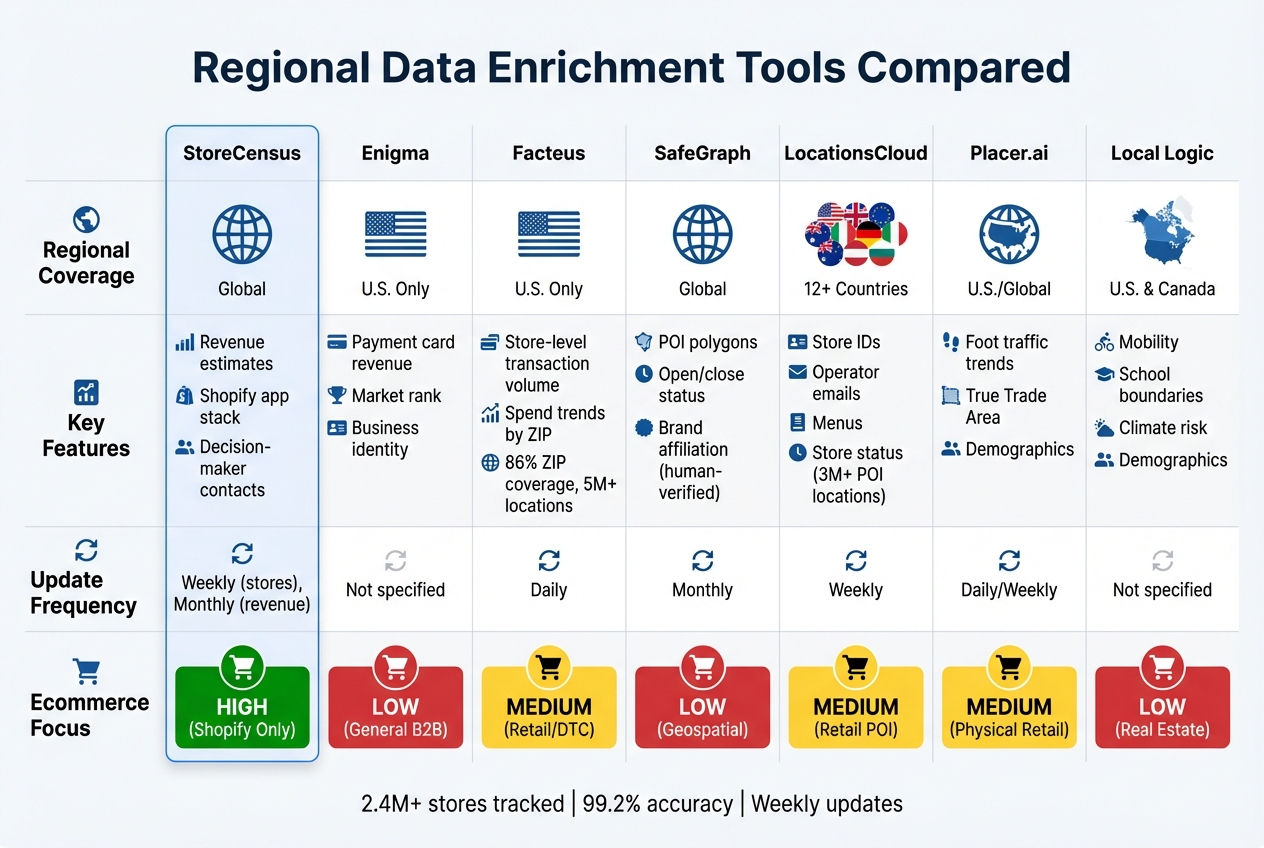
Regional Data Enrichment Tools Comparison 2025: Features, Coverage and Update Frequency
Regional Coverage and Features Table
When examining regional data enrichment tools, it's clear that platforms differ in their geographic reach, depth of data, and focus on ecommerce. Some tools concentrate exclusively on U.S. data with detailed transactional insights, while others provide global points of interest (POI) coverage alongside location-based analytics.
StoreCensus zeroes in on Shopify, tracking over 2 million active stores worldwide. It offers data enrichment like revenue estimates, app stack analysis, and decision-maker contacts, which can be directly synced to CRMs.
Facteus, on the other hand, specializes in U.S. store-level transaction data, covering over 5 million locations and 86% of all ZIP codes, with daily updates. Meanwhile, Enigma focuses on U.S.-specific business identity data and payment card revenue insights.
For global POI data, SafeGraph stands out with its "gold standard" accuracy, featuring human-verified polygons across multiple countries. Similarly, LocationsCloud provides data for over 3 million POI locations across 12+ countries, offering custom enrichments like store operator emails.
Here's a detailed comparison of these tools, highlighting their regional coverage, features, update frequency, and ecommerce focus:
| Tool | Regional Coverage | Key Enrichment Features | Update Frequency | Ecommerce Focus |
|---|---|---|---|---|
| StoreCensus | Global | Revenue estimates, Shopify app stack, decision-maker contacts | Weekly (Stores), Monthly (Revenue) | High (Shopify Only) |
| Enigma | U.S. Only | Payment card revenue, market rank, business identity | Not specified | Low (General B2B) |
| Facteus | U.S. Only | Store-level transaction volume, spend trends by ZIP | Daily | Medium (Retail/DTC) |
| SafeGraph | Global | POI polygons, open/close status, brand affiliation | Monthly | Low (Geospatial) |
| LocationsCloud | 12+ Countries | Store IDs, operator emails, menus, store status | Weekly | Medium (Retail POI) |
| Placer.ai | U.S./Global | Foot traffic trends, True Trade Area, demographics | Daily/Weekly | Medium (Physical Retail) |
| Local Logic | U.S. & Canada | Mobility, school boundaries, climate risk, demographics | Not specified | Low (Real Estate) |
How to Implement Regional Data Enrichment in 2025
Audit and Identify Data Gaps
Start by defining your "Perfect Client" Profile using specific regional metrics like revenue range in USD, location within the US, tech stack (e.g., Meta Pixel), and industry type. Then, pinpoint where leads are slipping through the cracks. Interestingly, 70% of qualified leads are lost not because of poor outreach but due to inefficient follow-up systems.
"The best prospecting system isn't about finding more leads. It's about losing fewer of the ones you already found." - StoreCensus
In 2025, Sarah, the founder of an email agency, used StoreCensus to uncover a key data gap: Shopify beauty brands earning $1M–$5M annually that used ReCharge for subscriptions but didn’t have Klaviyo. By focusing on this niche and implementing a targeted enrichment and follow-up strategy, her agency hit $84K in Monthly Recurring Revenue (MRR) with 14 clients by the end of the year. This example highlights how specific enrichment workflows, like those offered by StoreCensus, can drive measurable results. When auditing your data, focus on anchor fields, such as street-level addresses, which provide more accurate insights (like Census tract or school district data) compared to broader ZIP codes.
Once you’ve identified gaps in your data, choose a tool that seamlessly integrates these insights into your CRM.
Tool Selection and Integration
Select tools that connect directly to your CRM via native integrations or platforms like Zapier to avoid losing 20% of leads due to manual data entry errors. For instance, StoreCensus integrates with platforms like HubSpot and Salesforce, automatically enriching your CRM with details such as revenue estimates and tech stack information. To prioritize leads effectively, implement a 1-5 star rating system within your enrichment tool. By dedicating 60% of your effort to "5-star" leads - those that perfectly match your ideal profile - you could boost your close rates by up to 70%.
For better results, use tools that update data weekly, ensuring your outreach stays accurate and timely. When running campaigns targeting US-based clients, confirm that the platform supports imperial units, MM/DD/YYYY date formats, and USD currency.
Once your data is integrated, automate your outreach to act on real-time regional insights.
Automate and Localize Outreach
Set up trigger-based workflows to respond to real-time events like competitor app uninstalls or new tech integrations. Outreach triggered by these signals can deliver a 40% conversion rate, far outperforming the 2–3% rate of generic cold emails. Schedule reminders for key moments, such as two weeks before contract renewals, during Q1 budget planning, or 30 days ahead of seasonal peaks.
Leverage timezone enrichment to ensure your messages land during local business hours across US time zones. Personalize your outreach by referencing specific tech gaps. For example, you might say, "I noticed your $2M Shopify store uses ReCharge but doesn’t have an email platform in place." This tailored approach can achieve response rates of 18–25%.
Take Marcus, a Meta Ads agency founder, as an example. He used this system to target DTC apparel brands with high traffic and active Meta Pixels. By managing extended sales cycles (lasting 2–4 months) and tracking progress meticulously, he grew his agency to $95K MRR in just one year. This case study further emphasizes the value of precise enrichment and follow-up workflows in achieving sustainable growth.
Conclusion
In 2025, regional data enrichment will be the cornerstone of successful ecommerce prospecting. With 25–30% of B2B data becoming outdated annually, relying on static databases is no longer an option. The ability to access up-to-date, detailed intelligence - like store locations, technology stacks, and real-time intent signals - can make or break a deal.
The most effective tools combine geospatial accuracy, real-time tracking, and automation. StoreCensus checks all these boxes, monitoring over 2.4 million stores with 99.2% accuracy and providing weekly updates. Whether you're narrowing down fashion retailers in North America by revenue or setting up alerts for events like competitor app uninstalls, StoreCensus turns regional data into actionable insights that seamlessly integrate with your CRM. This level of precision transforms outreach and streamlines workflows.
Consider this: companies that use advanced personalization strategies grow their revenue 40% faster, and 73% of customers now expect businesses to understand their specific needs. Regional data enrichment makes this kind of personalization scalable. By turning granular data into actionable insights, businesses gain a competitive edge. Accurate regional insights not only improve targeted outreach but also cut down on manual lead management and drive revenue growth. The result? Fewer lost leads and more closed deals, all contributing to a more efficient and impactful sales process.
StoreCensus empowers teams to act faster, target smarter, and scale effectively without increasing headcount. With automated intent triggers, users see response rates increase by 3–5x, and some agencies have reported growth exceeding 150%. Leveraging precise, localized data is the key to transforming your ecommerce prospecting strategy in 2025.
FAQs
How does regional data enrichment help improve lead generation and market segmentation?
Regional data enrichment takes simple details, such as names and locations, and turns them into comprehensive profiles packed with actionable insights. This process empowers businesses to pinpoint top-quality leads, craft personalized outreach, and better target specific customer groups.
For example, enriched data might include information like a prospect's industry, company size, or buying habits. With this level of detail, businesses can create precise customer segments and design marketing campaigns that feel tailored and relevant. By factoring in regional preferences and behaviors, companies can streamline their lead generation efforts, cut down on wasted resources, and see higher conversion rates. It’s a smarter way to make informed decisions and ensure the right message reaches the right audience.
What features should you prioritize in a regional data enrichment tool?
When selecting a regional data enrichment tool, it’s essential to prioritize features that boost accuracy, efficiency, and scalability. Start by ensuring the tool offers advanced filtering options. These allow you to zero in on specific criteria like geographic location, company revenue, or even tech stack, helping you focus on the most relevant leads.
Equally important is data accuracy. Tools with real-time updates and verification processes ensure your information stays reliable and current, which is critical for making informed decisions.
Integration capabilities are another key factor. A tool that connects seamlessly with your existing systems - such as CRMs, APIs, or automation workflows - can save time and reduce manual effort by automating data updates and enrichment. Look for features like AI-powered enrichment, strong security protocols, and support for adding data from third-party sources. A well-rounded tool that combines these elements can significantly enhance your lead generation and market research efforts.
How do real-time updates in data enrichment tools help businesses stay competitive?
Real-time updates in data enrichment tools give businesses a clear advantage by ensuring access to the most current and accurate market insights. With up-to-the-minute information on store inventories, consumer behavior, and sales trends, companies can make swift, informed decisions and adjust to shifts in their target markets. This not only helps in spotting new opportunities but also in fine-tuning marketing strategies while avoiding the pitfalls of outdated data that could slow growth.
On top of that, real-time updates allow businesses to personalize their outreach efforts and boost customer engagement. Continuously enriched databases enable companies to customize offers, streamline inventory management, and elevate the overall customer experience. In today’s fast-moving markets, this kind of flexibility is key, helping businesses stay relevant and achieve better outcomes - like higher conversion rates and stronger customer loyalty.