Social Signal Trends for Lead Scoring 2026
Real-time social signals—saves, shares, comments—and AI scoring are changing ecommerce lead prioritization and cutting acquisition costs.

In 2026, social signals are revolutionizing lead scoring for ecommerce. These signals - like comments, shares, and saves on social platforms - offer real-time insights into buyer intent, replacing outdated methods based on static data. Businesses leveraging these signals see higher conversion rates, shorter sales cycles, and improved lead prioritization. Key takeaways include:
- Social signals matter: Actions like saving a post or commenting on pricing content indicate strong purchase intent.
- Behavioral data dominates: Engagement metrics now account for 60–70% of lead scoring models.
- Platform-specific insights: TikTok excels at discovery, Instagram aids in research, and LinkedIn drives B2B interactions.
- AI and real-time scoring: Adaptive systems analyze engagement instantly, improving lead quality and reducing acquisition costs.
Key Social Signal Metrics for 2026 Lead Scoring
High-Value Engagement Metrics
When it comes to engagement, quality now matters more than just quantity. Metrics like shares, saves, and direct messages (DMs) carry more weight than simple likes because they show deeper interest. For example, when someone saves your post, it often means they plan to revisit or even share it with others - possibly a buying committee. Shares, in particular, are a strong signal of high lead intent.
On LinkedIn, the scoring system is straightforward: Inbound DMs earn +40 points, connection requests add +30, three or more profile views within 30 days score +25, post comments contribute +20, and saves or shares are worth +15. Additionally, maintaining a Social Selling Index above 70 adds another +5 points.
Behavioral signals now make up 60–70% of the lead scoring process, shifting the focus from demographic fit to active engagement. The reasoning is simple: someone who actively interacts with your content is more likely to convert than someone who just matches an ideal customer profile on paper.
Conversion Benchmarks for Social Engagement
Understanding conversion benchmarks is key to setting realistic goals and prioritizing leads. While social media typically accounts for 2–8% of total ecommerce revenue, the details tell a bigger story. For instance, only 2–5% of customers convert on their first click from social media, but those who do tend to have a 23% higher lifetime value compared to customers acquired through paid search.
In B2B lead generation, conversion rates for actions like quote requests usually fall between 2% and 5%. However, inbound leads - those who self-qualify by engaging with your content - convert at an impressive 14.6%, compared to just 1.7% for outbound leads. This makes inbound leads 8.6 times more likely to convert. Businesses using lead scoring systems report a 77% increase in lead ROI, while AI-powered scoring can lower customer acquisition costs by up to 60%.
Platform-Specific Signals
Each platform brings its own set of engagement signals that influence lead scoring. For example:
- TikTok: With a 3.70% engagement rate, it’s ideal for early-stage discovery and awareness.
- Instagram: Though its engagement rate is lower at 0.48%, it shines in the research and conversion stages, especially when users save posts or click on product tags.
- LinkedIn: A go-to for B2B, where behavioral signals like profile views and lead gen form completions outperform static demographic data.
For ecommerce, understanding these platform-specific patterns is critical. These insights fuel predictive scoring models that use real-time data to identify and prioritize high-intent leads. By recognizing these variations, businesses can better integrate social signals with ecommerce intelligence tools, ensuring they focus on the leads most likely to convert.
Integrating Social Signals with Ecommerce Intelligence Platforms
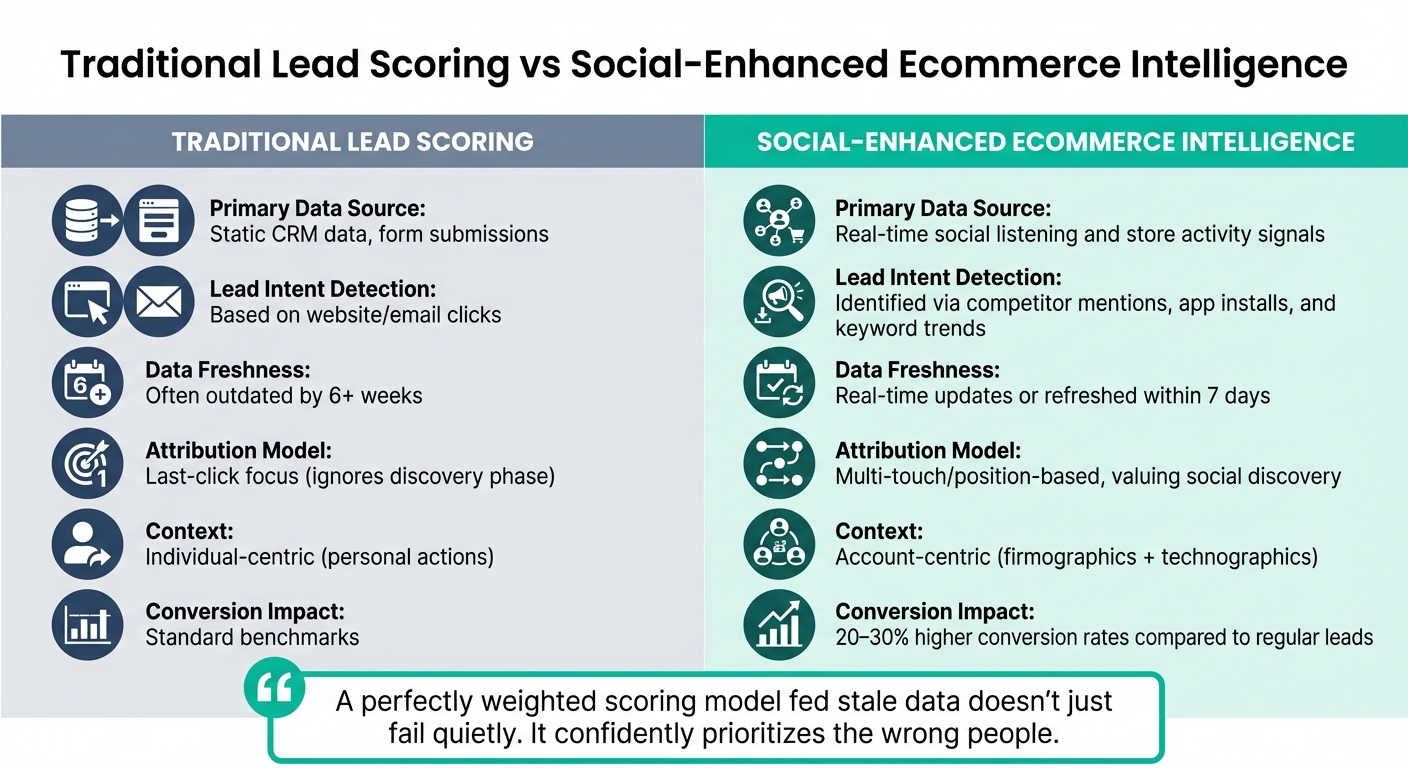
Traditional vs Social-Enhanced Lead Scoring Comparison 2026
Using StoreCensus for Social-Enhanced Lead Scoring
StoreCensus takes lead scoring to a new level by combining ecommerce signals with social intent data, offering a more dynamic way to evaluate lead quality. It monitors over 2.5 million ecommerce stores and analyzes more than 25 data points, such as app installations, store activity, and growth trends. For example, when a Shopify store adopts a new payment processor or installs an app, these technographic updates act as indicators of intent - similar to how competitor mentions on social media can signal interest.
This method shifts the focus from static demographic profiles to real-time actions, showing not just who leads are but what they're currently doing. Imagine a store owner who recently added an email marketing tool and interacted with industry-related content. This combination of technical readiness and behavioral activity provides a clearer picture of intent. Businesses using a mix of firmographic and intent-based targeting have been shown to close deals that are 73% larger on average.
StoreCensus also excels at uncovering the "Dark Funnel" - the hidden 90% of buyer research that happens before a prospect even visits a website. For instance, if multiple stakeholders from the same ecommerce company engage with relevant content within a 72-hour timeframe, StoreCensus flags the account for immediate action. This enables automated outreach based on a blend of social and ecommerce data, ensuring timely follow-ups.
Benefits of Real-Time Monitoring
Real-time monitoring changes the way leads are managed and prioritized. Instead of waiting for a prospect to fill out a form, sales teams can act as soon as a high-value signal is detected. For instance, the platform identifies key changes - like app removals or hitting a new revenue milestone - and sends instant alerts via Slack or email. This approach has proven effective, with 68% of marketers reporting better lead quality through social listening, and companies leveraging these insights achieving up to 10% faster revenue growth.
Automation further enhances the process by combining social engagement data with ecommerce activity. Custom workflows allow businesses to set specific scoring rules. For example, when a lead's combined score - based on social and ecommerce signals - exceeds a certain threshold, the system automatically routes that lead to sales with a 24-hour follow-up SLA. AI-driven lead enrichment using these signals can boost conversion rates by 25% while cutting acquisition costs by 15%.
Comparison: Traditional vs. Social-Enhanced Lead Scoring
The advantages of social-enhanced lead scoring become clear when compared to traditional methods:
| Feature | Traditional Lead Scoring | Social-Enhanced Ecommerce Intelligence |
|---|---|---|
| Primary Data Source | Static CRM data, form submissions | Real-time social listening and store activity signals |
| Lead Intent Detection | Based on website/email clicks | Identified via competitor mentions, app installs, and keyword trends |
| Data Freshness | Often outdated by 6+ weeks | Real-time updates or refreshed within 7 days |
| Attribution Model | Last-click focus (ignores discovery phase) | Multi-touch/position-based, valuing social discovery |
| Context | Individual-centric (personal actions) | Account-centric (firmographics + technographics) |
| Conversion Impact | Standard benchmarks | 20–30% higher conversion rates compared to regular leads |
The transition from static to behavior-driven scoring isn't just about collecting more data - it’s about capturing actionable insights as they happen.
"A perfectly weighted scoring model fed stale data doesn't just fail quietly. It confidently prioritizes the wrong people." - Prospeo team
Emerging Trends and Predictions for 2026
Ecommerce is undergoing a transformation, with advancements in AI and social commerce reshaping how businesses identify and prioritize genuine buyer intent.
AI-Driven Signal Analysis
AI is revolutionizing lead evaluation by replacing static scoring systems with adaptive models that learn from conversion data. Instead of assigning fixed points for actions, machine learning now assesses thousands of variables to pinpoint behaviors linked to successful deals.
One major leap forward is the ability to differentiate between research and purchase intent. For instance, someone searching for "best CRM tools" is likely exploring options, while a search for "HubSpot vs. Salesforce pricing comparison" signals a readiness to decide. AI analyzes these language patterns in real time, making lead scores far more precise.
Another game-changer is conversational scoring. AI evaluates chatbot and voice interactions on the fly, adjusting lead scores based on the prospect's questions and urgency. For example, if a prospect asks about implementation timelines or integration features during a chat, the system flags them as high-priority and routes them to sales immediately.
The results speak volumes. Businesses using AI-powered scoring report that 84% have a stronger grasp of customer intentions. Additionally, intent-based ads deliver 220% higher click-through rates compared to traditional campaigns. The Intent-Based Networking market reflects this momentum, projected to grow at 25% annually and hit US$27.3 billion by 2035.
As AI continues to refine lead scoring, social commerce is emerging as another powerful tool to capture consumer intent.
Social Commerce and Its Role in Lead Scoring
Social commerce is reshaping the entire buying journey. By 2026, platforms like TikTok and Instagram will host everything from discovery to checkout. This shift means lead scoring models must now track in-app behaviors like shoppable tag clicks, "add to cart" actions, and checkout initiations.
These actions provide high-quality intent data. For instance, when someone interacts with a product tag or saves an item on TikTok, it signals deeper interest than a simple website visit. While social media introduces 48% of customers to brands, only 2-5% make a purchase on their first click. However, customers acquired through social channels tend to have a 23% higher lifetime value than those from paid search.
Interactive video commerce takes this further by allowing marketers to track engagement during livestreams or product videos. For example, they can identify whether viewers watched pricing discussions or skipped them, helping brands distinguish between casual browsers and serious buyers.
The rise of "Agentic Commerce", where AI shopping agents handle searches and purchases for consumers, is also reshaping the landscape. AI-driven referrals saw a staggering 1,247% increase in conversions in October 2025 compared to the previous year. This trend means scoring models must now account for both human and machine interactions.
As consumer behaviors evolve, integrating real-time data becomes essential for effective lead scoring.
Dynamic Scoring and Real-Time Data
Static lead scores are becoming obsolete. The new norm is dynamic scoring, which updates instantly as new data comes in. For example, if a prospect visits a pricing page at 2:00 PM, their score adjusts immediately rather than waiting for a delayed update.
This real-time approach is crucial because engagement peaks right after an interaction. Alerts sent via Slack or SMS allow sales teams to respond faster, boosting conversion rates. Dynamic systems also include score decay, reducing a lead's score after 30 days of inactivity to help teams focus on active prospects.
Rising ad costs further underline the importance of real-time monitoring. CPMs on Meta platforms have climbed 15-25% year-over-year across most industries. With buyers completing 60-90% of their decision-making process before contacting vendors, businesses have a shrinking window to influence decisions.
Privacy regulations are also reshaping lead scoring. As third-party cookies phase out, companies are turning to first-party data and server-side tracking through tools like Conversions API. This shift emphasizes the need for models built on direct data - such as social interactions, website activity, and CRM records - rather than outdated third-party lists.
The convergence of AI insights, social commerce, and real-time data is redefining how businesses evaluate and prioritize leads. These changes are setting new standards for success in the increasingly competitive ecommerce landscape.
Conclusion
Lead scoring in 2026 focuses heavily on continuous behavioral signals rather than one-off actions. Repeated visits to pricing pages, consistent social media engagement, and interactions with decision-stage content now carry more weight than isolated behaviors. Social signals, like comments, shares, and engagement with creator content, have become real-time indicators of sales readiness. This shift highlights the growing importance of social commerce in shaping buying decisions.
With the old marketing funnel becoming obsolete, lead scoring must now consider in-platform actions like impulse purchases and seamless conversions. Social commerce platforms, which combine discovery and checkout in one place, require scoring models to track these integrated behaviors. For context, 72.3% of online users rely on social media for brand research, and 64% of TikTok shoppers make purchases after seeing ads or shoppable content.
Ecommerce businesses that combine real-time social signals with tools like StoreCensus can better identify high-intent leads. By monitoring changes in tech stacks, app installations, and store activity alongside social engagement, businesses can verify data accuracy and focus on leads showing consistent interest across multiple channels.
The numbers back this up: companies using lead scoring report a 77% increase in ROI, while AI-driven models reduce acquisition costs by up to 60% and increase sales-ready leads by 50%. With the global social commerce market projected to grow from $683 billion in 2024 to over $1 trillion by 2029, success will come to those who treat social signals as genuine indicators of purchase intent - not just vanity metrics.
FAQs
Which social signals best predict purchase intent?
In 2026, some of the strongest indicators of purchase intent will come from specific engagement behaviors on social media. These include actions like profile views, comments, and content saves on platforms like LinkedIn. Additionally, active mentions of brands, relevant keywords, or industry topics across social media channels will also serve as key signals. Together, these behaviors point to active buyer interest and a clear alignment with what prospects are seeking.
How do you combine social signals with store activity data?
Combining insights from social signals and store activity data allows businesses to gain a deeper understanding of a store's behavior and intentions. Social signals, like mentions or engagement on social media, paired with real-time store updates - such as app installations or design tweaks - paint a clearer picture of a store's activity. Tools like StoreCensus simplify this process by tracking and enriching store data. This helps teams focus on leads that show strong intent, using both social engagement and operational cues to guide their priorities.
How can I keep lead scores accurate in real time?
To keep lead scoring accurate and up-to-date, automation and AI-powered data tools are your best allies. By pulling in real-time updates - like social media activity, website engagement, and in-store interactions - you can create a dynamic scoring process that adjusts as new information comes in. Automating lead qualification not only speeds up the process but also ensures precision when handling large numbers of leads.
Incorporating insights from social listening and tracking behavior adds another layer of depth to your scoring models. Plus, regularly revisiting and updating your scoring criteria ensures your system stays aligned with the latest trends and data, keeping your scores both relevant and dependable.