Shopify Lead Segmentation with Psychographic Data
Use psychographic signals and tech-stack momentum to segment Shopify stores, personalize outreach, and improve engagement and conversions.

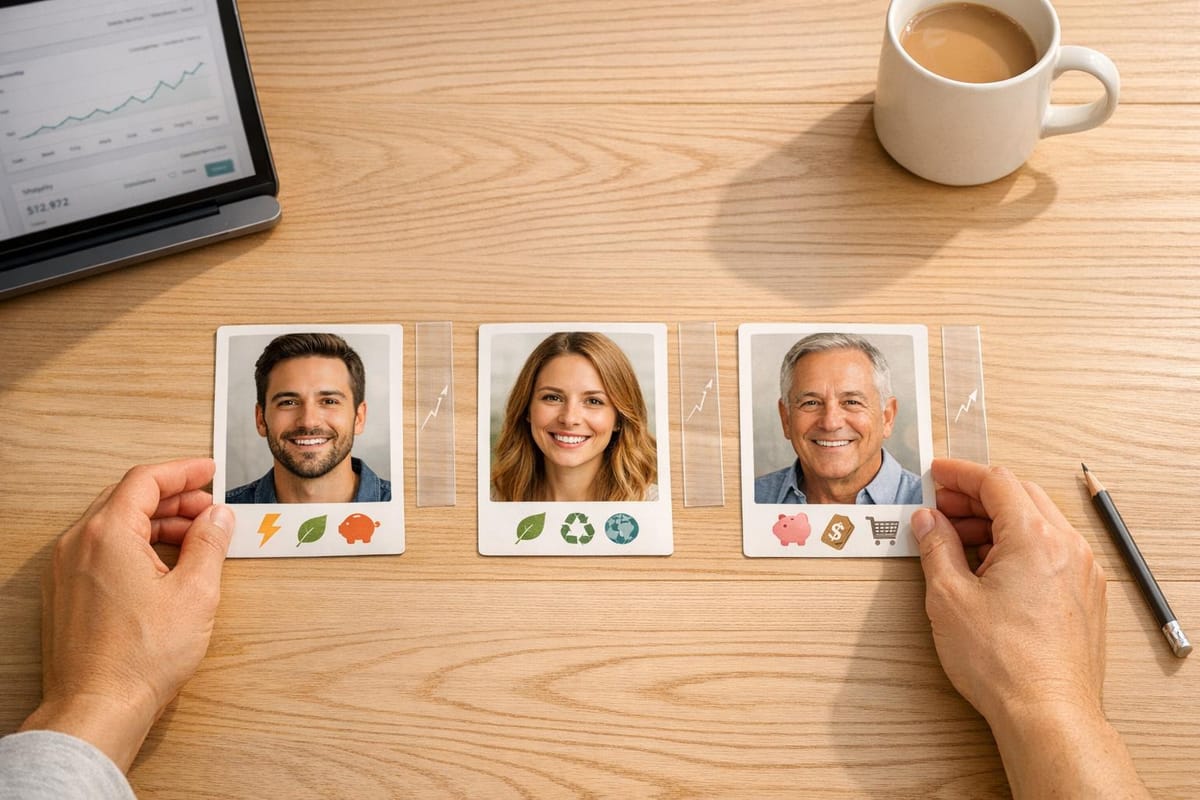
Psychographic segmentation dives into the "why" behind Shopify store owners' decisions, helping you understand their values, motivations, and challenges. Unlike basic demographic filters, this approach reveals deeper insights - like whether a store is driven by growth or constrained by budget. Using tools like StoreCensus, you can analyze over 2.5 million Shopify stores based on tech stacks, app usage, and momentum signals to create targeted outreach.
Here’s what you’ll learn:
- What psychographic segmentation is: Grouping customers by values, interests, and motivations instead of surface-level data.
- Why it matters: Personalized campaigns using this data see up to 49% higher click-through rates and reduce lead loss.
- How to apply it: Use Shopify analytics, external tools like StoreCensus, and customer surveys to craft precise segments.
- How to improve results: Track metrics like open rates, refine segments regularly, and update messaging to align with customer priorities.
This strategy shifts your focus from “what they do” to “why they do it,” creating campaigns that resonate with Shopify merchants’ mindsets.
E Commerce Psychology & Psychographic Marketing by Joris Fonteijn
What Is Psychographic Segmentation
Psychographic segmentation dives into what drives customer decisions by focusing on values, motivations, preferences, pains, friction, and risks. Unlike demographic or behavioral data that shows "who" and "what", psychographics reveal the "why." For example, knowing that a Shopify store earns $500,000 annually is helpful, but understanding that the owner prioritizes rapid growth through TikTok marketing is what truly shapes a strategy.
This type of segmentation uncovers the underlying reasons behind decisions. Take two Shopify stores using email marketing apps: one might prioritize automation and ROI tracking, while the other seeks simplicity and affordability. These nuances allow for more precise targeting. As Daniel Kyne, Founder of OpinionX, explains:
"Psychographic factors (people's needs, pains and desires) are what actually drive customers to behave the way they do."
At its core, psychographic segmentation identifies positive levers - like values and motivations - that encourage action, and negative levers - like pain points and risks - that create hesitation. For instance, a store owner driven by rapid scaling (a positive lever) might also worry about the technical complexity of new tools (a negative lever). Addressing both sides in your messaging can highlight benefits while easing concerns, making it a powerful tool for Shopify-focused strategies.
Why Psychographic Data Matters for Shopify
Psychographic data goes beyond surface-level insights to reveal the strategic priorities of Shopify merchants. For instance, a store using tools like Meta Pixel, Klaviyo, and TikTok Pixel shows a growth-driven mindset with a focus on ROI and automation. In contrast, a store relying on PageFly and Judge.me might reflect a DIY Builder approach - budget-conscious and growth-oriented but struggling with technical challenges.
This depth of understanding changes how you qualify leads. Francisco Ribeiro, a Product Manager at Glofox, offers a great example. By having customers rank their needs, Ribeiro identified how gym size influenced their top concerns. This insight allowed Glofox to adjust its product roadmap based on financial impact rather than guesswork. For Shopify prospecting, psychographic segmentation works similarly: it uncovers the real drivers behind customer challenges.
Another key takeaway is the importance of momentum over size. A $200,000/year Shopify store that recently adopted TikTok Pixel and upgraded to Klaviyo might be more aligned with growth than a $2 million/year store stuck using outdated tools. In fact, TikTok Pixel adoption surged 50% year-over-year in 2025, signaling a shift toward social commerce and younger audiences.
Benefits of Psychographic Segmentation
With a deeper understanding of store owner motivations, psychographic segmentation offers several advantages:
- Improved personalization: Tailor messaging to align with individual values and priorities instead of generic pain points. Speak directly to what matters most to the merchant.
- Better campaign targeting: Identify high-intent leads by recognizing stores actively addressing specific challenges.
- Higher conversion rates: Address friction or risks head-on. For example, reassure a DIY Builder concerned about complexity by emphasizing ease of use and support. For a growth-focused merchant worried about attribution gaps, highlight ROI tracking and multi-channel insights.
Campaigns leveraging psychographic segmentation have shown impressive results, with open rates exceeding 45% and reply rates surpassing 25% - well above typical industry benchmarks.
As Kyne puts it:
"Software buying today is focused on problem/solution fit - target customers have a problem they're looking to address, and they're evaluating your product as a potential solution."
Psychographic insights give you the context to demonstrate that you understand their specific problem before even presenting a solution.
How to Collect Psychographic Data for Shopify Leads
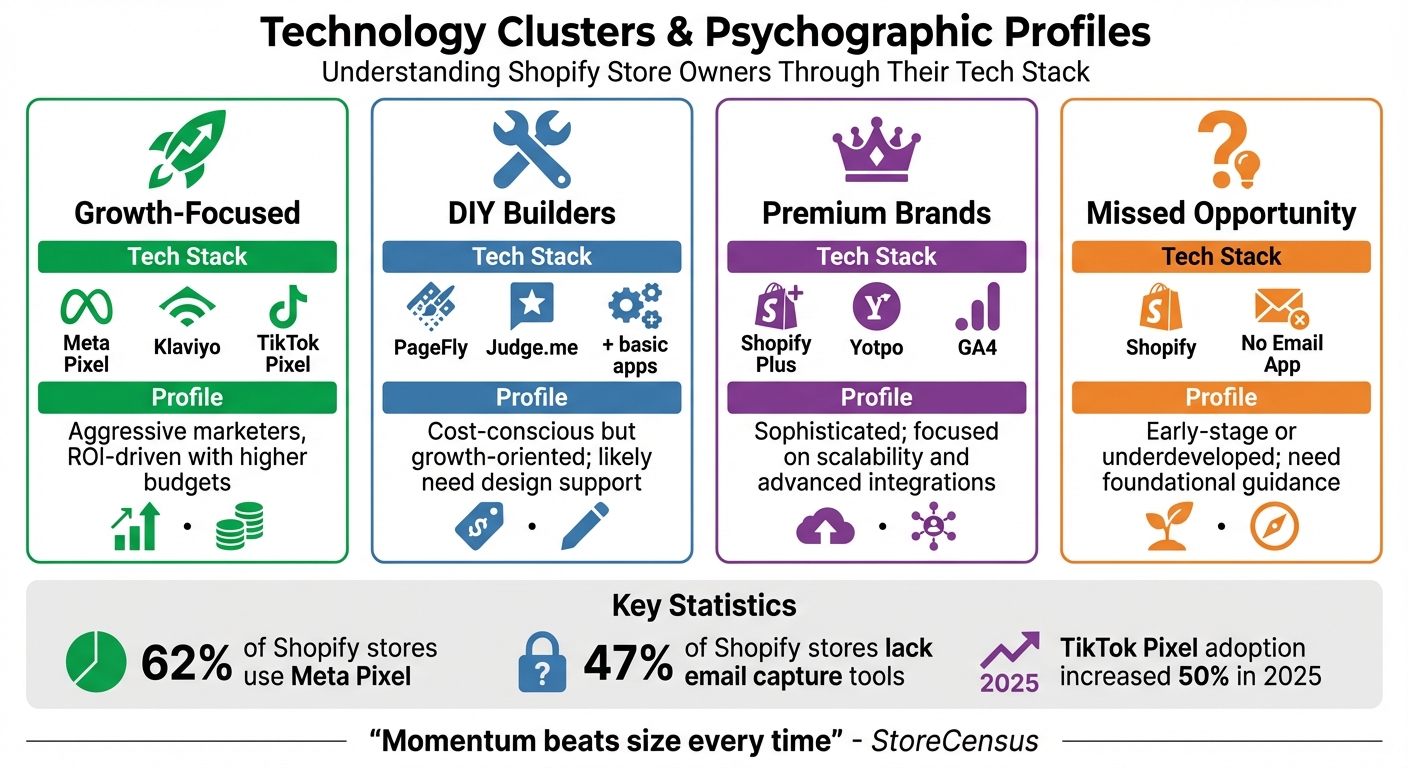
Shopify Store Technology Clusters and Psychographic Profiles
To effectively gather psychographic data, you need to combine direct customer behavior insights with external signals. This approach helps uncover the deeper motivations behind Shopify merchants' decisions, enabling you to create precise psychographic segments tailored to your store's audience.
Using Shopify Store Analytics
Shopify's analytics tools offer a wealth of data to identify psychographic traits by observing how customers interact with your store. For example, analyzing purchase behaviors and browsing habits can help you understand customer priorities and values. Shopify also supports RFM analysis (Recency, Frequency, Monetary), which segments customers into categories like "Champions" or "At-Risk", based on their engagement levels and spending patterns.
Additionally, Shopify's segmentation filters - such as total_spent, number_of_orders, and customer_tags - allow you to group leads based on their activity and perceived value. Customer tags can serve as psychographic markers. Labels like "eco-conscious", "value-seeker", or "hobbyist" provide clues for personalized marketing strategies. This is particularly important, as a McKinsey study found that 71% of customers expect personalized interactions, while 76% feel frustrated when personalization is lacking.
External Data Sources for Psychographic Insights
Shopify's tools are just the beginning. External platforms can provide additional layers of insight by analyzing signals such as technology stacks, app usage, and recent store activities. For instance, StoreCensus tracks over 2.5 million ecommerce stores and categorizes them into Technology Clusters based on their app configurations. These clusters often reveal the psychographic tendencies of store owners:
| Technology Cluster | Tech Stack Pattern | Psychographic Interpretation |
|---|---|---|
| Growth-Focused | Meta Pixel + Klaviyo + TikTok Pixel | Aggressive marketers; ROI-driven with higher budgets |
| DIY Builders | PageFly + Judge.me + basic apps | Cost-conscious but growth-oriented; likely need design support |
| Premium Brands | Shopify Plus + Yotpo + GA4 | Sophisticated; focused on scalability and advanced integrations |
| Missed Opportunity | Shopify + No Email App | Early-stage or underdeveloped; need foundational guidance |
For example, a store using Meta Pixel, Klaviyo, and TikTok Pixel might fall into the "Growth-Focused" cluster, suggesting a focus on aggressive marketing and ROI. On the other hand, a store relying on basic tools like PageFly and Judge.me may indicate a "DIY Builder" profile - someone who values growth but is budget-conscious.
External signals also highlight trends. For instance, TikTok Pixel adoption surged by 50% in 2025, and 62% of Shopify stores use Meta Pixel. However, 47% of Shopify stores lack email capture tools, creating a "Missed Opportunity" segment ripe for targeted solutions. Tracking momentum indicators, such as recent app installations or updated marketing tools, often provides better insights into a store's growth potential than static metrics. As StoreCensus aptly notes:
"Momentum beats size every time".
To deepen these insights, consider combining external data with direct customer feedback.
Creating Customer Surveys and Feedback Loops
While passive data collection is valuable, direct customer feedback offers a more nuanced understanding of psychographic traits. Surveys, especially post-purchase ones, are a great way to capture customer motivations and intentions while their experience is still fresh. For instance, you can ask whether a purchase was for personal use or a gift, what drove the decision (e.g., convenience versus quality), or what values (like eco-friendliness) influenced the choice.
Keep surveys focused on key data points that can directly improve your marketing efforts. Using standardized options instead of open-ended questions simplifies segmentation. Even a single, well-chosen preference field - like channel preference or product interest - can make your outreach more effective. On-site preference forms or loyalty program sign-ups are also excellent opportunities to gather psychographic data.
| Psychographic Lens | Data to Capture | Practical Application |
|---|---|---|
| Values | Eco-friendly, trend-seeking, or value-driven | Craft messaging that aligns with customer beliefs |
| Interests | Hobbyist vs. professional status | Recommend products suited to their skill level |
| Motivations | Gift vs. personal use | Personalize follow-ups and gift guides |
| Channel Preference | SMS, email, or social media | Optimize outreach based on preferred communication channels |
Considering the average cart abandonment rate hovers around 70%, improving segmentation through psychographic insights can help address friction points and increase conversions.
How to Build Psychographic Segments in Shopify
Turning psychographic data into usable customer segments is all about understanding your audience on a deeper level. It means focusing on what drives their decisions - values, interests, and motivations - rather than just their buying history. Shopify's segmentation tools make this process manageable, but the real test lies in setting up criteria that reflect these internal drivers.
Defining Segment Criteria
Start by identifying the psychographic traits that influence customer behavior. These traits should go beyond surface-level actions and highlight what truly motivates your audience. For example, you might group customers as hobbyists versus professionals, eco-conscious shoppers versus trend-followers, or value-driven buyers versus premium seekers. Each group responds differently to messaging, so defining these distinctions is key.
To create a segment in Shopify, navigate to Customers > Segments > New segment. Psychographic data is often stored as tags or meta-fields, which you can use as filters. For instance, if you've tagged customers as "eco-friendly" through surveys, you can filter using customer_tags CONTAINS 'eco-friendly'. Shopify even provides a real-time count of matching customers, letting you see if your segment is large enough for a campaign.
Take it a step further by combining psychographic filters with behavioral and geographic data. For example, you could create a segment for "Eco-Conscious High Spenders" by layering customer_tags CONTAINS 'eco-friendly' with total_spent > $500 and last_order_date within last 90 days. This approach ensures you're targeting customers who not only share your brand's values but are also actively engaged.
| Psychographic Lens | Criteria Examples | Outreach Angle |
|---|---|---|
| Values-Based | Eco-first, Sustainability-focused | Highlight ethical sourcing and environmental impact |
| Interest-Based | Hobbyist vs. Professional | Educational content for hobbyists; bulk options for pros |
| Motivation-Based | Trend-seeker vs. Value buyer | Early access to new drops for trend-seekers; discounts for value buyers |
| Usage-Based | Gift-giver vs. Self-user | Gift guides and packaging options vs. replenishment reminders |
For Shopify store owners targeting other businesses (B2B), tools like StoreCensus can help segment stores based on psychographic tendencies. For instance, a "Growth-Focused" profile might include stores with aggressive marketing strategies and larger budgets. These profiles often reveal momentum indicators, like new app installations or an expanding product catalog, which can be more telling than revenue alone. As Nick, the founder of StoreCensus, explains:
"Momentum beats size every time. A $200k/year store growing 50% annually is a better prospect than a $2M/year store that's stagnant."
- Nick, Founder, StoreCensus
Once you've defined your criteria, the next step is to keep your segments organized and easy to manage.
Organizing and Naming Segments
A clear naming system is essential for smooth campaign management and team collaboration. Use descriptive names that immediately convey the segment's focus, like "Eco-Conscious High Spenders" or "Professional-Tier Hobbyists." For B2B segments, a format such as [Vertical] | [Revenue Range] | [Key Tech Signal/Gap] works well - for example, "Beauty | $100k-$500k | No Klaviyo".
Organize your segments into priority tiers to streamline outreach. For instance, an "A-list" segment might include high-momentum stores with advanced tech stacks, while a "C-list" segment could target newer stores with foundational gaps. Consistency in tagging is also crucial - standardize tag names and field values to avoid fragmenting your segments. For example, using both "eco-friendly" and "eco-conscious" can create confusion and reduce accuracy.
You can also use Shopify Flow to automate actions when a customer joins a specific segment. For instance, trigger a tailored welcome sequence for value-driven shoppers or set reminders for follow-ups. Document each segment's purpose and corresponding actions to keep your team aligned and avoid overloading customers with too many messages.
How to Personalize Outreach Using Psychographic Segments
Once you've identified your audience segments, the next step is crafting outreach that connects on a deeper level. The key? Delivering the right message to the right person through the right channel.
Aligning Messaging with Segment Values
Your messaging should reflect what each segment values most. For example, eco-conscious shoppers care about ethical sourcing, sustainability, and environmental impact. Meanwhile, adventure-seekers respond to visuals that highlight exploration and new experiences.
Take Golde, a wellness beverage company, as an example. In 2025, co-founder Trinity Mouzon Wofford used segmentation to uncover that customers weren’t just buying matcha for health benefits - they valued the ritual of a calming, meditative morning. As Wofford shared:
"We found one of the big reasons why customers use our products, beyond the fact that they are looking for the benefit, is that they love the ritual."
By shifting their messaging to focus on self-care and personal time, Golde created a stronger connection with their audience. Similarly, Honest Paws reframed abandoned cart emails to emphasize emotional value. Instead of a generic reminder, they wrote, "your pet's wellness is one click away", turning the purchase into an act of care rather than a transaction.
For B2B outreach, the same principles apply. If you're targeting a "Growth-Focused" Shopify store - those using tools like Meta Pixel, Klaviyo, and TikTok Pixel - highlight ROI, advanced attribution, and automation. For "DIY Builders" with simpler setups like PageFly and Judge.me, focus on ease of use, quick wins, and professional results. Tools like StoreCensus can help identify these tech clusters, allowing you to tailor your pitch to each store's needs and sophistication level.
| Psychographic Segment | Messaging Focus | Example Hook |
|---|---|---|
| Eco-Conscious | Sustainability, ethics, environmental impact | "Your customers care about the planet - show them you do too" |
| Adventure-Seekers | New experiences, exploration | "Gear up for the next adventure - new arrivals just dropped" |
| Routine-Oriented | Reliability, consistency, replenishment | "Never run out - your next order is ready when you are" |
| Value-Driven | Discounts, cost-effectiveness, sales | "Save 20% on your favorites - limited time only" |
| Self-Care/Ritual | Peace, meditative experiences, "me-time" | "Take a moment for yourself - you've earned it" |
Once your messaging is on point, the next step is choosing the best channels to deliver it.
Customizing Channels and Campaigns
With your messaging aligned to segment values, focus on the channels that will best engage each group. For instance, eco-conscious consumers and self-care buyers are drawn to email and Instagram, where you can share detailed stories about your brand's mission. On the other hand, trend-seekers and younger audiences thrive on TikTok and Instagram, where visual content and social proof dominate. TikTok's popularity among Shopify stores has surged, with TikTok Pixel adoption increasing by 50% in 2025.
For value-driven shoppers, SMS and web push notifications work well for delivering time-sensitive discounts. Routine-oriented customers appreciate automated reminders via email or WhatsApp. An example is Sova, a gut health brand, which uses WhatsApp to send 30-day replenishment reminders paired with a personalized discount and direct checkout link.
Propeller Coffee Co. saw a 175% boost in email marketing conversions by segmenting their audience based on factors like purchase frequency, product mix, and location. They then tailored promotions and product suggestions to each group. Former VP Aaron Zack's strategy shows how combining psychographic insights with channel-specific strategies can lead to outstanding results.
For B2B outreach, channel selection is just as critical. Use LinkedIn for pitching professional services and agencies, Instagram DM for direct-to-consumer fashion and lifestyle brands, and Twitter/X for tech-savvy SaaS companies. The key is to avoid generic templates. Instead, lead with specific observations about the business. As StoreCensus explains:
"People don't reply to pitches - they respond to insights."
For instance, if a Shopify store has Meta Pixel installed but lacks email retargeting, point that out and offer a solution. If they've recently added TikTok Pixel, acknowledge their move into social commerce and position yourself as an expert in that space. Tools like StoreCensus make it easier to identify these specific signals, helping you craft pitches that stand out.
It’s worth noting that 71% of customers expect personalized interactions, and 76% feel frustrated when brands fail to deliver. By aligning your message with their values and choosing the right channels, you’re not just improving your chances of conversion - you’re fostering relationships built on genuine understanding.
How to Analyze and Improve Psychographic Segmentation
Creating psychographic segments is just the beginning. To make meaningful progress, you need to track their performance and refine them over time. Without measurable data, it’s impossible to identify which segments are driving results and which need adjustment.
Tracking Engagement and Conversion Metrics
Start by analyzing how each segment performs throughout your sales funnel - not just at the awareness stage. Key metrics to focus on include open rates, reply rates, meeting rates, and close rates. For example, if a segment has a high open rate but struggles to convert meetings into closed deals, it might mean your messaging grabs attention but fails to qualify prospects effectively.
Here’s a real-world example: In 2025, an email marketing agency used StoreCensus to target Beauty & Personal Care stores with annual sales between $100,000 and $500,000. They focused on stores using Meta Pixel but not Klaviyo. Out of 174 valid emails, they achieved a 32% open rate, a 16% response rate, and a 9% meeting rate. This effort resulted in a 35% close rate, adding $14,500 in new Monthly Recurring Revenue (MRR).
Use these benchmarks to gauge your own performance:
| Metric | Good | Great | Excellent |
|---|---|---|---|
| Open Rate | 25% | 35% | 45%+ |
| Reply Rate | 8% | 15% | 25%+ |
| Meeting Rate | 3% | 8% | 15%+ |
| Bounce Rate | <5% | <2% | <1% |
But don’t stop at the numbers. Dig into the sentiment behind responses to separate genuine interest from polite declines. Also, keep an eye on Customer Lifetime Value (LTV) and repeat purchase rates within each segment. A group with lower initial conversions but higher LTV could be more rewarding over time.
These insights serve as a roadmap for refining your segmentation strategy.
Updating Segment Definitions
Once you’ve established benchmarks, it’s essential to regularly update your segment definitions to keep pace with shifting market dynamics. Segmentation works best when it evolves alongside customer behavior and emerging trends. Review your tactics weekly and reassess revenue estimates or tech signals on a monthly basis.
Focus on momentum indicators rather than static metrics. For instance, a growing store that recently installed tools like TikTok Pixel may be a better target than a larger, stagnant business. In 2025, TikTok Pixel installations rose by 50% year-over-year, reflecting a trend toward younger audiences and social commerce. If growth-oriented businesses are your priority, tweak your segments to emphasize recent app installations or other dynamic changes.
To allocate resources effectively, use a 1-5 star rating system. Dedicate 60% of your efforts to "5-star" leads - those that perfectly align with your ideal budget, needs, and timing. Meanwhile, maintain automated monthly touchpoints for "3-star" leads. Keep in mind, though, that 60% of your top prospects might not be ready to buy for another 3–12 months. Instead of abandoning these leads, nurture them with timely reminders, such as alerts for contract renewals, budget updates, or new product launches.
StoreCensus can help you monitor real-time changes within your segments. If a group shows a weak meeting-to-close conversion rate, adjust your criteria and test alternative approaches. This ongoing refinement ensures your segmentation remains effective and aligned with your business goals.
Conclusion
Psychographic segmentation is changing the game for Shopify lead generation. By focusing on what truly drives a store - its values, growth goals, and technology preferences - you can craft outreach that feels personal and relevant. As we've seen, tailoring your approach makes a big difference.
This strategy doesn't just improve lead generation; it delivers measurable results. Targeted outreach can achieve response rates of 15–25%, far outpacing the usual 1–3%. When your messaging aligns with a store's actual needs - whether it's a growth-driven brand aiming for better ROI or a hands-on entrepreneur looking for expert support - you see higher open rates and more conversions.
Executing this level of precision is easier with the right tools. StoreCensus simplifies the process by tracking a comprehensive list of Shopify stores and offering real-time insights into revenue, traffic, app usage, and tech stacks. It replaces tedious manual research with automation, letting you filter leads by momentum indicators like recent TikTok Pixel installations, which saw a 50% increase year-over-year in 2025. You can also pinpoint stores with solid marketing budgets but missing key tools. All this data - tech stack, revenue tier, and growth signals - stays tied to each lead profile, ensuring you never lose sight of why a prospect is valuable.
By combining these insights, you minimize lead loss and strengthen connections.
"The best prospecting system isn't about finding more leads. It's about losing fewer of the ones you already found." - StoreCensus Team
FAQs
What psychographic signals matter most for Shopify lead segmentation?
Understanding the psychographic signals behind Shopify lead segmentation can reveal a lot about a store's motivations, values, and behaviors. Some of the most telling indicators include growth trends, app usage patterns, and recent design or technology updates. These clues often highlight a store's openness to new ideas and its strategic focus.
When you pair these signals with methods like RFM analysis (Recency, Frequency, Monetary value) and categorizing leads by spend tiers, you can zero in on high-value opportunities. This approach also sheds light on a store's mindset, branding priorities, and how it engages with its customers. It’s a deeper dive into what makes each store tick.
How do I turn app and tech stack data into psychographic segments?
To build psychographic segments using app and tech stack data, look at the technologies a Shopify store relies on to uncover behaviors and preferences. For instance, stores using advanced tools like Klaviyo often prioritize personalized marketing efforts. On the other hand, stores with simpler tech stacks might be in earlier growth stages or focusing on foundational operations. Tools like StoreCensus can monitor app usage and changes in activity, offering insights into operational priorities and shifting strategies. This approach helps fine-tune segmentation, making targeting and outreach more precise and effective.
How often should I refresh segments based on momentum signals?
To keep your targeting sharp, it's important to update audience segments frequently based on momentum signals. Using real-time monitoring and alerts - like app installs, removals, or shifts in store activity - can help automate this process. Whenever new signals come in, adjust your segments promptly or set up a system for regular updates. This approach ensures your outreach remains timely and aligned with current behaviors. Dynamic updates play a key role in refining lead qualification and improving targeting accuracy.