Geographic Data for Ecommerce Lead Targeting
Leverage location data to target high-value ecommerce regions, cut lead research time, assign territories, and boost conversion rates and ROI.

Sales teams waste time chasing low-value leads without geographic focus. Using location data can improve conversion rates by up to 3x and cut lead research time by 60%. It helps identify high-growth regions, prioritize valuable markets, and align resources more effectively.
Key takeaways:
- Target the right regions: Avoid pitching to areas you can't serve (e.g., international shipping limits or regulatory issues).
- Spot high-growth markets: Focus on hubs like California or Texas, where ecommerce activity clusters.
- Distribute resources wisely: Invest in regions with high potential and avoid oversaturated areas.
Tools like StoreCensus allow precise filtering by location, integrating geographic data into CRMs for smarter lead management. This approach reduces wasted effort, improves ROI, and ensures your outreach reaches the right audience.
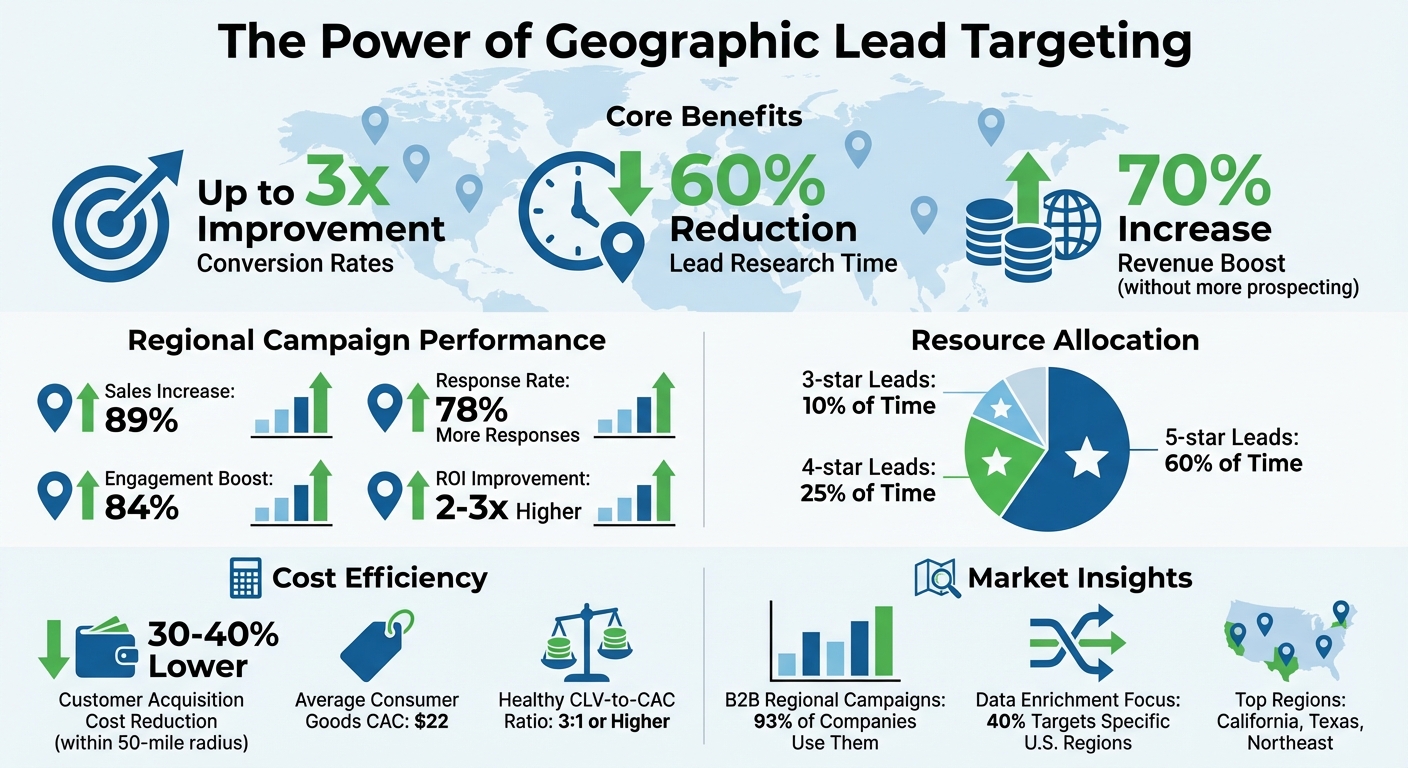
Geographic Lead Targeting Impact: Key Statistics and ROI Metrics
Generate More Leads and Sales with Geo Location Targeting
Problems with Lead Targeting Without Geographic Data
Skipping geographic data in your lead targeting can drain your budget on low-quality leads and leave potential growth areas untapped. Here’s a breakdown of the challenges this creates.
Targeting the Wrong Regions
Reaching out to areas you can’t serve is a waste of time and resources. For example, if your business lacks international shipping capabilities or your software doesn’t comply with local regulations, pitching to those regions is almost guaranteed to fail. Without proper location filters, your team might send one-size-fits-all messages to places that don’t align with your offerings. The result? Low engagement and disappointing click-through rates.
Missing High-Growth Markets
Geographic data helps uncover where your best opportunities lie. For instance, financial services often cluster in New York, tech startups thrive in California, and beauty brands tend to concentrate in specific metro areas. Without this information, these patterns remain hidden in basic lead lists. It’s worth noting that 40% of data enrichment efforts focus on specific U.S. regions. Without these insights, your team risks spreading resources too thin and missing out on the regional hubs where your ideal customers are most active.
Poor Resource Distribution
When sales teams spend time qualifying leads from areas they can’t support, budgets and efforts are misdirected. Without knowing where prospects are located, it’s easy for teams to overlap in saturated regions while ignoring new, high-potential markets. This inefficiency - often called a "Prospecting Tax" - forces teams to restart their efforts each month because there’s no clear record of which regions yield quality leads and which simply drain resources.
How Geographic Data Fixes Lead Targeting Problems
Geographic data transforms lead targeting from a guessing game into a precise, data-driven strategy. By understanding where your ideal customers are located, you can fine-tune your approach to meet their specific needs.
Finding High-Intent Stores by Location
Regional demand patterns help identify which stores are most likely to convert. Take a winter apparel brand, for example. Targeting stores in Minnesota would naturally yield better results than pitching the same products to retailers in Florida. Geographic data aligns your offerings with local factors like weather, economic trends, and state regulations.
Location-based targeting doesn’t just improve accuracy - it delivers results. It boosts sales by 89% and engagement by 84%. Companies focusing on leads within a 50-mile radius of their operations enjoy 30% to 40% lower customer acquisition costs, thanks to the proximity advantage. This closeness allows for in-person consultations and product demonstrations, which help build trust more effectively.
Geographic segmentation also doubles or even triples ROI by directing resources to areas with the highest sales potential. By focusing on regions where your infrastructure, compliance tools, or logistics naturally align with local demands, you can avoid wasting time on prospects unlikely to convert.
But geographic data doesn’t stop at identifying high-intent stores - it also highlights where market growth is accelerating.
Identifying Fast-Growing Regions
Not all markets grow at the same pace. Around 40% of B2B data enrichment campaigns target specific U.S. regions, with California, Texas, and the Northeast leading the way. These areas are hotspots for ecommerce activity and faster technology adoption.
With over 4.6 million active Shopify stores globally and an average of 61,000 new stores created each month, tracking where this growth is concentrated can give you a competitive edge. High-growth verticals like Beauty & Wellness, Jewelry, and Pet products often cluster in metro areas, forming regional hubs of activity.
Combining geographic analysis with growth signals - like new store openings, app installations, or marketing pixel adoption - helps you spot trends early. For instance, TikTok Pixel adoption surged by 50% between 2024 and 2025, signaling regions where businesses are actively investing in expansion.
These insights not only improve lead quality but also help allocate resources more efficiently.
Allocating Sales Resources by Region
Geographic data ensures your sales efforts are focused where they matter most. High-performing sales teams dedicate 60% of their time to 5-star leads, 25% to 4-star leads, and just 10% to 3-star leads. Geographic fit plays a key role here. A perfect prospect in a location you can’t serve is a missed opportunity - and wasted effort.
By incorporating geographic fit into a lead rating system, sales teams see a 70% boost in revenue without increasing prospecting efforts. Merging location data with revenue and technology insights allows you to create focused segments like “US-based Beauty Brands - High Value,” which gain even more precision as interaction data accumulates.
"The best prospecting system isn't about finding more leads. It's about losing fewer of the ones you already found." - StoreCensus
Avoid spreading resources too thin across oversaturated areas. Instead, assign sales reps to specific territories where they can develop deeper regional expertise and stronger customer relationships. This approach not only maximizes efficiency but also builds a compounding pipeline in regions with the highest potential for growth.
Using Geographic Data with StoreCensus
StoreCensus offers access to location data for over 2.5 million ecommerce stores. By combining country, state, and regional filters with 25+ other data points - like installed apps, revenue ranges, and growth indicators - you can create Shopify brand prospect lists tailored to your geographic focus and ideal customer profile. This precise targeting not only improves lead selection but also integrates smoothly into your existing sales processes.
Filtering Stores by Location
With StoreCensus, you can filter stores by ISO country codes (e.g., "US", "GB", "CA") and state abbreviations (e.g., "CA", "NY", "TX"). These geographic filters work alongside advanced criteria like technology stack, traffic levels, and product catalog size. For instance, you could focus on beauty brands in California that use Meta Pixel and generate revenue between $100K and $250K. This level of detail ensures you're reaching the right prospects and avoiding outreach to stores outside your target market.
What makes this approach stand out is how it combines location-based filtering with intent signals, like recent app installations or revenue changes. This layered filtering approach reflects how 93% of B2B companies run regional campaigns, concentrating their efforts where they can achieve the best results. Next up: how to track regional activity to stay ahead of market changes.
Tracking Regional Store Activity
Once high-growth regions are identified, StoreCensus enables real-time tracking to monitor ongoing activity. The platform captures changes over 7- and 30-day periods, tracking metrics like product counts, traffic, and technology investments. If a store in your target region installs a new app, updates its theme, or moves into a higher revenue bracket, StoreCensus automatically detects it and can trigger outbound workflows.
For example, the StoreCensus 2025 Shopify Index revealed that TikTok Pixel adoption grew by 50% year-over-year, while Shopify stores overall saw a 12% increase. By keeping tabs on where these trends are happening geographically, you can pinpoint fast-growing markets before your competitors. You can even set alerts for actions like "Theme Changed" or "App Uninstalled" in specific states to identify stores during key transition periods - moments when they're likely evaluating new solutions.
Adding Geographic Data to Lead Records
Incorporating geographic data into lead records enhances targeting and simplifies sales distribution. Each lead record includes detailed location information, such as address, city, state, country, zip code, and timezone. This goes beyond basic contact details, allowing you to personalize outreach with local market insights, schedule communications during business hours, and assign leads to the right territories.
StoreCensus ensures 99.2% data accuracy, and its geographic data integrates directly with CRMs like HubSpot and Salesforce through native connections. Whether you're exporting a lead list or syncing data via the API, location details flow seamlessly into your sales workflows. This means every lead is routed to the appropriate sales rep, ensuring territory-based lead generation runs smoothly from the start.
Measuring Results from Geographic Targeting
Once you've incorporated geographic data into your workflows, the next step is understanding its impact on lead conversion. Analyzing performance by region helps you determine whether your targeting efforts are effective or if you're wasting resources. The focus should be on metrics tied to geography rather than just overall pipeline figures. A good starting point is tracking regional conversion rates - the percentage of leads from a specific area who become customers. For context, the average ecommerce conversion rate typically falls between 2% and 3%. Comparing these rates across regions can highlight where your strategy is thriving and where adjustments are needed.
Metrics for Geographic Targeting
To evaluate the efficiency of your spending, monitor cost per acquisition (CPA) by region. For consumer goods, the average customer acquisition cost is about $22. Compare CPA with the customer lifetime value (CLV) for each region to identify which markets are worth the investment. A CLV-to-CAC ratio of 3:1 is considered healthy, while anything above 3.5 indicates even greater profitability.
Other key metrics include:
- Order growth by region: This helps you spot areas where demand is increasing.
- Traffic by location: Identify regions with high traffic but low conversion rates, signaling untapped opportunities.
Armed with these insights, you can refine your approach through targeted testing.
Testing Geographic Campaigns
A/B testing is a powerful way to optimize your regional campaigns. Experiment with different messaging, offers, and timing to discover what resonates locally. Businesses that use geographic segmentation often achieve 2–3x higher ROI compared to broader, national campaigns.
Another useful tactic is adjusting your budget based on regional performance. For instance, allocate more resources to ZIP codes or states showing strong results, while scaling back in underperforming areas. The benefits of such strategies are clear - regional campaigns have been shown to boost sales by up to 89%, increase engagement by 84%, and generate 78% more responses. Once you've validated these approaches, the next step is integrating this data into your CRM for streamlined lead management.
Syncing Geographic Data to CRM
After identifying successful regional strategies, syncing geographic data with your CRM ensures seamless lead management and routing. By integrating location details - such as country, state, city, ZIP code, and timezone - into platforms like HubSpot or Salesforce, you can automate territory assignments and track performance more effectively. Tools like StoreCensus make this process easier by syncing geographic data directly.
Here are some best practices for CRM integration:
- Use ISO 3166-1 alpha-2 codes (e.g., "US", "GB", "CA") for country fields to maintain compatibility with CRM reporting.
- Implement a 1–5 star rating system to prioritize leads based on regional fit and revenue potential. Focus 60% of your sales efforts on 5-star prospects.
- Include timezone data to ensure automated emails and calls are sent during local business hours.
These steps not only enhance lead routing but also improve the overall efficiency of your geographic targeting strategy. By combining data insights with CRM automation, you can maximize your team's productivity and focus on high-value opportunities.
Conclusion
Geographic data is changing the game for ecommerce teams by replacing guesswork with precision. Instead of casting a wide net and hoping for results, teams can now zero in on regions where they have the best operational capacity, language skills, and market alignment. This approach eliminates wasted effort, speeds up sales cycles, and boosts conversion rates by focusing on prospects who are more likely to benefit from your solution.
When geographic data is combined with tools like technology stack insights, growth indicators, and activity tracking, the results are even more impactful. These integrations allow teams to refine their audience segments, transforming massive prospect lists into smaller, highly qualified groups that are more likely to engage - making outreach efforts far more effective.
StoreCensus brings this precision to life by offering detailed store tracking enriched with location data. This data syncs seamlessly with CRM systems, enabling automated territory assignments and performance monitoring.
For agencies, SaaS founders, and growth teams focused on ecommerce, location intelligence is no longer optional - it’s essential. It helps pinpoint the right markets, allocate sales resources effectively, and craft messaging that truly resonates with local audiences. By adopting tools like StoreCensus, teams can shift from reactive strategies to proactive domination of key markets, solving the lead targeting challenges that once held them back and unlocking new growth opportunities.
FAQs
Which regions should we target first?
To zero in on the best regions for ecommerce lead generation, start by targeting areas with strong ecommerce activity and growth potential. The United States stands out as a prime choice due to its advanced digital infrastructure, high levels of consumer spending, and the sheer volume of Shopify stores operating within the country.
To refine your efforts even further, leverage tools like geographic filtering to focus on high-density ecommerce hubs. States like California, Texas, New York, and Florida are excellent examples. By concentrating on these regions, you can boost the efficiency of your outreach and spot promising growth opportunities.
What location fields should go into our CRM?
Including country and region/state fields in your CRM is a smart move for fine-tuning your lead targeting. This allows for precise geographic segmentation, which is vital for crafting regional strategies, managing shipping logistics, and addressing local demand. Want to go even further? Adding city-level data can take your outreach to the next level, especially for campaigns that focus on specific locations. With detailed geographic information, your sales efforts can be more personalized and relevant, making it easier to focus on high-potential opportunities and connect with businesses in areas that show strong promise.
How do we measure ROI by region?
Analyzing ROI by region means looking at how outreach efforts perform in different geographic areas. To do this, businesses focus on key metrics like conversion rates, sales volume, and engagement, all broken down by region.
Tools such as StoreCensus make this process easier by tracking store activity, identifying growth trends, and monitoring technology updates specific to each area. This helps businesses connect leads and sales to specific regions.
By comparing metrics like revenue and lead quality across various locations, companies can fine-tune their strategies, allocate resources where they’re needed most, and improve overall ROI.