Ecommerce Hierarchies: Key Roles to Target
Target the right ecommerce decision-makers by matching outreach to eight distinct roles, their priorities, and buying signals.


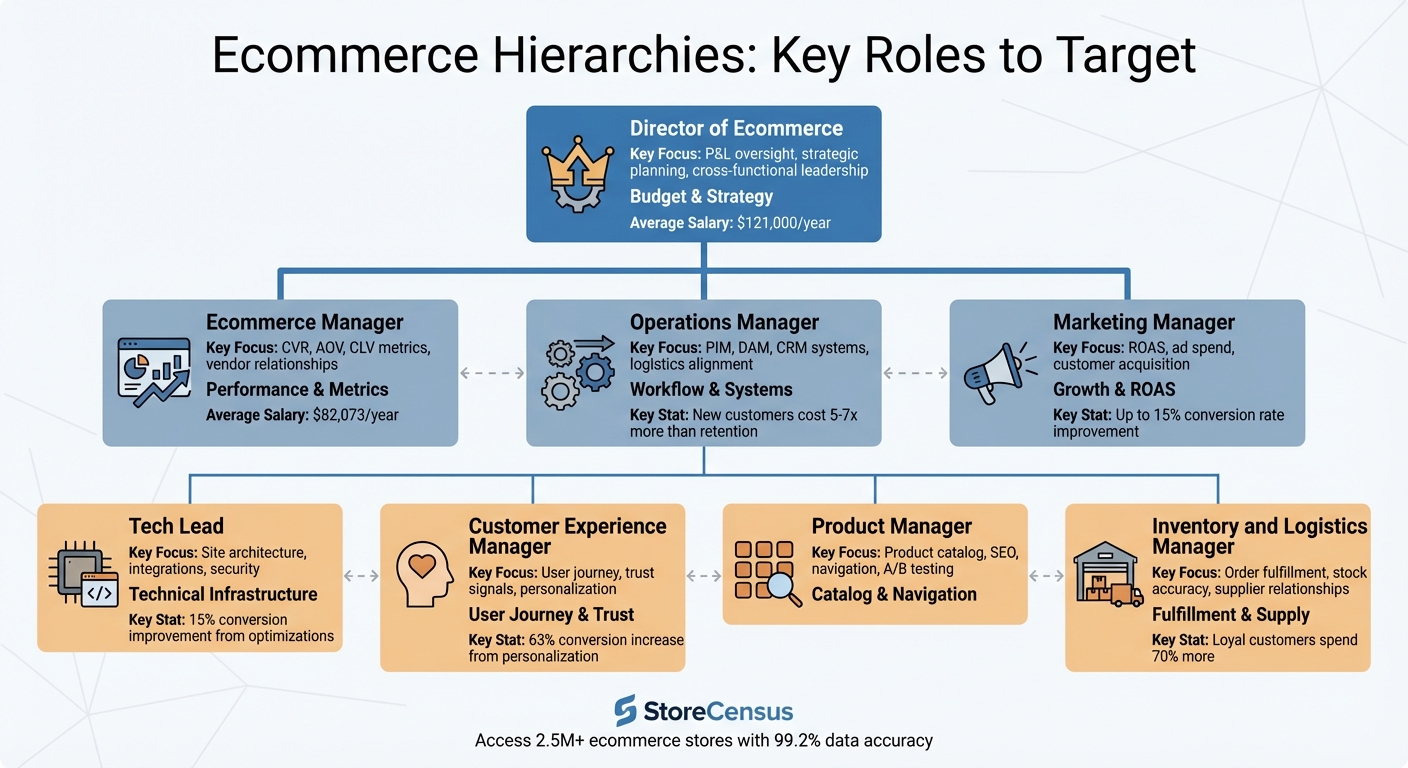
In ecommerce, success often hinges on connecting with the right decision-maker. Each role - from Ecommerce Managers to Directors of Ecommerce - carries distinct responsibilities and decision-making powers. Understanding these roles allows you to craft tailored outreach strategies that address their specific challenges and goals. Here's a quick breakdown of the key roles and their focus areas:
- Ecommerce Manager: Oversees budgets, conversion funnels, and vendor relationships, focusing on metrics like CVR, AOV, and CLV.
- Operations Manager: Aligns logistics, IT, and marketing, ensuring smooth workflows and reducing cart abandonment through technical optimizations.
- Marketing Manager: Manages ad spend, brand positioning, and customer acquisition strategies, focusing on ROAS and customer retention.
- Tech Lead: Builds and maintains the technical infrastructure, optimizing site performance, integrations, and security.
- Customer Experience Manager: Enhances user journeys, improves trust signals, and drives customer retention through personalization.
- Product Manager: Manages product catalogs, navigation, and SEO to improve customer engagement and sales.
- Inventory and Logistics Manager: Ensures accurate inventory, smooth order fulfillment, and data-driven supply chain decisions.
- Director of Ecommerce: Develops overarching strategies, manages P&L, and integrates technology to scale the business.
StoreCensus simplifies the process of reaching these decision-makers by providing structured data on over 2.5 million ecommerce stores. With advanced filters and real-time updates, it helps you target the right people at the right time, improving outreach effectiveness and response rates.
8 Key Ecommerce Roles and Their Primary Responsibilities
1. Ecommerce Manager
Decision-making Authority
Ecommerce Managers oversee budgets for marketing, technology, and staffing, turning broad company goals into actionable plans. They set critical KPIs like conversion rate (CVR), average order value (AOV), and customer lifetime value (CLV). As Mike De Lia, Ecommerce Manager at Ridge, explains:
It's basically leading our web strategy.
Their role involves breaking down executive-level objectives into clear directives for development and marketing teams. They also handle vendor relationships, negotiate pricing, and oversee key aspects of the site, from navigation to the checkout process. In 2024, the average salary for this position in the U.S. was $82,073. This level of control allows them to build effective lead generation strategies.
Impact on Lead Generation
Although Ecommerce Managers prioritize conversions, they also influence how potential customers are brought into the funnel. They work closely with marketing teams to ensure external channels - like SMS, email campaigns, and search engine marketing (SEM) - align with landing pages to attract high-quality traffic. For example, Ridge achieved record sales by tweaking the product page design to simplify product comparisons. By analyzing metrics like cost per click (CPC) and traffic sources, they can adjust budgets to focus on the most effective channels.
Role in Driving Ecommerce Growth
Ecommerce Managers are deeply involved in refining the customer journey. They identify friction points in conversion funnels, run A/B tests on landing pages and checkout processes, and use strategies like cross-selling, upselling, and product bundling to boost AOV. For instance, enhanced product content can increase conversion rates by up to 15% across various categories.
Mike De Lia shared a notable example where an A/B test showed conflicting results after adding an influencer to a landing page. By collaborating with other departments, he discovered the issue stemmed from external media performance rather than site design. This prevented what he described as:
a "brash" strategic decision.
He often poses a key question:
Are we using the native real estate that we have the best that we can?
This focus on maximizing every page's effectiveness, alongside maintaining accurate product listings and synchronized inventory, ensures the ecommerce site operates as a powerful revenue driver.
2. Operations Manager
Decision-making Authority
Operations Managers play a central role in aligning marketing, sales, logistics, and IT to meet strategic goals. They control the ecommerce budget, making key decisions on marketing expenditures, technology upgrades, and staffing needs. This includes selecting and implementing critical software tools like Product Information Management (PIM), Digital Asset Management (DAM), and Customer Relationship Management (CRM) systems. They also oversee site architecture to ensure the platform remains secure and scalable, particularly during high-traffic periods. Day-to-day responsibilities include managing logistics, inventory, order fulfillment, and customer service, while identifying bottlenecks and improving workflows. These efforts create a solid operational framework that supports effective lead generation.
Impact on Lead Generation
Operations Managers significantly influence lead generation by leveraging automated CRM systems to handle signups, enhance customer data, and address cart abandonment issues. They ensure lead magnets function reliably and maintain the infrastructure for email marketing campaigns. By focusing on site speed, mobile responsiveness, and secure payment options, they reduce bounce rates and improve the shopping experience, which helps prevent abandoned carts. Additionally, integrating POS systems with inventory and sales tracking enables smoother lead conversion. Considering that acquiring a new customer costs 5 to 7 times more than retaining an existing one, these technical optimizations are crucial for maximizing ecommerce efficiency and growth.
Role in Driving Ecommerce Growth
Operations Managers are instrumental in driving long-term growth by improving service delivery and streamlining logistics. They ensure timely product delivery through in-house warehouses or third-party fulfillment (3PL) partners, while tracking key metrics like order accuracy and cycle time to enhance scalability. Their efforts significantly impact customer retention, as loyal customers tend to spend nearly 70% more than new ones. By synchronizing inventory across physical stores, online platforms, and digital marketplaces, they help avoid stockouts and overselling, while improving overall sales tracking. These operational improvements provide the foundation for consistent and scalable ecommerce growth.
3. Marketing Manager
Decision-making Authority
Marketing Managers hold a crucial role in shaping an ecommerce brand's growth and visibility. They manage budgets and allocate resources across essential platforms like Meta, Google, and TikTok, ensuring every dollar spent maximizes return on ad spend (ROAS). These professionals also define brand positioning strategies and select tools such as HubSpot, Marketo, and ActiveCampaign to enhance customer engagement and streamline campaigns. With oversight of specialized teams - SEO experts, content creators, and graphic designers - they develop email marketing flows and conversion funnels that transform clicks into sales. This blend of authority and strategy lays the groundwork for effective lead generation systems.
Impact on Lead Generation
Marketing Managers leverage their control over budgets and resources to create strategies that attract high-quality traffic and drive conversions. They design and manage funnels that guide visitors seamlessly into becoming customers. By analyzing customer personas and mapping their journeys, they implement inbound and outbound tactics that engage users at various touchpoints. Their management of both paid and organic channels - such as search engines, social media, email campaigns, and display ads - ensures a well-rounded approach to lead generation. Targeted content strategies, which have been shown to improve conversion rates by up to 15%, further enhance the effectiveness of these funnels. Additionally, they collaborate with merchandising managers to craft promotions and work closely with sales teams to spotlight key product features during client interactions.
Role in Driving Ecommerce Growth
Often referred to as the "digital performance engine", Marketing Managers play a critical role in scaling customer acquisition through multi-channel campaigns. They closely monitor key performance indicators (KPIs) such as click-through rates (CTR), conversion rates (CVR), and ROAS to optimize campaigns and reduce customer acquisition costs. Beyond attracting new customers, they focus on boosting customer lifetime value by implementing retention strategies, creating email workflows, and delivering personalized messaging. Their reliance on data-driven methods, including constant A/B testing, ensures campaigns are continually refined based on analytics rather than guesswork. As highlighted by BigCommerce:
Marketing teams promote the business, build brand awareness and acquire customers. Without them, no one will know about your product and you won't generate sales.
4. Tech Lead
Decision-making Authority
Tech Leads oversee the technical backbone of ecommerce operations, making crucial choices about architecture, integrations, and infrastructure. They decide on and implement systems like PIM (Product Information Management), DAM (Digital Asset Management), and CRM (Customer Relationship Management) that form the foundation of the sales ecosystem. Their responsibilities also include creating custom integrations with payment gateways, marketing automation platforms, and other third-party tools to ensure seamless data flow between storefronts and backend systems. Additionally, they establish critical security measures, such as firewalls and intrusion detection systems, to safeguard operations. These decisions - spanning servers, analytics, and beyond - have a direct impact on site performance and revenue. This technical foundation supports the smooth lead generation processes discussed further below.
Impact on Lead Generation
By aligning technology with business goals, Tech Leads significantly influence the flow of quality leads. They integrate automation tools and CRMs to ensure lead data seamlessly transfers from websites into sales databases, reducing the need for manual input. They also implement key technical SEO strategies - like metadata optimization, structured data, and site architecture improvements - that help ecommerce sites rank higher in search engines, driving organic traffic. Through analytics tools, they gain insights into high-quality leads and refine conversion strategies. Optimizing site speed and uptime helps lower bounce rates and ensures sales aren't lost during high-traffic periods. In fact, well-optimized integrations can lead to conversion rate improvements of up to 15%. By enhancing backend systems, Tech Leads play a direct role in boosting conversions and delivering a better user experience.
Role in Driving Ecommerce Growth
Tech Leads develop scalable solutions that support long-term growth. As ecorn.agency puts it:
The eCommerce Developer/Technical Lead is the backbone of your online operations, ensuring everything runs smoothly behind the scenes.
They drive advancements by introducing features like AI-powered chatbots, personalized recommendation systems, and multi-channel payment options to enhance customer experiences. With the rise of mobile commerce, they focus on responsive designs to capture this growing audience. Automated tools like cart abandonment emails and post-purchase follow-ups are also part of their toolkit - essential strategies, given that retaining a customer costs 5 to 7 times less than acquiring a new one. By prioritizing performance metrics such as load times, uptime, and transaction accuracy, Tech Leads ensure the platform can handle increasing demands as the business scales.
5. Customer Experience Manager
Decision-making Authority
Customer Experience Managers oversee every aspect of the user journey, from the first click to post-purchase interactions, ensuring everything runs smoothly. They lead teams of customer service representatives and account managers who handle complex customer inquiries. On top of this, they shape the website's information architecture, making sure content is easy to navigate. Their responsibilities also include strategically placing trust signals - like customer reviews, security badges, and return policy details - to build confidence in the brand. Additionally, they set the rules for personalized product recommendations and automated follow-up messages, tailoring the shopping experience to each visitor.
Impact on Lead Generation
By improving site navigation and emphasizing trust, CX Managers turn casual visitors into potential leads. Their strategies focus on visibility, relevance, credibility, and trust to attract and engage users. Personalization plays a big part in this, as aligning marketing messages with user behavior can increase conversion potential by an impressive 63%. Tools like quizzes and surveys help them gather detailed lead segmentation data, making their campaigns even more effective. It’s worth noting that leads generated through SEO close at a rate of 14.6%, which is significantly higher than the 1.7% close rate for outbound leads. These personalized approaches not only improve lead generation but also support overall ecommerce growth.
Role in Driving Ecommerce Growth
Beyond generating leads, CX Managers play a big role in driving growth by focusing on customer retention. Retaining an existing customer is far more cost-effective - five to seven times cheaper - than acquiring a new one, and loyal customers tend to spend nearly 70% more than first-time buyers. To encourage retention, CX Managers simplify the checkout process by offering guest checkout options and reducing form complexity, which helps cut down on cart abandonment. They also use automated post-purchase emails to turn one-time buyers into repeat customers. With mobile commerce expected to make up over 10% of all U.S. retail sales by 2025, creating a seamless mobile-first experience is a priority. This includes ensuring buttons, menus, and forms work perfectly on smartphones. By prioritizing convenience and personalization, CX Managers drive repeat purchases and long-term growth.
6. Product Manager
Decision-making Authority
Product Managers shape the vision and strategy for the digital storefront, turning business objectives into actionable site features. They ensure the product catalog is accurate, complete with SEO-friendly details, and decide which features - like landing pages, collection pages, or navigation tools - best guide visitors through the site. Their role also includes overseeing quality checks for new product launches, managing international site versions, and refining A/B tests using insights from various departments. By steering these efforts, they not only enhance the digital storefront but also create a solid foundation for generating leads.
Impact on Lead Generation
Strong SEO and intuitive navigation are key to improving site visibility and creating entry points for potential customers. Product Managers design landing pages for new product launches, which act as critical conversion points. They also craft detailed product content, ensuring products are presented in ways that resonate with buyers. Unlike roles that focus on overall site performance or user experience, Product Managers zero in on how products are showcased to drive leads. For example, in June 2024, Mike De Lia, Ecommerce Manager at Ridge, tackled a navigation issue where 90% of traffic targeted the "classic" wallet over the new "MagSafe" version. He introduced a toggle button on the product detail page, allowing users to switch between the two styles without leaving the page. This small but impactful change helped the company achieve a record sales day.
Role in Driving Ecommerce Growth
Product Managers fuel growth by boosting metrics like Average Order Value (AOV) and Customer Lifetime Value (CLV) through strategic cross-selling and upselling on product pages. They use A/B testing and analytics to create innovative digital experiences, such as co-branded landing pages or improved navigation. As Mike De Lia aptly asks:
Are we using the native real estate that we have the best that we can?
7. Inventory and Logistics Manager
Decision-making Authority
Inventory and Logistics Managers oversee the entire order fulfillment process, warehouse operations, and the logistics chain. They play a pivotal role in managing supplier relationships, handling supplier data, and processing purchase orders. Their responsibilities also include selecting inventory management software to ensure digital product catalogs reflect real-time stock availability. By keeping inventory synchronized across physical stores, online platforms, and digital marketplaces, they align stock levels with sales data to support marketing initiatives and campaigns. These efforts help prevent overselling and ensure that inventory meets customer demand, directly contributing to marketing and lead generation goals.
Impact on Lead Generation
This role has a significant influence on lead generation. For example, no matter how well an SEO or social media campaign performs, it can all fall apart if customers find products out of stock when they visit. Trust and credibility are essential for lead generation success, and nothing undermines trust faster than inaccurate inventory displays. Additionally, the data collected by these managers - such as customer preferences and supplier performance - helps refine targeted campaigns and uncover upselling opportunities. Considering that global e-retail sales exceeded $4.2 trillion in 2020, the logistics operations they manage are operating on an enormous scale.
Role in Driving Ecommerce Growth
Inventory and Logistics Managers are key players in ecommerce growth by prioritizing convenience, which is often the main reason customers stay loyal. Fast and efficient order fulfillment is a major competitive advantage, especially since loyal customers tend to spend nearly 70% more than new buyers. These managers track vital metrics like order accuracy, inventory accuracy, and order cycle time to ensure smooth operations that lead to satisfied customers. They also use Point of Sale (POS) systems to monitor customer behavior across multiple channels, generating insights that improve supply chain efficiency and sales strategies. As businesses grow from mid-sized to enterprise levels, this role becomes even more critical for managing the complexities of multi-channel operations while maintaining the speed and reliability that keep customers coming back. These efficiencies enable smarter, data-driven decisions powered by tools like StoreCensus.
8. Director of Ecommerce
Decision-making Authority
The Director of Ecommerce serves as the primary architect of a company’s digital sales strategy. This role carries significant weight, with responsibilities that include managing the ecommerce budget, forecasting sales, and allocating resources to ensure the best return on investment. With full profit and loss (P&L) oversight, they determine which technologies to implement and lead cross-functional teams spanning marketing, IT, sales, and customer service. In the United States, the average salary for this position is around $121,000 per year, reflecting its critical role in shaping a company’s online success. Their strategic leadership lays the groundwork for generating leads and driving consistent growth.
Impact on Lead Generation
Directors of Ecommerce play a pivotal role in lead generation by steering key marketing efforts like SEO, PPC, email campaigns, and social media advertising. They ensure these initiatives align with the broader goals of the business. A significant part of their work involves Conversion Rate Optimization (CRO), which includes analyzing performance data and testing new digital experiences to improve results. They also oversee the adoption and use of CRM systems and marketing automation tools, which are essential for capturing leads and analyzing customer data effectively. With ecommerce sales expected to grow by 8.9% in 2023, directors who refine their lead generation tactics can help their companies secure a larger share of the market.
Role in Driving Ecommerce Growth
Directors of Ecommerce are key drivers of growth, leveraging digital innovation and transformation to stay ahead of the competition. They incorporate cutting-edge technologies like AI-powered recommendation engines and augmented reality, enabling their companies to break into new global markets while navigating localization and compliance challenges. Under their leadership, enhanced content strategies can boost conversion rates by up to 15%. By using advanced analytics and business intelligence tools, they fine-tune the customer journey to improve overall performance. Acting as a bridge between technical teams and marketing departments, they ensure that website functionality supports promotional efforts. From refining site navigation and content to optimizing checkout processes and promotional campaigns, these directors create seamless shopping experiences that convert first-time visitors into loyal customers.
The Perfect Org Structure for eCommerce with Angus Cowan
How to Find Decision-Makers with StoreCensus
Reaching the right ecommerce professionals is key to successful lead generation, and StoreCensus makes this process seamless. Forget outdated contact lists or hours of manual research - StoreCensus tracks over 2.5 million ecommerce stores and enriches each one with 25+ structured data points. These include direct connections to decision-makers like Marketing Managers, Tech Leads, and Directors of Ecommerce. This robust dataset forms the foundation of the platform's advanced segmentation features.
With StoreCensus, you can use advanced filters to narrow down your target audience based on factors like revenue tier, technology stack, installed apps, and growth signals. For instance, if you're focusing on Marketing Managers, you might filter for stores generating $2 million to $10 million annually. Businesses in this range often have dedicated marketing leaders with the resources to invest in strategic improvements. StoreCensus emphasizes this point:
"A $5M/year supplement brand has more in common with a $5M/year fashion brand than it does with a $200K/year supplement brand".
This approach - filtering by revenue and intent signals - helps you identify the most relevant prospects quickly and effectively.
StoreCensus also provides real-time monitoring by running weekly updates. These crawls detect changes like tech stack updates, new app installations (e.g., Klaviyo or Gorgias), and shifts in revenue bands. These are key indicators that a store is scaling and might be open to new tools or leadership. Outreach based on these intent signals can produce response rates 3–5× higher than traditional cold outreach, while automated triggers can boost conversion rates by 3×.
With an impressive 99.2% data accuracy rate and weekly updates, StoreCensus ensures you're always working with the most current information. For users on the Professional plan or higher, API access automatically enriches your CRM with real-time ecommerce intelligence, such as revenue estimates and team size. This feature improves lead scoring and routing, saving sales teams from wasting up to 50% of their time on unqualified leads.
Additionally, StoreCensus offers 24/7 automated workflows that kick off outreach the moment a store shows buying intent - whether through a tech upgrade or moving into a new revenue band. This ensures you connect with decision-makers like Directors of Ecommerce or Operations Managers at the perfect time, rather than relying on poorly timed cold emails. These real-time insights integrate seamlessly with earlier-discussed roles, enabling highly targeted outreach strategies.
Conclusion
Generating leads for ecommerce requires reaching the right people with tailored, role-specific messaging. Each decision-maker has unique challenges and authority, so understanding their roles is key. As Entaice Braintrust aptly puts it:
Think of an ecommerce manager as the captain of a ship. They steer the ecommerce business, ensuring it stays on course.
By recognizing these dynamics, you can create pitches that align with each individual's needs and priorities.
StoreCensus takes this a step further by simplifying your outreach process. With access to decision-makers at over 2.5 million ecommerce stores, it eliminates the tedious task of manual research. Using technographic filters, you can pinpoint stores based on their exact technology stack - like identifying Marketing Managers at stores using "Klaviyo AND Recharge but NOT Mailchimp." Its Decision Maker Finder provides verified contact details, including emails, phone numbers, and LinkedIn profiles, specifically for founders, marketing directors, and growth leads.
What makes StoreCensus stand out is its ability to capitalize on moments of high buying intent. With Evergreen Automations, your team gets alerts when a store uninstalls a competitor's app or moves into a new revenue tier - clear indicators that they're exploring new solutions. This timing advantage can yield 3–5× higher response rates compared to traditional cold outreach. Plus, weekly data updates ensure your contact information stays fresh and integrates seamlessly with tools like Apollo.io, HubSpot, and Salesforce.
With the combination of role-specific strategies and real-time data, you can connect with decision-makers at the perfect moment, driving more effective and impactful outreach.
FAQs
Which ecommerce role should I contact first?
To get started, connect with the key decision-maker responsible for ecommerce strategy and performance - someone like the Chief eCommerce Officer or an equivalent leader. This approach ensures you're speaking with someone who has the authority to align with your objectives and take action on your proposal.
How do I tailor outreach for each decision-maker?
To make your outreach more effective, it's important to align your messaging with the specific responsibilities of each decision-maker. For instance, if you're targeting a Chief eCommerce Officer, focus on strategies for driving growth. For a marketing manager, emphasize campaign performance metrics. And for a tech lead, prioritize discussing technical compatibility.
Tools like StoreCensus can help you fine-tune your approach by segmenting prospects based on factors such as store activity, technology stack, or growth indicators. This way, your communication speaks directly to their unique challenges and needs, increasing the chances of meaningful engagement.
What signals show a store is ready to buy now?
Signals that a store might be ready to make a purchase often include recent shifts in its technology stack, such as new app installations or the removal of outdated tools. Other indicators include website design updates or noticeable business activities that hint at growth or increased user engagement. Platforms specializing in ecommerce intelligence can help track these signals in real-time, providing valuable insights into potential opportunities.