How Data Signals Improve Lead Nurturing Automation
Use real-time app, growth and tech-stack signals to score leads, trigger timely outreach, and boost response rates and pipeline ROI.


Data signals are transforming how businesses nurture leads by enabling precise, real-time outreach based on a prospect's actions. Unlike static data, these signals - such as app installs, revenue growth, or tech stack changes - provide actionable insights into buyer intent. Here's why it matters:
- Personalized Timing: Signal-based workflows trigger outreach at the most relevant moments, like after a competitor's app is removed or when a business hits a revenue milestone.
- Higher ROI: Companies using behavioral signals report a 77% increase in lead generation ROI and 18–25% response rates, compared to just 2–3% for generic messages.
- Lead Scoring: Combining fit (e.g., revenue range) and intent (e.g., app installs) helps prioritize high-value leads, boosting close rates up to 40–60%.
- Automation: Tools like StoreCensus enable real-time monitoring and automated workflows, ensuring no lead is overlooked.
The result? Faster conversions, better engagement, and more efficient pipelines. Signal-driven automation ensures your outreach aligns with a lead's needs, maximizing the chances of success.
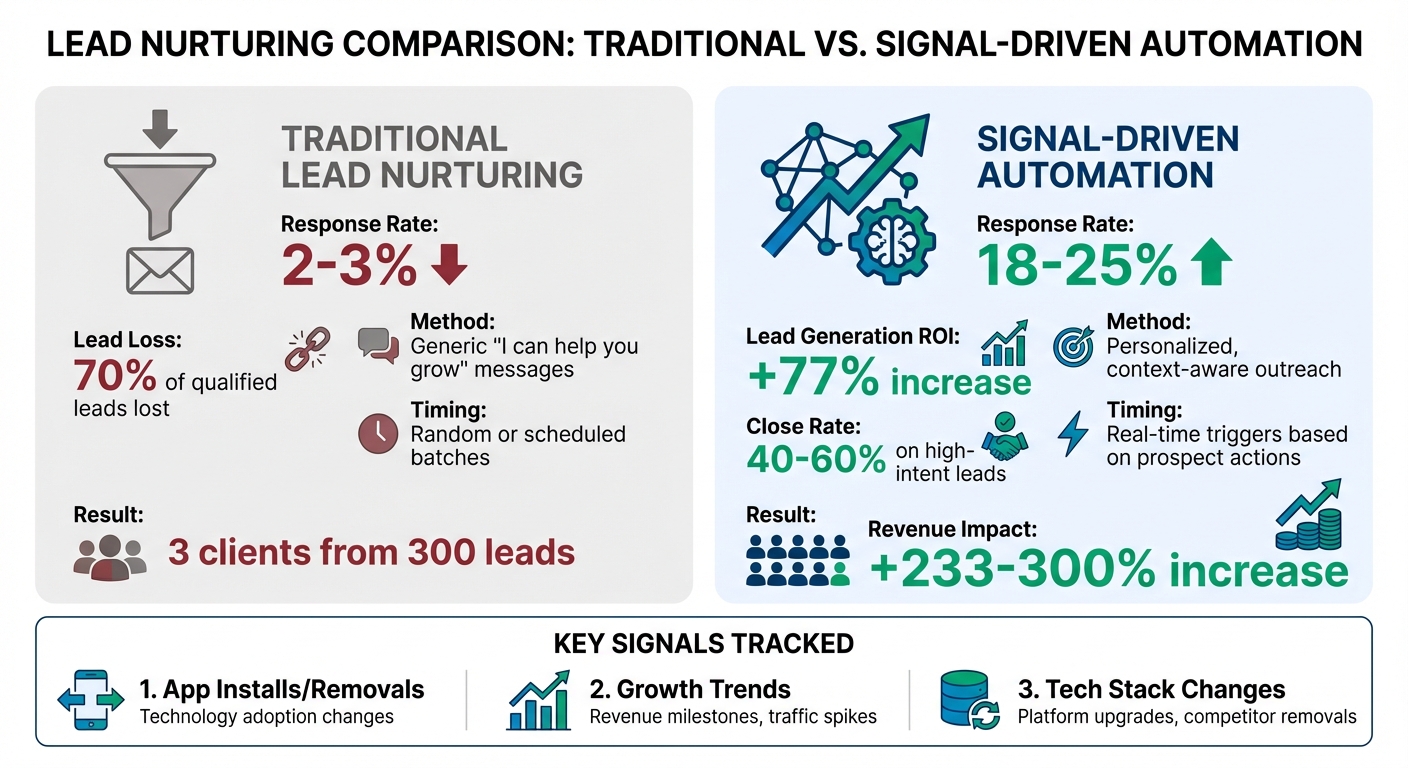
Signal-Driven vs Traditional Lead Nurturing: Performance Comparison
Nurture prospects with marketing automation | 10 rules for online lead gen #8
Key Data Signals for Ecommerce Leads
Data signals can tell you a lot about a potential lead. Some highlight immediate buying intent, while others offer insights into overall activity. For ecommerce businesses, three types of signals stand out: app installs and removals, growth trends and business activity, and technology stack changes. Together, these signals provide a clear picture of a store's priorities and readiness to engage, helping you fine-tune your lead scoring and outreach efforts.
App Installs and Removals
When a store installs or removes an app, it’s like a window into their strategy. For example, adding a subscription app like ReCharge shows they’re focusing on recurring revenue. Installing a Meta Pixel? That’s a sign they’re diving into paid social ads. These actions reveal where their priorities lie right now.
What’s even more interesting is spotting gaps. Imagine a store using ReCharge for subscriptions but missing Klaviyo for email marketing. That’s a clear opportunity. Outreach that specifically addresses such gaps gets an 18–25% response rate, compared to just 2–3% for generic messages.
Here’s a real-world example: In 2024, an agency founder filtered Shopify subscription brands using ReCharge but missing Klaviyo. This approach uncovered 247 prospects, leading to $84K MRR.
App removals also tell a story. If a store removes an app, it could mean dissatisfaction or an upcoming contract expiration - perfect timing for a personalized pitch. For instance, setting reminders two weeks before a contract ends can give you a strong edge.
| Signal Type | Intent Indication | Recommended Action |
|---|---|---|
| New App Install | Shift in priorities or new strategy | Congratulate them or offer complementary solutions |
| App Removal | Dissatisfaction or platform change | Suggest a better alternative or offer an audit |
| Missing Key App | Operational gap or untapped revenue potential | Highlight the ROI of addressing the gap |
| Competitor Install | Active evaluation of a category | Showcase your unique advantages |
Growth Trends and Business Activity
Revenue and traffic data can show you how ready a store is to invest. For example, stores earning $1M–$5M annually often have budgets for $5K–$10K monthly retainers, while those in the $250K–$1M range lean toward $3K–$5K retainers. High traffic - like 25K+ monthly visitors - signals strong demand, meaning they’re likely ready for advanced services rather than basic setups.
Timing is everything. Budget resets often happen in the first week of a quarter. Seasonal businesses gear up about 30 days before their peak periods. Product launches? They create a two-week window of opportunity. And since 60% of top prospects aren’t ready to buy for 3–12 months, tracking these signals helps you follow up at the perfect moment.
Take Marcus, for example. In 2024, this Meta ads agency founder targeted DTC apparel brands with strong traffic signals and an active Meta Pixel. By evaluating ad spend (a proxy for revenue) and understanding the long sales cycle (2–4 months), he landed 12 clients and grew to $95K MRR within a year.
Companies that prioritize these growth signals have seen an average 77% boost in lead generation ROI. Simple systems, like reminders for activity triggers - two weeks before a contract ends, 30 days before a seasonal peak, or two weeks after a product launch - can make all the difference.
Technology Stack and Store Design Changes
A store’s tech stack is like a blueprint for its capabilities and ambitions. Upgrades or redesigns show they’re actively investing, which shifts your outreach from a cold call to an informed conversation. This lets you address specific challenges with precision.
Complex tech stacks often signal larger budgets. Stores using multiple premium apps are more likely to invest in high-ticket solutions. For example, if a store has an extensive product catalog but lacks advanced search functionality, that’s an immediate need you can address. These insights are gold for crafting timely, tailored outreach.
"The intelligence that made them a good prospect travels with them through your entire sales process."
- StoreCensus
Tracking tech stack changes also helps you anticipate when a competitor’s contract might be ending, giving you a chance to swoop in. Without systems to monitor these evolving contexts, 70% of qualified leads are often lost.
Traditional prospecting methods - like scraping lists and sending generic “I can help you grow” emails - don’t cut it anymore. They barely yield a 2–3% response rate. But signal-driven approaches, like identifying tech gaps and sending personalized messages (e.g., “I noticed you lack [Tool] for your [App] setup”), deliver far better results.
Setting Up Lead Scoring with Data Signals
Building a Scoring Framework
A solid scoring framework categorizes leads into two main areas: Fit and Intent. Fit evaluates basic attributes like revenue range, industry type, and the technology they use. Intent, on the other hand, focuses on actions - think app installations, pricing page visits, or email engagement. Together, these metrics help identify who’s ready to buy and who needs more nurturing.
Assign different weights to actions based on their level of intent. For example, high-intent behaviors like visiting a pricing page or requesting a demo might earn 15–20 points, while lower-intent actions, such as reading a blog post, might only add 2–5 points. In the ecommerce space, intent can also be revealed through technology gaps - like a store using ReCharge but not Klaviyo. Negative scoring is equally important. Deduct points for poor-fit signals, such as being in an incompatible location, being a competitor, or showing 30+ days of inactivity.
To prioritize leads, use a 1–5 star system. Five-star leads (perfect fit and high intent) should command about 60% of your focus, with close rates between 40% and 60%. Four-star leads, while slightly less promising, still deserve 25% of your attention and typically close at a rate of 20% to 30%. Leads rated three stars or below can be shifted to automated nurture campaigns. To streamline the process, set a scoring threshold - like 100 points - to signal when a lead is ready to move from marketing to sales.
With this framework in place, your scoring system can deliver automated, real-time updates for better lead management.
Automating Lead Score Updates
Manual lead scoring is time-consuming and doesn’t scale well. The best systems sync data in real time, ensuring your CRM always reflects the latest lead behaviors. Tools like StoreCensus or Zapier can push live scores from sources like your data warehouse or spreadsheets directly into platforms such as Salesforce or HubSpot. For instance, if a lead installs an app or visits your pricing page, their score updates immediately. This real-time functionality is key to making data signals actionable.
Incorporate score decay into your system - recent actions should carry more weight than older ones. For example, a pricing page visit from yesterday is far more relevant than one from six months ago. For leads that aren’t ready to buy, set up automated reminders to reassess them in 90 days based on new activity.
"As a rule of thumb, the smaller the value of each sale compared to your total bottom line, the more important it is to process leads quickly, and the less it makes sense to dedicate an employee to understanding and assessing hard-to-quantify factors."
- Boris Jabes, CEO, Census
To further streamline the process, use data enrichment tools like Clearbit to fill in missing details - such as company size, tech stack, or key decision-makers - before running your scoring formula. This ensures each lead is accurately scored right from the start, saving your sales team valuable time and effort.
Creating Trigger-Based Automation Workflows
Timing is everything when it comes to turning generic outreach into campaigns that truly resonate. Trigger-based workflows kick in the moment a lead takes a specific action - like installing an app, hitting a revenue milestone, or launching a new product. This ensures your outreach feels relevant and timely, increasing the chances of a positive response.
Personalized Outreach Based on App Installs
When a store installs a particular app, it often signals a specific need or gap in their setup. For instance, if a Shopify store adds ReCharge but hasn’t yet adopted Klaviyo, it highlights an opportunity to address their needs. You can create a workflow that triggers an email immediately after this combination is detected, referencing the newly added tool and explaining how your service complements it.
Take Sarah as an example. Between 2024 and 2025, she ran an email agency for subscription brands and used this exact strategy. By targeting Shopify beauty brands earning $1M–$5M annually that used ReCharge but not Klaviyo, she converted 25% of qualified leads by Month 5. By Month 12, she had grown her Monthly Recurring Revenue (MRR) to $84,000 with 14 clients. This approach works because it’s contextual - you're addressing a problem the lead just created by their own actions.
Next up, let’s look at how growth signals can guide your outreach.
Launching Campaigns for Growth Signals
Growth signals - like a spike in traffic (25,000+ monthly visitors), moving into a higher revenue tier, or securing new funding - indicate that a business is expanding and may have the budget to invest in new solutions. Automated workflows can be set up to trigger when these milestones are reached. For example, if a company posts job openings for roles like "Web Developer" or "Growth Manager", it’s a sign they’re scaling. Reaching out during this growth phase, rather than after the dust settles, maximizes your chances of success.
But it’s not just growth signals - real-time updates can also create valuable outreach opportunities.
Real-Time Alerts for Store Changes
Changes to a store - such as launching a new product, redesigning their website, or removing a competitor’s app - offer short windows for action. Real-time monitoring can help you respond in hours, not days. For instance, if a store launches a new product, you can set up an alert to send a congratulatory email two weeks later, offering help with scaling or optimization. Similarly, if a competitor’s app is removed, it’s a clear sign they might be exploring alternatives, so reaching out immediately is key.
Research shows that 60% of top B2B prospects won’t be ready to buy for 3 to 12 months. However, responding within minutes instead of hours can double your meeting conversion rates. Tools like StoreCensus can track these changes in real time, ensuring you act before the opportunity slips away.
| Trigger Scenario | Recommended Timeline | Outreach Approach |
|---|---|---|
| App Install Gap | Immediately upon detection | "Noticed you're using [App A] but not [App B]. Most brands see [X%] gain by connecting them." |
| Product Launch | 2 weeks after launch | "Congrats on launch! Ready to tackle [specific problem]?" |
| Contract Lock-In | 2 weeks before end | "Your contract ends soon. Ready to explore alternatives?" |
| Budget Timing | 1st week of new quarter | "Budget should be refreshed now. Still interested?" |
| Seasonal Business | 30 days before season | "Busy season coming. Let's get a solution in place." |
"A personalized email is only half the battle. Receiving a timely cold email when the pain is highest results in higher response rates and is all about timing."
Segmenting and Personalizing Nurturing Campaigns
After setting up trigger-based workflows, the next step is grouping leads based on active intent signals to deliver more focused and effective messaging.
Segmenting Leads by Intent Signals
The best segmentation strategies combine firmographic fit with behavioral intent. Instead of relying solely on static demographics, focus on grouping leads by their actions. For instance, you might create a segment like "beauty brands earning $1M–$5M annually, using ReCharge for subscriptions, but not Klaviyo for email marketing". This level of specificity allows you to target a clear, actionable gap in their tech stack.
Another powerful approach is segmenting leads based on their digital body language. When a lead visits your pricing page, downloads a case study, and responds to an email, they’re signaling increasing interest. Companies using this type of lead scoring have reported a 77% boost in lead generation ROI compared to those that don’t.
You can also identify leads by growth signals. For example, businesses with over 25,000 monthly visitors, recent funding announcements, or job postings for roles like "Growth Manager" often indicate they are scaling up and ready to invest. Tools like StoreCensus monitor these indicators in real time, enabling you to create dynamic segments that adjust as businesses hit new milestones. This ensures your sales team spends most of their time on top-tier leads (those with the best fit and timing) and less on lower-priority ones that require longer nurturing. By segmenting this way, you can lay the groundwork for personalized messaging that stays relevant as leads evolve.
Dynamic Content Personalization
Static content often falls short when a lead’s buying signals change. If a lead installs a new app, moves into a higher revenue bracket, or removes a tool from their tech stack, your messaging should update accordingly. Dynamic content personalization ensures your emails, landing pages, and follow-ups reflect these changes in real time.
For example, if a lead visits your pricing page but doesn’t schedule a demo, you could send them a relevant case study within hours. If they later download a technical guide, your next email should reference that action and offer a more detailed resource. This strategy also relies on score decay, which gradually lowers the value of older actions, keeping your segments focused on current intent rather than outdated interest. Personalization like this can cut customer acquisition costs by 50% and increase revenue by up to 15%. Since 80% of potential customers who aren't ready to buy immediately will make a purchase within the next 24 months, tailoring your content to their evolving signals ensures you stay relevant throughout their buying journey.
| Lead Quadrant | Fit / Intent Level | Recommended Action |
|---|---|---|
| High Fit / High Intent | Perfect match + active signals | Immediate sales outreach |
| High Fit / Low Intent | Perfect match + passive signals | Automated nurture with educational content |
| Low Fit / High Intent | Poor match + active signals | Archive or refer to partner |
| Low Fit / Low Intent | Poor match + passive signals | Remove from active pipeline |
Using StoreCensus for Signal Tracking and Automation
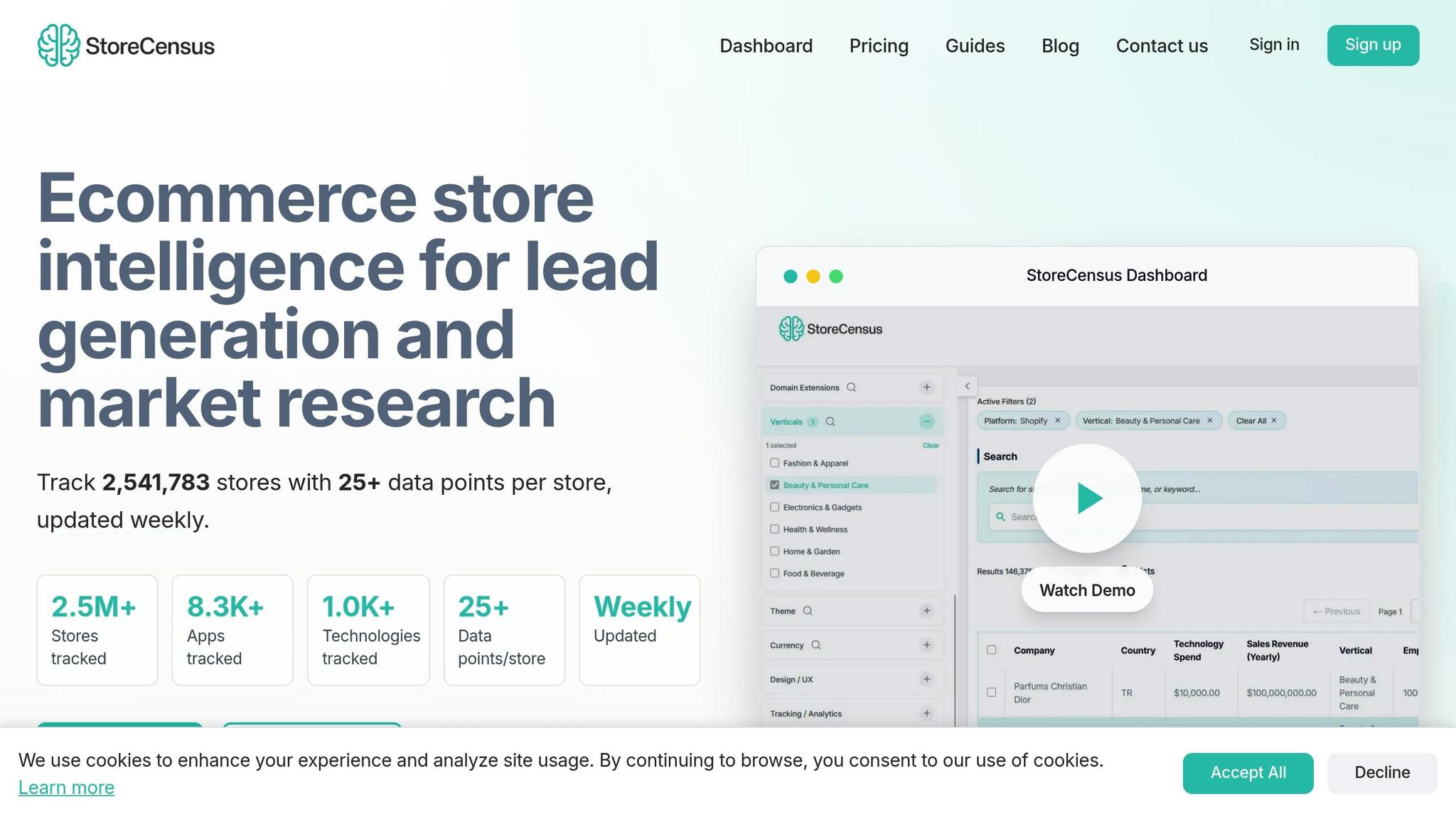
Gain full visibility across thousands of ecommerce stores in real time. StoreCensus acts as a centralized prospecting tool, combining discovery, qualification, tracking, and nurturing into one seamless process. By eliminating fragmented data, it ensures no leads slip through the cracks.
Real-Time Monitoring with StoreCensus
StoreCensus monitors 2.5 million ecommerce stores, analyzing over 25 structured data points like tech stacks, revenue tiers, traffic patterns, catalog size, store age, and activity levels. This real-time tracking identifies when a lead is primed to convert - for instance, after installing a subscription app but skipping email marketing tools, or when experiencing a sudden traffic surge.
The platform’s signal-based filtering allows for highly targeted searches. Imagine focusing on beauty brands using ReCharge for subscriptions but missing Klaviyo for email campaigns. Such precise targeting can boost response rates to 18–25%, compared to the low 2–3% seen with generic outreach. Unlike traditional CRMs, where key technical details often get lost during CSV imports, StoreCensus retains this context throughout the sales process. This continuity ensures that your team can leverage this intelligence for smoother automation and better results.
Automating Workflows with StoreCensus Integrations
StoreCensus doesn’t just track leads - it turns insights into action by automating workflows. It keeps your sales pipeline organized with automated statuses like Contacted, Replied, Negotiating, Closed, and Rejected, ensuring visibility at every stage. You can set triggers for critical events, such as two weeks before a competitor’s contract ends, the start of a new quarter when budgets reset, or 30 days before a seasonal peak. These automated reminders help reduce the loss of qualified leads, which often happens due to poor follow-up systems rather than weak initial outreach.
The platform also syncs seamlessly with CRMs and sales tools, enabling automated workflows based on real-time data. For example, if a store installs a new app or hits a revenue milestone, StoreCensus can trigger personalized sequences in your CRM or outbound tool. Agencies using this method of tracking and nurturing leads over time have reported up to 233% more revenue from the same prospecting efforts.
Measuring and Optimizing Signal-Driven Automation
Key Metrics to Monitor
To evaluate the effectiveness of signal-driven automation, start by tracking engagement metrics like email open rates, click-through rates, and content downloads. These indicators help determine if your timing and messaging align with your audience's interests. Beyond engagement, focus on conversion metrics such as MQL-to-SQL conversion rates and the speed at which leads progress through the funnel. Interestingly, organizations that implement lead scoring see an average 77% boost in lead generation ROI compared to those that don't.
Another valuable metric is lead score velocity, which measures how quickly a lead's score increases based on real-time behaviors. Combine this with metrics like sales cycle speed and the number of meetings booked to identify high-priority prospects and operational efficiencies. Lastly, assess the impact on Monthly Recurring Revenue (MRR) and overall pipeline health to understand the long-term value signal-driven automation brings.
Once you have these metrics, you can start refining your campaigns using A/B testing.
Using A/B Testing for Optimization
A/B testing allows you to fine-tune signal-driven campaigns. Experiment with elements like subject lines, calls-to-action, and content sequences. For example, if a lead installs a subscription app, test subject lines referencing that specific action versus more general messaging. Tailor your tests to the digital behaviors revealed by signals - a company dropping a competitor’s tool will need different outreach than one experiencing rapid growth.
Timing is another critical factor. Test whether immediate outreach after a signal triggers better results than waiting 48 hours. You can also adjust the weight of signals in your scoring model. For instance, assign more value to a pricing page visit compared to a blog post read. These optimizations can lead to impressive results - marketing personalization driven by signal data can cut customer acquisition costs by up to 50% and increase revenue by as much as 15%.
Once optimized, compare performance metrics to measure the impact of your changes.
Comparing Performance Before and After Signal Implementation
To visualize the impact of signal-driven automation, compare pipeline performance before and after its implementation. Traditional methods often fail to capitalize on leads, with roughly 70% of leads lost due to poor follow-up. In contrast, signal-driven systems actively track and re-engage prospects over time. For example, one comparison showed that 300 leads generated only 3 clients using traditional outreach, while the same 300 leads brought in 10-12 clients with signal-driven automation - yielding a 233% to 300% revenue increase.
Signal-based outreach also outperforms generic campaigns. Outreach informed by specific tech stack signals achieves 18-25% response rates, compared to just 2-3% for generic outreach. And while immediate conversions are critical, don’t overlook long-term value - around 80% of potential customers who aren’t ready to buy now will make a purchase within 24 months. Tracking both short-term and long-term outcomes ensures a comprehensive view of your pipeline’s health.
Conclusion
Data signals elevate lead nurturing to a whole new level, turning it into a precise sales machine that captures prospects throughout their buying journey - even those who might not make a purchase for another 3 to 12 months. By leveraging signal-driven automation, agencies can generate 233% more revenue from the same prospecting efforts compared to older, less targeted methods.
The key lies in hitting the right target at the right time. High-intent leads - those identified through real-time signals like app installs, growth patterns, or changes in their tech stack - are prioritized, resulting in close rates of 40–60% on these top-tier prospects. Meanwhile, automated nurture sequences ensure no lead falls through the cracks, keeping the pipeline moving efficiently.
Platforms like StoreCensus are game-changers in this process. By maintaining continuous lead intelligence throughout the sales cycle, StoreCensus doesn't just track data - it powers workflows that are fully automated and signal-driven. With real-time monitoring, outreach is triggered precisely when intent is highest, leading to response rates of 18–25%, a massive leap compared to the industry average of just 2–3% for generic campaigns.
These strategies don't just improve conversions; they also transform overall pipeline efficiency. For instance, companies that implement lead scoring see an average 77% increase in lead generation ROI. On top of that, marketing personalization fueled by signal data can slash customer acquisition costs by up to 50% while boosting revenue by as much as 15%. These metrics show just how impactful a data-driven approach can be.
"As a rule of thumb, the smaller the value of each sale compared to your total bottom line, the more important it is to process leads quickly".
- Boris Jabes, CEO of Census
FAQs
How can data signals optimize the timing of lead nurturing?
Data signals provide real-time insights into essential store activities like app installations, updates, and growth trends. These insights help businesses pinpoint pivotal moments in a store's lifecycle, allowing for automated and personalized follow-ups at just the right time.
By acting on these insights, you can connect with leads when they're most receptive. This ensures your outreach feels timely and relevant, boosting conversion rates and building stronger connections with potential customers.
What are the most valuable data signals for improving lead nurturing in ecommerce?
The best data signals for lead nurturing in ecommerce revolve around app installations and removals, store updates, and growth trends. These signals offer clear insights into a store's behavior and development, making it easier to spot engagement opportunities. For example, keeping an eye on app installs or removals can reveal shifts in a store's tech stack, hinting at efforts to optimize or expand.
Similarly, tracking store activities like design overhauls or business changes can point to stores that are actively investing in their online presence - prime candidates for outreach. Growth trends, such as rising traffic or revenue, help you focus on leads with the highest potential. By weaving these real-time signals into automated workflows, you can send personalized and well-timed messages, boosting the impact of your lead nurturing strategy.
How do data signals help prioritize leads for better engagement?
Data signals like app installs, shifts in store activity, and growth patterns are essential for lead scoring. They help pinpoint leads showing strong purchase intent. For example, leads that are actively expanding or making noticeable updates can be flagged as higher priority, ensuring your outreach targets the most promising prospects.
Using these insights, you can fine-tune your lead nurturing process, connect with high-intent leads more quickly, and boost the efficiency of your sales automation efforts.