Data Enrichment vs. Manual Lead Qualification
Data enrichment automates ecommerce lead qualification, delivering faster, cheaper, and more accurate lead scoring than manual research for scalable growth.


Which is better for qualifying ecommerce leads: automation or manual effort? Here's the answer: data enrichment is faster, more scalable, and accurate, while manual qualification struggles with time, cost, and consistency.
Key takeaways:
- Data enrichment automates lead qualification, updating information like revenue, tech stack, and contact details in minutes. It processes thousands of leads, reduces errors, and boosts conversion rates by 25–35%.
- Manual qualification relies on human research, which is slow, subjective, and costly. Sales reps spend hours per lead, risking outdated data and missed opportunities.
Quick Comparison
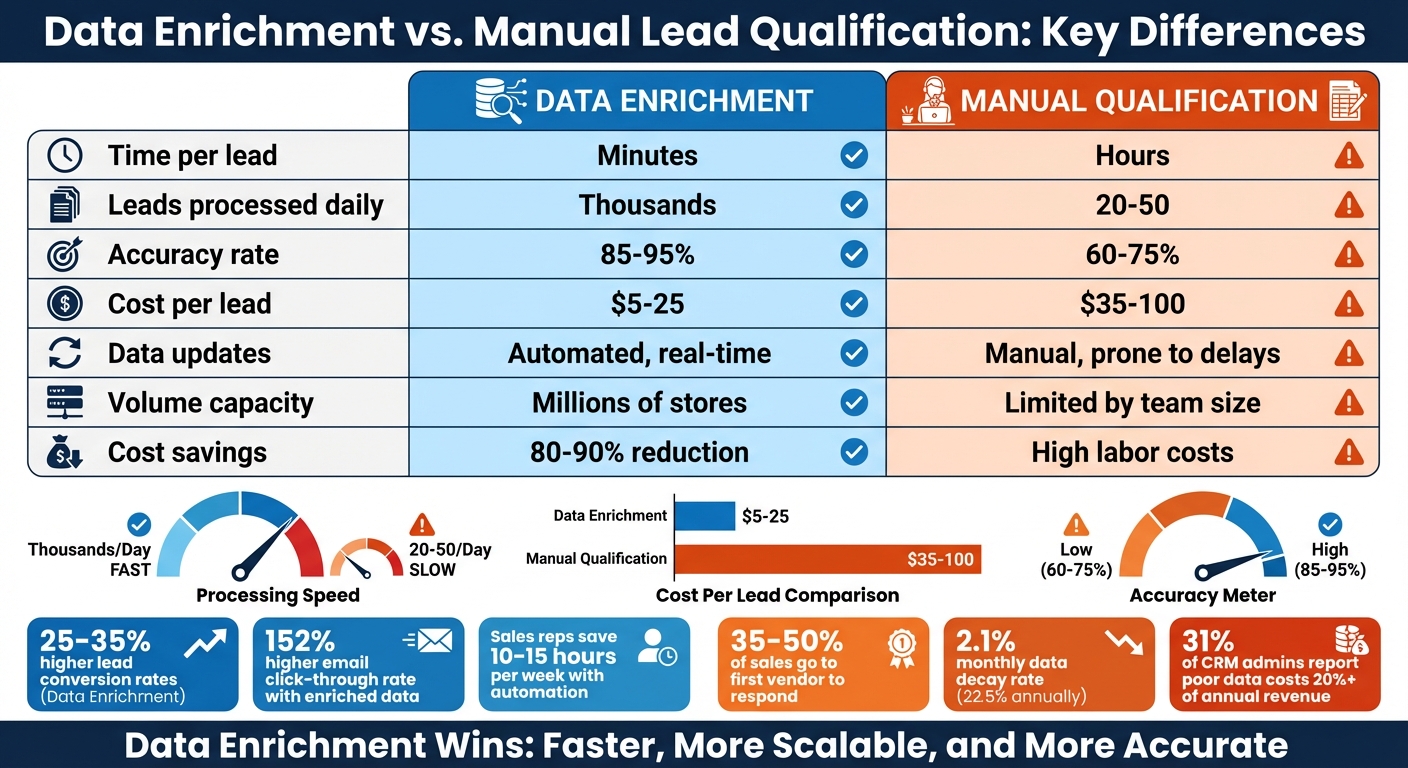
| Metric | Data Enrichment | Manual Qualification |
|---|---|---|
| Time per lead | Minutes | Hours |
| Leads processed daily | Thousands | 20–50 |
| Accuracy rate | 85–95% | 60–75% |
| Cost per lead | $5–25 | $35–100 |
| Data updates | Automated, real-time | Manual, prone to delays |
Why it matters: In ecommerce, where data changes constantly and speed is critical, automation ensures you act on accurate, up-to-date information while saving time and money. Manual methods may still work for small, high-value targets but fall short for scaling lead generation effectively.
Data Enrichment vs Manual Lead Qualification: Speed, Cost, and Accuracy Comparison
Build an AI agent with me! Ep. 10: Lead Enrichment
How Data Enrichment Works for Ecommerce Lead Qualification
Data enrichment platforms are designed to automatically gather, organize, and update ecommerce store data by continuously crawling the web. For instance, tools like StoreCensus monitor over 2.5 million active Shopify stores worldwide, frequently refreshing their database with new stores, revenue estimates, app installations, and contact details on a monthly basis. This automation directly addresses the issue of B2B data decay, which happens at an average rate of 2.1% per month. By keeping your lead data updated without manual input, these platforms ensure your information remains accurate and actionable. Let’s take a closer look at how they collect and filter this data.
Automated Data Collection and Filtering
Enrichment platforms operate by constantly tracking ecommerce stores and capturing changes in real time. For example, StoreCensus identifies shifts in store activity as they happen. This real-time monitoring allows sales teams to filter leads using specific criteria like platform usage, installed apps, or growth indicators such as recent app additions or revenue milestones. These advanced filters make it easier to target leads based on meaningful, actionable signals.
In addition to filtering, AI-powered tools handle data cleaning and standardization automatically. Automation platforms like Zapier also play a role, creating workflows (called "Zaps") that enrich, filter, and score leads as soon as they’re captured through web forms or ad campaigns. This seamless process enhances lead profiles, setting the stage for more detailed and personalized engagement.
Adding Structured Data to Leads
Once a lead enters your system, enrichment tools append multiple data points to transform a simple email address into a comprehensive profile. This can include:
- Firmographic data: Company size, revenue range, and location.
- Technographic data: Information on Shopify apps or ERP systems in use.
- Contact-level data: Verified emails, direct-dial phone numbers, and job titles.
- Behavioral signals: Web visits, content downloads, and hiring trends.
For ecommerce businesses specifically, StoreCensus provides more than 25 structured data points per store, such as estimated sales, product catalog size, and active app installations. This depth of information enables advanced lead scoring and hyper-targeted outreach that addresses specific needs.
With enriched data, sales teams can skip time-consuming discovery steps and jump straight into personalized conversations. For instance, if a store has recently installed Klaviyo for email marketing, you can tailor your pitch to focus on complementary tools or services. According to Ariana Shannon, Marketing Director at SalesIntel:
"Enriched data can be trusted to carry out the most crucial B2B marketing strategies: strengthening ABM, improving segmentation, and gaining intelligence on what stimulates revenue".
The impact of personalization is clear - emails that leverage enriched behavioral data see a 152% higher click-through rate compared to non-personalized ones. This enriched data integrates seamlessly with sales tools, ensuring your team has everything they need for effective outreach.
Integration with Sales and CRM Tools
Data enrichment doesn’t work in isolation - it connects directly with your existing sales tools. Platforms like Salesforce, HubSpot, and Marketo sync enriched data into your CRM, ensuring your pipeline is always updated. For custom workflows, API access allows businesses to embed ecommerce intelligence directly into their systems.
Real-time monitoring further enhances this process by triggering automated workflows whenever critical store changes occur. This ensures your team contacts prospects at the right moment, maximizing engagement. As Knock AI puts it:
"Every missing field in your CRM is a missed AI opportunity".
With data enrichment, those gaps are filled, giving your team the actionable intelligence needed to make smarter, faster decisions.
How Manual Lead Qualification Works for Ecommerce Leads
Manual lead qualification depends on sales teams digging into each prospect individually to gather and verify information. This often means scouring websites, LinkedIn, and directories for contact details. Sales reps also look for "hand-raising" signals - things like demo requests, newsletter sign-ups, or webinar registrations - to gauge a prospect's interest. While this method can produce accurate results for small batches of leads, it becomes unmanageable when dealing with dozens or even hundreds daily. Let’s break down how manual methods tackle website research, contact verification, and the challenges that come with them.
Researching Store Websites and Activity Signals
The process starts with sales teams analyzing ecommerce websites to determine a store's potential. They might inspect the site's source code to identify the tech stack, check funding information on platforms like Crunchbase, and verify contact details through social media profiles. However, this approach is far from foolproof. Much of the decision-making relies on subjective judgment - a sales rep might label a store as "ready to buy" based on intuition rather than solid, objective data.
Contact Verification and Lead Scoring
Once a lead looks promising, reps manually verify contact details and score the lead using frameworks like BANT (Budget, Authority, Need, Timeline). Unlike automated systems, manual scoring is slow and inconsistent. Reps often have to enter data manually across multiple platforms, which eats into their time. In fact, sales reps can spend up to 60% of their time qualifying leads, with as much as 80% of that effort going toward prospects that never convert. On top of that, manual qualification has an average response time of 42 hours per lead. In the fast-paced ecommerce world - where 35–50% of sales go to the first vendor to respond - such delays can be a dealbreaker.
Challenges with Manual Processes
Manual lead qualification comes with major scalability issues. A single sales rep can typically handle only 20–50 leads per day using manual methods, while automated systems can process thousands at the same time. The cost difference is also striking: manual qualification costs between $35 and $100 per lead, compared to $5 to $25 for automated approaches. Ariana Shannon from SalesIntel highlights another issue:
"Too much inaccurate and incomplete data begins to create a signal vs noise problem where more data actually begins to make you less effective".
During busy ecommerce seasons, lead volumes can spike by 400–600%, causing manual processes to fail entirely. Additionally, manual data entry often results in duplicate or conflicting records in CRMs. This can have a big impact, as 31% of CRM administrators report that poor-quality data costs their companies at least 20% of their annual revenue.
Data Enrichment vs. Manual Lead Qualification: Key Differences
Data enrichment and manual lead qualification differ in how they handle efficiency, scalability, accuracy, and cost. These differences can make or break your lead qualification process, directly impacting your sales performance.
Efficiency and Scalability
The speed gap between these two methods is striking. A salesperson manually researching leads can only cover about 20 prospects daily, spending hours combing through websites, LinkedIn profiles, and databases. On the other hand, data enrichment tools can analyze thousands of leads in just minutes. This isn't just faster - it's operating at a completely different level.
By automating tedious tasks like research and data entry, sales reps save 10 to 15 hours per week. This extra time can be spent on actual selling. George Mckenna, Head of Cloud Sales at Ultima, highlights the impact:
"The sales managers used to make 100-150 calls per day. Now they can achieve their targets by making 30 calls per day because they are calling prospects who actually pick up the phone. That's more results, less calls."
Scalability is another area where automation shines. While manual teams are limited by their size and working hours, data enrichment platforms can manage databases with millions of entries simultaneously. For example, during ecommerce peak seasons, lead volumes can surge by 400–600%, overwhelming manual processes. Automated systems handle these spikes effortlessly. This efficiency means more engaged prospects and higher revenue potential.
| Metric | Data Enrichment | Manual Lead Qualification |
|---|---|---|
| Time per lead | Minutes | Hours |
| Volume handled | Millions of stores | Limited by team size |
| Cost-effectiveness | 80-90% cost savings | High labor costs |
Accuracy and Lead Quality
Speed and volume are important, but the quality of lead data is what drives conversions. Manual qualification often struggles in this area due to human subjectivity. Sales reps rely on incomplete information, leading to inconsistent scoring and more errors. Additionally, manual data entry is prone to typos, formatting issues, and duplicate entries.
Data enrichment tools, however, use automated validation and cross-check multiple sources, achieving accuracy rates of 85–95%. Some top-tier tools even claim accuracy rates as high as 97–98%. This precision directly boosts conversions - companies using enriched data report 25–35% higher lead conversion rates.
Automation also combats data decay, a major issue for B2B databases that lose around 2.1% of accuracy each month (or 22.5% annually). Manual teams can’t keep up with this decay, especially for large datasets. Enrichment tools, with their automated refresh cycles, ensure data remains up-to-date without constant effort.
Here’s a quick comparison of the accuracy metrics:
| Metric | Data Enrichment | Manual Lead Qualification |
|---|---|---|
| Accuracy rate | 85-95% | 60-75% |
| Conversion improvement | 25-35% higher | Lower |
| Error sources | Automated validation | Human subjectivity |
Bad data has a real cost. Thirty-one percent of CRM administrators report that inaccurate data causes their companies to lose at least 20% of annual revenue. In fast-paced ecommerce environments, where 35–50% of sales go to the first vendor to respond, the speed and precision of data enrichment give businesses a clear edge.
When Data Enrichment Outperforms Manual Qualification
Automation has its perks, but there are specific situations where data enrichment leaves manual qualification in the dust. It’s not just about speed - it’s about handling massive volumes, delivering real-time insights, and streamlining complex workflows.
High-Volume Shopify Lead Generation

When you’re dealing with thousands (or even millions) of prospects, manual research simply can’t keep up. It’s slow, resource-intensive, and limits how many leads you can qualify in a day. For Shopify app developers or agencies targeting niche store segments, this bottleneck can be a dealbreaker.
That’s where tools like StoreCensus come in. Instead of painstaking manual digging, StoreCensus enriches store data with key insights - revenue estimates, installed apps, tech stack details, and even growth trends. Want to target stores using Klaviyo or Gorgias? Done. Need to focus on businesses in a specific revenue bracket or those that recently updated their tech stack? You can filter that in minutes.
The difference is staggering. A manual team might qualify a few dozen stores in a week. Meanwhile, enrichment tools can process millions of records at once. For SaaS founders launching a Shopify app, this means you can pinpoint every potential customer in your niche from day one - no months-long slog of manual research. Plus, real-time insights ensure you’re always acting on up-to-date information.
Real-Time Monitoring for Growth Signals
Manual research has another major flaw: it can’t keep up with how fast data changes. By the time you’ve verified details, they’re often outdated. Real-time monitoring solves this by tracking behavioral signals as they happen, giving you a window into buying intent.
StoreCensus, for example, flags activities like new app installations, app removals, design updates, or other signals of growth. These changes trigger instant alerts, giving you the chance to act while the lead is still “hot.” And speed matters - a lot. Research shows that 35–50% of sales go to the first vendor to respond. If a store adopts a new app and you’re the first to reach out, your chances of closing the deal skyrocket.
CRM Integration and Workflow Automation
Real-time alerts are great, but they’re even better when paired with seamless CRM integration. Automated CRM workflows take updated data and turn it into actionable insights without the need for manual input.
StoreCensus integrates directly with CRMs and outbound platforms, enriching leads as soon as they hit your pipeline. For example, if a store meets specific criteria - like being a Shopify Plus store in the U.S. with over $1 million in estimated revenue - the system can automatically route that lead to senior reps, enrich contact records with decision-maker details, or trigger personalized email campaigns based on app usage.
This isn’t just about saving time on data entry. It’s about precision. High-value leads are prioritized, outreach is tailored, and your sales team always has the freshest, most relevant information at their fingertips. Unlike manual processes that need constant oversight, enrichment tools work around the clock, ensuring no opportunity slips through the cracks.
Data Enrichment with StoreCensus for Ecommerce Lead Qualification
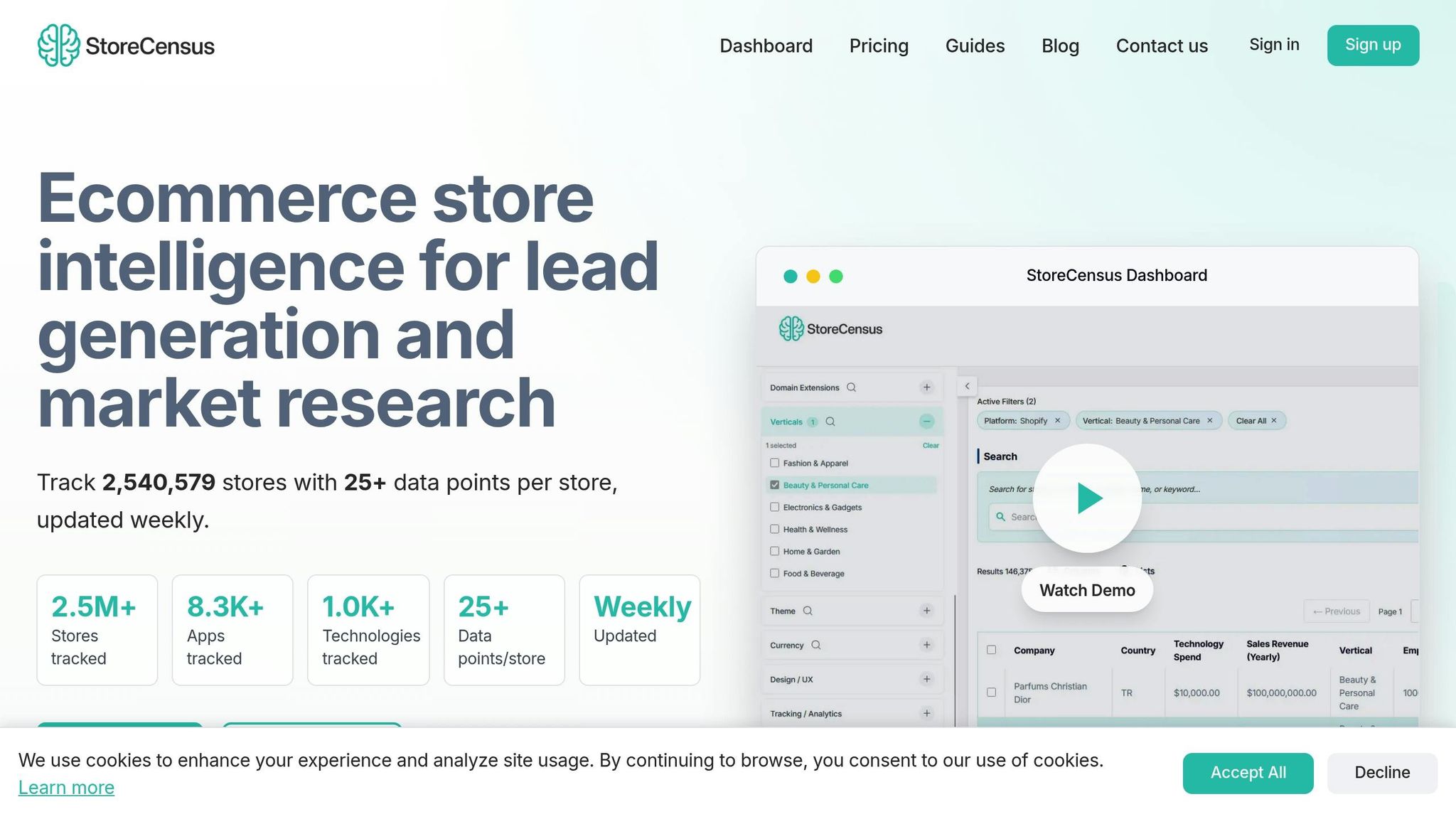
StoreCensus takes the hassle out of ecommerce lead qualification by automating the process on a large scale. This automation not only speeds things up but also ensures consistent accuracy - solving the problems that come with manual qualification. With access to structured data on over 2.5 million ecommerce businesses, updated continuously, you’ll always be working with the latest information.
Ecommerce Store Intelligence at Scale
StoreCensus keeps tabs on over 2 million active Shopify stores globally, enriching each store’s profile with more than 25 structured data points. These include details about the store’s technology stack (like popular apps such as Klaviyo or Gorgias), revenue estimates based on traffic and product catalog size, growth metrics, and verified contacts for key decision-makers. The platform’s built-in decision-maker finder saves you from the hassle of manual LinkedIn searches by identifying roles like VP of Marketing, Head of Growth, and Marketing Directors, complete with contact details. Data updates are frequent - new stores are added weekly, and revenue and app installations are refreshed monthly. Considering that B2B data decays at a rate of about 2.1% per month (or roughly 22.5% annually), this regular refresh cycle ensures you’re always working with accurate information. This strong data foundation is further enhanced by advanced filtering tools and real-time alerts for precise targeting.
Advanced Filtering and Real-Time Alerts
With this rich dataset, StoreCensus makes it easy to segment your target audience. You can filter stores by revenue, installed apps, location, growth trends, or even specific technology updates. For instance, if you’re looking for U.S.-based stores using a particular marketing app and generating over $1 million in revenue, you can identify them in seconds. Want to know when a business adopts a new marketing tool? Instant alerts notify you of these changes, so you can act quickly. The platform tracks app installs, removals, design updates, and other activity signals. Given that 35–50% of sales go to the first vendor to respond, this speed could give you a serious edge in closing deals.
Sales and Marketing Workflow Integration
StoreCensus integrates seamlessly with tools like Salesforce, HubSpot, and outbound platforms such as Apollo, syncing enriched leads directly into your workflows. API access allows you to incorporate ecommerce intelligence into your existing systems without a hitch. Companies that use lead enrichment effectively have seen conversion rates jump by 25% and deal closures happen 30% faster. Plus, with options like direct CSV exports and CRM synchronization, StoreCensus can cut manual data entry by up to 50%, letting your team spend more time selling and less time digging for information.
Conclusion: Why Data Enrichment is the Future of Lead Qualification
Automation has proven to outpace manual lead qualification in every key area - speed, precision, and scalability. In a world where 35–50% of sales go to the first vendor to respond, relying on manual research is a costly gamble. Data enrichment tools eliminate time-consuming tasks, analyzing thousands of leads in mere minutes.
Outdated and inaccurate data is a silent revenue killer. Poor-quality data can drain at least 20% of a company’s annual revenue, and with B2B data decaying at a rate of 2.1% per month, manually maintained databases quickly lose their edge. Data enrichment platforms solve this by continuously updating records, ensuring teams work with fresh, actionable insights rather than wasting time on outdated information.
Automation also brings a level of depth and real-time insight that manual processes simply can't replicate. For example, StoreCensus monitors over 2.5 million stores, providing 25+ data points for each - including revenue estimates, tech stack details, and verified decision-maker contacts - all updated on a weekly or monthly basis. This level of detail and freshness is impossible to achieve manually.
The results speak for themselves. Companies that adopt data enrichment often see conversion rates improve by as much as 30%. In today’s fast-paced and competitive ecommerce landscape, speed and accuracy are no longer luxuries - they’re necessities. Data enrichment has become a key driver of success, helping businesses stay ahead of the curve and win in competitive markets. For any team serious about growth, embracing data enrichment is no longer optional - it’s a must.
FAQs
How does data enrichment help boost lead conversion rates?
Data enrichment boosts lead conversion rates by giving sales teams access to detailed, accurate, and current information about their prospects. By incorporating details like company profiles, technology usage, and recent business activities, sales teams can create outreach efforts that feel tailored and relevant to each potential customer. This level of personalization not only grabs attention but also increases the likelihood of engagement and conversion.
It also helps pinpoint high-intent leads by highlighting key indicators, such as signs of business growth, new technology adoption, or expansion efforts. With these insights, sales teams can prioritize their time and energy on opportunities that are most likely to convert, improving productivity and outcomes. Many businesses that leverage data enrichment report noticeable gains in their conversion rates, making it a powerful asset in modern lead qualification strategies.
How do the costs of data enrichment compare to manual lead qualification?
The cost gap between data enrichment and manual lead qualification can be striking. Manual lead qualification demands a lot of time and effort, which translates to higher labor costs that rise as the number of leads grows.
On the other hand, data enrichment tools streamline much of this process through automation, cutting down both time and expenses. These tools often operate on subscription-based pricing, making them a more budget-friendly option for businesses aiming to scale. In contrast, manual methods come with continuous labor costs that increase alongside lead volume. While manual approaches might occasionally offer finer precision, data enrichment tools stand out for their speed, affordability, and scalability - perfect for companies focused on improving efficiency while keeping costs under control.
Why is real-time data important for qualifying ecommerce leads?
Real-time data plays a key role in qualifying ecommerce leads by allowing businesses to pinpoint stores that are actively expanding or displaying strong intent. Monitoring live updates - like app installations, changes in technology, or shifts in store activity - helps businesses focus on leads that are more likely to convert.
Using real-time alerts ensures outreach efforts are both timely and relevant. These alerts can even trigger automated workflows for sales and lead nurturing, streamlining the process. By relying on up-to-date information, businesses can improve the accuracy and efficiency of their lead qualification efforts while avoiding outdated data pitfalls.