Best Practices for Timing Email Outreach
Boost email engagement by sending B2B outreach midweek (Tue–Thu) mid-morning or evening, using timely follow-ups, A/B tests, and automation.

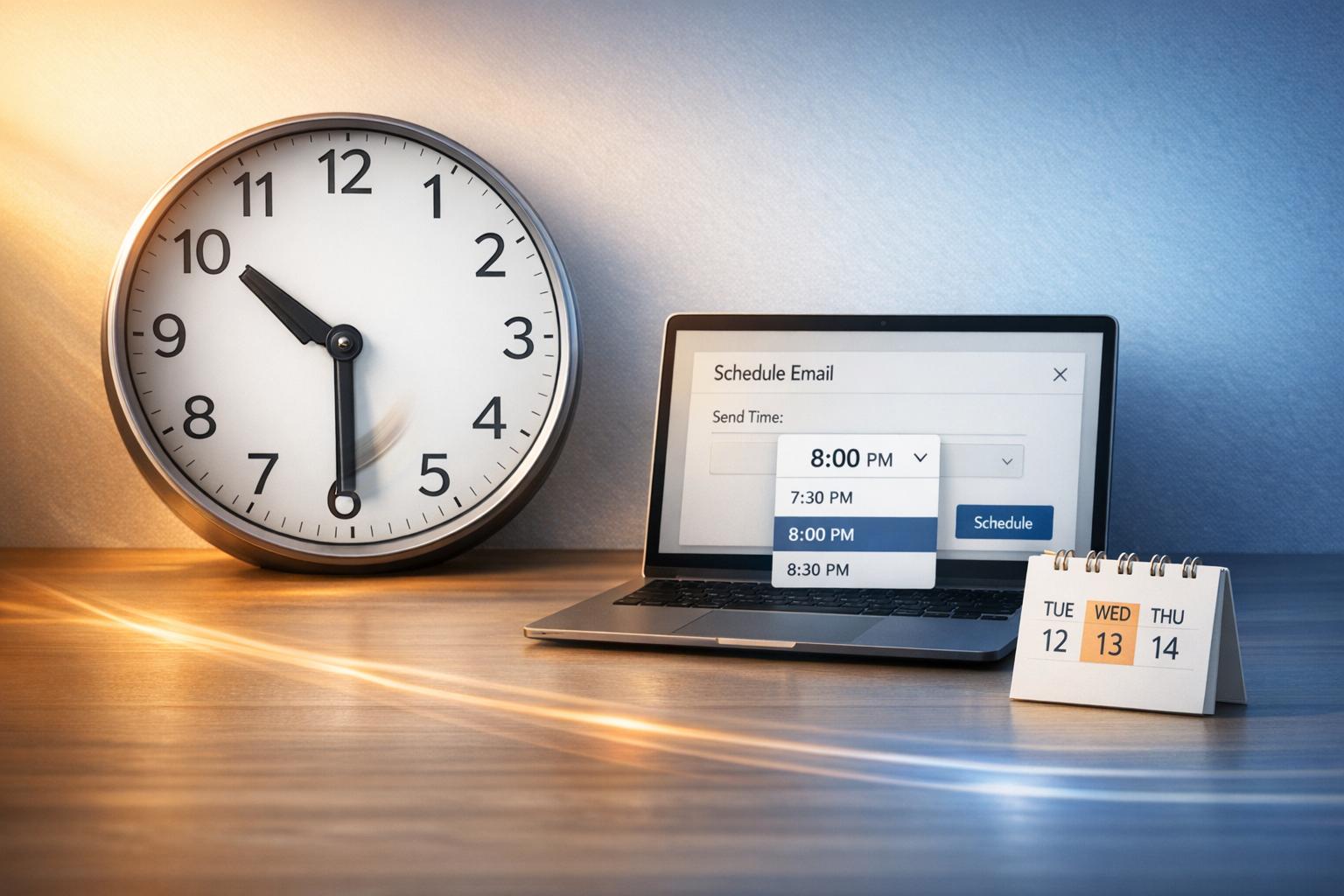
Timing can make or break your email outreach efforts. The right time can double your conversions, but poorly timed emails risk being ignored. Here’s what you need to know:
- Best Days: Tuesday, Wednesday, and Thursday are the most effective for engagement. Avoid Mondays (inbox overload) and weekends (low activity).
- Best Times: For B2B, send between 9:00 AM and 11:00 AM. For higher evening engagement, aim for 8:00 PM–9:00 PM.
- Follow-Up: 55% of responses come from follow-ups. Start 2–3 days after the initial email and gradually extend intervals.
- Frequency: Twice a week yields the highest click rates (5.31%). Daily emails may lead to lower engagement.
- Personalization: Tailor timing to your audience’s industry and behavior. For example, healthcare professionals prefer early mornings, while retail audiences are active in the evening.
Key Insight: Timing isn’t one-size-fits-all. Use A/B testing, monitor metrics like click-through rates, and leverage automation tools to optimize your email schedule.
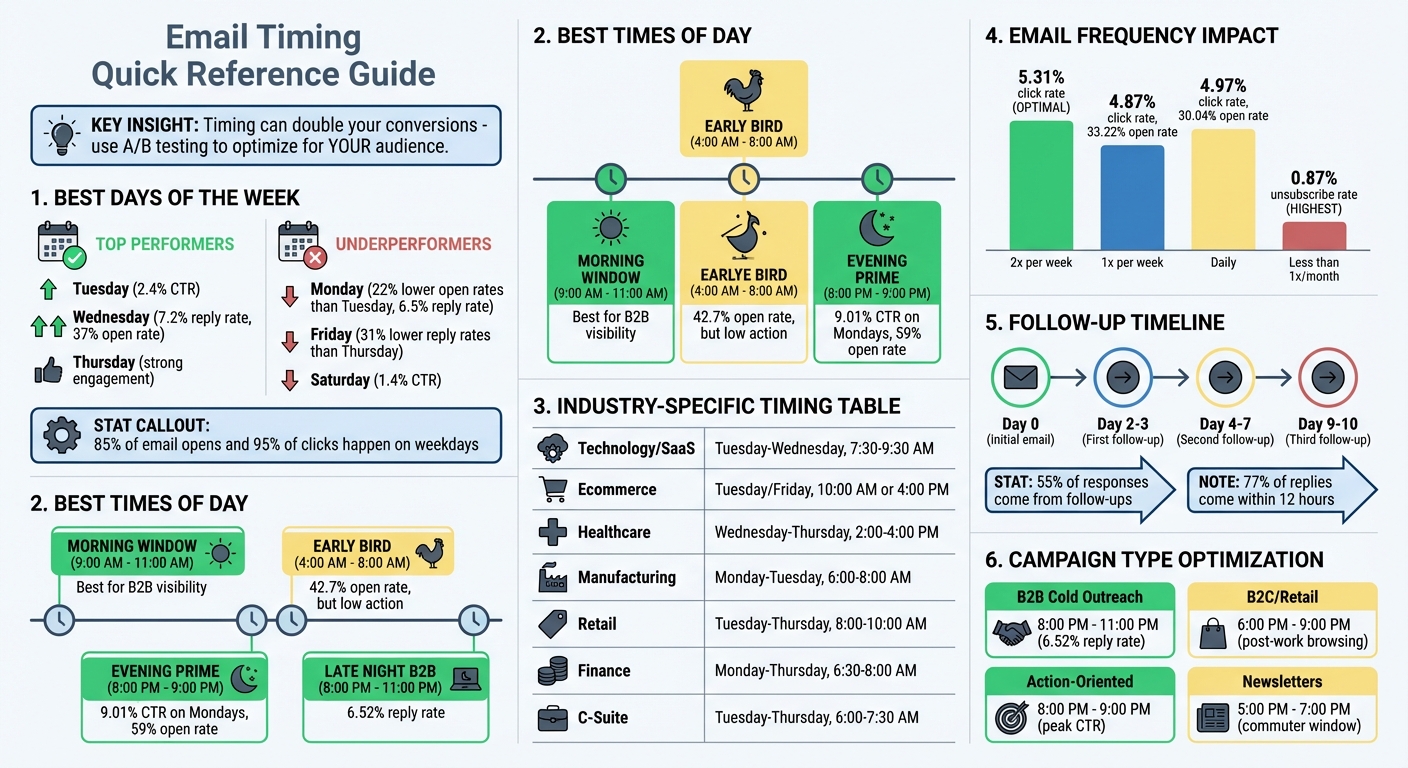
Best Times and Days to Send Email by Industry and Campaign Type
The best cold email follow up sequence for 2025
Best Days to Send Emails
Picking the right day to send emails can be just as important as choosing the perfect time.
Highest-Performing Days
The middle of the week - Tuesday, Wednesday, and Thursday - is your best bet for email engagement. These days strike a balance, avoiding the chaos of Mondays and the early weekend mindset of Fridays, giving your emails the best shot at being noticed and acted upon.
- Tuesday leads the pack with a click-through rate of 2.4%.
- Wednesday shines with the highest reply rate at 7.2% and open rates reaching 37% for B2B cold emails.
- Thursday holds steady with strong open and click rates, making it another dependable option.
Experts back this up:
Christina Marfice, Sales Writer at Superhuman, says, "Tuesday and Wednesday consistently deliver the highest open rates and click-through rates for B2B emails".
Hugo Pochet, Co-Founder of Mailpool, explains, "The mid-week timing avoids Monday's overwhelming inbox backlog and Friday's mental checkout".
Days That Underperform
On the flip side, Monday, Friday, and weekends tend to fall short in engagement.
- Monday emails face challenges with open rates 22% lower than Tuesday, as recipients deal with weekend email overflow. While open rates hover around 22.0%, reply rates drop to 6.5%, as people focus on meetings and planning their week.
Antonio Gabric, Outreach Manager at Hunter.io, notes, "Mondays are the worst for sending emails. People open emails, but response rates are lower... companies have meetings and weekly planning sessions, so they have limited focus on answering emails".
- Friday afternoons fare no better, with reply rates dipping 31% lower than Thursday.
- Weekends are a no-go for B2B emails. Saturday is particularly weak, with click-through rates sinking to just 1.4%. In fact, 85% of all email opens and 95% of all clicks happen on weekdays.
Industry-Specific Day Selection
While general trends are helpful, tailoring your email schedule to your industry can make all the difference.
- Apparel and accessories brands find Tuesday most effective, with open rates hitting 11.17%.
- Food and beverage companies see the highest order rates on Thursday at 0.61%.
- Sporting goods break the mold, performing best on Sunday with a 2.79% click rate.
Audience behavior also varies by sector:
- B2B and professional services audiences engage most from Tuesday to Thursday mornings, between 9:00 AM and 11:00 AM.
- E-commerce and retail audiences are more active during evening hours, from 6:00 PM to 9:00 PM.
- Healthcare professionals prefer Wednesday and Thursday afternoons, with Monday open rates falling by 34%.
- Manufacturing contacts respond well to early morning emails (6:00 AM to 8:00 AM) on Monday and Tuesday, aligning with production planning.
- Tech professionals tend to engage later in the day, during late afternoon wrap-ups.
Timing your emails to match your audience's work habits can make a big impact on your results.
Best Times of Day to Send Emails
Timing your emails wisely can make all the difference in ensuring they stand out in a crowded inbox.
Peak Performance Hours
The sweet spot for B2B emails is between 9:00 AM and 11:00 AM. This mid-morning window is when professionals have cleared their initial inbox clutter and are ready to engage, but haven’t yet shifted focus to lunch or other tasks.
For early birds, sending emails between 4:00 AM and 8:00 AM can yield a 42.7% open rate, as 58% of US consumers check their email first thing in the morning. However, keep in mind that emails opened during these early hours are often skimmed rather than thoughtfully acted upon. For cold outreach, the 7:00 AM to 11:00 AM timeframe sees the strongest reply rates at 7%.
Here’s a clever trick: try sending emails at slightly odd times, like 9:07 AM instead of the top of the hour. Automated systems often schedule emails for exactly 9:00 AM, creating a delivery bottleneck. Avoiding these spikes can improve your chances of standing out. On the flip side, 11:00 AM should generally be avoided, as it’s a peak time for meetings and inbox activity.
"Timing is about showing up at the right moment in someone's mental workflow, not hitting a universal sweet spot", says Inbox Zero.
To make the most of these hours, ensure your emails align with your recipients’ local time zones.
Time Zone Alignment
Once you’ve determined the best hours, syncing them with your recipients’ local time zones is critical. Sending an email at 9:00 AM in your time zone won’t help if your audience is three time zones away.
Segment your email list geographically - common groupings include US East Coast, West Coast, Europe, and Asia-Pacific. Scheduling tools like Yesware, Woodpecker, or Superhuman can help ensure emails arrive at the right time for each group. For your most important segments, consider manual adjustments, while AI-driven tools can handle less critical markets.
Timing is everything, especially since 75% of outreach emails are opened within the first hour of delivery. Emails sent during local business hours are more likely to appear near the top of the inbox, signaling professionalism. Late-night emails, on the other hand, can come across as intrusive or desperate.
When Evening Sends Work
While mornings dominate for visibility, evenings can be surprisingly effective for engagement. B2B cold emails sent between 8:00 PM and 11:00 PM achieve a 6.52% reply rate, thanks to less crowded inboxes and recipients who are more relaxed.
"The morning hours are perfect for visibility... The evening hours (8 PM – 9 PM) are perfect for action", explains MailerLite.
Evening emails work particularly well for action-driven campaigns like surveys, webinar invites, or product promotions. For instance, click-through rates are highest between 8:00 PM and 9:00 PM, with Mondays at 9:00 PM reaching an impressive 9.01% CTR. Emails sent at 8:00 PM can hit a 59% open rate, compared to only 45% at 2:00 PM.
For B2C audiences, evenings are prime time. The 6:00 PM to 9:00 PM window is ideal for reaching people after work, especially on their phones. Parents, in particular, are more reachable between 9:00 PM and 10:00 PM, once their kids are in bed. Additionally, the 5:00 PM to 7:00 PM commuter window is great for newsletters and bite-sized content.
Here’s a quick breakdown of how evening timing can boost different campaigns:
| Campaign Type | Optimal Evening Window | Key Benefit |
|---|---|---|
| B2B Cold Outreach | 8:00 PM – 11:00 PM | Higher reply rates (6.52%) |
| B2C / Retail | 6:00 PM – 9:00 PM | Post-work browsing and impulse buys |
| Action-Oriented | 8:00 PM – 9:00 PM | Peak click-through rates |
| General Newsletters | 5:00 PM – 7:00 PM | Commuter engagement |
While mornings offer a strong start, evenings open up unique opportunities for engagement across various campaigns.
Email Frequency and Spacing
Fine-tuning how often and when you send emails can make a big difference in keeping your audience engaged. Striking the right balance helps maintain visibility without overwhelming your subscribers.
How Often to Send
The sweet spot for email frequency typically falls between once a month and twice a week. According to MailerLite's analysis of 12 billion emails, sending emails twice per week results in the highest average click rate at 5.31%. On the flip side, sending emails daily reduces open rates to 30.04%, compared to 33.22% for weekly emails.
Here’s a breakdown of email frequency and its impact:
| Sending Frequency | Average Open Rate | Average Click Rate | Unsubscribe Rate |
|---|---|---|---|
| Less than 1/month | 35.11% | 3.74% | 0.87% |
| 1–3 times/month | 33.48% | 4.32% | 0.54% |
| 1 time/week | 33.22% | 4.87% | 0.38% |
| 2 times/week | 32.98% | 5.31% | 0.33% |
| Daily | 30.04% | 4.97% | 0.36% |
Irregular sending - such as less than once a month - can lead to higher unsubscribe rates (0.87%), more than double the rate for weekly emails (0.38%). When subscribers forget why they signed up, they’re more likely to hit "unsubscribe" than engage with your content.
For cold outreach, follow the 3-Round Rule: limit email-only attempts to three messages before switching to other channels like LinkedIn or phone calls. While B2B conversions often require around eight touchpoints, spreading these across different platforms is more effective than relying solely on email.
Follow-Up Timing
Getting your follow-up timing right can make all the difference. Around 55% of email responses come from follow-up messages, not the initial email.
- First follow-up: Wait 2–3 business days. If a link is clicked, follow up within 48 hours.
- Subsequent reminders: Gradually extend the gaps - 4–7 days, then 7–10 days.
This gradual spacing helps you stay visible without coming across as pushy. A suggested timeline might look like this: Day 0, Day 4, Day 9, Day 15.
"Timing is about finding balance: Too fast: you look automated. Too slow: you lose momentum. Just right: you stay relevant, respectful, and visible", says OutlinkReach.
If an email is opened but not replied to, follow up within 2–3 days while the topic is still fresh. On the other hand, if follow-ups go unopened, pause the sequence and wait 3–6 months before trying again.
Maintaining a Regular Schedule
Consistency isn’t just about timing individual emails - it’s about creating a reliable pattern that builds trust over the long term. Regular communication helps improve overall campaign performance.
For newsletters and ongoing campaigns, stick to a predictable schedule. Whether it’s every Tuesday morning or the first Monday of each month, consistency helps set expectations.
E-commerce brand Live the Creed captures this idea perfectly:
"When we send an email, we want our customers to care to open it as it's something they don't see in their inbox every day".
This approach prioritizes quality and consistency over sheer volume.
A smart move is to let subscribers choose their preferred frequency when they sign up. This reduces unsubscribes and gives you clear insight into what your audience wants. Some people may want daily updates, while others prefer monthly summaries. Offering options shows you respect their inbox.
Adjusting frequency based on seasonal trends can also work well. For example, increase emails during busy times like the holidays or major industry events, and scale back during slower periods. Just make sure any changes feel intentional, and communicate them clearly to your audience when necessary.
Timing by Audience and Industry
Audience behavior and industry routines play a huge role in determining email engagement, often outweighing generic timing advice. Tailoring your approach based on these factors can significantly boost your results.
Industry-Based Segmentation
Each industry operates on its own rhythm, and your email timing should reflect these unique patterns. Work schedules, decision-making cycles, and daily routines all influence when people are most likely to engage.
- Healthcare professionals tend to check emails early in the morning, between 6:00 AM and 7:00 AM, before their day gets consumed by patient appointments.
- Field service workers and contractors are more likely to engage during lunch breaks when they're away from active job sites.
- Ecommerce and retail audiences are often active in the evenings (6:00 PM–9:00 PM) or on Sunday afternoons, when they have time to browse leisurely.
- B2B cold outreach performs best late at night, with reply rates peaking between 8:00 PM and 11:00 PM, achieving a 6.52% reply rate. Similarly, tech professionals are more responsive in the late afternoon as they wind down their day.
By understanding these patterns, you can align your email schedule to match the natural habits of your target industry.
Using Audience Data
The most effective timing strategy comes from analyzing your specific audience's behavior rather than relying solely on industry norms. Start by mapping out a typical day for your recipients. Are they morning inbox-clearers, mid-morning multitaskers, or evening browsers?
Timing also depends on the difference between visibility and action. Emails sent between 8:00 AM and 11:00 AM often get opened as people clear their inboxes, but emails sent between 8:00 PM and 9:00 PM tend to drive more click-throughs and conversions when recipients have time to engage more deeply.
Knowing your audience's device preferences can help too. Desktop users generally show higher engagement and conversion rates, while mobile users tend to skim quickly. For example:
- Executives often check emails during their commute (7:00 AM–8:00 AM or 5:00 PM–6:00 PM).
- Parents may engage later in the evening (9:00 PM–10:00 PM) once their children are asleep.
AI tools can further refine this process by analyzing individual subscriber habits and delivering emails at the precise moment each recipient is most likely to engage. Combining these insights with your campaign goals ensures your timing strategy is on point.
Matching Timing to Campaign Goals
Your campaign objective should dictate when you send your emails. Timing isn’t just about engagement - it’s about aligning with your desired outcomes.
- For quick replies or meeting bookings, morning slots work best as people organize their day and clear their inboxes.
- For thoughtful responses or leisurely browsing, such as newsletters or B2C promotions, evening sends are ideal since recipients have more time to engage.
If you’re targeting desktop conversions, mid-week mornings (9:00 AM to 11:00 AM) are prime time when users are at their desks. On the other hand, mobile-friendly content that requires less immediate action can be sent during broader time windows.
For B2C and retail campaigns, timing promotional emails around payday cycles - like the 1st and 15th of the month - can tap into higher purchase intent. Behavior-based triggers, such as follow-ups 1 to 3 hours after cart abandonment or website visits, also capture interest while it’s still fresh.
As Joseph Hsieh, a Klaviyo Smart Send Time user, explained:
"Finding the right time to send was helpful and drove comparative higher engagements".
Testing and Improving Your Timing
Finding the perfect time to send emails isn't a one-size-fits-all process. It requires systematic testing and ongoing adjustments. What works for one audience may not resonate with another, so experimenting with data is key.
A/B Testing Send Times
To pinpoint the best send time, split your recipient list into similar groups and send the same content at varying times. This way, timing becomes the only factor you're testing. Popular comparisons include morning (8:00 AM–11:00 AM) versus afternoon (2:00 PM–5:00 PM), different weekdays, or early morning (6:00 AM–9:00 AM) versus mid-morning (10:00 AM–12:00 PM).
For reliable results, test each variation with at least 200 recipients over a full business week. Allow 24–48 hours after sending to gather complete engagement data. If your audience spans multiple time zones, segment your list so emails arrive at the appropriate local time for each group. Once testing is complete, focus on evaluating performance using key metrics.
Metrics to Monitor
Rather than relying on open rates - now less dependable due to Apple’s Mail Privacy Protection - focus on Click-Through Rate (CTR) and Click-to-Open Rate (CTOR). In 2024, average marketing email CTR was 2.62%, while CTOR stood at 5.63%. For cold outreach, aim for open rates between 15–25% and reply rates of 5–15%.
Keep an eye on negative indicators, too. Bounce rates should stay below 5%, and unsubscribe rates under 1%. Spikes in these metrics might signal that certain send times are triggering spam filters or wearing out your recipients. As Filip Kubiński, Outbound Expert at Growbots, highlights:
"A message can be twice as likely to convert purely depending on when you send it".
Armed with these insights, automation tools can help fine-tune your timing even further.
Automation for Better Timing
AI-powered tools can analyze engagement trends and send emails when recipients are most likely to interact. Platforms like MailerLite and Klaviyo offer "Smart Sending" features that automatically adjust timing based on user behavior. These tools have been shown to boost open rates by 35–50% compared to traditional batch sending methods.
For ecommerce, tools like StoreCensus take automation a step further. They schedule emails based on real-time triggers, such as app installations, design updates, or growth signals. This approach ensures your messages reach recipients at moments of high intent, replacing rigid schedules with dynamic, behavior-driven sequences.
Quick Reference: Timing by Day and Industry
Here’s a handy guide to help you pinpoint the best timing strategies for different industries. The table below summarizes key insights from performance data across various sectors. Treat it as a starting point and adjust based on your own testing and audience behavior.
| Industry / Segment | Best Day(s) | Best Time (Local) | What to Optimize For |
|---|---|---|---|
| Technology & SaaS | Tuesday, Wednesday | 7:30 AM – 9:30 AM | High reply rates |
| Ecommerce | Tuesday (clicks), Friday (opens) | 10:00 AM or 4:00 PM | Conversion |
| Retail | Tuesday – Thursday | 8:00 AM – 10:00 AM | Visibility |
| B2C / Retail (Leisure) | Thursday, Friday | 3:00 PM – 7:00 PM | Engagement |
| Finance / Professional Services | Monday – Thursday | 6:30 AM – 8:00 AM | Early morning review |
| Healthcare | Wednesday, Thursday | 2:00 PM – 4:00 PM | Mid-afternoon window |
| Manufacturing | Monday, Tuesday | 6:00 AM – 8:00 AM | Planning phase |
| C-Suite Executives | Tuesday – Thursday | 6:00 AM – 7:30 AM | Pre-workday |
| Creators / Authors | Tuesday (opens), Monday (clicks) | 9:00 PM | Late-night action |
| Institutions / Non-Profit | Friday, Saturday | 8:00 AM | Morning priority |
This table simplifies the detailed strategies discussed earlier, offering a clear reference for scheduling decisions. It highlights how different industries benefit from tailored timing, ensuring emails land at the right moment.
For B2B cold outreach, an unexpected sweet spot emerges: emails sent between 8:00 PM and 11:00 PM achieve a 6.52% reply rate - much higher than emails sent during traditional business hours. This late-evening success stems from decision-makers reviewing their inboxes without the distractions of a busy workday.
When targeting Shopify brand prospect lists and retail sectors, consider leveraging evening leisure hours, when recipients are more open to browsing and shopping. For example, in the Sporting Goods vertical, Sunday outperforms other days for click rates at 2.79%, making it a uniquely effective day for this niche.
While 85% of email opens and 95% of clicks occur on weekdays, weekends can still be effective for niche or B2C campaigns. Use advanced scheduling tools to deliver emails based on recipients' local time, ensuring they arrive at the most opportune moment.
Key Takeaways
Here’s a breakdown of the main points:
Timing gives you an edge. For B2B outreach, Tuesday through Thursday are consistently the best days. Align your send time with your campaign goals - early morning emails might grab more opens, but conversions are more likely when recipients have the mental space to engage later in the day.
Tailor timing to your industry. Universal rules don’t always apply. For instance, ecommerce businesses often see better open rates on Fridays, while clicks peak on Tuesdays. Dive into your audience's habits to fine-tune your timing. AI-powered scheduling tools can simplify this by automating sends at the most effective times, which can lead to better results.
Automation makes timing smarter. Instead of sticking to rigid schedules, tools like StoreCensus can trigger emails based on specific behaviors, such as app installs, design updates, or growth signals. This approach ensures your outreach aligns with moments when prospects are actively considering solutions, making your emails more relevant.
Track the right metrics to improve. Open rates can be misleading, especially with Apple's Mail Privacy Protection impacting the data. Focus on click-through and reply rates instead. Since 77% of replies come within 12 hours, use this window to follow up or decide when to switch to another outreach method after three email attempts.
FAQs
How do I pick the best send time for my audience?
The best time to send email outreach often hinges on your audience and objectives. For B2B audiences, mornings (8:30–11:00 a.m.) or early afternoons (1:30–3:30 p.m.) on Tuesdays and Wednesdays tend to yield good results. However, timing can differ based on industry and audience behavior. To fine-tune your approach, experiment with various times within these ranges and track engagement metrics. Using A/B testing and analyzing response rates will help you identify the most effective timing for your unique audience.
How many follow-ups should I send before stopping?
It's often suggested to send 3 to 5 follow-ups during your outreach efforts. This approach strikes a balance between being persistent and respecting the recipient's time and attention.
What email timing metrics should I track now?
Track essential metrics such as open rates, click-through rates, response times, engagement times, optimal days and times, and unsubscribe rates. These data points provide valuable insights to fine-tune your email outreach strategy, helping you adjust timing and content for improved outcomes.