
Best Practices for Sales Pipeline Data Enrichment
Automated enrichment turns messy CRM data into reliable, real-time account intelligence—improving lead prioritization, personalized outreach, and forecasting.


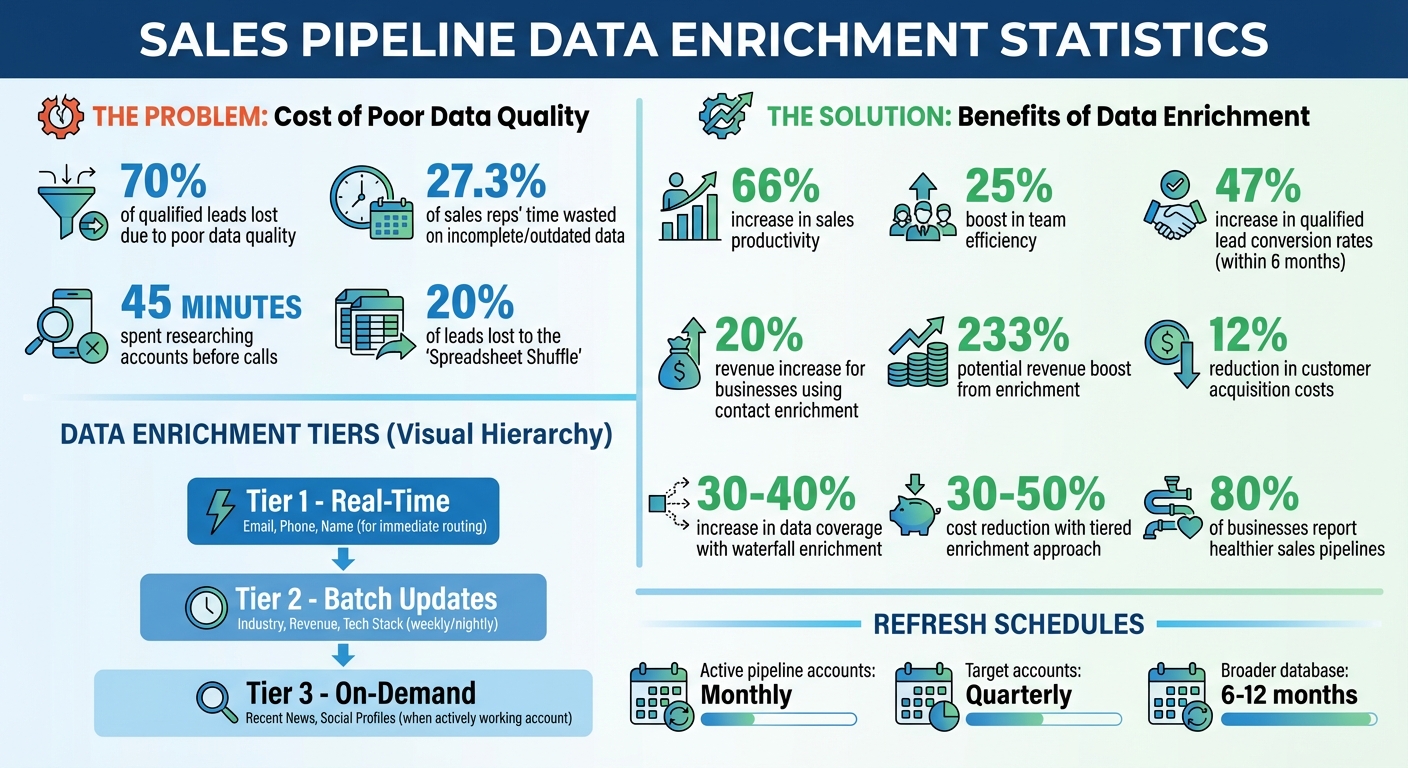
Poor data quality can waste time, reduce trust in your CRM, and cost you up to 70% of qualified leads. Enriching your sales pipeline data solves this by adding critical details like company size, revenue, tech stack, and behavioral signals. This leads to:
- 66% increase in sales productivity
- 25% boost in team efficiency
- Improved lead prioritization and personalized outreach
Key challenges include outdated data (job titles change at a 66% annual rate) and fragmented systems, which force sales reps to spend 45 minutes researching accounts before calls. Manual entry errors further disrupt sales efforts and forecasting.
How to improve:
- Automate enrichment workflows: Use tiered updates to keep critical data fresh while cutting costs.
- Expand data attributes: Add firmographics, technographics, and intent signals to better qualify and prioritize leads.
- Track real-time intent signals: Monitor changes like app installs or platform updates for timely outreach.
Tools like StoreCensus simplify this process by automating enrichment, tracking 25+ data points, and providing CRM integrations. This ensures your pipeline stays up-to-date, helping you focus on converting leads instead of chasing new Shopify brand leads.
Sales Pipeline Data Enrichment: Key Statistics and Impact on Revenue
Common Problems in Sales Pipeline Data Enrichment
Incomplete and Outdated Data
Data tends to lose its accuracy quickly. For example, job titles change at a rate of nearly 66% annually, and contact information becomes outdated by about 22% to 22.5% each year. This means the firmographic and technographic details collected just six months ago may no longer reflect reality. People change roles, companies undergo mergers or acquisitions, and tech stacks are constantly updated.
Outdated data in your CRM can make lead scoring unreliable. You might prioritize a prospect based on an outdated job title or company size, only to find out their circumstances have changed. This wastes time and slows down sales efforts, as reps must verify basic details before every call. If you're relying on single-source or low-quality list vendors, you could be working with job titles that are over 18 months old, making your outreach irrelevant.
When outdated data is stored across fragmented systems, the problem only worsens, making it harder for sales teams to act efficiently.
Data Silos and Fragmentation
Lead information is often scattered across multiple platforms - CSV files, Gmail threads, Slack messages, and spreadsheets. This fragmentation makes it difficult for sales teams to track why a prospect was qualified or what specific technologies they were using, forcing reps to waste time piecing together the context.
"We had a variety of tools, and that was the pain - the variety. We had to go to multiple places to get streamlined data." - Lyndsay Thomson, Head of Sales Operations, Cytel
When data isn't unified, sales reps spend over 45 minutes researching accounts before calls. And about 20% of leads are lost due to what’s often referred to as the "Spreadsheet Shuffle", where critical information is scattered across disconnected files and communication tools. Without a centralized view, teams struggle to coordinate effectively and lose visibility on high-priority prospects.
In addition to the challenges of fragmented data, manual processes introduce their own set of problems.
Manual Data Entry and Errors
When sales reps encounter inaccurate data - like dialing three incorrect numbers in a row - they lose trust in the CRM. This turns what should be a valuable resource into a liability, making pipeline forecasts unreliable. Errors from manual data entry not only disrupt forecasting but also make it harder to maintain actionable and reliable data.
"The average agency loses 70% of qualified leads not because of bad outreach, but because of failed follow-ups." - StoreCensus
Manual systems also struggle to nurture or re-engage the 60% of prospects who aren’t ready to buy for 3–12 months. This creates what some call a "Prospecting Tax", where teams are constantly chasing new leads instead of focusing on converting the ones already in the pipeline.
What is Data Enrichment and Why Does it Matter for B2B Sales? | ZoomInfo
How to Improve Sales Pipeline Data Quality
Improving sales pipeline data quality requires more than just cleaning up after the fact. It’s about shifting to proactive processes, automating data updates, and ensuring your team has accurate, actionable information at every stage. By focusing on automation, diverse data attributes, and real-time tracking, you can create a system that supports smarter decisions and more effective outreach.
Automate Data Enrichment Workflows
Automation takes the hassle out of manual data updates, keeping your CRM up-to-date from the moment a lead enters the pipeline. With trigger-based workflows, new records are enriched instantly. Using a method like waterfall enrichment - where multiple data providers are queried sequentially - can fill in missing details and increase data coverage by 30–40%.
To manage costs and maintain speed, consider a Data Triage Framework that organizes enrichment into three categories:
- Tier 1: Critical data like email, phone number, and name should be enriched in real time for immediate routing and outreach.
- Tier 2: Information such as industry, revenue, and tech stack can be updated in batches (e.g., weekly or nightly) for segmentation and lead scoring.
- Tier 3: Details like recent news or social profiles can be enriched on demand, only when a rep is actively working on an account.
This tiered approach can cut enrichment costs by 30–50% while ensuring the most important information stays current.
To protect high-quality data that has been manually verified, implement field-level governance. For example, add a "Manually Verified" checkbox or a "Data Source" field in your CRM. Automation rules can then skip over these fields, preventing generic database entries from overwriting your best data.
Use Multiple Data Attributes
While automation ensures your CRM is up-to-date, enriching leads with a variety of data attributes allows for more personalized and effective outreach. Basic contact details like an email address or phone number might help you make initial contact, but they don’t provide the context needed for meaningful conversations. Adding account-level insights gives your sales team the tools to tailor their approach and prioritize the best opportunities.
"The real gap is not contact data. It is account intelligence." - Semir Jahic, CEO & Co-Founder, Salesmotion
For example, combining attributes like platform usage, revenue range, and industry-specific challenges can help you create hyper-targeted segments. Instead of broadly targeting "ecommerce businesses", you could focus on "Shopify beauty brands doing $1M–$5M using ReCharge but missing Klaviyo". This level of precision makes your outreach more relevant and increases response rates.
Incorporating firmographic and technographic data - such as employee count, revenue, and existing tools - also refines lead scoring. This lets you identify high-potential buyers who align with your ideal customer profile, rather than treating all inbound leads the same.
Track Real-Time Intent Signals
Static data can quickly become outdated, so integrating real-time intent signals is key to keeping your prospect information fresh. Technology stacks and business needs change rapidly, and relying on old data can lead to missed opportunities.
Set up tiered refresh schedules to keep your database current:
- Update active pipeline accounts monthly.
- Refresh target accounts quarterly.
- Review your broader database every 6–12 months to balance accuracy and cost.
Pay attention to behavioral signals like app installs, design updates, or platform migrations. These changes often indicate that a prospect is actively investing in growth, creating the perfect moment for outreach.
Using Enriched Data Across the Sales Pipeline
Once your data quality is improved, the next step is to use those insights effectively across your sales pipeline. Enriched data isn't just about tidying up records - it’s about leveraging those details to identify better leads, tailor your outreach, and predict revenue with greater accuracy. Let’s break down how enriched data can elevate each stage of your sales process.
Lead Generation and Qualification
Enriched data turns lead generation into a more targeted and efficient process. Instead of taking a broad approach and hoping for results, you can zero in on prospects using specific criteria. These might include firmographics like company size and revenue, technographics such as their tech stack, or behavioral signals like recent website updates or app installs. For instance, instead of pursuing all ecommerce businesses, an agency could focus on "Shopify beauty brands generating $1M–$5M annually and using specific subscription apps."
This level of precision matters. Automated tools using enriched data can qualify thousands of leads in minutes, while manual efforts are limited to just 20–50 leads daily. Speed is also a key factor - being the first to respond often determines who wins the deal. Companies that adopt comprehensive data enrichment report an average 47% boost in qualified lead conversion rates within six months. Additionally, combining firmographics, technographics, and behavioral signals creates a complete picture of your Ideal Customer Profile, helping you identify high-intent prospects faster than your competitors.
Sales Outreach and Personalization
Gone are the days when generic outreach worked. With enriched data, sales teams can personalize their communication by referencing specific challenges, software stacks, or recent company developments. Intent data takes it a step further, highlighting accounts that are actively researching solutions so your team can focus on "in-market" prospects who are ready to make a decision.
The results speak for themselves: 80% of businesses using contact enrichment report healthier sales pipelines, often leading to a 20% increase in revenue. Enriched profiles also allow reps to handle objections and close deals more effectively by using insights from account intelligence and historical patterns. Instead of guessing what might resonate, your team can craft messages that directly address each prospect’s needs. This level of tailored outreach not only improves engagement but also enhances forecasting by aligning sales activity with real-time data.
Pipeline Forecasting and Reporting
Accurate forecasting relies on clean and up-to-date data. Outdated or incomplete information can lead to unreliable pipeline reports and inflated deal values. Regular enrichment ensures your data stays current, which directly impacts forecasting accuracy.
How StoreCensus Simplifies Data Enrichment
StoreCensus takes the hassle out of managing outdated, fragmented, and manually entered data by automating the enrichment process. This ensures an accurate, up-to-date sales pipeline in real time. For ecommerce sales teams, manual data enrichment can slow things down significantly. StoreCensus eliminates this bottleneck by continuously collecting and updating structured data from over 2.5 million ecommerce stores, primarily those on Shopify. Instead of spending hours researching, you get instant access to 25+ structured data points, including app installations, tech stacks, decision-maker contacts, and real-time activity signals.
The platform doesn’t just gather data - it acts on it. StoreCensus keeps tabs on over 2.5 million Shopify stores and triggers automation workflows whenever activities like monitoring app installs and removals or tech updates suggest high intent. As the company explains:
"The intelligence that made them a good prospect travels with them through your entire sales process".
Key Features and Benefits of StoreCensus
StoreCensus simplifies pipeline management with tools like advanced filtering, real-time monitoring, and CRM integration. It allows you to segment ecommerce stores by:
- Firmographics: Revenue tiers, employee counts, and locations.
- Technographics: Installed apps, themes, and integrations.
- Behavioral Signals: App changes, growth patterns, and new hires.
These features help you zero in on prospects that align with your ideal customer profile.
The platform also includes a built-in CRM with features like a 1–5 star lead rating system, status tracking, and reminders for nurturing long-term opportunities. API access enables a waterfall enrichment strategy, cross-referencing data with other providers to achieve over 95% accuracy. Multi-source email verification ensures bounce rates stay below 5% before launching outbound campaigns.
Pricing is flexible to fit your needs. For example:
- Professional Plan: $99/month includes 5,000 credits, 10 automation flows, and access to decision-maker contacts.
- Growth Plan: $149/month adds team access and lookalike audience features.
These tools make it easier to generate actionable insights for day-to-day sales operations.
Use Cases for StoreCensus in Sales Pipelines
Sales teams leverage StoreCensus to pinpoint high-intent leads by tracking key store activities, like new app installations or tech stack updates. For instance, a Shopify app developer could set up automated workflows to notify their team whenever a store within a specific revenue range installs a complementary app - indicating they’re likely open to new solutions.
Another major application is competitive intelligence. By monitoring store activity, such as app removals or shifts in vendor preferences, teams can respond quickly to potential opportunities. The built-in CRM also helps sales reps focus their efforts, with up to 60% of their time dedicated to "5-star" leads that include verified decision-maker contacts. Long-term nurturing tools ensure that even less immediate prospects remain engaged. As StoreCensus puts it:
"The best prospecting system isn't about finding more leads. It's about losing fewer of the ones you already found".
Conclusion
Tackling data quality challenges can completely reshape how your sales process works. With enriched pipeline data, your CRM evolves into a powerful intelligence hub. By leveraging detailed technographic and firmographic insights, you can pinpoint gaps in a prospect's technology stack and craft more personalized outreach strategies. This level of precision matters - a whopping 27.3% of sales reps' time is lost chasing incomplete or outdated data, leading to over a quarter of their weekly efforts being wasted.
Data enrichment doesn’t just save time - it saves money. It can lower customer acquisition costs by around 12% and replace outdated prospecting methods (which can lose up to 70% of qualified leads). The result? A potential revenue boost of 233%, thanks to faster pipeline movement and sharper forecast accuracy.
StoreCensus steps in to automate data enrichment, removing the need for tedious manual research and keeping your pipeline consistently up-to-date. Its built-in CRM tools allow your team to focus on the most promising prospects. These automated insights directly support the strategies discussed earlier, enabling more precise and impactful outreach efforts.
Ultimately, a high-performing sales team thrives on accurate, real-time data and smart automation. With a pipeline built on reliable, continuously updated information, your outreach becomes sharper, your forecasts more dependable, and your sales cycles shorter. Quality data isn't just a tool - it's the foundation of sales success.
FAQs
How often should I refresh CRM data for active deals vs. target accounts?
To keep your CRM data accurate, update it regularly. For active deals, aim for real-time updates or at least daily checks to ensure everything stays current. For target accounts, you can afford to update less often - weekly or bi-weekly should work, depending on how quickly their details evolve. Consistent updates lead to better data quality and more effective sales strategies.
Which fields should be locked to prevent overwriting verified data during enrichment?
To keep your data accurate, it's essential to lock specific fields such as verified contact details, decision-maker information, revenue, traffic, and technology stack. Locking these fields ensures that critical information stays consistent and isn't accidentally overwritten during the enrichment process.
Which intent signals are most useful for triggering timely outreach?
The best intent signals for timely outreach are real-time store activity changes, growth indicators, and technology stack updates. These signals show active research or interest in solutions like yours, signaling current buying intent and opening the door for quick follow-up opportunities.