AI Contact Verification for B2B Outreach
Continuously verify and enrich B2B contacts with AI to lower bounce rates, boost accuracy (85–95%), and scale verification at lower cost.


Maintaining accurate contact data is critical for B2B outreach success. Outdated information leads to wasted time, reduced email deliverability, and skewed sales forecasts. AI-powered verification offers a solution by continuously monitoring and updating contact data in real time, outperforming older methods in accuracy, speed, and cost efficiency.
Key Takeaways:
- Challenges with outdated data: High bounce rates harm email performance and sender reputation, while static databases cause sales teams to chase invalid leads, often found in unverified Shopify brand prospect lists.
- Traditional methods: Limited to basic checks like formatting and domain validation, with low scalability and accuracy (60–75%).
- AI-powered solutions: Cross-reference multiple sources (e.g., LinkedIn, websites) for 85–95% accuracy, processing thousands of leads daily at $5–$25 per lead.
Quick Comparison:
| Criteria | Traditional Methods | AI-Powered Verification |
|---|---|---|
| Accuracy | 60–75% | 85–95% |
| Scalability | 20–50 leads/day | Thousands/millions leads/day |
| Cost per Lead | $35–$100 | $5–$25 |
| Real-Time Updates | No | Yes |
AI verification transforms outdated processes by automating data cleanup and providing real-time updates, ensuring outreach focuses on the right contacts with minimal effort.
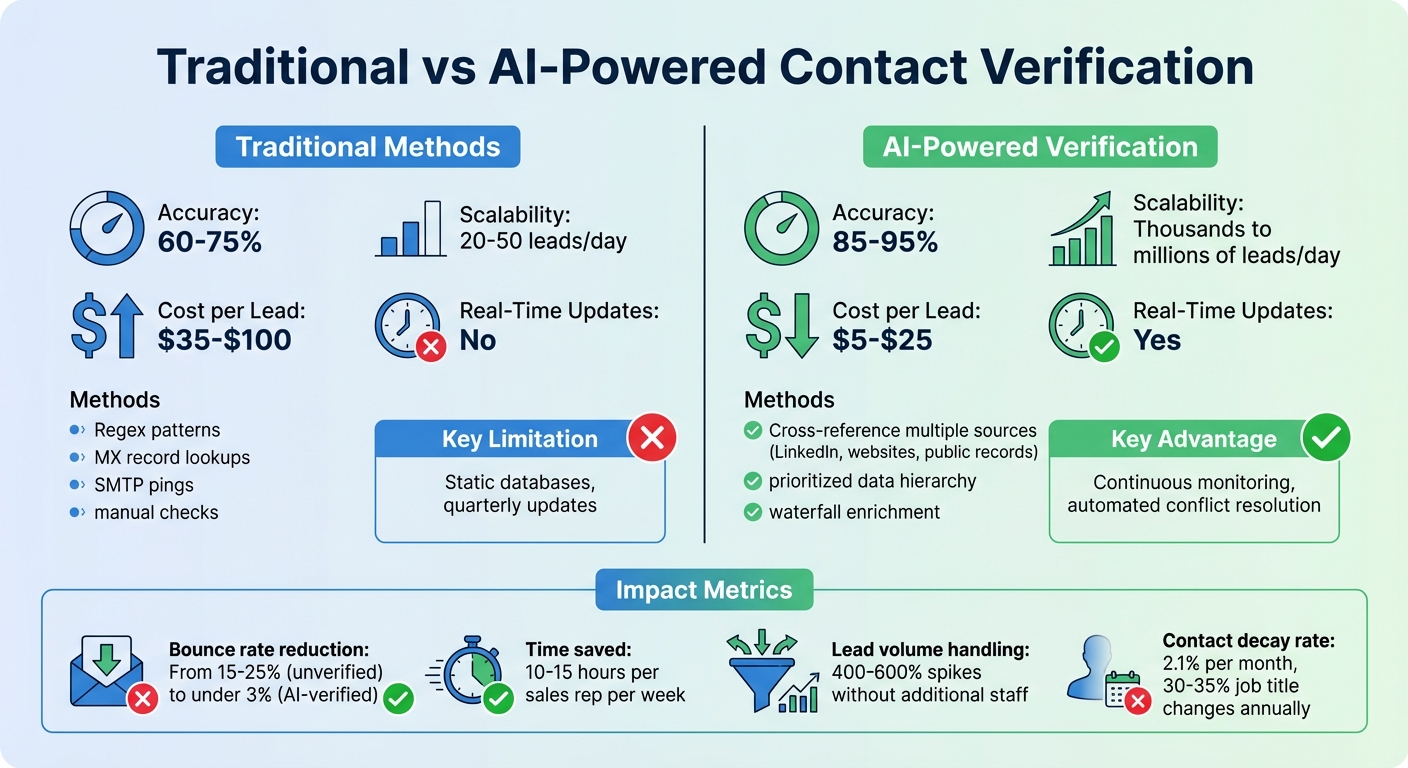
Traditional vs AI-Powered Contact Verification Comparison
How to REALLY Run Catch-All Email Verification (The 2026 B2B Method)
1. Traditional Verification Methods
Before the rise of AI, contact verification relied heavily on older, manual approaches. These traditional methods used a mix of technical checks and human effort to validate contact information. For instance, they utilized regex (regular expression) patterns to ensure email addresses were formatted correctly, verifying the presence of an "@" symbol and a valid domain. Additional steps, like MX record lookups, confirmed a domain's ability to receive emails, while SMTP pings checked whether an email address was active and reachable.
Accuracy
While traditional methods could catch basic errors, they often failed to address more complex issues. For example, regex might confirm an email address looks valid, but it wouldn’t reveal if the contact no longer works there or if the domain itself is inactive. Manual checks, like reviewing profiles, were not only time-consuming but also prone to mistakes. These methods typically achieved accuracy rates of 60–75%, meaning about one in four contacts could still turn out to be outdated or incorrect even after verification.
Scalability
Scaling traditional verification methods was - and still is - a major challenge, especially for modern B2B campaigns. Manual processes limited teams to qualifying just 20–50 leads per day. Given that B2B sales cycles often stretch from 3 to 12 months, this bottleneck led to what’s been called the "Prospecting Tax" - a situation where up to 70% of qualified leads were lost simply because they were stuck in static spreadsheets. Additionally, the lack of automated follow-ups created a "Black Hole" effect, where 40% of leads disappeared after showing initial interest but receiving no further outreach.
Cost Efficiency
Traditional methods were far from cost-effective. The cost per lead ranged between $35 and $100, largely due to the labor-intensive nature of the process. On top of that, sales representatives often spent valuable time chasing invalid contacts or manually updating spreadsheets, further driving up costs. Another key drawback was the loss of context - by the time a follow-up occurred, sales reps might forget why a lead was initially qualified or miss crucial details. These inefficiencies drained resources and diminished the effectiveness of outreach efforts.
Impact on B2B Campaigns
Traditional verification methods often resulted in what’s known as a "leaky bucket" effect in B2B campaigns. Contacts could become invalid over time due to job changes, company rebranding, or other shifts. Without real-time updates, sales teams frequently operated with outdated information, reducing the success rate of their outreach and weakening the overall impact of their campaigns.
2. AI-Powered Verification Methods
AI has reshaped how contact verification works in B2B outreach. Instead of sticking to basic format checks, these advanced systems analyze millions of records to uncover patterns that traditional methods often miss. For instance, AI can detect inconsistencies like a job title that doesn’t match a LinkedIn profile or a domain that’s technically valid but inactive for months. This deeper level of analysis catches errors that would slip through conventional checks, improving accuracy, scalability, and cost efficiency.
Accuracy
AI-powered verification achieves accuracy rates of 85–95% - a noticeable improvement over the 60–75% range of traditional methods. The difference lies in how AI processes conflicting data. Instead of treating all information equally, AI uses a prioritized data hierarchy. For example, a recent LinkedIn update carries more weight than an outdated trade-show badge scan when determining someone’s job title. AI also cross-references multiple sources simultaneously, like social media, company websites, data providers, and public records, rather than relying on one database at a time. This approach is especially effective for tricky cases, such as executives using personal email addresses or international phone numbers with non-standard formats. By addressing these gaps, AI ensures outreach efforts remain accurate and current.
Scalability
AI systems handle scale in ways that manual methods simply can’t. While traditional processes limit teams to verifying 20–50 leads per day, AI solutions can process thousands - or even millions - of leads daily. High-value leads get in-depth checks, including SMTP pings, phone carrier lookups, and LinkedIn cross-references, while SMB leads are validated more quickly through MX records and syntax checks. This flexibility allows teams to manage 400–600% spikes in lead volume without needing additional staff. AI also replaces periodic database cleanups with real-time tracking, monitoring for updates like job changes, funding rounds, and domain redirects. For ecommerce teams, tools like StoreCensus apply similar principles, tracking over 2.5 million stores for changes such as app installs, design tweaks, or tech stack updates - triggering outreach at just the right time. This level of scalability not only boosts productivity but also slashes costs by automating labor-intensive tasks.
Cost Efficiency
AI verification dramatically cuts costs, reducing the cost per lead to $5–$25, compared to the $35–$100 range typical of manual processes. By automating tedious spreadsheet tasks, AI reduces the time spent on each lead from hours to mere minutes. This shift allows sales teams to focus more on selling and less on data cleanup, resulting in cleaner pipelines and more efficient resource allocation.
Impact on B2B Campaigns
AI verification doesn’t just clean up contact lists - it transforms them into detailed prospect profiles. By automating contextual enrichment, AI enables highly targeted personalization. Teams can rank leads using tiered systems, dedicating 60% of their efforts to the most valuable prospects based on factors like budget, timing, and specific needs. AI also flags critical updates - like a CFO leaving, a company rebranding, or a domain redirecting - before the next outreach cycle begins. This real-time insight solves the "leaky bucket" issue that plagued older methods, where contacts quietly became outdated between quarterly updates.
Pros and Cons
When it comes to contact verification in B2B outreach, both traditional and AI-powered methods bring their own set of advantages and challenges.
Traditional methods are straightforward and come with lower upfront costs. But they often rely on static data, which quickly becomes outdated. This lack of scalability can lead to higher long-term expenses, especially since contacts tend to decay rapidly between quarterly database updates. These shortcomings highlight why many are turning to AI-powered solutions, which tackle these issues head-on with advanced data cross-referencing techniques.
AI-driven methods significantly improve accuracy, using strategies like waterfall enrichment to refine data quality. They also excel at handling large volumes of leads efficiently, cutting costs while maintaining precision. Automated monitoring ensures that changes are detected in real time, reducing outdated entries and lowering bounce rates to under 3% - a stark contrast to the 15–25% seen with unverified lists.
However, implementing AI systems isn’t without its challenges. Initial setup requires planning, especially when deciding whether enrichment should overwrite existing CRM data or just fill in missing details. Teams accustomed to manual processes may also face a learning curve. Despite this, the time savings are undeniable - sales reps can reclaim 10–15 hours of research time each week.
"Data is a depreciating asset. If you're not continuously enriching and verifying your contact database, you're making decisions on information that's already out of date." - Cleanlist
For ecommerce teams, tools like StoreCensus apply similar AI-driven principles, monitoring over 2.5 million stores to keep data fresh. This continuous tracking ensures outreach happens at the right moment - critical in an environment where 30–35% of job titles change annually and contact decay reaches 2.1% per month. Such dynamic capabilities demonstrate why AI is becoming a cornerstone of modern B2B campaigns.
Conclusion
The difference between traditional and AI-powered verification lies in speed, precision, and flexibility. Traditional methods depend on basic syntax checks and static databases that need regular updates. In contrast, AI-powered systems automatically resolve conflicts by cross-referencing multiple sources, like LinkedIn profiles, company registries, and SMTP pings, making them far more efficient and reliable.
A standout example is waterfall enrichment, which boosts verified email accuracy from 70–85% to 90–98% by sequentially querying over 15 providers. This process saves sales teams valuable time and ensures data stays relevant, reducing the risk of outdated information. These improvements not only enhance data quality but also enable more precise and effective ecommerce outreach.
For ecommerce teams, tools like StoreCensus are game-changers. It tracks 2.5 million Shopify stores and enriches them with over 25 data points. By monitoring app changes and growth signals in real time, StoreCensus helps teams act quickly on high-intent leads.
Since data can become outdated almost instantly, continuous monitoring is essential. While setting up AI-driven systems requires careful planning, their ability to keep data fresh and actionable makes them indispensable. With AI, businesses can ensure their databases remain accurate, empowering more effective B2B campaigns.
FAQs
How do I measure ROI from AI contact verification?
Tracking ROI effectively means keeping an eye on key metrics like better lead quality, reduced bounce rates, and higher conversion rates. Using verified contact data plays a huge role here - it allows for more precise and targeted outreach. This not only boosts efficiency but also drives revenue growth. In fact, research shows that verified data can improve sales efficiency by 3 to 5 times, making it an essential asset for fine-tuning B2B outreach efforts.
Will AI verification overwrite my CRM contact fields?
AI contact verification ensures your CRM data remains precise by automatically validating and updating contact details. It doesn't overwrite existing CRM fields unless explicitly set up to do so, maintaining the integrity of your original data while keeping it current.
How often should contacts be re-verified for outbound?
Contacts need to be re-verified every 2 to 3 months to combat data decay and keep up with organizational changes. Regular updates help maintain accurate information, which directly boosts the effectiveness of outbound campaigns.